Tag Archives: Restaurants

The Restaurant Fire That Ended The Life Of Tom Stacks: The Most Unique Voice In Jazz -1936

The Tragic End of Tom Stacks, Star Crooner of The 1920’s

Tom StacksOnce you have heard Tom Stacks sing you would recognize his voice anywhere.

Tom Stacks was a tenor and a drummer appearing on hundreds of recordings in the 1920s and 1930s, primarily as a singer with Harry Reser’s band.

Stacks was a small man with an adolescent voice that sounded like he was singing with a perpetual smile.

Best demonstrating Stacks unique ability to turn a song into his own, is his rendition of a tune written by Richard Whiting and Byron Gay, Horses. If there was ever a novelty song with witty lyrics that epitomized the roaring twenties, this is it. (see lyrics at end of article)

Another song, Masculine Women and Feminine Men, a song written by Edgar Leslie and James V. Monaco seems more apropos for today rather than 1926. Continue reading

Rae Samuels & The Last Bottle Of Beer

Vaudeville Star Rae Samuels Tries To “Steal” A Heavily Insured Bottle of Beer

Rae Samuels last bottle of beer Dec 30 1932Will Prohibition Be Finished? – The last bottle of beer that was distilled in the U.S.A. before prohibition and that during several years was a fine attraction of theatres and shows in Chicago – Americans like a good joke, will surely “have lived.” This bottle of beer has been insured against “accidents” for $25,000.

You know, it’s funny how some stories change when you start looking into them.

When I first started to write about this news photograph the focus was on the end of prohibition. But then I wondered who was the unidentified woman in the photograph? It turned out that her story was more interesting than the beer bottle and the end of prohibition.

The woman being “pinched” by the cop is Rae Samuels, for over 20 years one of vaudeville’s biggest stars, earning $2,500 per week. She is so forgotten today that she does not even have a Wikipedia page. Continue reading

Classic Hollywood #48 – Frank Sinatra

Frank Sinatra And Family At The Stork Club – 1947

And the story of when Frank Sinatra met The Godfather author Mario Puzo.

Frank Sinatra and Family at Stork Club 1947

New York – FAMILY HARMONY – Dispelling the rumors of a rift, crooner Frank Sinatra takes time off to entertain his wife and their children Frankie Jr., and Nancy, with dinner at The Stork Club. 10 -17-1947

Despite the news caption that harmony had returned to the Sinatra marriage, it would be only three years later that Frank’s wife Nancy filed for legal separation. The two were divorced in 1951 and Frank immediately married Ava Gardner.

During December Turner Classic Movies has featured Frank Sinatra as its star of the month in honor of what would have been Sinatra’s 100th birthday.

One movie that TCM will not be showing as part of their Sinatra tribute will be The Godfather. Though Sinatra does not appear in the movie, the character of singer/actor Johnny Fontane was assumed to be based upon Frank Sinatra.

Sinatra and his lawyers were wary at the inclusion of the mob-affiliated Fontane character in the book and later the movie. The lawyers wanted to see a manuscript before the book was published. The request was refused.

In the book, Puzo thought he portrayed the Fontane character sympathetically. But Puzo also realized that if Sinatra thought the character was himself, he might not like it – the book  – or Puzo.

This turned out to be a very astute assumption: Sinatra was not pleased when he read the book.

After the publication of The Godfather in 1969, at Elaine’s restaurant in New York, Puzo had a clear indication he was not on Sinatra’s buddy list. Host and owner Elaine had asked Sinatra if he would like to meet Puzo who was dining there at the same time as Puzo. Sinatra emphatically said, “no.”

As Mario Puzo described in his 1972 book The Godfather Papers, (G.P. Putnam Sons) Puzo finally met Sinatra in August 1970 In West Hollywood, California at the famous Chasen’s restaurant. Continue reading

Ten Great Films From The 1940s Featuring New York City

Filming Around New York City In The 1940s

On The Town posterDuring Hollywood’s golden years from the 1930s through the early 1950s there were many films set in New York City, but the vast majority were made on the studio lots in southern California. Almost every studio had their own New York set which would convey “the Big Apple.”

The reasons for doing so were obvious; the costs of actually sending the cast and crew on location to film would be cost prohibitive and complete control could be exercised in the studio for crowd control, noise, lighting and other technical issues.

Occasionally films would use stock footage of New York or a second unit directing team would be sent to capture a New York scene or two to be used as establishing shots showing the audience, yes this is New York. Usually though none of the principal characters in the film were ever actually in New York, but back in Hollywood, playing against what is called a “process shot” a background screen showing New York footage usually while the actors were walking or driving.

Even such quintessential “New York” films such as A Tree Grows In Brooklyn (1945) and Yankee Doodle Dandy (1942) were shot completely in Hollywood.

So when the cast and crew actually did any filming in New York it was a rare treat, especially looking back today at the much changed metropolis.

Here are ten of the best 1940s films where a part of the movie was actually filmed on location in New York City.

Saboteur Cummings and Lloyd Statue of LibertySaboteur (1942) This cross-sountry chase of one man falsely accused of sabotage pursuing the real saboteur winds up in New York. Director Alfred Hitchcock had his second unit shoot footage in the city that shows New York in the midst of World War II. We see Rockefeller Center, Radio City Music Hall, the waterfront and other familiar city sights.  A masterpiece of storytelling the film moves at a smooth pace as you bite your nails watching. Spoiler alert: Sinister character actor Norman Lloyd battles hero Robert Cummings on Bedloe’s Island at The Statue of Liberty in one of the most iconic conclusions to a film ever shot. The Liberty’s torch scene, however was shot in the studio.

Ray Milland The Lost Weekend Third Avenue photo Life MagazineThe Lost Weekend (1945) Director Billy Wilder takes advantage of New York, shooting many of the exteriors of The Lost Weekend on location. Ray Milland’s portrayal of troubled, alcoholic writer Don Birnam won him an Academy Award for best actor. The film also won Oscars for best picture, best director and best screenplay. There are so many shots of Milland in the city it becomes a game to recognize where the actual locations are. Third Avenue is prominently put on display. The giant street clock Milland passes in one scene is still there today – located on Third Avenue between 84th and 85th Streets. All the mom and pop stores and restaurants along the way are long gone, replaced mostly by chains. P.J Clarke’s on Third Avenue and 55th Street was used in the shooting but many of the interior scenes of the bar were shot back in Hollywood. Continue reading

Old New York In Postcards #12 – 20 Historic Buildings That Were Demolished

20 Historic, Beautiful New York Buildings That Were Demolished

City Hall Newspaper Row Buildings (l-r) World Building (aka Pulitzer Building), Sun Building, Tribune Building - all demolished. New York Times and Potter Buildings are still extant

City Hall Newspaper Row Buildings (l-r) World Building (aka Pulitzer Building), Sun Building, Tribune Building – all demolished. New York Times and Potter Buildings are still extant

New York City real estate developers will always knock down a building if a buck can be made. So it really should come as no surprise that these buildings were demolished because they outlived their usefulness or more often than not, the land they sat upon was deemed more valuable than the building itself.

Nathan Silver’s must-own book, Lost New York (1967) Houghton Mifflin, was the first book to explicitly point out what New York City had lost architecturally over the years. If you have never read it, you should.

For our short postcard essay, there are hundreds of examples we could have chosen from and we picked 20. We omitted places of worship, theatres and restaurants which are the most transitory of buildings.

We’ve covered hotels before, and we could do another story on all the historic hotels that have been torn down, but we’ve included a few in this retrospective.

Rather than comment extensively on the buildings, a brief summary will suffice and the images should convey what we have lost. These postcards have been scanned at 1200 dpi in high resolution, click on any postcard to enlarge.

Singer Building hresSinger Building – 149 Broadway (corner Liberty Street),  A gem by architect Ernest Flagg, built 1908. Once the tallest building in the world. The Singer Building was elegant and sleek. Demolished 1967-68 and replaced by a ugly box of a building built by the Unites States Steel Corporation.

Produce Exchange hresProduce Exchange – 2 Broadway between Beaver and Stone Streets. Architect George B. Post’s splendid work of grace was constructed between 1882-84, and demolished 1957.

Gillender Building 2 hresGillender Building – northwest corner Wall Street and Nassau Street. Architects, Charles I. Berg and Edward H. Clark, built in 1897 at a cost of $500,000. The Gillender Building was the tallest office building in the world for a brief time. The 20-story tower lasted only 13 years. In 1910 it was the first modern fireproof building to be demolished and it was done at breakneck speed, in under 45 days. The Gillender Building was replaced by the Bankers Trust Tower. Continue reading

New York’s Chinatown Described In 1898

Joss Houses, Chinese Restaurants and Opium Smoking

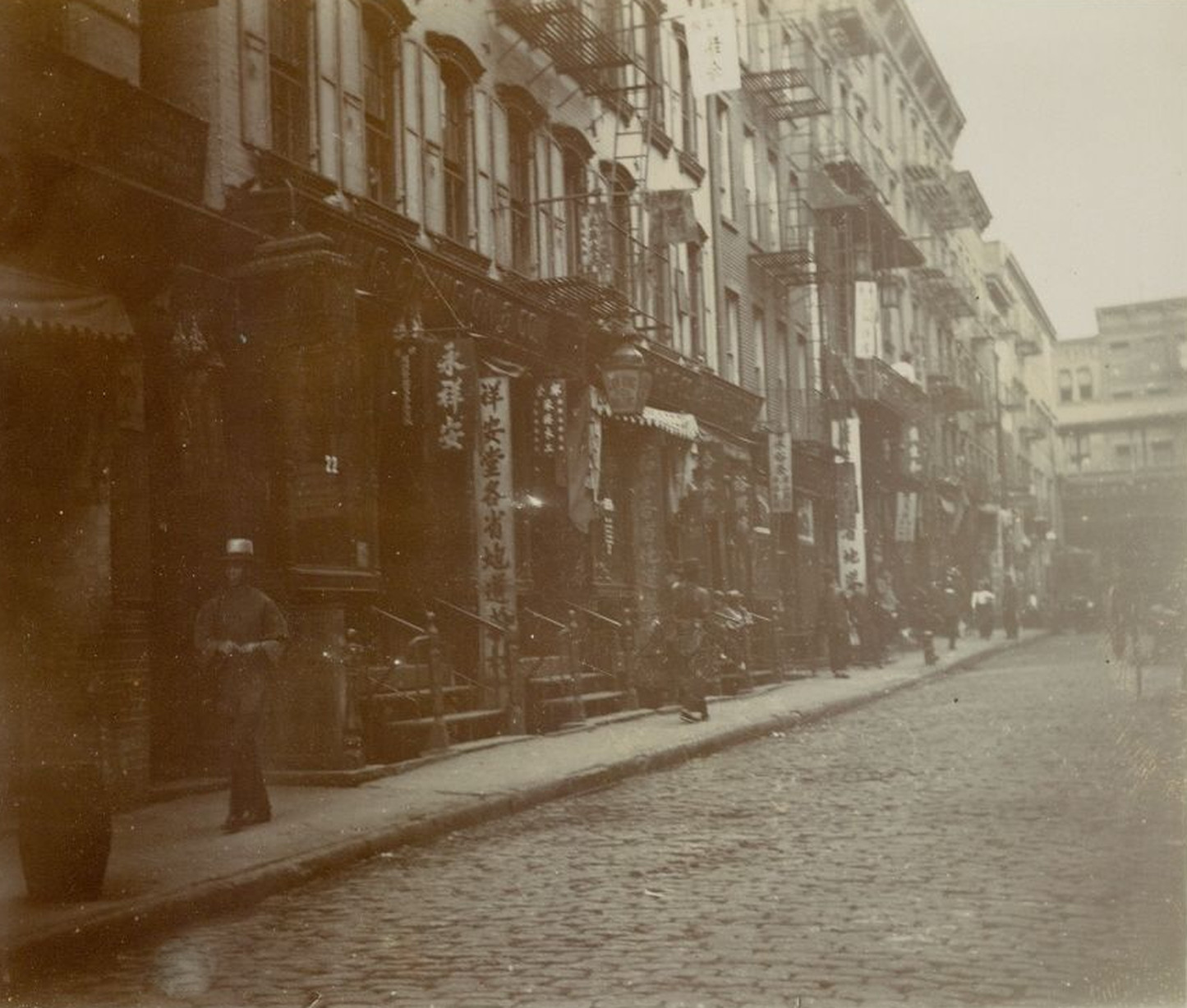
Chinatown 1896 looking at 22 Mott Street

Bing Chung Importers (near left) in the heart of Chinatown at 22 Mott Street in 1896

The great thing about reading old guidebooks to New York City is that you can see the world through contemporary eyes. This usually means all foreigners were viewed as curiosities with their exotic customs and provincial ways.

In 1897 the Chinese population in New York City was only 7,000 – almost all living in Chinatown centered around Mott Street. In 2015, New York City’s Chinese population is now over 500,000 people spread throughout the five boroughs.

The guidebook we quote from is Rand, McNally Handy Guide to New York City, Brooklyn, Staten Island, and other suburbs included in the Greater New York edited by Ernest Ingersoll (1898). This portion is called “A Ramble At Night”, and the visitor to New York is directed to tour the areas of New York that are off the beaten path after 9 p.m. such as Little Italy and The Bowery. The purpose of the night ramble is to “give some hints as how the dark, crowded, hard-working, and sometimes criminal portions of the city look at night.” Reproduced below is the section on the Chinatown.  Continue reading

Old New York In Postcards #10 – Restaurants

A Look At Churchill’s and Four Other Restaurants From Old New York

Exterior Churchills Restaurant Broadway 49th St c 1915Churchill’s Restaurant southwest corner 49th Street and Broadway, circa 1915.

Police Sergeant Jim Churchill did not have the background of a typical restauranteur. He put in 20 years on the job policing the streets of New York and was named acting Captain of a precinct in the Bowery for a few months starting in November of 1901. He wound up being dismissed from the force in 1902 for neglect of duty.

It seems that Churchill was not aggressive enough in closing saloons operating illegally on Sunday and shutting down houses of ill-repute under his jurisdiction. From reading the newspaper accounts of his trial, Churchill may have been set up by others in the police department who wanted his ouster.

Churchill, with the help of friends and backers went into business for himself. In May 1903 Churchill ironically opened a saloon at 1420 Broadway between 39th and 40th Streets. The small bar and restaurant prospered and in 1906 he moved north to new digs on Broadway at 46th street to a space which could accommodate up to 350 patrons.

But even that was not enough room for the captain’s friends and clientele. In 1909 Churchill built for himself a spacious, luxurious entertainment and feasting palace at 49th Street that could seat 1,400 diners. Designed by architect Harold M. Baer, the three story terra cotta brick building with stucco ornamentation attracted huge crowds. Even with so much more space, guests frequently would have to wait in line for a table as capacity crowds filled the restaurant.

Employing over 300 people and with an annual advertising budget of $50,000 for a $250,000 business, Churchill’s became world famous and remained a favorite restaurant and cabaret spot for the Broadway crowd throughout the teens.

Churchill’s stayed in business until prohibition cut into profits and forced Jim Churchill to close his doors and lease the space to a Chinese restaurant. The building was demolished in 1937 and the location eventually housed heavyweight champ Jack Dempsey’s Broadway Bar and Grill from 1938 until its closing in 1974.

Churchill went abroad for a number of years after closing his restaurant and upon returning to the states, he commented about the changes that many New York City restaurants had undergone during the 1920’s. To the New York Times he remarked, “Hostesses? There were no such things in my days. No one ever thought of such a thing. It was not permitted that any woman come into a restaurant-cabaret unaccompanied. Instead of hostesses I employed 30 boys, one of them the late Rudolph Valentino, to dance with women who came unescorted for luncheon.”

When Churchill died in 1930 at the age of 67, he left most of his sizable estate, a half million dollars, to his wife.
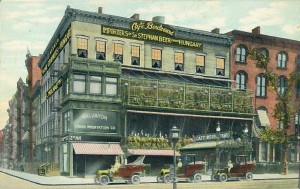
Exterior Cafe Boulevard Restarant 156 2nd ave at 10th st 1911The Cafe Boulevard 156 Second Ave southeast corner of 10th Street, circa 1909. Continue reading

New Year’s Eve Celebrations Of The Past, New York City 1906

Festivities In New York City On New Year’s Eve 1906

A couple of years ago we featured photos of Times Square and New Year’s celebrations from the 1950’s – 1960’s. This time we went back in time a bit further to New Year’s Eve 1906.

Probably something you never thought about: where else did New Yorkers celebrate New Year’s besides Times Square, which started drawing crowds in 1904 with the completion of the New York Times Tower Building?

The answer is all over the city at various churches, hotels, restaurants and clubs, with Trinity Church being a focal point for large crowds.

Seen below is the crowd outside of Trinity Church at Broadway and Wall Street on New Year’s Eve 1906 awaiting the arrival of 1907.

New Year's Eve 1907 outside Trinity Church

It proves again that celebrating the New Year has not changed that much over the years. People have always liked to congregate on New Year’s Eve in New York City even in freezing weather. It’s just that back then the majority of celebrants were New Yorkers, unlike today where many revelers are visiting from all over the globe.

Here is how the New York Tribune described Continue reading

Old New York In Photos #45 – Broadway After Snowstorm 1905

New York City 1905 After A Big Snowstorm – The Sights Along Broadway Between 29th and 30th Streets Described

New York After a Big Snowstorm 1905 ph Detroit Photo Library of CongressSo far New York City has not had a major snowstorm this season like upstate New York received earlier this month. But I dream of New York City days gone by like this one shown above.

In this high resolution photograph (click to greatly enlarge) taken in 1905, the effects of a recent snowstorm can be seen as the snow has been shoveled high onto the edge of the street and sidewalk.

We are looking up Broadway from the northwest corner of 29th Street towards 30th Street. On the extreme left at 1209 Broadway is one of the many United Cigar Stores outlets, a chain store which dominated New York’s tobacco retail industry at the turn of the century. Next door at 1211 Broadway is Marcus & Marcus supplying men’s furnishings.

Across the street at 1204 Broadway an advertisement in the window at ground level announces that the entire stock in their window was purchased by The Maurice Company, a clothing company run by Maurice Rogaliner. The “Broadway Dentists” also had offices in the same building along with Sol Young, Photographer.

Next door to the Maurice Company is Shanley’s Restaurant, owned by brothers Tom and Michael Shanley.

Shanley’s was one of the most famous eateries of the late 19th and early 20th century in Manhattan. With three restaurants, this one at 1210-1212 Broadway was their second location which opened in 1896. As the restaurant guide Where And How To Dine In New York (Lewis, Scribner & Co; 1903) describes it:

Everybody in New York knows Shanley’s and almost everybody has dined at one or another of the three establishments conducted under this name. The management acknowledges but one purpose in the conduct of its restaurants — to make its guests absolutely comfortable and to persuade them that Shanley^s holds the recipe for good cheer. It has taken twelve years to develop the atmosphere which one finds in Shanley’s and during this time the extent of its business operations has been greatly enlarged.   The service at Shanley’s is entirely a la carte. The cuisine is proverbial for its excellence. Chops, steaks, lobsters, game, shell fish and kidneys are among the special attractions of the house.

Next to Shanley’s the building with the initials HB and the crown on its sign is the Hof Brau Haus Restaurant. Continue reading

Classic Hollywood #30 – Alec Guinness Predicted James Dean’s Death

The Strange Tale Of How Obi-Wan Kenobe (Sir Alec Guinness) Eerily And Accurately Told James Dean He Was Going To Die In His New Car

James Dean Ursula Andress 1955 8 29 ph Earl Leaf

James Dean and Ursula Andress attend a benefit, one month before Dean’s death in a auto crash

James Dean is seen here talking to one of his “girlfriends,” the 19-year-old Swiss actress Ursula Andress. This photograph was taken at a benefit for the “Thalian’s Ball” on August 29, 1955 at Ciro’s in Hollywood and shows them in a non-combative mood. The sexually ambiguous Dean may have been set up on dates with Andress by the studio publicity department. Regardless, press accounts at the time refer to Andress and Dean as dating one another.

Even though Andress spoke very little English, their relationship was considered very stormy.  At one time it was reported by a tabloid that Dean was said to be taking German language lessons so that they could “argue in another language.” Andress would go on to fame as Honey Ryder, the first “Bond Girl” in 1962’s Dr. No.

Dean, an avid auto racer, agreed to purchase a new sports car on September 21 1955, a silver Porsche 550 Spyder that he nicknamed “Little Bastard” which was then painted on the car.

Two days later on September 23, Dean was eating at the trendy Villa Capri Restaurant on McCadden Street in Hollywood and spotted actor Alec Guinness trying to get a table without any success. Guinness was exhausted having just arrived from London on a 16 hour flight for his first trip to Hollywood. As Guinness and his companion, screenwriter Thelma Moss exited the restaurant, Dean ran after them to intercede. Continue reading