Tag Archives: Restaurants

The Startling Changes in New York From 1873 – 1923

Robert Underwood Johnson Tells Of New York In 1873 and How It Changed Over 50 Years

Everything today seems to be moving at the speed of light. Changes of all sorts have greatly altered our everyday living in ways that might have been unimaginable 20 or even 10 years ago.

Some might argue there was more change at the end of the 19th and beginning of the 20th century than there is today. All the people who lived through and witnessed that change are long dead. Maybe if you heard it from someone first hand, it might make a greater impression upon you.

Fortunately we have people like Robert Underwood Johnson (1853-1937) who put down his memories in his book, Remembered Yesterdays (Little, Brown & Co., 1923) which serves as a living time capsule of that period.

Johnson was a long time editor at The Century Magazine, a leading monthly periodical which covered news art and literature. Johnson also wrote regularly for Scribner’s Magazine.  Along with John Muir, Johnson was one of the main forces behind the creation of Yosemite National Park.  Johnson personally knew every major personage imaginable during his lifetime and his memoir reflects that.

What I found particularly interesting was a brief chapter entitled “New York in the 70’s” (meaning the 1870s). In that chapter, Johnson compares the New York City he arrived in, in 1873 with the present (1923).

This is what had occurred over 50 years. Below is an excerpt from the book:

A STUDY IN CONTRASTS

LOOKING back it is difficult to identify the New York of that time, just beginning to feel its strength, with the brilliant metropolis of to-day. Think of the points of contrast! In 1873 there were no electric lights, no skyscrapers, no trolleys, no blazing, twirling or winking signs and thus, of course, no Great White Way, Broadway being preéminently the street of business and there being little or no shopping on the cross streets above Fourteenth. Continue reading

We’ve Seen This Before, Late March New York City Snowstorm Shuts Down The City – 1956

Huge Snowstorm In March 1956 Paralyzed New York City and Suburbs

New York – Pedestrians trample their way through snow-covered streets here 3/19 after the worst snowfall in eight years crippled New York’s transportation system and left thousands of motorists stranded on the highway systems leading into the city. More than 2,000 cars were abandoned on the roads. photo United Press Telephoto 3/19/1956

Just in time for spring, the weather forecasters are predicting a lot of snow for New York City starting Tuesday, March 20. Possibly eight inches will fall across the area and then melt within a couple of days.

Snow becomes the main news story here in New York. This will be a small storm compared to the snowstorm that hit New York City on March 18 – 20, 1956.  By the time it was over, New York City received 13 and a half inches of snow, making travel in the region next to impossible.

New York – Snow business is bad business for the owner of a corner grocery store in suburban Queens here 3/20. Folks weren’t exactly beating a path to his door so he closed for the day. 3/20/1956 photo United Press Telephoto

What made this storm worse than others what not just the amount of snow but the surprise nature of it. Continue reading

New Yorkers Welcome In The New Year 1907 – But No Horn Blowing Allowed

New Year’s Celebration 1907 – New York Police Commissioner Bans Horn Blowing

A photographer from the Montauk Photo Concern decided to photograph the scene inside the Cafe Martin, at 26th Street and Fifth Avenue on New Year’s Eve December 31, 1906.

As midnight approached the revelers at Cafe Martin noisily whooped it up, raised their glasses and toasted the coming New Year of 1907. This photograph captures a singular moment: right before the stroke of midnight the lights were put out and at exactly twelve, were put on again. The guests then sang along as the band broke into the Star Spangled Banner. Afterwards guests blew horns and confetti was strewn everywhere. Young men filled with the idea of making a speech got up on chairs and spoke to the heart’s content without anyone to stop them.

The guests, all elegantly attired, look like they are having an extraordinary time.

Outside the restaurant it was supposed to be quieter. A city ordinance forbidding horn blowing in the streets had been on the books for years. Earlier in the day Police Commissioner Theodore Bingham informed the newspapers that the bells of Trinity and Grace Church would be heard when they tolled the midnight hour.

Bingham instructed the police to enforce the noise law. All horn blowing was prohibited on New Year’s Eve! Continue reading

Old New York In Postcards #17 – Riverside Drive

Postcard Views of Riverside Drive 1900-1920

Riverside Drive may not be the most famous street in Manhattan, but it is among the prettiest.

The natural beauty of the surrounding area made this parcel of Manhattan real estate an ideal setting for a park and residential development.

Up until the late 19th century there was not a whole lot of home building along this western portion of the city with the exception of a few mansions perched high along the river.

As transportation options continued to improve, Riverside Avenue began attracting wealthy New Yorkers and real estate developers to the west side. The extension of the Ninth Avenue Elevated in 1879 and opening of the subway in 1904 made it possible to commute from the upper west side to New York’s business center downtown. In 1908 Riverside Avenue’s name was officially changed to Riverside Drive.

If Riverside Drive had been built as originally proposed by Park Commissioner William Martin in 1865, it would have been a 100 foot wide straight boulevard.

Fortunately that turned out to be impractical due to the natural topography of the area.

Riverside Drive looking north towards Grant’s Tomb 1912

In 1873 Frederick Law Olmsted the designer of Central and Prospect Park received the job of laying out Riverside Park and Drive. Olmsted realized that incorporating the existing landscape surrounding Riverside Avenue into a park was a better plan than grading and straightening the hills along the drive.

By the time work started on the park in 1875 Olmsted had left New York City. Over the next 25 years  a succession of designers, engineers and architects executed Olmsted’s proposal but not exactly sticking to his plan. Calvert Vaux, Samuel Parsons and Julius Munckwitz all had their turn in building up Riverside Drive and its park.

By the turn of the 20th century Riverside Drive was lined with expensive single family townhouses and row houses overlooking the Hudson River. Land speculation led to a spate of luxury apartment buildings in the upper parts of the boulevard.

A touring bus along Riverside Drive

The first portion of  Riverside Drive from 72nd to 85th Street was opened in 1879. Riverside Park terminated at 129th Street. The Riverside Viaduct completed in 1900, bridged the schism between 125th and 135th Streets. Riverside Drive then continued north to 181st Street.

Here are some of the views from 100 years ago.

postcard view Riverside Drive north from 72nd Street 1918

Riverside Drive north from 72nd Street 1918

This World War I era view shows Riverside Drive at 72nd Street looking north. The entire block between 73rd and 74th Streets and Riverside Drive and West End Avenue belonged to one man and his extravagant home. The french style chateau with the large front lawn is the 75-room Charles M. Schwab mansion.  Designed by Maurice Ebert and completed at a cost of $6 million in 1905, the home contained a gym, a bowling alley, a pool, and three elevators. Schwab had made his millions working with Andrew Carnegie. Schwab went on to head United States Steel. Continue reading

Old New York In Photos #77 – Fourth Ave. & 23rd St. 1908

Fourth Avenue & 23rd Street 1908 –  A Detailed Breakdown Of New Yorker’s Going About Their Business

A spectacular clear view of Fourth Avenue looking south towards 23rd Street from 1908 shows pedestrians going about their daily activities. Once again the source is the Detroit Publishing Co..

Above 14th Street up to 34th Street Fourth Avenue is now called Park Avenue South.

Before we examine our old picture, let’s take a modern look at approximately the same spot from Google maps.

Now forget our modern view and return to 1908.

When we zoom in on some of the details, there are some interesting things to take note of. You can click any photo to enlarge.

The People

Unless you were a construction worker, city worker or a young boy, almost every man wore a hat, jacket and usually a tie. Here almost all the men are wearing straw hats.

The man in the center holding a newspaper is smoking a cigarette. I’ve seen men smoking in old photos but usually not on the street. The subway kiosk on the northeast corner of 23rd street is an “exit only.”  There is a trash can right by the kiosk.

Looking at the southeast corner we can see another subway kiosk and lots of people crossing the street. The subway kiosks were removed many years ago and the subway entrances and exits relocated.

The shadows indicate that it is probably around noon. With the exception of a newspaper on the ground, there is hardly any litter on the streets or sidewalks. Civilized people disposed of their trash properly.

These two women with their ornate flowered hats are crossing the street, carefully. No matter how often the streets were cleaned there was horse manure and urine everywhere. By 1908 at least women’s skirts were no longer dragging on the ground. Over the years skirts had gradually risen to slightly above the ankles. The little boy in the background between the women looks like the poorest person in this prosperous district.

On the southeast corner a group of boys and young men have newspapers that they are getting ready to sell. The World; The Times; The Herald; The Evening Post; The Globe and Commercial Advertiser; The Tribune; The Morning Telegraph; The Sun; The Call; The Press; The American; The Evening Journal; in the highly competitive world of journalism there were over a dozen major daily newspapers in English and many more in other languages. Continue reading

Sheep In Brooklyn – 1901

Central Park Was Not The Only New York City Park To Have Sheep Manicuring Its Lawn

The History of Prospect Park’s Flock Of Sheep

Sheep grazing in a meadow is something you expect to see in the countryside, not New York City. As some New Yorker’s know Sheep Meadow in Central Park once had sheep roaming in it.

But did you know that Brooklyn’s Prospect Park also had its own flock of livestock on its grounds? When this photograph was taken in 1901, Prospect Park had about 30 sheep, with three full-time shepherds to watch over the flock.

While still under design the Prospect Park Commissioners in 1866 proposed “to enclose with a sufficient iron paling and make use of as a pasture ground for deer, antelopes, gazelles, and such other grazing animals as can he satisfactorily herded together in summer upon it.”

Deer, antelopes and gazelles were not confined to the park. After the opening of Prospect Park in 1867 sheep were introduced to graze on its grounds.

Over the years the number of sheep fluctuated to as many as 110 as some sheep were sold off and others acquired.

Paddy Welch was the main shepherd of the Southdown’s and New Hampshire’s, until political influence forced him from his job in the early 1890s. In 1922 Prospect Park increased the value of its herd by introducing pure-bred Southdown’s.

By 1934 city planning titan and Parks Commissioner Robert Moses, had enough of Central Park’s sheep. The 49 pure-bred Dorset sheep in Central Park were moved to Prospect Park to join the hornless Southdown’s on February 19, 1934. The Central Park building where the sheep had been housed was remodeled and became the site of the restaurant Tavern on the Green. Continue reading

New York In 1911 As Drawn By Vernon Howe Bailey

6 Drawings Of New York Unseen For Over 100 Years By Vernon Howe Bailey

Times Square The Great White Way (1911)

Obscure publications can yield hidden gems. These drawings by famed artist Vernon Howe Bailey appeared in the Illuminating Engineer in 1911 and as far as can be determined have not been reproduced since then.

Vernon Howe Bailey (1874-1953) was a prodigious illustrator whose work appeared primarily in  newspapers and magazines.

He eventually made his way to the New York Sun newspaper in the 1920s where he captured New York’s architecture and streets  with exquisite on-the-spot illustrations.

Eventually a good deal of Bailey’s New York City work was compiled in a book called Magical City. These illustrations were not included in that book. So for the first time in over 100 years here are Vernon Howe Bailey’s renderings of New York City in 1911.

Looking North on the Speedway to the Famous High Bridge (1911)

As these illustrations were intended for a magazine promoting electric lighting, you will notice that electric light fixtures appear rather prominently in each illustration.

The Harlem Speedway, where wealthy New Yorker’s used to take out their horse drawn carriages for a spirited run, was eventually incorporated into the highway that became the Harlem River Drive. Continue reading

Old New York In Photos #72 – Hotel Netherland circa 1912

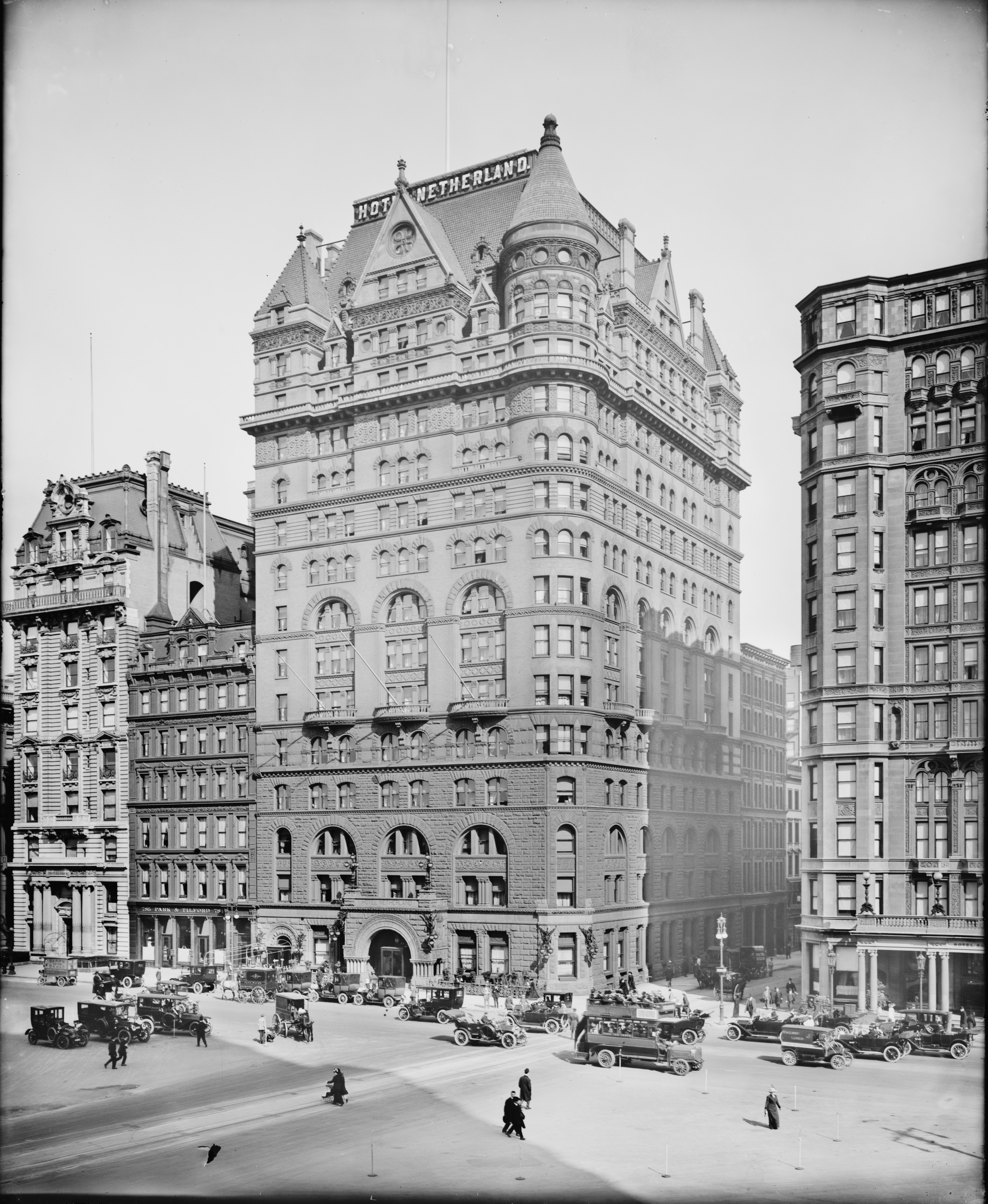
The Hotel Netherland Fifth Avenue and 59th Street c. 1912

Located at 783 Fifth Avenue on the corner of 59th Street, the Hotel New Netherlands, was built by the Astor estate under William Waldorf Astor and leased by General Ferdinand P. Earle. For 33 years it was one of the finest of New York’s hostelries.

After the Hotel New Netherlands opened on June 1, 1893, a guide book noted the new hotel’s room rates as “unannounced, but among the most expensive.”

The New Netherlands was on the European plan, which meant you didn’t necessarily have to have your meals at the hotel, but you could eat there for an extra charge.

For a comparison the most expensive New York hotels on the European plan; the Normandie; Vendome; Brunswick; and Gilsey had rooms starting at $2.00 per night. the Waldorf was $2.50 per night. On the American plan with meals included, the Windsor was $6.00 and the Savoy was $4.50. The only other hotels besides the New Netherlands that did not list their prices were the Grenoble and the Plaza.

Architect William Hume designed what was at the time the tallest hotel in the world at 17 stories and 229 feet. The hotel had a fine panoramic view of the city. The seemingly endless green expanse of Central Park was directly across the street.  From the higher floors looking past the park you could see the Hudson River and looking southeast was a clear view of the Brooklyn Bridge.

It’s an interesting design and as you look up at the ornate hotel you will notice a hodgepodge of styles.

The hotel was renamed in 1908 as the Hotel Netherland. Later it was the home to the famous Louis Sherry’s restaurant from 1919-1925. When the hotel closed in 1925, it was soon demolished and replaced by the 35 story Sherry-Netherland Hotel in 1927.  The address of the new hotel was changed to 781 Fifth Avenue.

The exact year our photograph by the Detroit Publishing Company is not certain. It probably falls between 1912 -1914 based upon the vehicles in the street. A look at the scene around the hotel shows a bustling metropolis in action. Examining the details is always interesting, you can click on any photo below to enlarge.

The Hotel Netherland’s advertising sign and roof line are quite a sight. The turret is absolutely great. Some of the hotel’s windows are open with curtains parted to let in light on this sunny day.

On the corner of the Netherland are these fantastic light fixtures. Continue reading

10 Vintage Advertisements From The New Yorker In 1949

10 Advertisements From Winter Issues of The New Yorker In 1949

New Yorker cover December 3 1949We’ve done this before looking at the advertising that appeared in The New Yorker magazine and decided to do it again. These ads appeared in the December 3, 10 & 17, 1949 issues of the magazine.

The most noticeable difference between these vintage ads from only 67 years ago and ads today is that almost every ad was for a service or product made in the United States. The few ads that were not for U.S. products, typically were for luxury products from France, Great Britain or Italy. Today go into any retail store and pick up almost any item and look for where it was made. Nineteen times out of twenty it will be made overseas, usually in China and most likely of inferior quality.

New Yorker 1949 Union Pacific Railroad Streamliner adPost World War II marked the beginning of the end of the luxurious era of train travel. The Union Pacific Railroad offered west coast travel on their Streamliners to and from Chicago. By the 1950s railroads would be permanently overtaken by airlines for long distance travel.
New Yorker 1949 Facts on Dial ad Before the internet if you needed some information about a subject you could look it up yourself or you could call the New York Public Library information desk. The library still offers this service. But there were also paid services for “sophisticated New Yorkers” like this one called Facts on Dial, Inc..
You could call Facts on Dial with almost any question and the researchers would have your answer “within minutes, sometimes even seconds.” In 1950 Facts on Dial was sued by Facts on File for unfair competition and trademark infringement. That was the end of Facts on Dial. If you call the number for Facts on Dial now, MU6-7800, ironically, a law firm answers.
New Yorker 1949 Amelia Earhart luggage adAmelia Earhart Luggage? Do you want your luggage to have the same fate as Amelia Earhart? Why a luggage company would name themselves after a pilot who vanished without a trace would seem bizarre. But the brand was launched in the 1930s by Orenstein Trunk of Newark N.J. when Amelia was the queen of the skies and very much alive.
New Yorker 1949 Dick the Oysterman Restaurant adOyster themed restaurants were plentiful in New York City when the waters along the east coast were chock full of oyster beds.
Richard Ockendon, better known as “Dick, the Oysterman,” had his original basement restaurant on Third Street since the turn-of-the-century. It was famous as a hang-out place for writers and artists. O. Henry based one of his short stories, The Country of Elusion on the bohemian restaurant.
Dick died of pneumonia on January 23, 1916 at the age of 39,  but his name and restaurant lived on, catering to the culinary tastes of Greenwich Village. By 1920 Dick’s had moved to Eighth Street where they remained until they closed their doors in 1952.

Continue reading

Old New York In Photos #61 – Times Square & Broadway at Night – 1911

Broadway At Night – 1911

Broadway Times Square at night 1911

Photograph 1 Times Square at night

The glow of streetlights wash out some portions of this interesting view of Broadway looking south from 43rd Street in Times Square. But for the most part, many details can be seen in this unusual nighttime view taken by The Detroit Publishing Company. There was no date associated with the picture at the Library of Congress which archives the Detroit Publishing Company’s holdings; it is listed as circa 1900-1915. So how can narrow down an approximate date?

The main clue is in the marquee of George M. Cohan’s Theatre on Broadway and 43rd Street which heralds the musical The Little Millionaire which ran from September 25, 1911 through March 9, 1912.

The other clues are the billboards posted on the building to the right of the Cohan theatre advertising Broadway productions; one proclaiming “It’s a Hitchcock Conquest”; another for Mrs. Fiske, and another for a drama called Bought and Paid For. Raymond Hitchcock’s play The Red Widow ran from November 6, 1911 to February 24, 1912. Bought and Paid For had a long run from September 26, 1911 until October 1912. But the advertisement that narrows the date down is for a musical titled Peggy which only ran from December 7, 1911 to January 6, 1912. Of course the advertisement could have remained up after the show had closed, but with ad space being valuable in Times Square, it is unlikely.

Checking the Library of Congress’ holdings we find a second similar photo almost certainly taken the same night of Times Square from 46th Street looking south,

Times Square at night 1911

Photograph 2 Times Square at night

A few more interesting things to notice while zooming in on the details of the second photograph: Continue reading