Believe it or not, this bucolic scene shown above, from March 1914, is in the Bronx at Jerome Avenue looking north from Clarke Place.
I have not been able to identify the lone building on the left. Besides some telephone and telegraph wires, Belgian block paved streets and trolley tracks, modernity had not yet touched most of the Bronx. The population according to the 1915 police census was 649,726.
In 1914 the Bronx was prosperous and living there was considered to be a sign of upward mobility.
Fast forward 102 years later. Below is the same street from about the same spot.
Jerome Avenue was transformed by the construction of the El in 1917 and 1918, darkening the street, but fostering a building boom. Continue reading →
Avery Corman Talks About: Dating, Restaurants, High School in The Bronx, The Advertising World, Getting Published and Having His Books Adapted To Film
We continue our interview with Avery Corman, author of the new book My Old Neighborhood Remembered A Memoir (Barricade Books) 2014, and his story of growing up in the Bronx during the 1940’s and 50’s.
Divided into 5 parts the first two parts of the interview can be seen here.
In part 3 Avery Corman discusses dating, blind dates, sex, going to the movies, the differences between eating out and restaurants, dessert havens like Krum’s, Addie Vallins and Jahn’s and the coming of television.
Part 4 Avery Corman recalls his high school years at DeWitt Clinton High School and his decision to go to New York University. Upon graduating Continue reading →
Avery Corman, Author of Kramer vs. Kramer, Talks About His Latest Book: My Old Neighborhood Remembered A Memoir
The neighborhood is the Bronx. The time is World War II and the post war years. And the writer is Avery Corman. His newest book My Old Neighborhood Remembered A Memoir (2014) Barricade Books, is his first non-fiction book and is filled with wonderful recollections of growing up.
After graduating college Corman was working on the fringes of advertising and with the encouragement of a friend, Herb Gardner (A Thousand Clowns; I’m Not Rappaport; etc), he took a stab at writing a book. That effort was published as Oh God! A Novel (1971). After that hurdle Corman never looked back and he became a full-time novelist. Oh God! was eventually made into a very popular movie in 1977 starring George Burns and John Denver.
Some of Corman’s other acclaimed novels include The Bust-Out King (1977), The Old Neighborhood (1980); 50 (1987); Prized Possessions (1991); The Boyfriend from Hell (2006) and his most famous work, Kramer vs. Kramer (1977) which was adapted into a movie in 1979 and was the winner of five Academy Awards including Best Picture.
Avery Corman’s success must partially stem from his middle-class upbringing in the Fordham section of the Bronx during the 1940’s and 50’s, where he admits he was not the best student when it came to math and science, but did well in the humanities and was surrounded by a loving, extended family.
My Old Neighborhood Remembered A Memoir is more a series of vignettes rather than a straight autobiography and that style comes off well. Corman shares his memories of childhood during World War II up until he becomes a successful author in the late 1960’s. He paints beautiful word pictures, sometimes tinged with sadness, of growing up in a wondrous place that no longer exists. Most of the stories offer short bursts of family life, games, food, education, sports and all the things that contributed to making the Bronx a special place to grow up in.
Corman’s stories resonate with a tender glow of friendships, family and the feeling that neighborhoods were once really neighborhoods, where the familiarity of rituals, people and places were ingrained in the surroundings.
Here are parts one and two of an exclusive interview with Avery Corman.
Part I, Avery Corman talks about what made the Bronx a special place during the war. His unique living situation and school life.
In 1911 The Proposed McCarren Bridge Was To Replace The “Old” Brooklyn Bridge So It Could Be Reconstructed
Existing & proposed bridges New York City 1911 – note the four lower Manhattan bridges instead of three (click to enlarge)
From the New York Tribune of January 1, 1911 comes this illustration showing New York City with its existing bridges and some proposed new ones.
Sandwiched very tightly between the Brooklyn Bridge and the Manhattan Bridge connecting lower Manhattan with Brooklyn, is a proposed new bridge which was to be called the McCarren Bridge named after “Long Pat” McCarren (1847-1909) a state senator who was Brooklyn’s Democratic political boss during the late 1800’s.
Once the proposed McCarren Bridge became a reality, city engineers planned to close and rebuild the Brooklyn Bridge. The engineers feared that the increase in heavy traffic on the Brooklyn Bridge would necessitate additional strength being added, otherwise a support or cable might give way causing a horrible catastrophe. Borings were even made at the site, but the McCarren Bridge was never built.
Other proposed bridges in the illustration show the Hell Gate Bridge which was begun in 1912 and completed in 1916.
Further north on the Harlem River connecting upper Manhattan with the Bronx is another proposed bridge that was never built nestled between the University Heights/West 207th Street Bridge and Washington Bridge. This bridge would have been located at 177th Street in the Bronx and was to be called The Morris Heights Bridge. Continue reading →
The Day The Yankees Paid Their Final Tribute To The “Iron Horse”
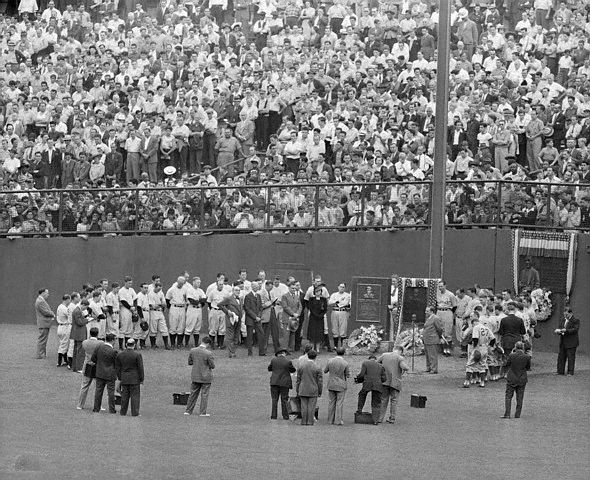
This monument ceremony seen below was supposed to take place July 4 1941, on the two year anniversary of Lou Gehrig Day in 1939.
Many baseball fans know that the New York Yankees began the tradition of Old-Timers Day with a ceremony on July 4, 1939 to honor Lou Gehrig, the “Iron Horse.” On that day, the Yankees brought together Lou’s old teammates to show their deep admiration for a man who exemplified everything the Yankees were about. At the last minute Gehrig was asked to say something to the packed house at Yankee Stadium.
The words he said, now known as, “The Luckiest Man on the Face of the Earth” speech, live on in immortality because it was completely spontaneous and from the heart.
What you may not know, is that you really have never heard or seen that speech.
You have only seen or heard small portions of Gehrig’s speech, because believe it or not, there is not one extant movie or audio recording of Gehrig’s complete speech. Only snippets.
As incredible as it sounds with all those newsreel cameras present to record the activities at Yankee Stadium, no complete version of the speech has surfaced in all these years. Continue reading →
Girls Chase A Boy to Give Him Birthday Kisses… and He Dies
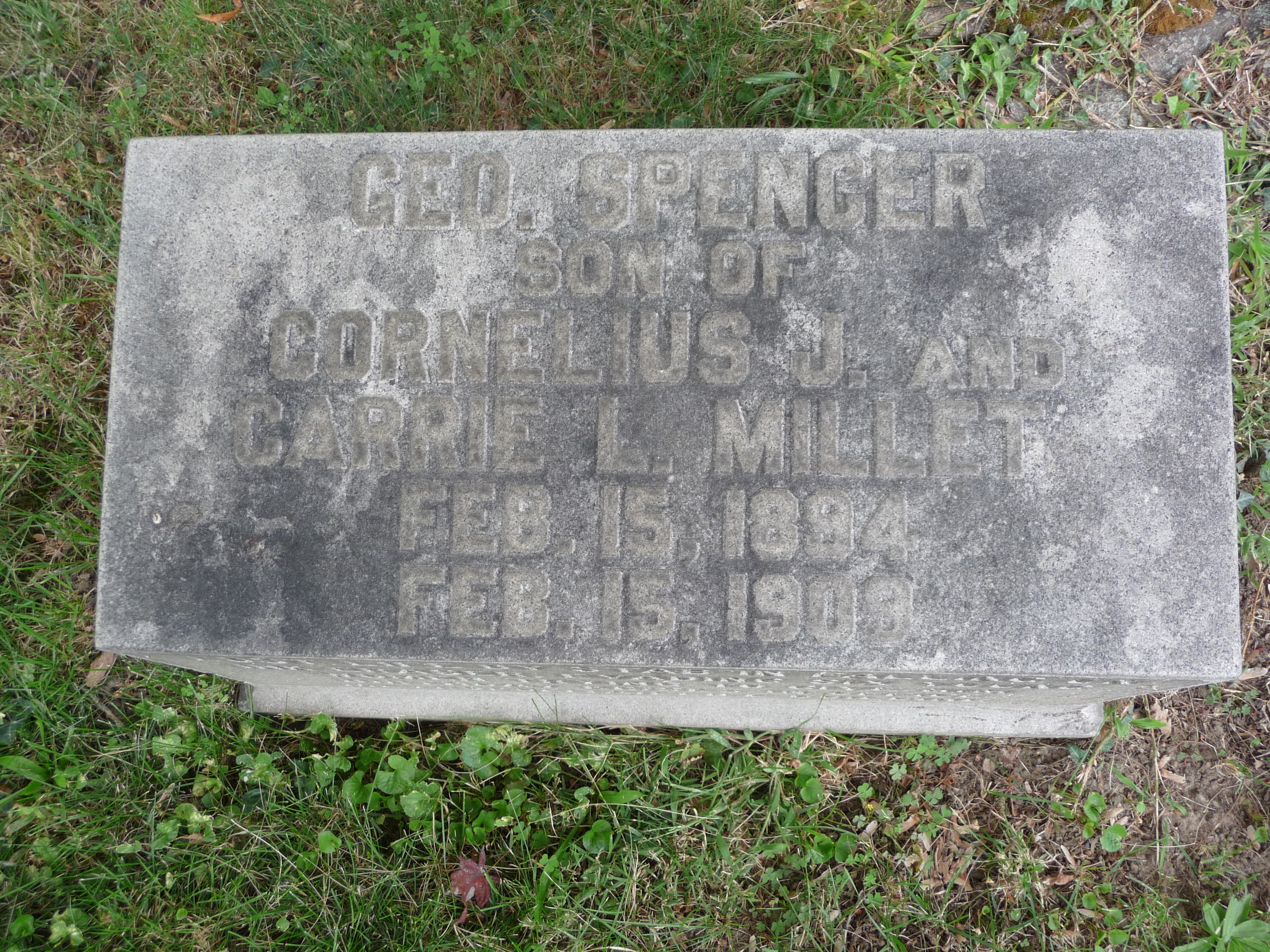
Woodlawn Cemetery Is The Final Resting Place of George Spencer Millet Who Had One Of The Strangest Deaths In New York’s History
There is a book called Woodlawn Remembers: Cemetery of American History by Edward F. Bergman (North County Books, 1988.) The book is mostly comprised of beautiful full page color and black & white photographs of monuments, tombstones and mausoleums with one page of text describing each person profiled. The cemetery is located in the northern part of the Bronx. Woodlawn is on my shortlist of recommendations of unusual places to go for New York visitors.
The book is fascinating to be sure. It covers many of the interesting and important historical figures at Woodlawn. But one story not mentioned, is the life and death of George Spencer Millet (misspelled as George Millitt by The New York Times in the story at the end of this article) who is interred at the cemetery.
Millet’s story is briefly recounted in Permanent New Yorkers A Biographical Guide To The Cemeteries of New York by Judi Culbertson and Tom Randall (Chelsea Green 1987.) This book contains photographs too, but has more detailed biographies than Woodlawn Remembers. Permanent New Yorkers also covers the entire New York area, not just focusing on the two most famous New York City cemeteries. Woodlawn and Greenwood. I highly recommend both of these out-of-print books.
It was February 15, 1909 and Millet was a good-looking boy. Because when the girls he worked with at The Metropolitan Life Insurance Company found out that it was his 15th birthday, they all insisted on giving him a kiss. Continue reading →
A Reflection on The Late, Great Yankee Stadium With Vintage Photographs
I visited the new Yankee Stadium once in 2009 when it first opened. The feeling was a bit surreal. It waslike being in Yankee Stadium, but it wasn’t. The main difference for me was the surrounding neighborhood and looking out past the right-center field bleachers and not seeing the apartment buildings and the Bronx County Court House.
The new Yankee Stadium is a glorified mall.
The old Yankee Stadium that existed from 1923 – 1973 was where the storied history of the Yankees took place. Even after the renovation of Yankee Stadium from 1974-1975 which included taking out the old wooden seats and the removal of the beams that could block your view from many of those seats, the stadium still retained some of the old charm, even though it lost a bit of its character. From 1976 -2008 the Yankees played in the same spot where Lou Gehrig, Babe Ruth, Mickey Mantle, Red Ruffing, Hank Bauer, Whitey Ford Joe DiMaggio and Bill Dickey saw action.
The Yankees of the last 35 years; Thurman Munson, Bobby Murcer, Ron Guidry, Mel Stottlemyre, Paul O’Neill, Don Mattingly and Derek Jeter could look around and seep in the history of this altered palace of baseball, even if there were heavy cosmetic changes to the outside and inside of the stadium itself.

 It was reported that since 2010 the Bronx is the fastest growing county in New York State.
 Jerome Avenue was transformed by the construction of the El in 1917 and 1918, darkening the street, but fostering a building boom. Continue reading