Tag Archives: Advertising

Old New York In Photos #29 – Times Square In Vintage Color Photographs

Advertisements & Scenes of Times Square In Vintage Color Photographs 1954

Times Sq 7 1954

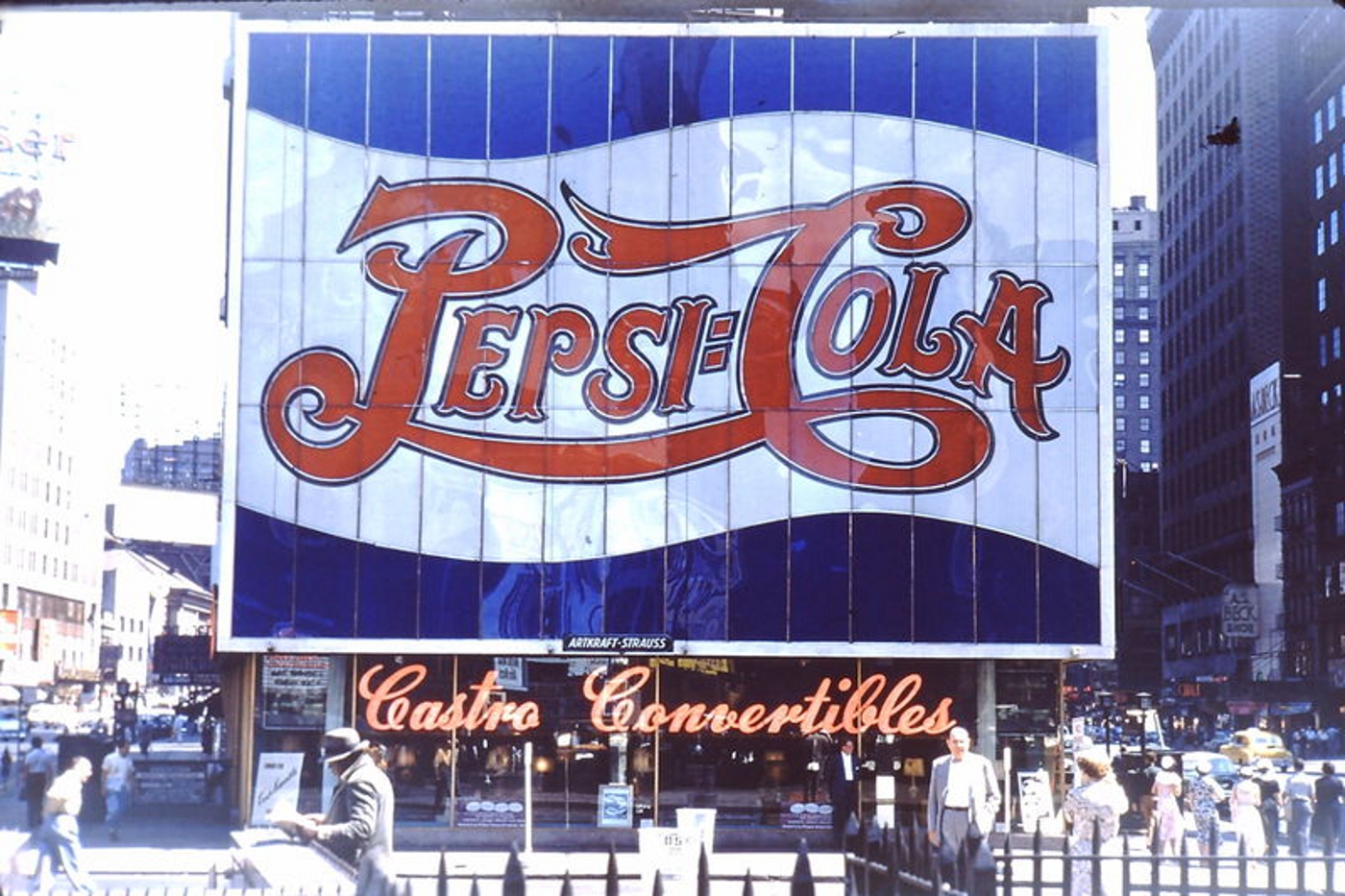
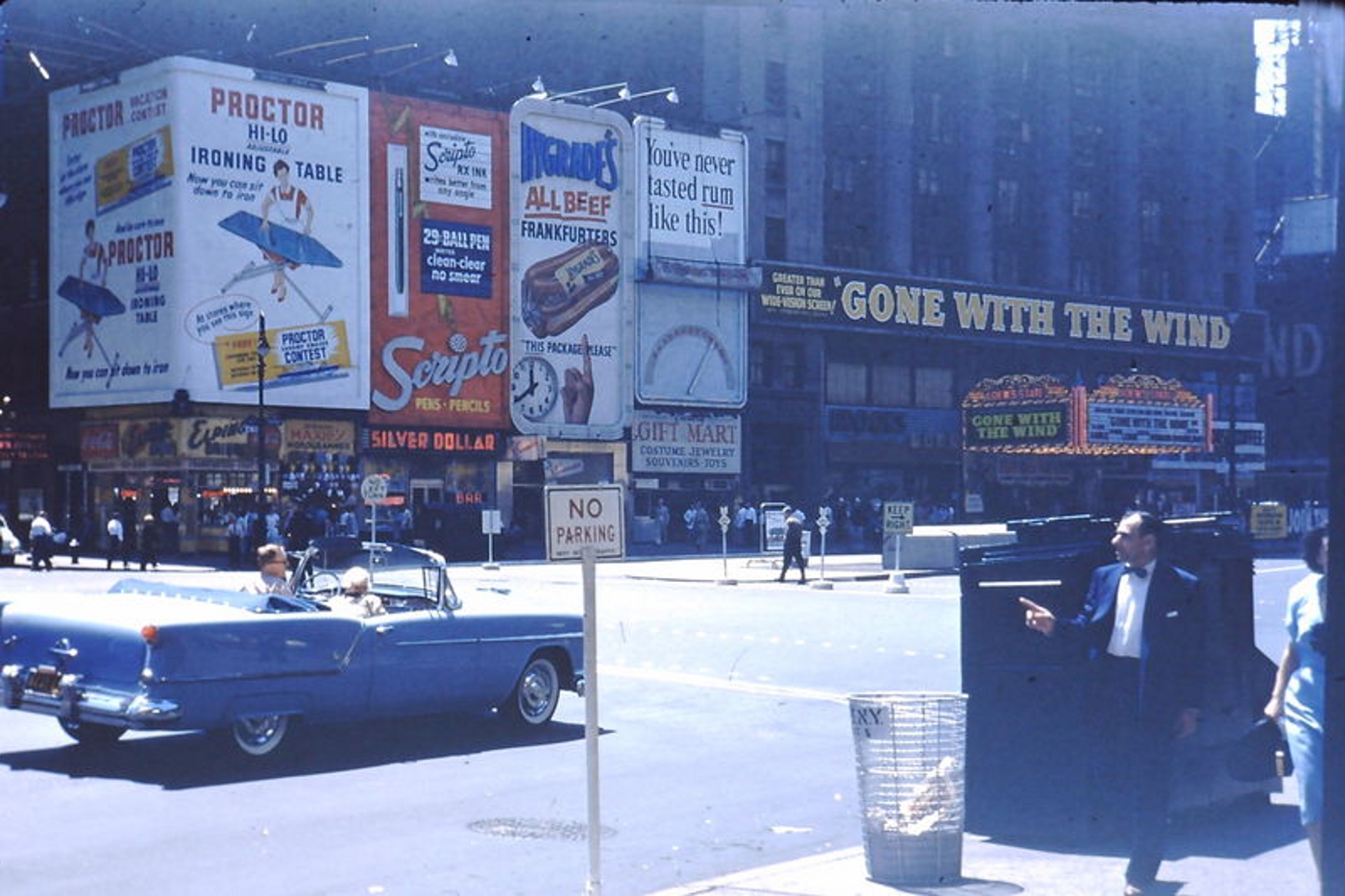
It’s been almost 60 years since these photographs were taken by an anonymous amateur photographer who was interested in the signage, ads and the streets surrounding a vibrant, now vanished Times Square.

The city began sterilizing all the flavor from the crossroads of the world in the late 1980’s. It was a few years later that most New Yorker’s began noticing the mall-ification of Times Square. True, Times Square had denigrated into a rather sleazy place from the mid-1960’s until the “revitalization” took place. But what has it become?

For anyone who lived through Times Square’s final heyday in the 1950’s, today the place must seem extremely distasteful with its countless tourist barkers, ill-planned pedestrian plazas and glass monolith buildings sheathed in gaudy LED light ads. It’s overcrowded with people moving slowly, chain stores, costumed kitsch characters and modern day hucksters hawking their products to tourists for a “real New York experience.” Give me the days of three card monte games and prostitutes over eight people wandering around in Mickey Mouse costumes any day.

As Nik Cohn said in 1997, ‘Times Square has always changed every 20 years. But this time it’s changed to a corporate, generic American city that doesn’t particularly express the uniqueness of New York.”

Times Sq  looking southeast 1954But let’s go back in time to 1954 when it was a better time for Times Square. Legitimate theatre was still great, movies offered up Cinemascope entertainment and real Broadway characters (not criminals and freaks) roamed the streets.

Enjoy these Kodachrome views of what you would have seen looking around Times Square on a sunny, warm July day in 1954.

Minimal commentary has been added for identification purposes. Click any photo to enlarge.

Times Sq 6 1954Times Square looking south from 46th Street. Shown are: Times Tower Building, Bishop’s Crook Light, Hotel Astor with The Astor Roof Garden, Victoria Theater showing About Mrs. Leslie starring Shirley Booth and Robert Ryan, on the extreme left a portion of the statue for the giant block long Bond Clothes advertisement.

Times Sq 1954 1Looking west from Broadway and Seventh Avenue along 45th Street. Shown are: the Astor Theater with a large billboard for Indiscretion of an American Wife starring Jennifer Jones and Montgomery Clift, and Rodgers and Hammerstein’s musicals Me and Juliet  and The King and I, and the 26 story Hotel Piccadilly at 227 West 45th Street. Continue reading

A Peculiar Kellogg’s Corn Flakes Ad 1907

Selling Cereal At The Turn Of The Century

Ad Corn Flakes 1907 Burr McIntosh

The company was only one year old in 1907 when this advertisement appeared in print.

This advertisement was supposed to sell you on buying Kellogg’s Toasted Corn Flakes. By just looking at the ad you are probably not quite sure what the image means. Not “boy gets girl,” but “corn gets girl”? Maybe she has a case of lachanophilia?

There is an explanation.

Company founder Will Keith Kellogg (April 7, 1860 – October 6, 1951) made himself, his cereals and the city of Battle Creek, Michigan famous. Kellogg did this by producing a better breakfast product and a lot of advertising.

W.K. Kellogg’s education never went beyond the sixth grade, yet with his strange brother Dr. John Harvey Kellogg (he advocated sexual mutilation and eugenics among other things), they figured out how to make a tasty corn flake. In producing their cereal they used only the corn grit or “the sweet heart of the corn.” Continue reading

Old Time Ads From The 1910 World Almanac – Part 2

More Interesting Ads From The 1910 World Almanac

1910 World Almanac Cover P1060720

We continue our look at the 1910 World Almanac And Encyclopedia’s advertising.

The New York World newspaper used their annual publication of the Almanac as a way to advertise their own newspaper.

1910 World Almanac Why the World P10607351910 World Almanac Subscribe to the World P1060734Why should you read The World?

There are seven good reasons according to the ad.

Considering almost every newspaper in the country had a political bias, The World claimed they were independent in politics. Another chief reason to read The World is that they were indefatigable in gathering news. As proof of their superiority, The World boasted they had more than twice the circulation of any other morning newspaper in New York.

A separate ad for Almanac readers to consider subscribing to The New York Sunday World stated that they were simply the best at everything, whether it be news, editorials, writers, humor etc. The annual cost for a subscription was $2.50.

1910 World Almanac Acme Fire Extinguisher P1060728A fire extinguisher was a necessity few could afford in 1910. Offered here straight out of a Roadrunner and Wile E. Coyote cartoon, comes the “Acme” Fire Extinguisher.

1910 World Almanac Baldness P1060751William Charles Keene, president of the Lorrimer Institute asks in his ad, “No More Bald Heads? Baltimore Specialist Says Baldness Is Unnecessary And Proves It.”

Of course it is not true. Continue reading

Old Time Ads From The 1910 World Almanac – Part 1

Huckesterism 101 – Useful? Crazy?  How Products Were Advertised In The 1910 World Almanac

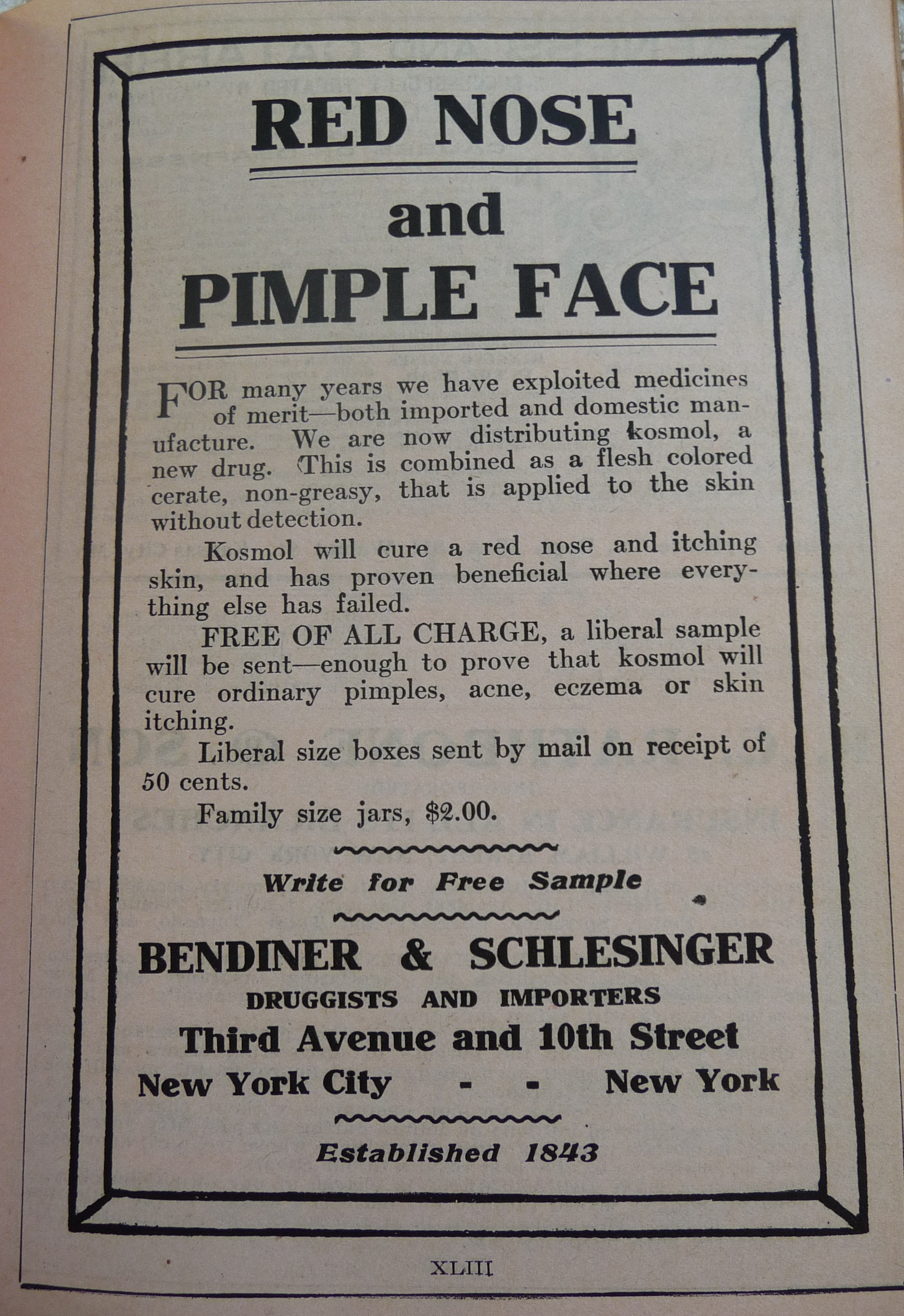
1910 World Almanac Red Nose Pimple Face P1060727

Red Nose and Pimple Face? Bendiner & Schlesinger Druggists on 3rd Avenue and 10th Street have something to help you.

One big difference between old advertising and today’s advertisements, is that today you sometimes have to scrutinize the ad to discover exactly what it is they are trying to sell to you.

Image plays a greater part in modern advertising.

Back in 1910 it was the words that counted.

When you look at old advertising you will notice that the copywriter gets right to the point about the product, though somewhat verbosely.

One thing has remained the same: advertisers used the same swaggering claims back then that they use today.

Even if they are completely false.

Here are some sample advertisements from among the hundreds contained in the 1910 World Almanac. Click on any image to enlarge.

1910 World Almanac Fat is Fatal P1060750


1910 World Almanac Fat is not Good Flesh P1060729


As long as their have been people unhappy with their weight, there have been people and companies who will exploit mankind’s battle with their waistlines. Loring & Co. marketed reducing tablets warning customers that “Fat Is Not Good Flesh.” Their reducing tablets tapped into something back then that is popular today: they contain no chemicals and are made wholly of roots and herbs.

Dr. J. Spillenger of New York City uses endorsements from customers and a dramatic illustration, while warning readers that “Fat Is Fatal.” New York City Mayor Michael Bloomberg would agree with the good doctor. What Dr. Spillenger does not say is exactly what his methods are to help you lose weight. Whatever his method, it involves not starving or exercising. “Rheumatism, Asthma, Kidney and Heart Troubles will leave as fat is reduced. Don’t take my word for this: I will prove it at my own expense,” the copy reads.

Sure, Doctor…sure.

1910 World Almanac Corpulent People P1060748Then there are those people who had no desire to lose weight but merely appear slimmer. Continue reading

You Are Creative And You Are Wasting Your Life

The Most Important Piece Of Career Advice You Will Ever Read

Forget all those best-selling, life affirming books which “reveal” valuable lessons that you should follow to have a happy life or a lucrative career.

Linds Redding, an award winning graphic designer who worked in the advertising industry for nearly 30 years, started a blog in 2011, the day he found out he had esophageal cancer.

The piece he wrote on March 11, 2012 called A Short Lesson In Perspective is a must read for anyone who is indulged in a creative profession or aspires to one. Even if you do not consider yourself creative, this is still well worth the few minutes it will take to read. It is not technically advice as much as it is self-reflection that has enormous value to the reader.

It is 2,900 words long, but even for those with short attention spans, I urge you to read to the end.

The whole article can, and should, be read here, and an excerpt (not from the beginning) is reproduced below: Continue reading

Old New York in Photos #22 – History of Times Tower Building & Times Square In Detail

Times Square And The New York Times Tower Building 1908

Times Square featuring The Times Tower 1908 – click to vastly enlarge (six megabytes!)

Times Square is burgeoning with activity in 1908 and there is so much to see in this picture.

This photograph of Times Square was part of The Detroit Publishing Company collection, now housed at The Library of Congress. The company made picture postcards from these original photographs at the turn of the century.

The area formerly known as Longacre Square became Times Square after the New York Times opened their iconic flagship office building in 1905 at what would become known as “the crossroads of the world,” the southern end of Times Square, the triangular intersection of 42nd and 43rd streets where Broadway and Seventh Avenue diverge.

Flatiron Building in 1903

The Times Tower Building design is reminiscent of the Fuller Building, which became popularly known as the “Flatiron Building” soon after it opened in 1902 between 22nd and 23rd Streets where Broadway and Fifth Avenue intersect. The two buildings don’t look alike at all. But because they were each built on irregular plots of land, the triangular buildings both resemble flatirons.

The original Times Tower Building was a Gothic structure of beautiful light limestone and featured intricate terra-cotta and granite on the facade. More about the building later in the article. Continue reading

Subway Song

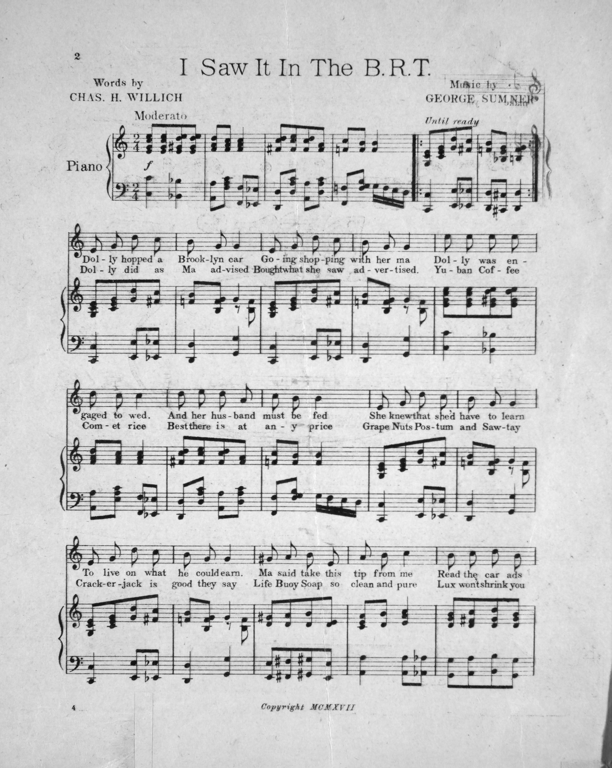
“I Saw It in The BRT”

An ode to the subway.

This 1917 ditty was written about the BRT (Brooklyn Rapid Transit System), which was the former name to the BMT (Brooklyn Manhattan Transit System).  The words which extoll the virtues of the advertising you would see on the train were written by Charles H. Willich and the music by George A. Sumner.

It is amazing how many products mentioned in the song are still around from almost 100 years ago: Grape Nuts, Wrigley’s Gum, Cracker Jacks, Aunt Jemima Pancake Mix and many others.

New Yorker’s have no more BRT, BMT, IND (Independent) or IRT (Interboro Rapid Transit). Now we just call it the subway, run by the oligarchal fiefdom called the MTA (Metropolitan Transit Authority).  And most of the ads you see are for acne treatments, learning English, and filing lawsuits.

Lyrics can be read here (click to enlarge):


Old New York In Photos #16 – Sixth Avenue Jewelers 1937

Gold & Silver – Highest Prices Paid – 1937

The year is 1937 and we are looking north on the west side of Sixth Avenue.  The Sixth Avenue Elevated in the background will soon be torn down. Sitting out in front of Roxy Jewelers is a man trying to drum up business to “sell your diamonds, pawn tickets, gold, silver, jewelry & antiques for the highest prices paid.”  The Great Depression saw many people selling off whatever valuables they had to pay the rent or just have enough to eat. Continue reading

30 Vintage Advertisements From The New Yorker Part 2

Ads From the November 3, 1951 New Yorker, continued

We continue our look at some of the advertisements from this issue of The New Yorker.  To put the prices of goods and services in perspective: in 1951, a first class postage stamp cost three cents; a loaf of bread cost sixteen cents; the minimum wage was seventy five cents per hour and the average salary was $4,200 per year.

For The Men

Of course The New Yorker appealed to the well heeled man as well as the elegantly outfitted woman. (click on any ad to enlarge)

Freeman Shoes –  Men’s shoes have not changed much in sixty years. If the Freeman Shoe is the footwear of the successful man, what is the footwear of the man who fails? Continue reading