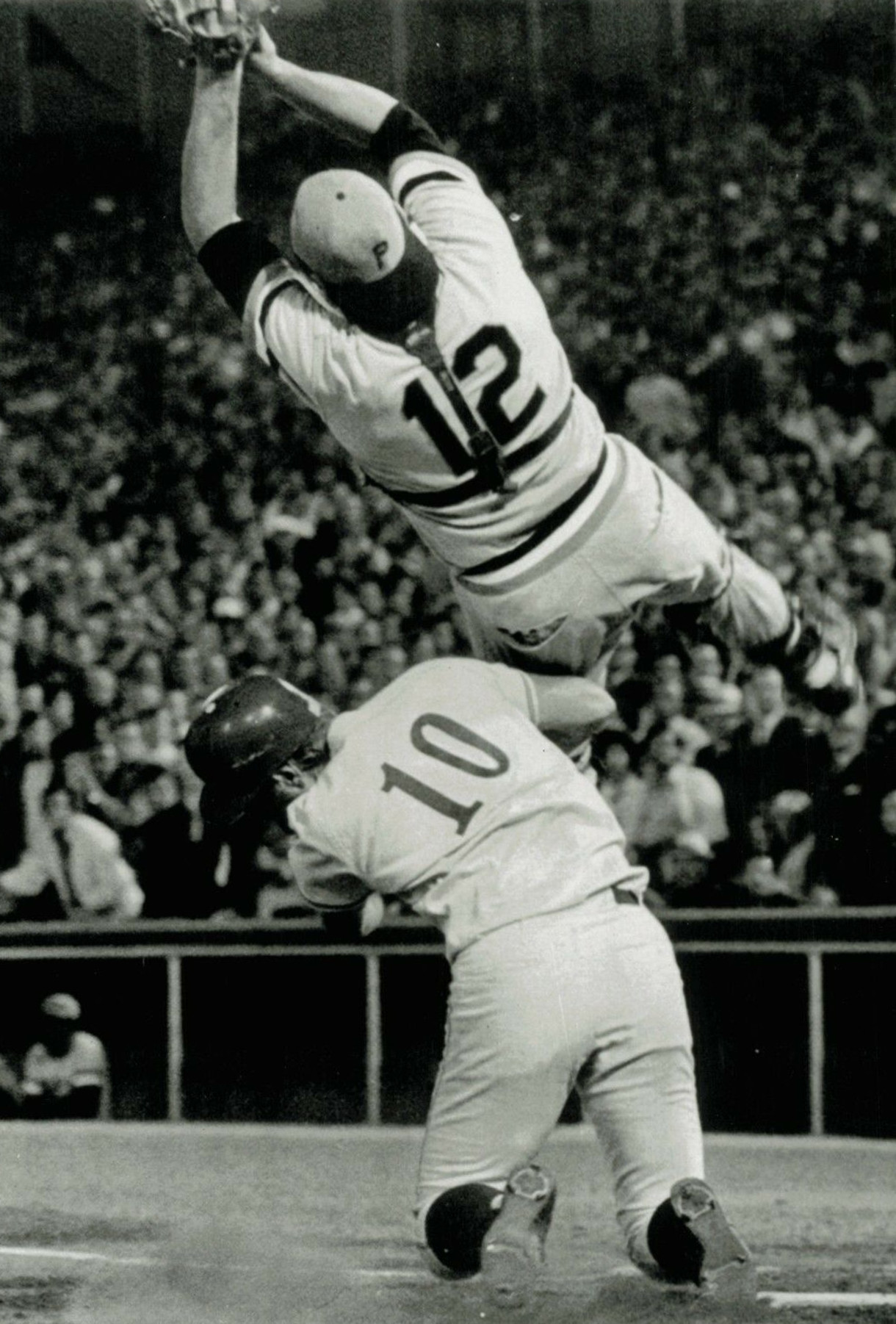
Rusty Staub Takes Out Catcher Jerry May At Home Plate – 1970
MONTREAL: Montreal Expos’ Rusty Staub (10) collides with Pittsburgh Pirates’ catcher Jerry May (12) after scoring Montreal’s second R.B.I. on a single by Coco Laboy, which also scored Don Hahn in the first inning here. August 4, 1970 photo: UPI Telephoto
Even though Rusty Staub scored, the Expos lost the game 4-2.
Baseball players have always played hard. It’s just that Continue reading →
The New York Times Loves To Ignore Rock N’ Roll Deaths
On February 3, 2026 Lamonte McLemore one fifth of the great singing group The Fifth Dimension passed away at the age of 90.
Amazingly, The New York Times did cover McLemore’s death with a well deserved obituary a week after his passing . McLemore, while not a rock star per se, was definitely part of the sixties pop rock identity.
Mickey Mantle Gives Advice To Prospects Rick Bladt and Joe Pactwa
Besides “hustle, play hard and be your best” what could Mickey Mantle say to young Yankee prospects? After all, they’re not Mickey Mantle.
As the news slug says:
March 8, 1971 -Ft. Lauderdale, FLA: Former Yankee great Mickey Mantle (L), a special instructor with the team at their spring training camp, gives some pointers to rookie outfield hopefuls Rich Bladt (C) and Joe Pactwa recently. Bladt played at Syracuse last season and Pactwa played at Manchester, N.H.. UPI Telephoto
August 17, 1973 – New York: T-shirt collectors vie to outdo each other. Nancy Greenberg wears gaudy New York souvenir shirt. What mother never told Kathleen O’Connell about is Ultra-Brite toothpaste. French Gitanes shirt worn by Paula Scher is more desirable than American brands; photos: Nancy Moran / New Yoik Times
August 17, 1973 – New York: Jean-Louis Hym’s Liberation shirt from Paris proclaims underground paper. Joel Handrroff, an artist, is not a country music fan, but he likes the shirt because of the black-on-yellow color scheme. Barry Levine’s extols Automotive High School. photo: Nancy Moran / New York Times
Fashions may change, but t-shirts have remained a staple of young people for more than half a century as evidenced by these photographs of young New Yorkers taken in 1973.
If you are wondering what a standard t-shirt cost in the early seventies, generally it was $1.98 for a regular t-shirt and $2.98 for a deluxe heavier cotton. Specialty t-shirts cost more. Continue reading →
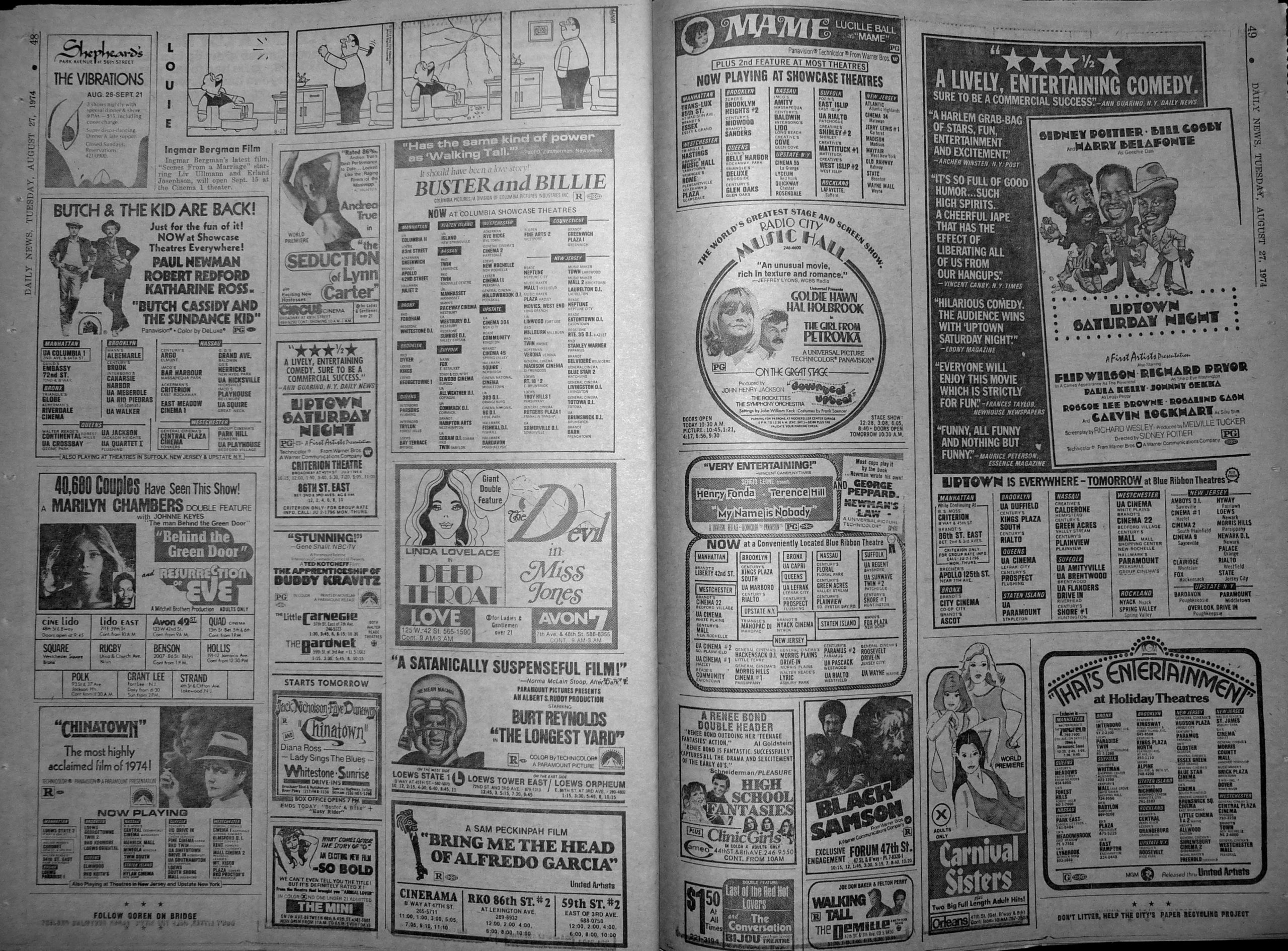
What’s Playing At The Movies – Ads From The Daily News 1974
That’s Entertainment Alongside Porn
Because I own some old newspapers that report historic events, I was looking at the New York Daily News of August 27, 1974 announcing the death of Charles Lindbergh on the front page. Turning the pages my attention was drawn to the movie advertisements.
The ads are simple, frequently without captivating graphics and usually lacking even brief summaries of the plot of the movies. Besides giving the theatres and times they were playing at, these ads were supposed to attract potential viewers with the title, the stars or a reviewers blurb.
The disarray of the motion picture industry in the seventies is evident in the variety of films playing at theaters.
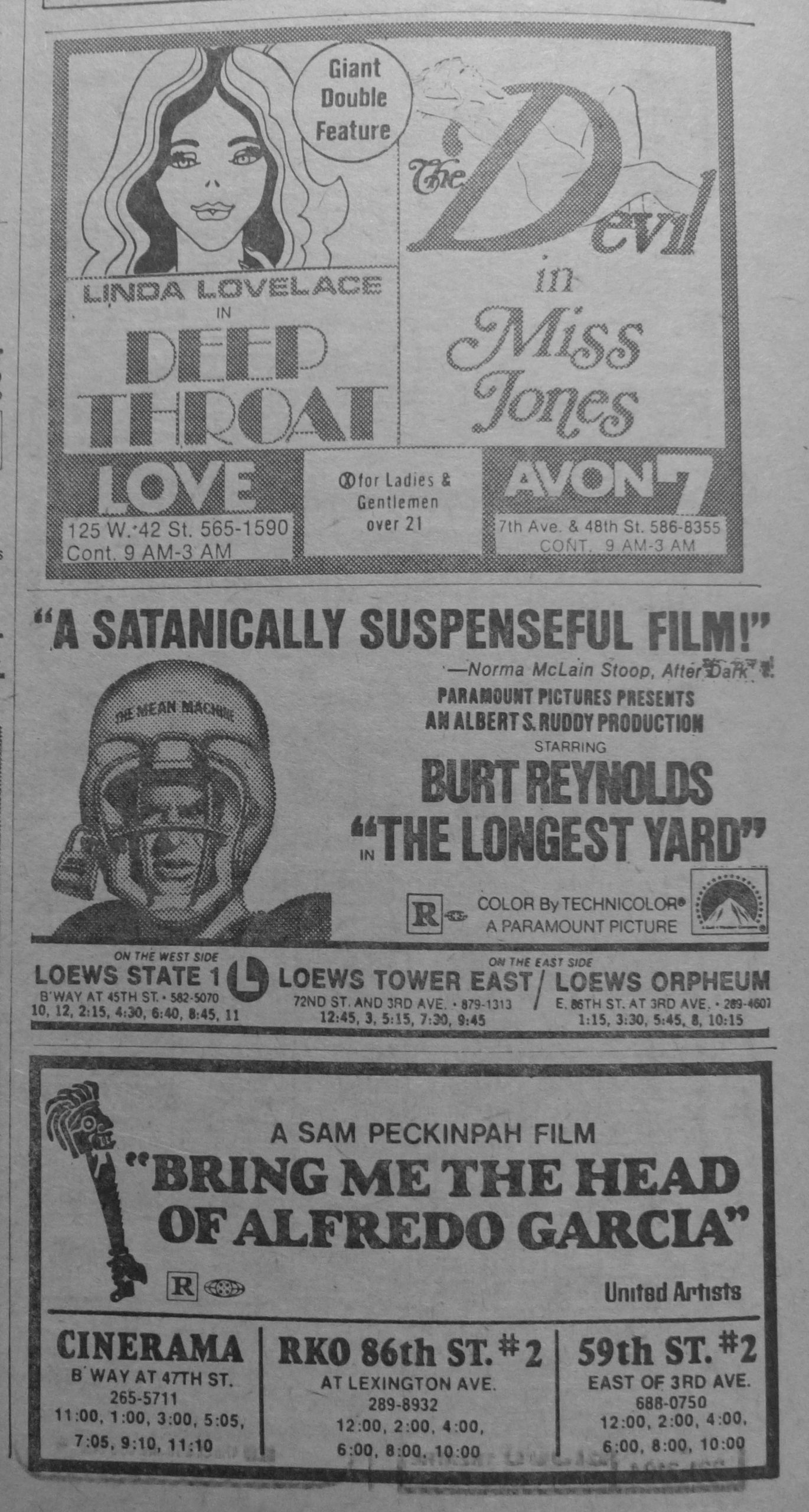
Adjacently advertised next to one another are Deep Throat; The Devil In Miss Jones; The Longest Yard and Bring Me The Head Of Alfredo Garcia. Two X-rated and two R-rated films.
Deep Throat (1973) was the first “mainstream” pornographic film. It was Continue reading →
Before cable television, baseball was usually televised only in your local broadcast area, if there was a major league team within your market. Otherwise you could tune into only one nationally broadcast game on Saturday, aptly named the “Game of the Week.” Continue reading →
A Dozen 1970 New Yorker Cartoons That Would Not Get Published Today
In 1970 the Women’s Lib movement was in full swing. But it was still de rigueur for the media to portray women as sexual objects.
The New Yorker magazine has always been a mirror of society in the drawings it decides to publish.
Looking back through its cartoons that ran in 1970, reveals what once was considered funny, would now be considered politically incorrect. They may be funny as well. It depends upon your sense of humor.
Many cartoons we display below, involve sexual harassment. But back then these cartoons were a reflection of many men’s behavior and attitudes towards women.
In it’s 100 years of publishing, is there a New Yorker cartoon that was offensive or in bad taste for the time it originally ran? I have seen thousands of their cartoons and have not found one.
What I find offensive is cartoons that are not funny. How did that get published?
Here are cartoons from The New Yorker magazine in 1970, that would probably never appear in The New Yorker today.
Even Being Indestructible Did Not Stop The Pay Phone’s Extinction
There are certainly people who have never seen a pay phone before. And people who are familiar with pay phones may have only seen them with push buttons. Rotary dial phones were replaced in the 1970s by push buttons. Whereas pay phones managed to remain ubiquitous until the 1990s.
Pay phones were once everywhere. You could find them in hotels restaurants, gas stations, drug stores, transportation facilities, office and public buildings and on street corners,
The ad above ran in the September 11, 1971 New Yorker magazine.
In 1970 vandals cost American Telephone and Telegraph $12 million Continue reading →
The Quiet Van Halen Speaks Of Family, Music, Life, Love And Loss
The band Van Halen share their name with its two founding members. So when speaking of Van Halen sometimes it’s important to distinguish if you are referring to the band or personnel. Frequently it was interchangeable. The band Van Halen or the guitarist Edward Van Halen. Infrequently was the reference to band co-founder Alex Van Halen.
Sitting behind a drum kit for over 50 years made it possible for Alex Van Halen to be in the background rather than the spotlight. Continue reading →