Tag Archives: 1900s

All New York City Sidewalks Are Not Created Equal

What Is The Width Of The Sidewalks In Manhattan?

Following up on our November 19, story, All New York City Streets Are Not Created Equal, the 1904 World Almanac has a list of the width of Manhattan’s sidewalks. The chart can provide the answer to which avenue has wider sidewalks Fifth Avenue or Lenox Avenue? While this may not be a burning question on anyone’s mind, it is interesting to see how much the sidewalk width varies from street to street and avenue to avenue.  The obvious differences are plainly apparent to any New Yorker walking the streets so we thought it would be worth it to reproduce this list with the actual measurements.

Width of Sidewalks in Manhattan Borough

In streets 40 feet wide 10 ft.
In streets 50 feet wide 13 ft.
In streets 60 feet wide 15 ft.
In streets 70 feet wide 18 ft.
In streets 80 feet wide 19 ft.
In streets above 80 feet, not exceeding 100 feet. 20 ft.
All streets more than 100 feet 22 ft.
 
Lenox and 7th Avenues, north of W. 110th St 35 ft.
Grand Boulevard (Broadway above 59th Street) 24 ft.
Manhattan St. 15 ft.
Lexington Avenue 18 ft. 6 in.
Madison Avenue 19 ft.
5th Avenue 30 ft.
St. Nicholas Avenue 22 ft.
Park Avenue from E. 49th to E. 56th St. and from E. 96th St. to Harlem River 15 ft.
West End Avenue 30 ft.
Central Park West, from W, 59th St. to W. 110th, East side 27 ft.
Central Park West, from W. 59th St. to W. 110th, West side 35 ft. 6in.

How many of these sidewalk measurements remained the same throughout the 20th century is open to conjecture. I would imagine that many sidewalks have had their original dimensions changed due to the high value of Manhattan real estate.

click to enlarge

This photograph, taken November 10, 1914 at the corner of Fifth Avenue and 59th Street looking south, has a clear view of the sidewalk. The men near the carriage are standing in front of the Hotel Savoy (built 1892 – demolished 1927). On the right at 58th Street is the Cornelius Vanderbilt II mansion (built 1893 – demolished 1926).  It does not appear that the sidewalk is actually 30 feet wide.

How The Super Wealthy Woman Of 1903 Lived

“Free To Indulge Her Whims and Fads In Whatever Way The Gay World Of Society, And Her Own Inclination, May Lead Or Tempt Her”

Let’s say you are the wife of a turn of the century financier. How do you run your household and spend your time and money? Is there no one to teach you except your family or contemporary one percenters?

Fortunately there was a book written just for the rare woman who needed such advice.

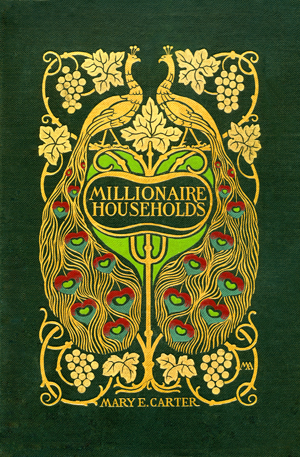
The book which could now be slightly updated and reprinted for today’s super wealthy billionaires is called, Millionaire Households and Their Domestic Economy With Hints Upon Fine Living by Mary Elizabeth Carter published by D. Appleton & Company 1903.

Miss Carter was not a society lady, but had managed a house for the wealthy Vanderbilt family.

With chapters such as Fine Living or Housekeeping; The Hostess’s Wardrobe; The Lady’s-Maid; The House-Maid; The Parlor-Maid; The Servant’s Dining Hall-Maid; The Butler and His Staff; The Valet; Monsieur Le Chef and His Aids; Side-Lights and Shifting Scenes When The “Smart Set” Dine; the book has everything you would need to know as the grande dame running an American version of Downton Abbey.

We learn from Miss Carter that a butler is more than just a servant. She writes, “When the ubiquitous newspaper reporter appears the butler knows how to get rid of him with as little information imparted as will spare the family from false statements or ridicule. During these interviews he requires his entire stock of aplomb. He must withhold all information possible, while appearing to give it out freely.”

This book was not for the 1% that we hear so much about today. In 1903, Millionaire Households and Their Domestic Economy would apply to only o.oo5% of Americans, since there were about 4,000 millionaires out of 80 million people living in the United States at the turn of the century. Approximately half of those millionaires resided in New York State. It is safe to say this book probably did not sell very many copies. It is also important to remember how much a million dollars was back in 1903. One would need to have about twenty million dollars today to have the purchasing power of a millionaire in 1900.

Comparatively today, globally there are about 10 million people (exclusive of their home) with a net worth  of one million dollars or more and approximately 3.1 million of them reside in North America.

The book gives a complete view into the way the millionairess should conduct her household. While the advice the book offers might seem frivolous and somewhat outrageous to read today, Continue reading

Old New York In Photos #23 – Subway Excavation Along Broadway & 49th St. 1901

Subway Excavation, Broadway and 49th Street – 1901

While the MTA is currently striving to build the new Second Avenue subway without disturbing businesses along the route, the Interborough Rapid Transit Company (IRT) had no such compunction about hampering businesses as demonstrated by this photograph taken on November 26, 1901.

We are looking north along Broadway towards 49th Street. The J.B. Brewster Carriage Continue reading

Old New York in Photos #22 – History of Times Tower Building & Times Square In Detail

Times Square And The New York Times Tower Building 1908

Times Square featuring The Times Tower 1908 – click to vastly enlarge (six megabytes!)

Times Square is burgeoning with activity in 1908 and there is so much to see in this picture.

This photograph of Times Square was part of The Detroit Publishing Company collection, now housed at The Library of Congress. The company made picture postcards from these original photographs at the turn of the century.

The area formerly known as Longacre Square became Times Square after the New York Times opened their iconic flagship office building in 1905 at what would become known as “the crossroads of the world,” the southern end of Times Square, the triangular intersection of 42nd and 43rd streets where Broadway and Seventh Avenue diverge.

Flatiron Building in 1903

The Times Tower Building design is reminiscent of the Fuller Building, which became popularly known as the “Flatiron Building” soon after it opened in 1902 between 22nd and 23rd Streets where Broadway and Fifth Avenue intersect. The two buildings don’t look alike at all. But because they were each built on irregular plots of land, the triangular buildings both resemble flatirons.

The original Times Tower Building was a Gothic structure of beautiful light limestone and featured intricate terra-cotta and granite on the facade. More about the building later in the article. Continue reading

A Sport That Never Gained Popularity

Jeeves, Get My Dirigible Ready!!!

The headline in the New York Times of March 7, 1909 proclaimed, Aerial Yachting Promises to be the Real Thing in Sport.  For some reason, this sport never took off – if you’ll pardon the pun.

Aerial Yachting would be for “the sport loving public who want the latest thing to machines that can be conveniently managed in the air and accommodate from three passengers up to half a dozen or so, making the trip socially pleasant apart from the novelty of the expedition.”

All you would need to participate would be a large sum of money to have a massive 100 foot plus dirigible powered by a motor constructed for you. Then of course you’d have to figure out how to fly the thing on your own because there weren’t too many aviators at the beginning of the 20th century.

The Clement-Bayard ship illustrated in the accompanying article below, was 175 feet long and had made successful flights over Paris.  Mr. Adolph Clement the builder of that dirigible, planned to open an agency at his automobile showrooms in New York to promote dirigible flights.

This was the dawn of aviation and World War I would see the dirigible used extensively for military purposes. The luxury aspect of dirigibles as a sport, never really caught on with the wealthy.

Original Times Article March 7, 1909 – click to enlarge


How Many Books Were Published 100 Years Ago As Compared To Today?

A Glut of Publishing

In 1907 there were 9,260 books published in the United States according to the New York State Library Bookboard.

Compare that to 2010 when there were 316,480 books published by traditional publishing companies according to Bowker.

Add to that another 2,776,260 on-demand titles produced by reprint houses specializing in public domain works and by presses catering to self-publishers and ”micro-niche” publications.

That is over 3 million books published in one year.

No wonder it is so hard to separate the wheat from the chaff. Continue reading

Life In 1909 – Random News And Advertising

What Was Happening On January 21, 1909

I picked a random day 103 years ago to see what was in the news. I read the entire New York Times newspaper for Thursday, January 21, 1909 to come up with the some interesting stories and unusual items.  The paper was only 18 pages! The major differences compared to current newspapers: few photographs accompany any story and  articles of different types are interspersed on the same page, so the news is not sectioned by category.  I have put the article summary in blue and my comments are in black italics.

Crowds flocked to the Auto Show at Madison Square Garden. Lots of famous people showed up including Colonel John Jacob Astor and Mr. & Mrs. George J. Gould. There was a selection in gasoline powered and electric cars on display.

Not many people realize that in the early days of automobile manufacturing gasoline and electric cars were battling for market share. Steam cars were also an option, but were left unmentioned in the article.  Before 1909 over 600 companies in the United States had at one time started manufacturing automobiles and half of them had already run out of business.  An estimated 200,000 automobiles were in use in the United States according to the  Association of Licensed Automobile Manufacturers. What would our current energy situation be like today had the electric car won the battle for vehicular supremacy over the gasoline powered engine?

An advertisement for Renault showed they led all automobile companies in US imports with 214 in 1907 and 244 in 1908.

The runner-up for sales in each year (by half as much) were in order: Mercedes, Fiat and Panhard?!

The Conference Committee of the Independent Telephone Officers to meet the following week on plans to build a long distance telephone line from Boston to Omaha. The cost: $5,000,000 immediate expenditure and $30,000,000 over the next four years! Continue reading

Old New York in Photos #10 – Rapid Transit 1905

Crosstown Rapid Transit, 1905, New York City


It probably made the crosstown trip faster than we currently do.

I like the sign in the background – Milk, Cider, Cream Soda, Buttermilk, Lemonade 3¢.

And I  love old handwriting:

Tuesday A.M. Dear Mamma, What do you think of this for rapid N.Y.  Please send my letters to Aunt Emma’s. Came Monday, will write to-day Love, Evan(?)

According to Appleton’s Dictionary of New York in 1905, there were 7-8  mail deliveries per day and the postal service made a profit. Continue reading

One of the Strangest Deaths in New York’s History

Girls Chase A Boy to Give Him Birthday Kisses… and He Dies

Woodlawn Cemetery Is The Final Resting Place of George Spencer Millet Who Had One Of The Strangest Deaths In New York’s History

Woodlawn cemetery 1909 Gravestone of George Spencer Millet died while evading girls kisses on his birthday at Metropolitan Life Building

There is a book called Woodlawn Remembers: Cemetery of American History by Edward F. Bergman (North County Books, 1988.)  The book is mostly comprised of beautiful full page color and black & white photographs of monuments, tombstones and mausoleums with one page of text describing each person profiled.  The cemetery is located in the northern part of the Bronx. Woodlawn is on my shortlist of recommendations of unusual places to go for New York visitors.

The book is fascinating to be sure. It covers many of the interesting and important historical figures at Woodlawn. But one story not mentioned, is the life and death of George Spencer Millet (misspelled as George Millitt by The New York Times in the story at the end of this article) who is interred at the cemetery.

Millet’s story is briefly recounted in Permanent New Yorkers A Biographical Guide To The Cemeteries of New York by Judi Culbertson and Tom Randall (Chelsea Green 1987.) This book contains photographs too, but has more detailed biographies than Woodlawn RemembersPermanent New Yorkers also covers the entire New York area, not just focusing on the two most famous New York City cemeteries. Woodlawn and Greenwood. I highly recommend both of these out-of-print books.

It was February 15, 1909 and Millet was a good-looking boy. Because when the girls he worked with at The Metropolitan Life Insurance Company found out that it was his 15th birthday, they all insisted on giving him a kiss. Continue reading

Old New York in Photos #5 – 42nd Street c. 1909

42nd Street Looking West From Park Avenue c. 1909

42nd Street 1910 Photo Detroit Publishing Co.

Trolleys, horse drawn wagons and no cars, dominate this view of 42nd street.  The building on the right is Grand Central Terminal before being completely renovated by the architectural firm of Warren & Wetmore. The tall building on the right past the trolley is the Hotel Manhattan (demolished c. 1962 and replaced by Sperry Hutchinson Building in 1964). In the far background in the center is The New York Times Tower Building which was opened in 1906. Continue reading