Tag Archives: 1900s

One of the Strangest Deaths in New York’s History

Girls Chase A Boy to Give Him Birthday Kisses… and He Dies

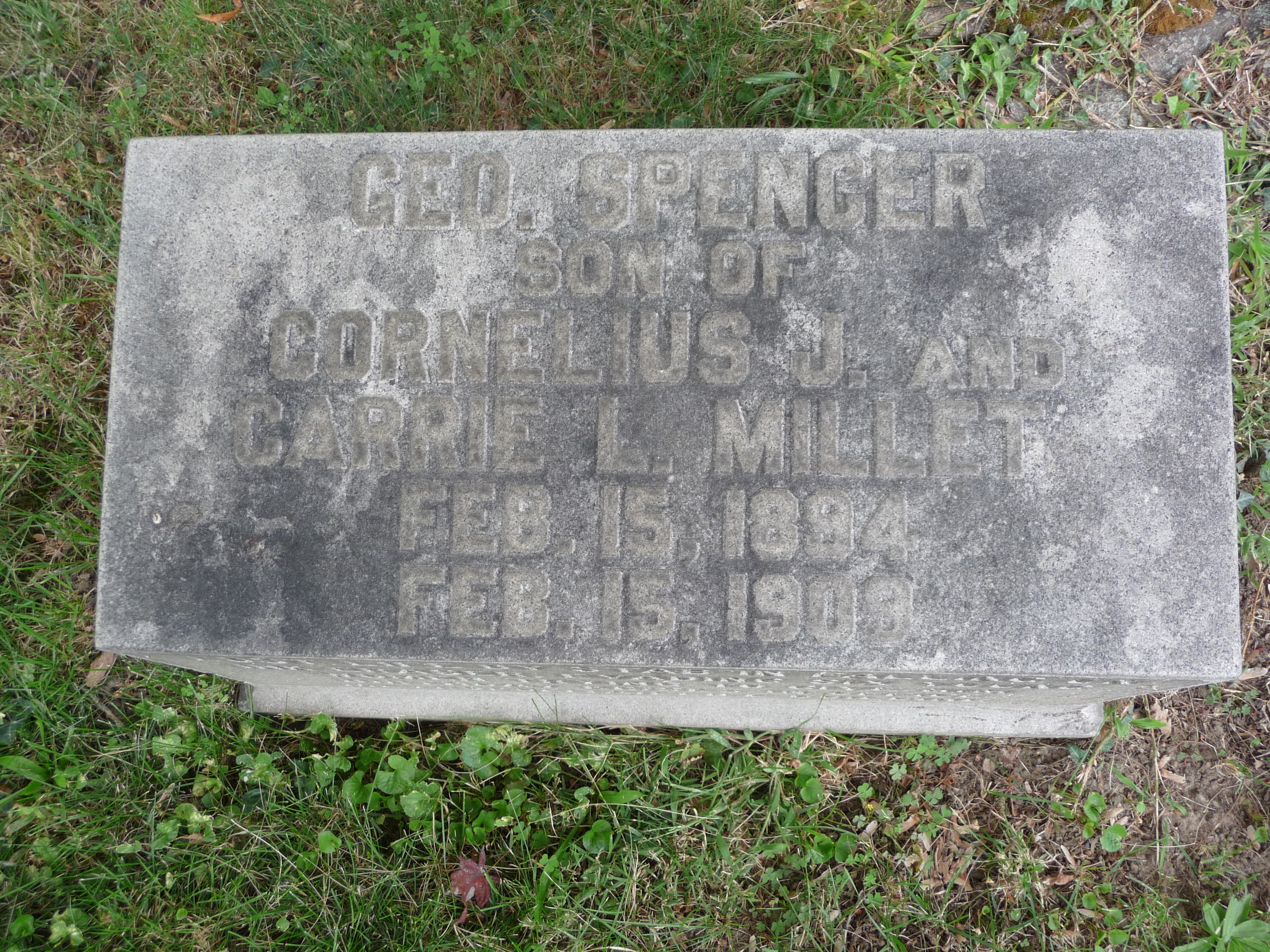
Woodlawn Cemetery Is The Final Resting Place of George Spencer Millet Who Had One Of The Strangest Deaths In New York’s History

Woodlawn cemetery 1909 Gravestone of George Spencer Millet died while evading girls kisses on his birthday at Metropolitan Life Building

There is a book called Woodlawn Remembers: Cemetery of American History by Edward F. Bergman (North County Books, 1988.)  The book is mostly comprised of beautiful full page color and black & white photographs of monuments, tombstones and mausoleums with one page of text describing each person profiled.  The cemetery is located in the northern part of the Bronx. Woodlawn is on my shortlist of recommendations of unusual places to go for New York visitors.

The book is fascinating to be sure. It covers many of the interesting and important historical figures at Woodlawn. But one story not mentioned, is the life and death of George Spencer Millet (misspelled as George Millitt by The New York Times in the story at the end of this article) who is interred at the cemetery.

Millet’s story is briefly recounted in Permanent New Yorkers A Biographical Guide To The Cemeteries of New York by Judi Culbertson and Tom Randall (Chelsea Green 1987.) This book contains photographs too, but has more detailed biographies than Woodlawn RemembersPermanent New Yorkers also covers the entire New York area, not just focusing on the two most famous New York City cemeteries. Woodlawn and Greenwood. I highly recommend both of these out-of-print books.

It was February 15, 1909 and Millet was a good-looking boy. Because when the girls he worked with at The Metropolitan Life Insurance Company found out that it was his 15th birthday, they all insisted on giving him a kiss. Continue reading

Old New York in Photos #5 – 42nd Street c. 1909

42nd Street Looking West From Park Avenue c. 1909

42nd Street 1910 Photo Detroit Publishing Co.

Trolleys, horse drawn wagons and no cars, dominate this view of 42nd street.  The building on the right is Grand Central Terminal before being completely renovated by the architectural firm of Warren & Wetmore. The tall building on the right past the trolley is the Hotel Manhattan (demolished c. 1962 and replaced by Sperry Hutchinson Building in 1964). In the far background in the center is The New York Times Tower Building which was opened in 1906. Continue reading

How to Win the World Series – Don’t Hit! Presenting the 1906 White Sox

Nicknamed The “Hitless Wonders”: The 1906 Chicago White Sox.

Portrait White Sox catcher Billy Sullivan 1909 Chicago Daily News negatives collection, Courtesy of Chicago History Museum

This dour looking man shared the team lead for the Chicago White Sox in home runs in 1906. His name was Billy Sullivan. He was the team’s catcher. He batted .218.

Billy Sullivan in 1910 Chicago Daily News negatives collection, Courtesy of Chicago History Museum

Billy Sullivan and Joe Sugden in 1901 Chicago Daily News negatives collection, Courtesy of Chicago History Museum

The other slugger to lead the team in home runs was outfielder / playing manager Fielder Jones. He batted .230.

fielder Jones at South Side Park 1905 Chicago Daily News negatives collection, Courtesy of Chicago History Museum

Fielder Jones & Frank Isbell 1907 Chicago Daily News negatives collection, Courtesy of Chicago History Museum

Fielder Jones Base Hit vs. Cubs Chicago Daily News negatives collection, Courtesy of Chicago History Museum

Sullivan and Jones each had two home runs.  This is the shared record with the 1907 Cubs for fewest amount of home runs for an individual team leader on a modern (post 1903) world championship team. Let’s give the 1907 Cubs some credit they walloped nearly double the number the White Sox did in 1906 by hitting 13 home runs.

The White Sox hit a total of seven home runs in 1906. Count them, seven.

The White Sox batted collectively .230. They did not have one .300 hitter who had more than ten at bats. Pitcher Frank Smith had a higher batting average  (.293)  than any other regular starter. They did finish in first place with a 93-58 record.

In the 1906 World Series against the crosstown rival Chicago Cubs the Sox  hit even lower, batting a collective .198.

1906 World Series West Side Grounds Chicago Daily News negatives collection, Courtesy of Chicago History Museum

1906 World Series fans Chicago Daily News negatives collection, Courtesy of Chicago History Museum

The Cubs had won a record 116 games, which is still the modern National League record for victories.

Yet the White Sox whipped the heavily favored Cubs four games to two and even managed to score eight runs in each of the last two games!

North Brother Island

A Close-up Look At Hidden New York: No People, But Lots Of Abandoned Buildings, Neglected Structures And A Safe Haven To Birds.

Having lived in New York City my whole life, there are places that I have never visited by choice and others that I have never been to because they are off-limits.  One of those off-limits places is North Brother Island, which is a small island just off the southern coast of the Bronx near the entrance to Long Island sound.

North Brother Island, if known by the general public at all, is famous for two reasons:

1-   In 1904 the excursion boat General Slocum caught fire and was beached near the island. The fire took the lives of over 1,000 people, mostly women and children going on a church outing to Long Island. Heroic rescuers who worked on North Brother brought many of the victims to the shores of the island.

2-   Mary Mallon a.k.a. Typhoid Mary who was a carrier of typhoid and spread disease and death in turn of the century New York. She was quarantined there until she died in 1938.

I am fascinated by abandoned structures. North Brother Island is chock full of history. Presented here is the link to the fabulous web site The Kingston Lounge which has done a phenomenal history and photo essay of the decaying remains on this forgotten section of New York City.

The 19.3 acre island is now controlled by the New York City Department of Parks and Recreation and since its human abandonment in the 1970’s has become a bird sanctuary.