Tag Archives: 1900s

Old New York In Photos #62 – Lower Manhattan From Atop The Brooklyn Bridge Tower 1905

Lower Manhattan As Seen From The Brooklyn Bridge Tower – c. 1905

View Manhattan From Brooklyn Bridge tower circa 1905 locThis unusual view was taken from the top of the New York tower of the Brooklyn Bridge around 1905. Lower Manhattan is in transition from low rise buildings to the ever increasing number of skyscrapers dotting the landscape.

We see smoke rising from many chimneys. Elevated trains make their way across the Brooklyn Bridge while many pedestrians use the bridge’s center walkway.

Near the waterfront atop a building, the Uneeda Biscuit Company billboard is conspicuously advertising one of the most popular turn-of-the-century brands right next to the heavily trafficked bridge.

Postcard Brooklyn Bridge transportation terminal hub on Park Row c. 1905

Postcard Brooklyn Bridge transportation terminal shed on Park Row c. 1905

At the end of the bridge on Park Row, the four and a half story shed structure is the transportation center also called Continue reading

One of The Most Timeless Political Cartoons Ever

An Appropriate Political Cartoon From 2016?

National Bird of Prey Cartoon 1905 Puck MagazineThe more things change the more they remain the same.

puck bannerThis great political cartoon ran in 1905 on the cover of the satirical Puck Magazine. The cartoon showing The National Bird of Prey “Corporate Vulture” feeding her young “dough” is as appropriate in 2016 as it was in 1905 . The hatchlings being fed in a nest lined with money are labeled “Our” Senators; “Our” Legislatures and “Our” Judges. Is the “Our” in quotes referring to the citizens who have been robbed of representative power or a sarcastic wink to the fact that “Our” government belongs to the corporations? With either interpretation it is a potent statement that still rings true today.

The only thing missing is Continue reading

Old New York In Photos #60 – Upper West Side 1908

Broadway on the Upper West Side Close-up Circa 1908

Details Of Life and Architecture From One Photograph

Broadway 70th closeup of people(Click to enlarge any of the photographs.)

From the Detroit Publishing Company comes a great photograph showing the busy thoroughfare of Broadway on the upper west side of Manhattan. The photo above is just one detailed portion of the main photograph (see below).

By zooming in we can clearly observe details otherwise unnoticed. We see three children taking in the sights of the city while riding in the back of an open horse drawn wagon. Pedestrians walk across the street without being too concerned about the light vehicular traffic. Notice the woman in the center of the photo holding up her dress slightly so it did not scrape the street. But it wasn’t just women who were careful: all New Yorkers had to be rather adept at avoiding horse urine and manure that littered the streets. On the right, horse waste can clearly be seen near the man stepping off the curb.

But where exactly are we on Broadway?

Here is the answer…

Broadway north from 70th streetWe are looking north on Broadway from 70th Street to about 79th Street. There are two main buildings that stand out in the photograph. On the right between 71st and 72nd Streets is The Dorilton, an exceptionally ornate apartment building by architects Janes & Leo, completed in 1902. On the left on the northwest corner of 73nd Street, just beyond the subway station, is the Ansonia Apartment Hotel completed in 1904.

Broadway 70th closeup subway station trolleyZooming in again on the details in the center portion of the photo, trolley number 3061 makes its way down Broadway, passing the  subway station of the IRT at 72nd Street. It appears workers are repairing or painting the doors leading to the station.

Now let’s look at some other details. Continue reading

Nine Turn-of-the-Century Advertisements

Nine Advertisements From Collier’s Weekly -1901

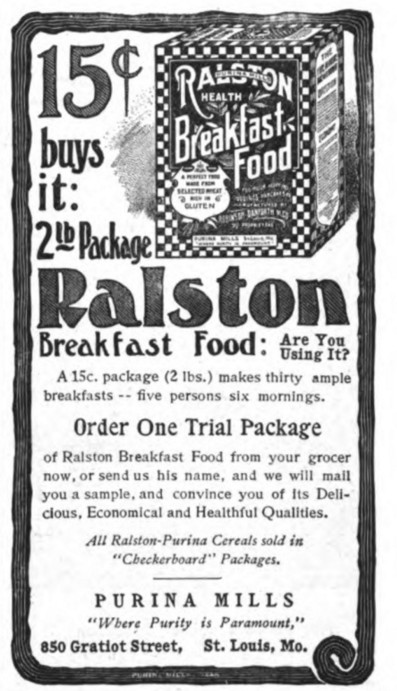
And you thought Ralston-Purina just made pet food? Apparently not.

And you thought Ralston-Purina just made pet food? Apparently not.

It is always fascinating to look back on how products and services were advertised long ago.

These ads all appeared in various issues of Collier’s Weekly Magazine during the autumn and winter of 1901.

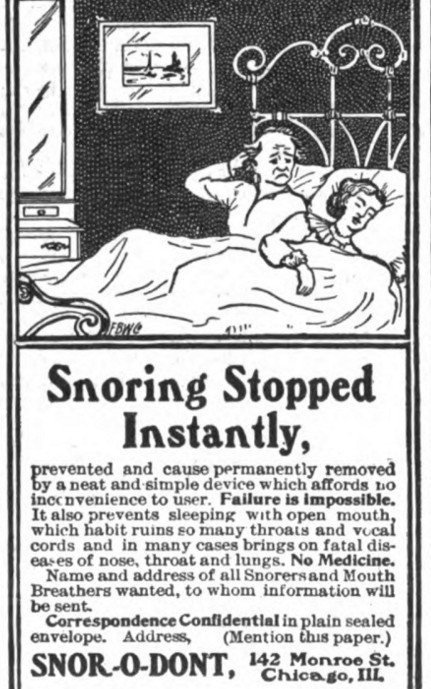
Colliers Ad Snoring Stopped InstantlySnor-O-Dont promises snoring will be stopped instantly and that failure is impossible and no medicine is involved. So what is the secret of Snor-O-Don’t? I don’t know. By the looks of the illustration the man is so sleep deprived that he may be reaching behind him to cover her face with a pillow. Suffocation, that’s a permanent snoring solution.

Colliers Ad Iver Johnson Revolver Features Child Iver Johnson, manufacturers of bicycles. guns and revolvers says that “accidental discharge is impossible” with their safety hammerless automatic revolver. What better way to demonstrate the safety of a handgun than to show a cherubic child poised to fire it?

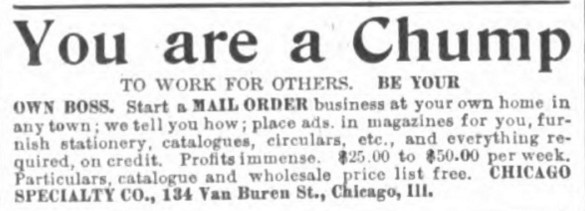
Colliers Ad You Are A ChumpNothing like being direct…chump. Continue reading

The Average Woman – 1908

The Average American Woman Is…Ungainly, Has An Appalling Lack of Symmetry, Is Inactive and Badly In Need Of Exercise

Ungainly FigureCharles Merriles penned a three part article for Physical Culture Magazine entitled The Average Woman which ran from the July – September 1908 issues. He offers a scathing indictment against the average woman as being generally disproportioned, out of shape and defective.

Today an article like the one Charles Merriles wrote would be savagely attacked and he would probably be apologizing on social media. But this was 1908 and it was a very much a man’s world.

Physical Culture Magazine described itself as “devoted to health, strength, vitality, muscular development, and care of the body”

The publisher of Physical Culture, Bernarr MacFadden, was a man driven by perfection, physical fitness and fame. His belief of natural cures and strength training was forward looking. but his many detractors considered him to be an obscene, health-nut.

Later in the 1920s MacFadden founded the New York Graphic newspaper which was ahead of its time for its use of composite photographs called composographs featuring “photoshopped” scenes that did not exist. The New York Graphic also presaged the National Enquirer and other publications of that ilk by its use of lurid and sleazy stories thus earning the nickname “the New York Pornographic.”

Merriles’ article was one of the surefire ways MacFadden’s Physical Culture liked to attract readers with scantily dressed women. To illustrate his article, Merriles advertised for regular looking women that he could photograph in athletic garb that would display their figure.

The photo captions alone are cringe worthy. To say Merriles was critical in his assessment of his models and the state of womanhood would be an understatement.

Chest Too FlatHere are some excerpts and photographs from Merriles’ article:

The average woman of today has nothing to boast of from the standpoint of mere physical attraction. When stripped of her furbelows and fancy frills we usually find a startling contrast. In but few cases has she anything to be proud of under such instances. Between the corset, false hips, busts, padding here and there to fill out, even the leanest woman is at times able to make what might be termed a fair appearance. And a woman who is suffering from too much avoirdupois can pull in the waist line to an extraordinary degree and thus add to her attractions, so she thinks.

The body to be beautiful must be strong. No unsightly angles should be apparent, all its outlines should be made up of curves. For instance, from the neck to the shoulder, there should be a gradual sloping away until one part merges into the other. There should be an appearance of symmetry, harmony, one part with another, which is the one necessary
characteristic of a beautifully formed body. There should be no large, prominent muscles, there should be no bulging bust, or large, massive hips.

Figure Fair Hips too largeThey are so ugly that they might almost be called vulgar. Then again, there is an entirely false conception of the form of women that has been produced largely by the habit of corset wearing. 

Though every woman cannot possess features that might be termed beautiful, I believe that my opinion is borne out by the facts when I state that practically every woman can have a finely-developed body. This means, in conventional parlance, a superb form.

Entire Body Too Thin Continue reading

Old New York In Photos #58 – Panorama Columbus Circle 1904

Panoramic View of Columbus Circle – 1904

Columbus Circle Trolley 1904 photo: National ArchivesThis phenomenal panoramic street level view of Columbus Circle comes via the National Archives. On their website it is misidentified as Eighth Avenue Trolley, (true – Eighth Avenue changes names to Central Park West) Downtown (which it certainly is not.) Click the photo to greatly enlarge.

We are looking north from 59th Street (Central Park South). The Columbus monument is not visible, but would be to the extreme left near where two gentlemen are standing in the street. Directly behind them are two subway kiosks for the entrance and exit of the soon to be opened New York City subway system.

Besides the subway, the new metropolis is emerging in other ways. An automobile is heading east towards Central Park South. To the left of the automobile, a trolley makes its way up Central Park West. To the left of the trolley is one of many horse drawn vehicles traveling up and down Broadway. Continue reading

Old New York In Photos #52 – Aerial View Of Broadway & Fifth Ave 1904

Fifth Ave and Broadway Looking North From The Top of the Flatiron Building 1904

Fifth Ave Broadway looking North from Flatiron Building

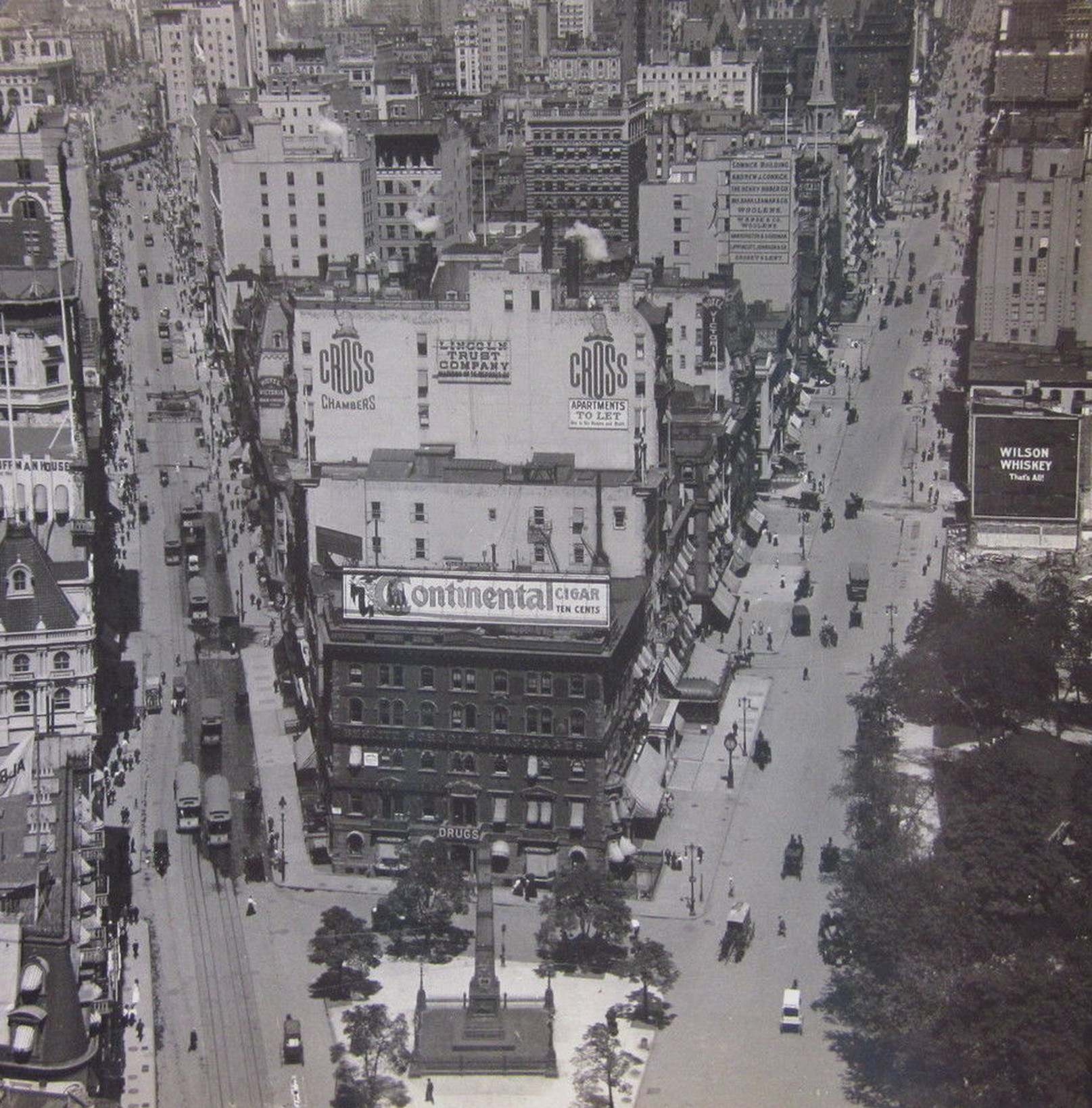
The Fuller Building known more commonly as the Flatiron Building sits at the convergence of Fifth Avenue and Broadway at 23rd Street. It is a great place to get a nice view of Manhattan, so the Keystone View Company sent a photographer to take this picture on a clear late summer day in 1904. This photo shows the two principal avenues of Manhattan splitting north after 24th street with Broadway branching off to the left and Fifth Avenue on the right.

The streets are busy with horsecars, trolleys and a few automobiles making their way up and downtown as all streets had traffic running both ways. Continue reading
“He Ruined My Wife.” The 109th Anniversary of The Crime Of The Century

Millionaire Harry K. Thaw Shoots Architect Stanford White At Madison Square Garden  June 25, 1906

The Beautiful Evelyn Nesbit Is At The Center Of It All

Evelyn Nesbit happy

In the annals of 20th century crime there are many cases that claim the title of the “crime of the century.” From the Lindbergh kidnapping case to the O.J Simpson saga, the public has always had an unquenchable thirst for following the media coverage of lurid crimes.

Madison Square Garden photo H.N. Tiemann

Madison Square Garden 1909 photo H.N. Tiemann

Harry Thaw’s murder of Stanford White at the roof garden theater of White’s creation, Madison Square Garden on June 25, 1906, was as big a story that has ever played out in the public eye. If it was not the “crime of the century,” it certainly qualifies for being in the top five.

A brief summary of the principal players in this drama and the events leading up to the murder goes like this.

In 1901, Stanford White, partner in the renowned architectural firm of McKim, Mead & White wants to meet artist’s model and showgirl Evelyn Nesbit, who is 16. White is known in certain circles for being a scoundrel and having many sexual affairs with actresses, models and other pretty girls. Stanford White photo Kings Notable New YorkersAfter meeting Nesbit under the approval of Evelyn’s mother, White becomes Evelyn’s benefactor over the course of several months paying for a multitude of things for Evelyn, her brother and mother. White arranges for Evelyn’s mother to take a trip back home to Pennsylvania while he promises to “look after Evelyn.” One night, while Evelyn’s mother is away and Evelyn is at White’s bachelor apartment, he plies Evelyn with liquor.  Evelyn passes out and White has his way with his virgin teen beauty. Evelyn wakes up in bed naked with White and is in shock after being raped. White begs Evelyn not to talk about what has happened. Continue reading

Old New York In Photos #47 – Before The Flatiron Building 1900

Before The Flatiron Building

The Intersection of 23rd Street Where 5th Avenue and Broadway Meet – 1900

23rd Street site of Flatiron Building c 1900 Photo Robert L BracklowThis view of 23rd Street at the intersection of Fifth Ave and Broadway was taken around 1900 by Robert Bracklow. The ornate street lamp and multitude of signs and advertising make this a great street level photograph. There is also something very interesting that I have rarely seen in any late 19th century photo of New York and that is another photographer taking a picture at the same time that this one was taken. He is directly to the left of the street lamp and the tripod is clearly visible while his head is under the covers to line up his shot.

From the approximate direction his camera is pointing, it looks like he is shooting straight up Broadway toward the Worth monument. I’d like to imagine that behind the camera is Joseph or Percy Byron of the famous New York Byron Company.

The famous Fuller Building, better known as the Flatiron went up in 1902 Continue reading

The Transforming New York City Skyline 1880-2009

Lower Manhattan’s Skyline Evolution

On March 21, 1909 The New York Sun newspaper published an illustration (reproduced below) that showed the rapid growth of the New York City skyline as seen from New Jersey in four line drawings from 1880 -1909.

Click to greatly enlarge this illustration.

We have added a photograph from approximately 100 years later showing the same view.

Transforming New York City skyline 1880-1909 The Sun March 21 1909new york skyline 2009  photo HiltonThe two constants are Trinity Church and St. Paul’s Chapel Continue reading