Tag Archives: 1900s

New Year’s Eve Celebrations Of The Past, New York City 1906

Festivities In New York City On New Year’s Eve 1906

A couple of years ago we featured photos of Times Square and New Year’s celebrations from the 1950’s – 1960’s. This time we went back in time a bit further to New Year’s Eve 1906.

Probably something you never thought about: where else did New Yorkers celebrate New Year’s besides Times Square, which started drawing crowds in 1904 with the completion of the New York Times Tower Building?

The answer is all over the city at various churches, hotels, restaurants and clubs, with Trinity Church being a focal point for large crowds.

Seen below is the crowd outside of Trinity Church at Broadway and Wall Street on New Year’s Eve 1906 awaiting the arrival of 1907.

New Year's Eve 1907 outside Trinity Church

It proves again that celebrating the New Year has not changed that much over the years. People have always liked to congregate on New Year’s Eve in New York City even in freezing weather. It’s just that back then the majority of celebrants were New Yorkers, unlike today where many revelers are visiting from all over the globe.

Here is how the New York Tribune described Continue reading

Old New York In Photos #45 – Broadway After Snowstorm 1905

New York City 1905 After A Big Snowstorm – The Sights Along Broadway Between 29th and 30th Streets Described

New York After a Big Snowstorm 1905 ph Detroit Photo Library of CongressSo far New York City has not had a major snowstorm this season like upstate New York received earlier this month. But I dream of New York City days gone by like this one shown above.

In this high resolution photograph (click to greatly enlarge) taken in 1905, the effects of a recent snowstorm can be seen as the snow has been shoveled high onto the edge of the street and sidewalk.

We are looking up Broadway from the northwest corner of 29th Street towards 30th Street. On the extreme left at 1209 Broadway is one of the many United Cigar Stores outlets, a chain store which dominated New York’s tobacco retail industry at the turn of the century. Next door at 1211 Broadway is Marcus & Marcus supplying men’s furnishings.

Across the street at 1204 Broadway an advertisement in the window at ground level announces that the entire stock in their window was purchased by The Maurice Company, a clothing company run by Maurice Rogaliner. The “Broadway Dentists” also had offices in the same building along with Sol Young, Photographer.

Next door to the Maurice Company is Shanley’s Restaurant, owned by brothers Tom and Michael Shanley.

Shanley’s was one of the most famous eateries of the late 19th and early 20th century in Manhattan. With three restaurants, this one at 1210-1212 Broadway was their second location which opened in 1896. As the restaurant guide Where And How To Dine In New York (Lewis, Scribner & Co; 1903) describes it:

Everybody in New York knows Shanley’s and almost everybody has dined at one or another of the three establishments conducted under this name. The management acknowledges but one purpose in the conduct of its restaurants — to make its guests absolutely comfortable and to persuade them that Shanley^s holds the recipe for good cheer. It has taken twelve years to develop the atmosphere which one finds in Shanley’s and during this time the extent of its business operations has been greatly enlarged.   The service at Shanley’s is entirely a la carte. The cuisine is proverbial for its excellence. Chops, steaks, lobsters, game, shell fish and kidneys are among the special attractions of the house.

Next to Shanley’s the building with the initials HB and the crown on its sign is the Hof Brau Haus Restaurant. Continue reading

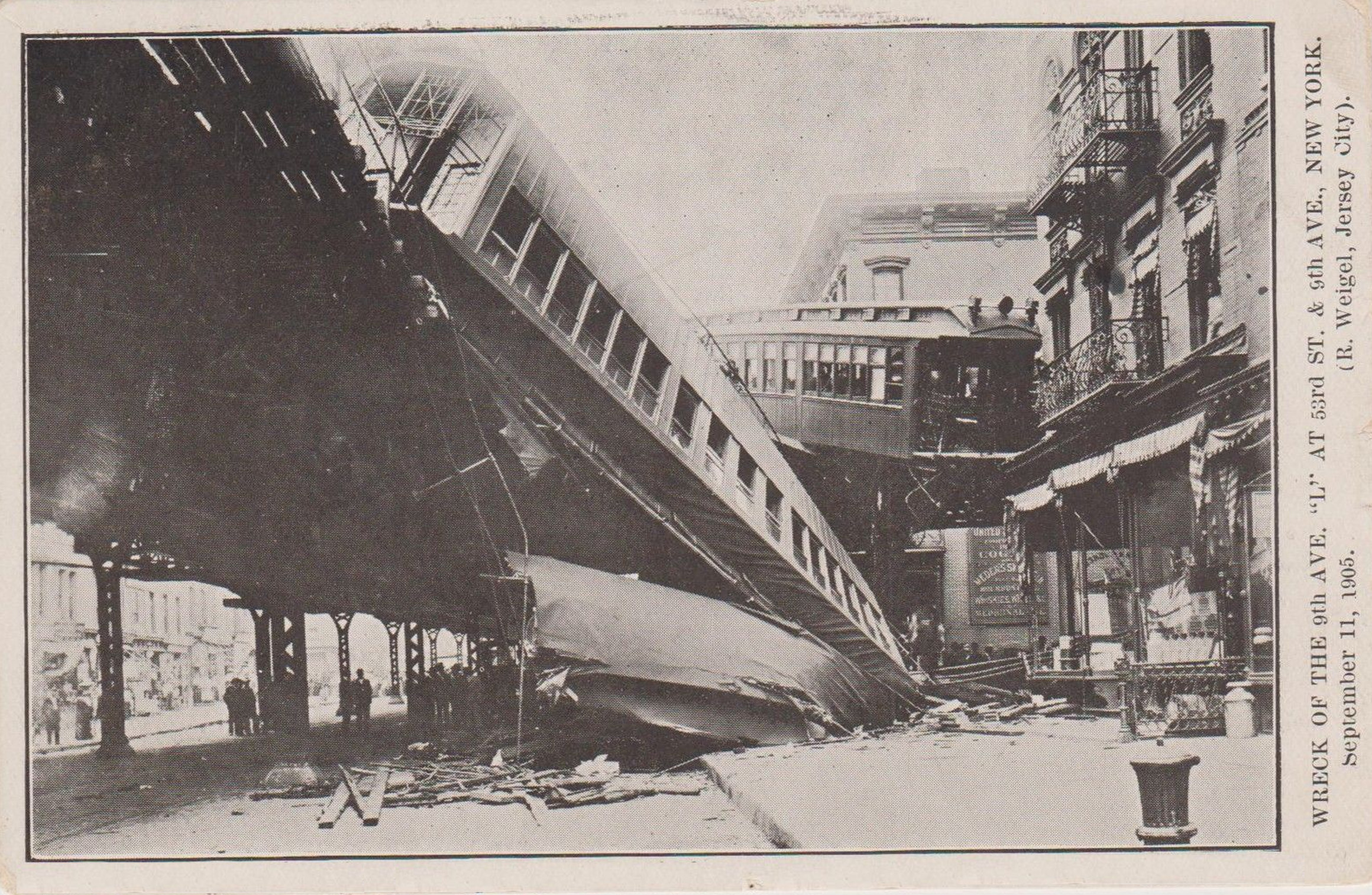
The Ninth Avenue Elevated Train Crash Of 1905

 In 1905, The Worst Elevated Train Accident In New York’s History Occurred

9th ave elevated railway accident 9 11 1905 postcard photo R Weigel

For as long as you live September 11 will be remembered as the date of  the terrorist attacks on America that brought down the World Trade Center towers. But before 2001,  9/11 marked the anniversary of the worst elevated train disaster in New York’s history. It is a disaster no one wanted to remember and was quickly forgotten except by train and New York history buffs.

The four elevated lines in Manhattan which had a glorious history are long gone, demolished between 1938 and 1955. The elevated lines began service in 1878 and until the subway was built, they provided the quickest and safest routes around New York.

9th Ave 53rd Street junction photo via - http://warofyesterday.blogspot.com

9th Ave 53rd Street elevated junction
photo via – http://warofyesterday.blogspot.com

But there were always fears among riders that one day an elevated train would jump the tracks.

Those fears came true on September 11, 1905.

Not surprisingly it happened at one of the more dangerous stretches of track along the elevated system.

The Sixth and Ninth Avenue Elevated lines shared their tracks above 53rd Street along Ninth Avenue. At 53rd Street the lines diverged, with the Sixth Avenue el traveling three avenues east along 53rd Street to continue its journey along Sixth Avenue.

At that Ninth Avenue junction, the towerman (also called switchman) was responsible for controlling whether trains traveling downtown would continue straight on the Ninth Avenue line or go along 53rd Street to the Sixth Avenue line.

The passengers aboard a five car “el” train that September 11 morning believed their train was going to continue straight down Ninth Avenue, as that was what the station guards at the previous station at 59th Street had told them.

If the train was proceeding down Sixth Avenue it was supposed to come to a full stop at 54th street and await a signal. The recommended maximum speed if a train was to continue down Ninth Avenue was nine miles per hour.

Diagram of Ninth Avenue El crash

Diagram of Ninth Avenue El crash (click to enlarge)

It was 7:05 in the morning as Paul Kelly, the motorman of the el train approached the intersection at 53rd street without stopping.

Witnesses said Kelly slowed down a bit but the train’s estimated speed was 25 miles per hour. Continue reading

While Touring With A Friend, A New Yorker Finds Her Missing Brother – 1905

Places A Tourist Should Go in 1905?

Bellevue And The Morgue.

1st Ave. 26th Bellevue Hospital postcard circa 1912

Visiting New York City today there are things that most tourists go and see. Typical touristy places include The Empire State Building, Times Square, The Statue of Liberty . A hundred years ago you might be surprised at what sights people would go and visit. In 1905 for one New Yorker, accompanying a visiting friend to Bellevue and visiting the morgue seemed like an interesting, if not macabre way to spend the day.

They say truth is stranger than fiction, so we’ll let The New York Evening World of September 11, 1905 pick up the rest of this strange story:

SAW PICTURE AT MORGUE OF DEAD BROTHER

Miss Magner, Showing a Friend the Sights, Identifies Photograph.

This isn’t a very big world since the railroad, the telegraph and the telephone annihilated distances, but here is the strange story of what happened at the points of a triangle with sides only a mile long.

On Feb. 26, 1904, the body of a young man was found on the doors of No. 269 Ninth Avenue, dead. No one knew him. At the morgue the body was photographed and a complete description taken. The breast and arms were tattooed with the form of a woman, the emblems of Faith, Hope and Charity and the initials “J.M.”

After a few days the unidentified body was burled In Potter’s Field, where it has lain for nineteen months. Last Saturday Miss Laura Magner, of No. 354 West Forty-sixth Street, who was entertaining a visiting friend from out-of-town, took him to see Bellevue Hospital and the Morgue.

Continue reading

The Craigslist Of Its Day – 1906

New York Times Lost And Found Simultaneous Classified Ads, Results In Diamond Brooch Being  Returned To Its Owner

diamond broochIf you look at old editions of newspapers from around the turn of the century you’ll notice the classified advertisements made up sometimes up to one quarter of the paper.

A typical weekday edition of the New York Times back then was only around twelve pages.

As such, people read newspapers from cover to cover and the classified’s acted as the craigslist of their day with all sorts of wanted ads: jobs and situations wanted, real estate and merchandise offerings and lost and found’s.

This story appeared in the January 26, 1906 New York Times:

HER LOST JEWEL RECOVERED

The Finder Took Mrs. Morgan’s Reward and Both Are Satisfied

Mrs. D.P. Morgan of 70 Park Avenue lost a jewel in a car on Sunday. She inserted the following advertisement in THE TIMES of Friday:

LOST- Sunday, Jan. 21, on 4th Av. car entered at 38th St, or in 47th St., between 4th and 6th Avs., circular brooch, size of a nickel, of 13 diamonds. If returned to 70 Park Av. $40 reward.

The same day this advertisement was brought to THE TIMES:

FOUND – In Madison Av. car, Sunday, one 13-stone diamond brooch, which will be, upon proper identification, returned to its owner for the reward of $100: make arrangements to receive same C.O.D. by express. T.X. Box 305 Times Square.

As the result of the publication of both advertisements “T.X.” has returned the jewel. He received the $40 reward and in addition the cost of his own advertisement in THE TIMES, and he is content. Mrs. Morgan is equally pleased.

“It is the first time that this brooch has been so speedily found,” said Mrs. Morgan yesterday. “It has been lost twice already . Perhaps because it had thirteen stones. I think I will either leave it at home in future or have a stone added or removed.”

Probably the most amazing thing about this article is that Mrs. Morgan lost the brooch twice previously and it was returned each time. She sounds rather cavalier about it, as if it is expected that if you lose something valuable in New York City, of course it will be returned to the rightful owner. Maybe the city was once like that, but I wouldn’t hold my breath waiting for it to happen today.

The second part of Mrs. Morgan’s solution to not losing the brooch in the future is also quite bizarre or extremely superstitious. How altering the brooch from thirteen diamonds to an even number of diamonds will prevent its future loss is baffling, as it is illogical.

The 1904 General Slocum Disaster Had Survivors That Lived Into The 21st Century

Catherine Connelly & Adella Wotherspoon, General Slocum Survivors, Lived To Ages 109 & 100

The Story of The General Slocum Steamship Disaster

General Slocum Disaster

June 15, 2014 marks the 110th anniversary of what had been New York’s biggest disaster and loss of life until the September 11 attacks occurred. We think it is worth remembering the ill-fated General Slocum steamship fire. Here is the story of the General Slocum and  a brief summary of the lives of the last two survivors of the disaster who amazingly lived into the 21st century.

A Beautiful Day For A Picnic

“Kleindeutchland,” as the area of Little Germany was called on the lower east side, was bounded approximately by the East River and Third Avenue and stretched from Houston Street to about 23rd Street. It was a working class, close-knit community of laborers and business owners. The German families that lived in this neighborhood made Tompkins Square Park their center for congregating and relaxation. But for special occasions they would embark on a trip to get out of the city.

Wednesday, June 15, 1904 was a sunny day and the members of the Sunday School of St. Mark’s Evangelical Lutheran Church at 323 E. 6th Street were looking forward to a day filled with games, music and a large picnic for their 17th annual excursion to bucolic Locust Grove, Long Island.

To get there, the church had chartered a steamship built in 1891, the three decked white paddle-wheeler, General Slocum.

Sudden Disaster

New York Tribune June 16, 1904 (click to enlarge)

New York Tribune June 16, 1904 (click to enlarge)

The General Slocum was filled with around 1,400 passengers, mostly women and children as the men generally had to work on a weekday. The Slocum headed out from its berth at 3rd Street on the East River at about 9:30 am with a band playing and the passengers joyously celebrating the smooth ride and beautiful weather.

Thirty minutes after setting out, the ship caught fire Continue reading

Old New York In Photos #36 – Grand Central 1909

Grand Central Station – 1909

Grand Central Terminal 1909 Acme

We are looking north on Park Avenue from 41st Street towards Grand Central Station. Grand Central became a “terminal” (end of the line) in 1913 with the completion of the current facility. When passengers disembarked they could hop on the elevated line shuttle which connected Grand Central at 42nd Street with the Third Avenue elevated or go on any one of the many trolley lines as seen in the photograph.

The caption for this 1960 AP News Features photograph showing Grand Central in 1909 says:

Once She Was A Lady

Grand Central Station in 1909 plainly was a bustling rail center – but nothing like what it is today. A $100 million skyscraper is going up on the venerable Park Avenue matron’s back, and the problem of building it reach deep under the terminal’s 48 acres. The new building will be finished in 1962.  Credit-  AP Newsfeatures 11-17-1960

The building the caption is referring to is the Pan Am Building (now known as the MetLife Building) at 200 Park Avenue designed by architects Emery Roth & Sons, Walter Gropius and Pietro Belluschi. Completed in 1962 and opened in 1963, the 59 story building remains an ugly boxy behemoth marring the New York City skyline.

The World’s First Fatal Plane Crash Could Have Killed The President – 1908

Orville Wright Of Wright Brothers Fame Piloted The First Fatal Airplane Crash

Orville Wright First Fatal Plane Crash

Orville Wright and Lieutenant Thomas Selfridge (right) being attended to after Wright’s airplane crashed at Fort Myer – September 17, 1908

Everyone knows that the Wright Brothers undertook the world’s first successful motorized airplane flight at Kitty Hawk, NC in 1903. What most people do not know is that five years later in 1908, Orville Wright was piloting a plane that crashed causing the first airplane fatality.

What even fewer people know is that the first fatality could easily have been President Theodore Roosevelt.

For several weeks beginning in September 1908, Orville Wright had been conducting test flights with the army at Fort Myer, a military post just outside of Washington D.C..

On September 14, it was reported that President Roosevelt had said he wanted to fly with Orville Wright on one of the upcoming test flights. Wright wisely demurred saying, “I have heard the report that President Roosevelt wants to ascend with me. I’m sorry, I don’t think the President of the United States should take such chances. Of course, flying in the air is as safe as riding in a streetcar, but there are accidents that might happen. Aside from my relatives, such an accident to me would mean nothing, but the Nation would be the sufferer if the President was injured or killed.”

Those who knew President Roosevelt said he would insist on flying with Wright when he returned to Washington D.C. from Oyster Bay, NY the following week. Fate would intervene in the President’s plans to fly with Wright.

Three days later on September 17, 1908 Orville Wright was at the controls flying with pilot Lt. Thomas Selfridge, who was Secretary of the Aerial Experiment Association. Continue reading

Old New York In Photos #35 – 1908 Snowstorm

Snow Removal In New York 1908

Looking south from Fourth Avenue & 15th Street on the east side of Union Square horse carts remove piles of snow - January 25, 1908 (photos LOC)

Looking south from 4th Avenue & 15th Street on the east side of Union Square horse carts remove piles of snow – January 25, 1908 (all photos Library of Congress)

While some people were complaining about the lack of snow removal in New York City this past week, it makes you realize how dependent we are on mechanized snowplows.

One hundred six years ago today, a major snowstorm similar to this past week’s storm, hit New York City on January 24, 1908 and dumped over ten inches of snow in New York and 35 mile per hour gusts of wind had some snowdrifts pile up from six to ten feet.

During the snowstorm near 9 East 14th Street - January 24, 1908

During the snowstorm by 9 E. 14th Street – January 24, 1908

The snow began the night of January 23 and continued until the afternoon of the 24th. The temperature never dipped below 22 degrees, but it was still miserable for commuters trying to get around town.

According to the New York Tribune, the Society for the Prevention of Cruelty to Animals sent men around to spread sand over the streets to prevent horses from falling. Unfortunately they only could get to a handful of spots and horses slipped and fell in heaps all over the city. The human toll from the storm was four deaths and thirteen injuries directly attributable to the severe weather.

The scene in front of Everett House 17th Street north side of Union Square January 25, 1908

The scene in front of Everett House 17th Street north side of Union Square January 25, 1908

All of the snow had to be removed by manual labor. And when the city put out notices that men were needed for temporary work to remove the snow with shovels, over 30,000 men applied.

Men shoveling snow in front of Everett House 17th Street north side of Union Square January 25, 1908

Men shoveling snow in front of Everett House 17th Street north side of Union Square January 25, 1908

At one recruiting station, the United Charities Building on East 3rd Street, 100 men were needed and 3,000 showed up. The police had to be called Continue reading