Category Archives: New York

Helen Keller And Al Smith 1929

New York State Commission For The Blind Christmas Fundraiser 1929

Helen Keller Al Smith 1929

This news photograph reads:

Helen Keller “Sees” And “Hears” Al Smith — World Famous Blind Deaf-Mute Meets Ex-Governor For First Time At Sale Benefiting The Blind

New York City – Photo Shows: Helen Keller, remarkable and world-famous blind deaf-mute “seeing” and “hearing”former Gov. Alfred E. Smith, who is greeting her with his famous smile and a word of cheer at the annual Christmas sale for the benefit of the New York State Commission for the Blind. Witnesses at the meeting of the famous people said that Miss Keller’s words could be understood. – December 19, 1929

Helen Keller was deaf and blind from infancy. She was born in Alabama on June 27, 1880.  Early in her childhood Miss Anne Sullivan was employed to instruct her, and so well succeeded that by means of touch she was able to communicate knowledge of the world that was closed to her understanding through the usual senses.

Helen Keller’s sense of touch was so acute that she was capable of understanding the speech of another merely by the placing of her fingertips upon their throat. Through the aid of Miss Sullivan, Keller became a highly educated young woman, earning a degree at Radcliffe College. She would go on to write 12 books and many magazine articles. She devoted her life advocating for people with disabilities.

Keller’s childhood story and that of her teacher Anne Sullivan, was told quite dramatically in the Broadway smash The Miracle Worker which ran for 719 performances from 1959-1961. The show won five Tony awards in 1960 including Best Actress in a Leading Performance for Anne Bancroft.  The1962 movie version featured the Broadway stars reprising their roles; Patty Duke as Helen Keller and Anne Bancroft as Anne Sullivan. Each won an Academy Award for their performances; Bancroft for Best Actress and Duke for Best Supporting Actress.

Alfred E. Smith was born December 30, 1873 on the lower east side of New York. He was elected Governor of New York, 1919-1920 and again from 1923-1928. In 1928 he became the first Roman Catholic to run for President and was defeated soundly by Herbert Hoover.  After the election Smith became president of Empire State, Inc. the firm that built the Empire State Building.

Al Smith died on October 4, 1944. Helen Keller passed away June 1, 1968.

Old New York In Photos #24 – Fort Tryon

Fort Tryon Hill As Seen From Fort George Hill

Fort Tryon Hill

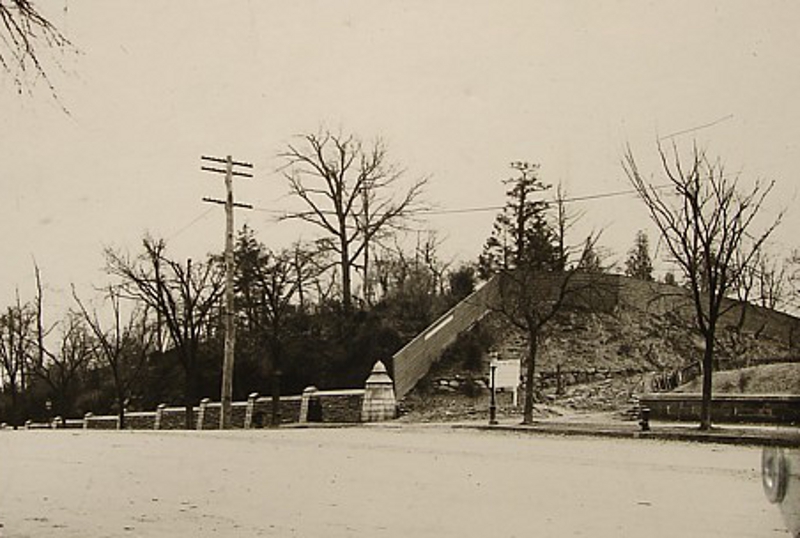
The northern area of Manhattan: Washington Heights, Inwood and Fort Tryon were among the last areas of the island to be developed. Much of the area remained somewhat rural until the early 20th century as evidenced in this undated photograph.

The area of Fort George Hill was at the time of the Revolution called Laurel Hill. Upon it the British constructed an extensive fortification called Fort George. The Fort was located at what would today be 192nd Street and Audubon Avenue. The neighborhood that sprung up around this area was given the name of Fort George Hill.

Fort Tryon Hill was one of the last portions of Manhattan to pass from Indian ownership to the possession of the Dutch. The aboriginal owners were the Wickquaskeek corrupted to Wickers Creek Indians.

Fort Tryon Map Showing Land Ownership and Parcels

Fort Tryon Map Showing Land Ownership and Parcels

Fort Tryon was named by the British for Major General William Tryon (1729–1788), the last British governor of colonial New York. Fort Tryon was part of a series of posts running along the Hudson River during the revolutionary war.

Between 1901 and 1904 Cornelius Kingsley Garrison Billings acquired several property lots from many different owners around Fort Tryon Hill. Billings had begun assembling an estate that culminated in a stately mansion being built which was completed in 1907. The mansion can be seen on the right hand side of the photograph. Billings sold the mansion in 1916 to John D. Rockefeller. In 1917 Rockefeller donated the Billings estate and surrounding properties which he had acquired to New York City and the area was turned into Fort Tryon Park. The mansion was destroyed by fire in 1926.

First Pneumatic Mail Delivery In New York 1897

The Pneumatic Mail Tubes And The “Age of Speed”

Pneumatic Tubes Produce Exchange Post Office 1897

Reading Howard Wallace Connelly’s highly entertaining 1931 autobiography Fifty-Six Years In The New York Post Office–  A Human Interest Story of Real Happenings in the Postal Service (self-published) the following anecdote begins Chapter VI:

When the pneumatic tubes were installed at the General Post Office, October 7, 1897, we Supervisors were given a fine treat after the ceremonies were over. A rough hastily constructed row of steps (circus show style) had been erected facing the tubes. Senator Chauncey M. Depew was Master of Ceremonies. Probably over a hundred friends and Post Office officials were spectators. The first tube contained only a large artificial peach. The roar of laughter that greeted it was heartily joined by the Senator. A Bowery audience that had attended a political meeting at which he was the principal speaker, instead of trying to break up the show, took quite a liking to the speaker and a loud voiced man yelled, “Chauncey, you’re a peach.” Hence the laugh when the first tube arrived. From the second tube, a cat was taken. How it could live after being shot at terrific speed from Station P in the Produce Exchange Building, making several turns before reaching Broadway and Park Row, I cannot conceive, but it did. It seemed to be dazed for a minute or two but started to run and was quickly secured and placed in a basket that had been provided for that purpose.  A suit of clothes was the third arrival and then came letters, papers, and other ordinary mail matter.

Hah-ha very funny. The postal officials must have had a ball putting a cat into the tubes. Can you imagine the public outcry if something like that was done now?

Connelly omits that the first parcel actually sent through the tubes was sent by Depew to the Produce Exchange Post Office which included Continue reading

New Yorker’s Starved For News -1953 The End Of The Strike

Newspaper Strike Ends December 8, 1953

Photo UPI

Beginning November 28, 1953, six of New York’s seven daily newspapers went on strike. 400 photo engravers demanded better pay and working conditions and the other newspaper employees honored their picket lines. For eleven days New York City had only one newspaper available to them, The New York Herald Tribune. Because the Herald Tribune had an outside commercial firm doing their photo engraving, they were the beneficiaries of added readership. Continue reading

All New York City Sidewalks Are Not Created Equal

What Is The Width Of The Sidewalks In Manhattan?

Following up on our November 19, story, All New York City Streets Are Not Created Equal, the 1904 World Almanac has a list of the width of Manhattan’s sidewalks. The chart can provide the answer to which avenue has wider sidewalks Fifth Avenue or Lenox Avenue? While this may not be a burning question on anyone’s mind, it is interesting to see how much the sidewalk width varies from street to street and avenue to avenue.  The obvious differences are plainly apparent to any New Yorker walking the streets so we thought it would be worth it to reproduce this list with the actual measurements.

Width of Sidewalks in Manhattan Borough

In streets 40 feet wide 10 ft.
In streets 50 feet wide 13 ft.
In streets 60 feet wide 15 ft.
In streets 70 feet wide 18 ft.
In streets 80 feet wide 19 ft.
In streets above 80 feet, not exceeding 100 feet. 20 ft.
All streets more than 100 feet 22 ft.
 
Lenox and 7th Avenues, north of W. 110th St 35 ft.
Grand Boulevard (Broadway above 59th Street) 24 ft.
Manhattan St. 15 ft.
Lexington Avenue 18 ft. 6 in.
Madison Avenue 19 ft.
5th Avenue 30 ft.
St. Nicholas Avenue 22 ft.
Park Avenue from E. 49th to E. 56th St. and from E. 96th St. to Harlem River 15 ft.
West End Avenue 30 ft.
Central Park West, from W, 59th St. to W. 110th, East side 27 ft.
Central Park West, from W. 59th St. to W. 110th, West side 35 ft. 6in.

How many of these sidewalk measurements remained the same throughout the 20th century is open to conjecture. I would imagine that many sidewalks have had their original dimensions changed due to the high value of Manhattan real estate.

click to enlarge

This photograph, taken November 10, 1914 at the corner of Fifth Avenue and 59th Street looking south, has a clear view of the sidewalk. The men near the carriage are standing in front of the Hotel Savoy (built 1892 – demolished 1927). On the right at 58th Street is the Cornelius Vanderbilt II mansion (built 1893 – demolished 1926).  It does not appear that the sidewalk is actually 30 feet wide.

How The Super Wealthy Woman Of 1903 Lived

“Free To Indulge Her Whims and Fads In Whatever Way The Gay World Of Society, And Her Own Inclination, May Lead Or Tempt Her”

Let’s say you are the wife of a turn of the century financier. How do you run your household and spend your time and money? Is there no one to teach you except your family or contemporary one percenters?

Fortunately there was a book written just for the rare woman who needed such advice.

The book which could now be slightly updated and reprinted for today’s super wealthy billionaires is called, Millionaire Households and Their Domestic Economy With Hints Upon Fine Living by Mary Elizabeth Carter published by D. Appleton & Company 1903.

Miss Carter was not a society lady, but had managed a house for the wealthy Vanderbilt family.

With chapters such as Fine Living or Housekeeping; The Hostess’s Wardrobe; The Lady’s-Maid; The House-Maid; The Parlor-Maid; The Servant’s Dining Hall-Maid; The Butler and His Staff; The Valet; Monsieur Le Chef and His Aids; Side-Lights and Shifting Scenes When The “Smart Set” Dine; the book has everything you would need to know as the grande dame running an American version of Downton Abbey.

We learn from Miss Carter that a butler is more than just a servant. She writes, “When the ubiquitous newspaper reporter appears the butler knows how to get rid of him with as little information imparted as will spare the family from false statements or ridicule. During these interviews he requires his entire stock of aplomb. He must withhold all information possible, while appearing to give it out freely.”

This book was not for the 1% that we hear so much about today. In 1903, Millionaire Households and Their Domestic Economy would apply to only o.oo5% of Americans, since there were about 4,000 millionaires out of 80 million people living in the United States at the turn of the century. Approximately half of those millionaires resided in New York State. It is safe to say this book probably did not sell very many copies. It is also important to remember how much a million dollars was back in 1903. One would need to have about twenty million dollars today to have the purchasing power of a millionaire in 1900.

Comparatively today, globally there are about 10 million people (exclusive of their home) with a net worth  of one million dollars or more and approximately 3.1 million of them reside in North America.

The book gives a complete view into the way the millionairess should conduct her household. While the advice the book offers might seem frivolous and somewhat outrageous to read today, Continue reading

All New York City Streets Are Not Created Equal

The Distances Between Streets & Avenues – Things You Probably Didn’t Know

If you are traveling at the same pace, regardless of the avenue, it is faster to walk between 6th and 7th Streets than walking from 13th to 14th Streets. Why? Because the block between 6th and 7th is only 181 feet, 9 inches while the block between 13th and 14th is 206 feet, 6 inches.

Anyone walking around Manhattan is sure to notice that street distances between blocks and avenues vary widely. But few know that the block lengths can vary by several feet.

When the grid plan for Manhattan’s streets were laid out, you’d think that the streets would be equidistant. They are not.

Maybe this is the sort of thing that almost no one would care about, but living up to this web site’s name, I found this chart very interesting. It is from the New York Bureau of Buildings in the 1892 edition of The World Almanac.

1892 World Almanac (click to enlarge)

As you see, the chart lists the distances between the avenues, the width of the avenues and streets and the length of blocks north of Houston Street.

There are a few interesting things to note. One is how far Avenues A, B, C and D extended northward in 1892. Avenue A was later renamed Sutton Place north from 53rd Street and York Avenue north from 59th Street. Avenue B was renamed East End Avenue from 79th to 90th Street. Many portions of Avenue A, B, C and D were never completed (the landfill required to extend them was never done), or wiped out with map changes and construction in the 20th century (e.g. The Franklin D. Roosevelt Drive). Regardless, the almanac still lists the proposed dimensions for the phantom avenues via the Bureau of Buildings.

The other thing to note is that the main cross streets of 14th, 23rd, 34th etc. are all the same: 100 feet wide as compared to the other streets which are all 60 feet wide.

I have used the modern names of avenues in parentheses. Below are some highlights of the chart.

Avenues in Manhattan are 100 feet wide with some notable exceptions:

Lexington Avenue – 75 feet

Boulevard (Broadway) above 59th Street – 150 feet

Madison Avenue South of 42nd Street – 75 feet

Madison Avenue North of 42nd Street – 80 feet

Madison Avenue From 120th to 124th Streets – 100 feet Continue reading

Miss Pigtail Contest – New York 1955

Childhood Innocence In A Unusual Contest

Chester Bugello age 7, borrows Maureen Albanese’s pigtail at the Miss Pigtail contest held at the Sullivan Street Children’s Center, New York City, July 8, 1955.

The look on Maureen’s face is priceless.

There were no “classy” contests like Toddler’s and Tiaras in the 1950’s. Whatever became of Chester and Maureen?

From our reader (comment below) – Margaret Mangiero Campbell winner in 1962 of the longest pigtail (year based on the crown worn by 5-year-old Michelle Paolercio.)

Classic Hollywood #18 – James Cagney At Grand Central Terminal

James Cagney Grabs Lunch At Grand Central

In the days before air travel became popular, almost everyone took the train to get around the United States.  On February 6, 1945 before boarding the Twentieth Century Limited for Chicago, James Cagney stopped in at a restaurant at Grand Central Terminal for a bite to eat. It appears he was enjoying a cup of coffee and a danish. Then he glanced up to see a photographer snapping this picture.

The difference between the “old days” and today is that movie stars of the golden years were not hounded by what has come to be known as the paparazzi – ruthless parasites, who violate every modicum of human decency. Yes, the old newspapers and magazines would send their  photographers out to capture celebrities and news events. But there was a mutual quid pro quo back then, even if the celebrities dd not enjoy the attention, they knew the press generally helped their careers and would accommodate them. The press also kept somewhat of a respectful distance. Those days are long gone.