Category Archives: New York

All New York City Sidewalks Are Not Created Equal

What Is The Width Of The Sidewalks In Manhattan?

Following up on our November 19, story, All New York City Streets Are Not Created Equal, the 1904 World Almanac has a list of the width of Manhattan’s sidewalks. The chart can provide the answer to which avenue has wider sidewalks Fifth Avenue or Lenox Avenue? While this may not be a burning question on anyone’s mind, it is interesting to see how much the sidewalk width varies from street to street and avenue to avenue.  The obvious differences are plainly apparent to any New Yorker walking the streets so we thought it would be worth it to reproduce this list with the actual measurements.

Width of Sidewalks in Manhattan Borough

In streets 40 feet wide 10 ft.
In streets 50 feet wide 13 ft.
In streets 60 feet wide 15 ft.
In streets 70 feet wide 18 ft.
In streets 80 feet wide 19 ft.
In streets above 80 feet, not exceeding 100 feet. 20 ft.
All streets more than 100 feet 22 ft.
 
Lenox and 7th Avenues, north of W. 110th St 35 ft.
Grand Boulevard (Broadway above 59th Street) 24 ft.
Manhattan St. 15 ft.
Lexington Avenue 18 ft. 6 in.
Madison Avenue 19 ft.
5th Avenue 30 ft.
St. Nicholas Avenue 22 ft.
Park Avenue from E. 49th to E. 56th St. and from E. 96th St. to Harlem River 15 ft.
West End Avenue 30 ft.
Central Park West, from W, 59th St. to W. 110th, East side 27 ft.
Central Park West, from W. 59th St. to W. 110th, West side 35 ft. 6in.

How many of these sidewalk measurements remained the same throughout the 20th century is open to conjecture. I would imagine that many sidewalks have had their original dimensions changed due to the high value of Manhattan real estate.

click to enlarge

This photograph, taken November 10, 1914 at the corner of Fifth Avenue and 59th Street looking south, has a clear view of the sidewalk. The men near the carriage are standing in front of the Hotel Savoy (built 1892 – demolished 1927). On the right at 58th Street is the Cornelius Vanderbilt II mansion (built 1893 – demolished 1926).  It does not appear that the sidewalk is actually 30 feet wide.

How The Super Wealthy Woman Of 1903 Lived

“Free To Indulge Her Whims and Fads In Whatever Way The Gay World Of Society, And Her Own Inclination, May Lead Or Tempt Her”

Let’s say you are the wife of a turn of the century financier. How do you run your household and spend your time and money? Is there no one to teach you except your family or contemporary one percenters?

Fortunately there was a book written just for the rare woman who needed such advice.

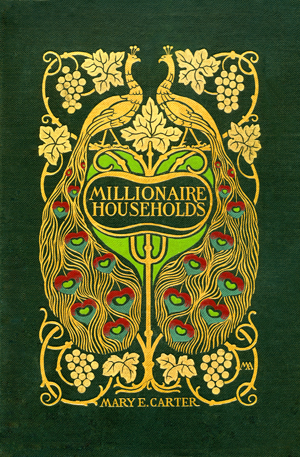
The book which could now be slightly updated and reprinted for today’s super wealthy billionaires is called, Millionaire Households and Their Domestic Economy With Hints Upon Fine Living by Mary Elizabeth Carter published by D. Appleton & Company 1903.

Miss Carter was not a society lady, but had managed a house for the wealthy Vanderbilt family.

With chapters such as Fine Living or Housekeeping; The Hostess’s Wardrobe; The Lady’s-Maid; The House-Maid; The Parlor-Maid; The Servant’s Dining Hall-Maid; The Butler and His Staff; The Valet; Monsieur Le Chef and His Aids; Side-Lights and Shifting Scenes When The “Smart Set” Dine; the book has everything you would need to know as the grande dame running an American version of Downton Abbey.

We learn from Miss Carter that a butler is more than just a servant. She writes, “When the ubiquitous newspaper reporter appears the butler knows how to get rid of him with as little information imparted as will spare the family from false statements or ridicule. During these interviews he requires his entire stock of aplomb. He must withhold all information possible, while appearing to give it out freely.”

This book was not for the 1% that we hear so much about today. In 1903, Millionaire Households and Their Domestic Economy would apply to only o.oo5% of Americans, since there were about 4,000 millionaires out of 80 million people living in the United States at the turn of the century. Approximately half of those millionaires resided in New York State. It is safe to say this book probably did not sell very many copies. It is also important to remember how much a million dollars was back in 1903. One would need to have about twenty million dollars today to have the purchasing power of a millionaire in 1900.

Comparatively today, globally there are about 10 million people (exclusive of their home) with a net worth  of one million dollars or more and approximately 3.1 million of them reside in North America.

The book gives a complete view into the way the millionairess should conduct her household. While the advice the book offers might seem frivolous and somewhat outrageous to read today, Continue reading

All New York City Streets Are Not Created Equal

The Distances Between Streets & Avenues – Things You Probably Didn’t Know

If you are traveling at the same pace, regardless of the avenue, it is faster to walk between 6th and 7th Streets than walking from 13th to 14th Streets. Why? Because the block between 6th and 7th is only 181 feet, 9 inches while the block between 13th and 14th is 206 feet, 6 inches.

Anyone walking around Manhattan is sure to notice that street distances between blocks and avenues vary widely. But few know that the block lengths can vary by several feet.

When the grid plan for Manhattan’s streets were laid out, you’d think that the streets would be equidistant. They are not.

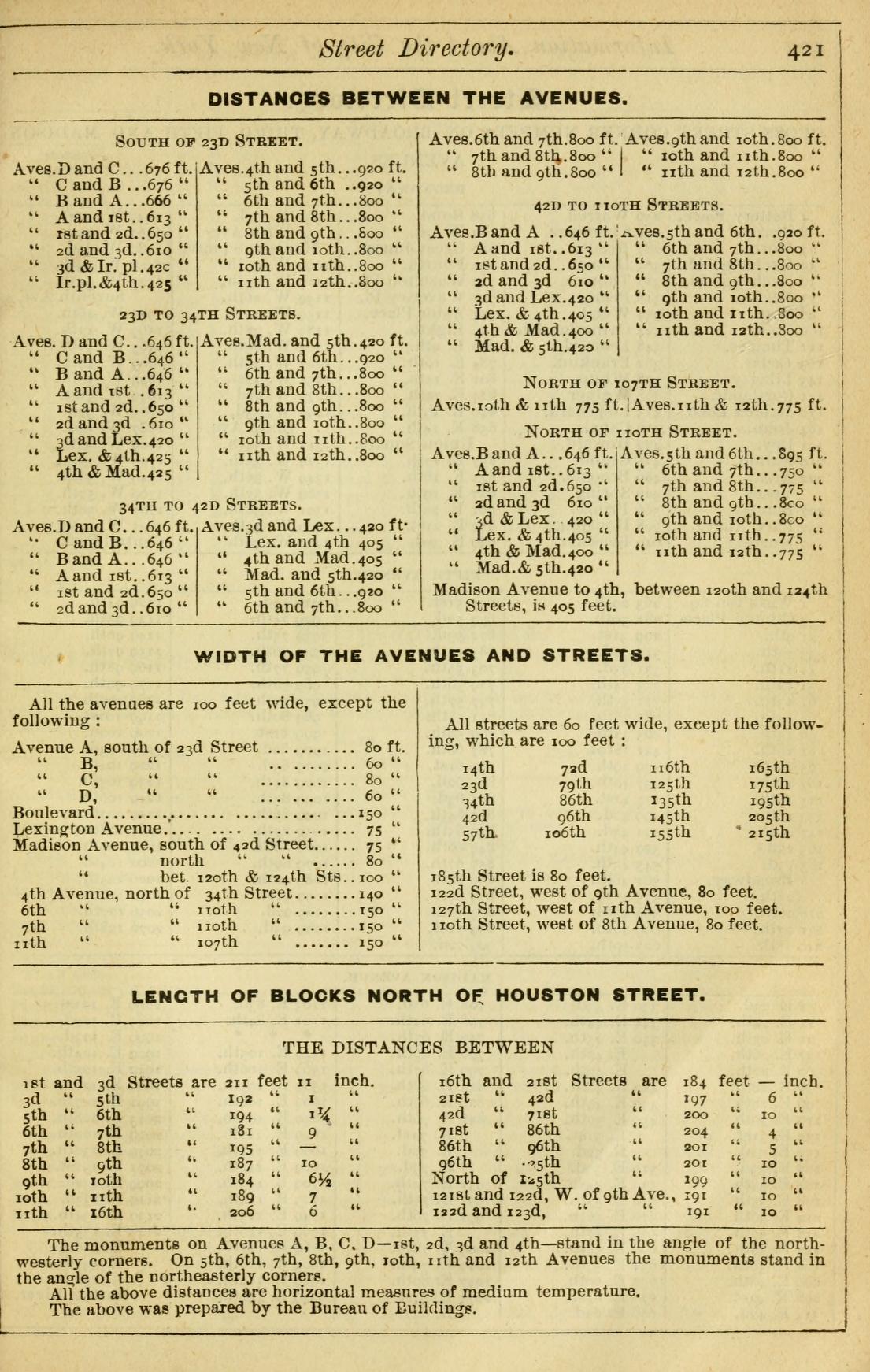
Maybe this is the sort of thing that almost no one would care about, but living up to this web site’s name, I found this chart very interesting. It is from the New York Bureau of Buildings in the 1892 edition of The World Almanac.

1892 World Almanac (click to enlarge)

As you see, the chart lists the distances between the avenues, the width of the avenues and streets and the length of blocks north of Houston Street.

There are a few interesting things to note. One is how far Avenues A, B, C and D extended northward in 1892. Avenue A was later renamed Sutton Place north from 53rd Street and York Avenue north from 59th Street. Avenue B was renamed East End Avenue from 79th to 90th Street. Many portions of Avenue A, B, C and D were never completed (the landfill required to extend them was never done), or wiped out with map changes and construction in the 20th century (e.g. The Franklin D. Roosevelt Drive). Regardless, the almanac still lists the proposed dimensions for the phantom avenues via the Bureau of Buildings.

The other thing to note is that the main cross streets of 14th, 23rd, 34th etc. are all the same: 100 feet wide as compared to the other streets which are all 60 feet wide.

I have used the modern names of avenues in parentheses. Below are some highlights of the chart.

Avenues in Manhattan are 100 feet wide with some notable exceptions:

Lexington Avenue – 75 feet

Boulevard (Broadway) above 59th Street – 150 feet

Madison Avenue South of 42nd Street – 75 feet

Madison Avenue North of 42nd Street – 80 feet

Madison Avenue From 120th to 124th Streets – 100 feet Continue reading

Miss Pigtail Contest – New York 1955

Childhood Innocence In A Unusual Contest

Chester Bugello age 7, borrows Maureen Albanese’s pigtail at the Miss Pigtail contest held at the Sullivan Street Children’s Center, New York City, July 8, 1955.

The look on Maureen’s face is priceless.

There were no “classy” contests like Toddler’s and Tiaras in the 1950’s. Whatever became of Chester and Maureen?

From our reader (comment below) – Margaret Mangiero Campbell winner in 1962 of the longest pigtail (year based on the crown worn by 5-year-old Michelle Paolercio.)

Classic Hollywood #18 – James Cagney At Grand Central Terminal

James Cagney Grabs Lunch At Grand Central

In the days before air travel became popular, almost everyone took the train to get around the United States.  On February 6, 1945 before boarding the Twentieth Century Limited for Chicago, James Cagney stopped in at a restaurant at Grand Central Terminal for a bite to eat. It appears he was enjoying a cup of coffee and a danish. Then he glanced up to see a photographer snapping this picture.

The difference between the “old days” and today is that movie stars of the golden years were not hounded by what has come to be known as the paparazzi – ruthless parasites, who violate every modicum of human decency. Yes, the old newspapers and magazines would send their  photographers out to capture celebrities and news events. But there was a mutual quid pro quo back then, even if the celebrities dd not enjoy the attention, they knew the press generally helped their careers and would accommodate them. The press also kept somewhat of a respectful distance. Those days are long gone.

What It Was Like Riding A Turn Of The Century New York Stagecoach

New York Transportation In The Early 1900’s

Hamilton Fish Armstrong was the longtime editor of the magazine Foreign Affairs. His charming memoir, Those Days published in 1963 by Harper and Row is a wonderfully evocative description of an upper middle class boyhood spent in New York City, the Hudson Valley and Quebec. The book’s dust jacket description states that it is: “A lively, spontaneous re-creation of the childhood of a famous editor and writer at the turn of the century – an unforgettable picture of a vanished New York.”

It’s one of those out of print, forgotten books that deserve to be read by a new generation. I highly recommend it.

Here is an excerpt from pages 68-69 where Armstrong describes getting uptown to school from his home on 10th street via the Fifth Avenue coach which was pulled by horses.

When I was nine the time came for me to go to a “real” school uptown, and unless it was pouring pouring rain or snowing I went of course, on skates. When the weather ruled this out I used the Fifth Avenue stage or the Sixth Avenue El.

On the stage I rode by choice  on the outside, either perched up behind the driver or, if I was lucky, along side him. Continue reading

Old New York In Photos #23 – Subway Excavation Along Broadway & 49th St. 1901

Subway Excavation, Broadway and 49th Street – 1901

While the MTA is currently striving to build the new Second Avenue subway without disturbing businesses along the route, the Interborough Rapid Transit Company (IRT) had no such compunction about hampering businesses as demonstrated by this photograph taken on November 26, 1901.

We are looking north along Broadway towards 49th Street. The J.B. Brewster Carriage Continue reading

The Day Brooklyn Will Never Forget – October 4, 1955 The Brooklyn Dodgers Become World Champions

Johnny Podres Shuts Out The Yankees to Win Game 7 of The 1955 World Series

Cover Daily News Oct 5 1955

The Brooklyn Dodgers had appeared in seven World Series previous to 1955. They had lost all of them. But on Tuesday, October 4, 1955, a magical afternoon (yes the World Series was always played in the daytime until 1971) occurred at Yankee Stadium in front of 62,485 fans. Amazingly the game was not sold out.

Johnny Podres, after winning game three of the World Series, was matched up in game seven against Yankee veteran Tommy Byrne. An interesting side note: Byrne rode the IND subway from 59th Street to Yankee Stadium unrecognized by anyone. Podres ended up pitching the game of his life – an eight hit, 2-0 shutout. The Dodgers had finally vanquished the Yankees who had beaten them in five previous World Series.

The Dodgers played without Jackie Robinson who was nursing a strained Achilles tendon. And the Yankees were equally handicapped without Mickey Mantle, who, even though he pinch hit in this game, missed most of the Series with a torn leg muscle. Other Yankees and Dodgers stars like Duke Snider and Hank Bauer played despite being injured.

First pitch of Game 7, 1955 World Series Yankee Stadium. Tommy Byrne throws a strike past Jim Gilliam

The Dodgers scored one run in the fourth when Roy Campanella doubled and a single by Gil Hodges drove him home. The Dodgers added a run in the sixth with Hodges hitting a sacrifice fly to drive in Pee Wee Reese.

Sandy Amoros Catch 10 4 55

The acknowledged defensive play of the game was made by Dodgers left fielder Sandy Amoros.

Continue reading