Category Archives: New York

Vintage 1978 Yankees Schedule Including Ticket Prices And Other Surprises

A Nostalgic Look At The 1978 Yankees Schedule Handout

Yankee Schedule 78 Seating

click to enlarge

I attended about 25 games in 1978 at Yankee Stadium. I was a young lad with a minimal allowance. So how could I afford it? Mostly I would buy general admission tickets. The cost, $2.50.

When I would splurge, about six times a year, I could buy a box seat for $6.50. Anywhere in the stadium. Field box, mezzanine, upper box, it didn’t matter, they were all available.

The Yankees drew over 50,000 fans 13 times during the year. Seven of the large crowd games were against the Red Sox. The average home attendance for the season was only 28,838.

I pulled this tri-fold schedule from my collection. The ticket prices are displayed below: Box Seats $6.50; Reserved Seats $5.00; General Admission $2.50 and Bleacher Seats $1.50.

click to enlarge

click to enlarge

There are several other things to notice here. First the schedule itself. Continue reading →

Old New York In Photos #29 – Times Square In Vintage Color Photographs

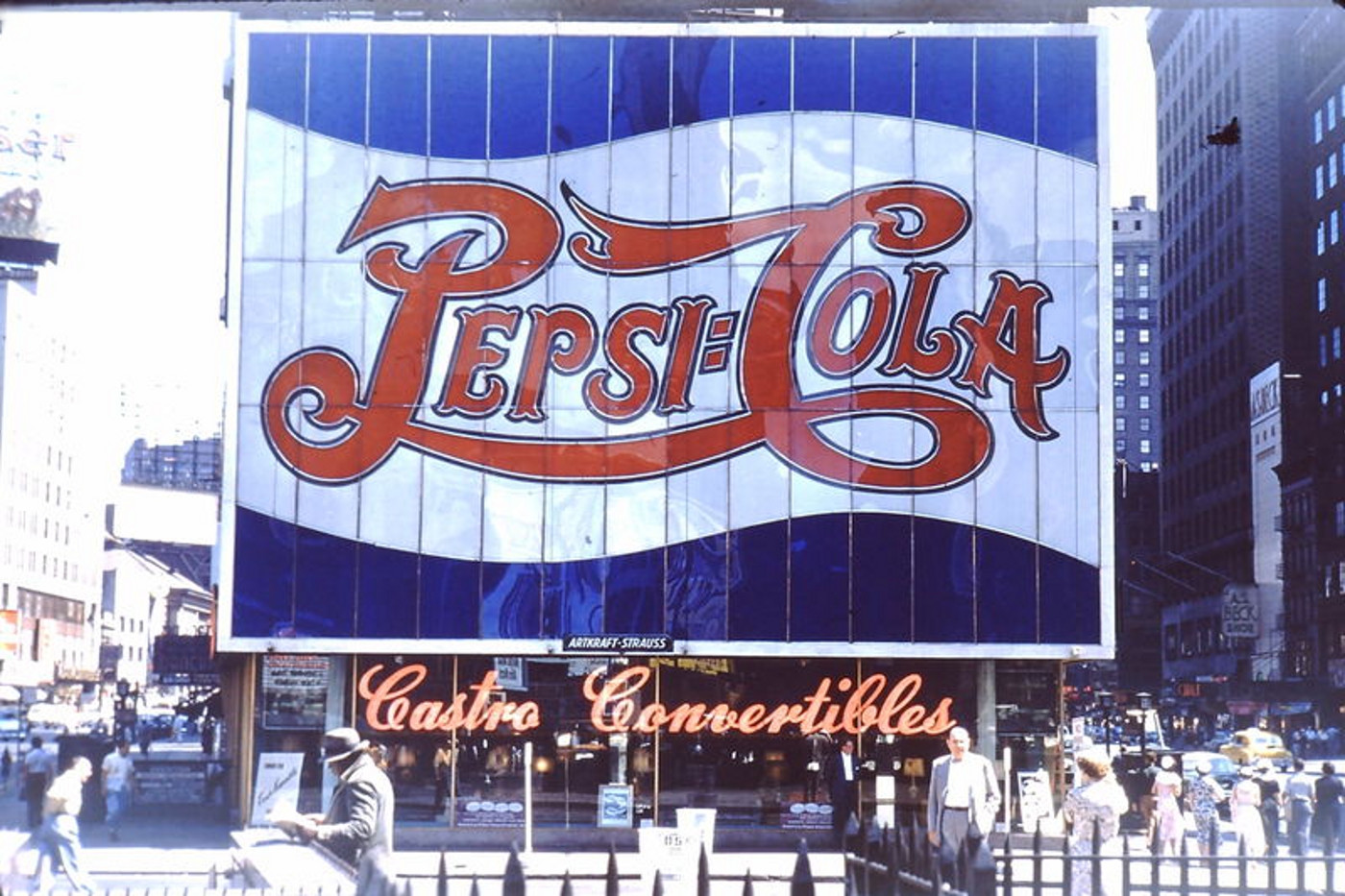
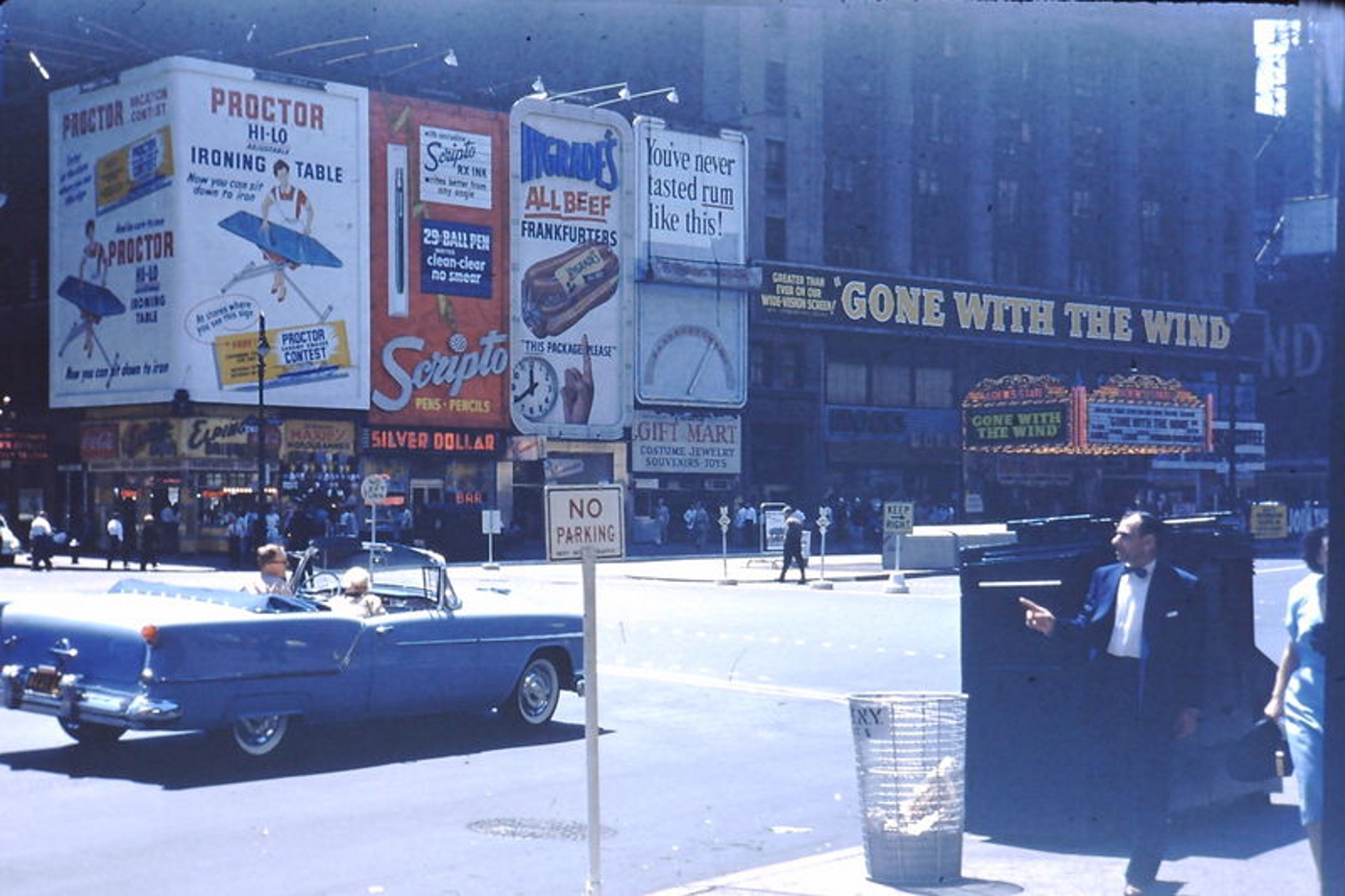
Advertisements & Scenes of Times Square In Vintage Color Photographs 1954

Times Sq 7 1954

It’s been almost 60 years since these photographs were taken by an anonymous amateur photographer who was interested in the signage, ads and the streets surrounding a vibrant, now vanished Times Square.

The city began sterilizing all the flavor from the crossroads of the world in the late 1980’s. It was a few years later that most New Yorker’s began noticing the mall-ification of Times Square. True, Times Square had denigrated into a rather sleazy place from the mid-1960’s until the “revitalization” took place. But what has it become?

For anyone who lived through Times Square’s final heyday in the 1950’s, today the place must seem extremely distasteful with its countless tourist barkers, ill-planned pedestrian plazas and glass monolith buildings sheathed in gaudy LED light ads. It’s overcrowded with people moving slowly, chain stores, costumed kitsch characters and modern day hucksters hawking their products to tourists for a “real New York experience.” Give me the days of three card monte games and prostitutes over eight people wandering around in Mickey Mouse costumes any day.

As Nik Cohn said in 1997, ‘Times Square has always changed every 20 years. But this time it’s changed to a corporate, generic American city that doesn’t particularly express the uniqueness of New York.”

Times Sq  looking southeast 1954But let’s go back in time to 1954 when it was a better time for Times Square. Legitimate theatre was still great, movies offered up Cinemascope entertainment and real Broadway characters (not criminals and freaks) roamed the streets.

Enjoy these Kodachrome views of what you would have seen looking around Times Square on a sunny, warm July day in 1954.

Minimal commentary has been added for identification purposes. Click any photo to enlarge.

Times Sq 6 1954Times Square looking south from 46th Street. Shown are: Times Tower Building, Bishop’s Crook Light, Hotel Astor with The Astor Roof Garden, Victoria Theater showing About Mrs. Leslie starring Shirley Booth and Robert Ryan, on the extreme left a portion of the statue for the giant block long Bond Clothes advertisement.

Times Sq 1954 1Looking west from Broadway and Seventh Avenue along 45th Street. Shown are: the Astor Theater with a large billboard for Indiscretion of an American Wife starring Jennifer Jones and Montgomery Clift, and Rodgers and Hammerstein’s musicals Me and Juliet  and The King and I, and the 26 story Hotel Piccadilly at 227 West 45th Street. Continue reading →

Beauties Of The Past – Annabelle Whitford

Annabelle Whitford Moore Buchan And The Original “Gibson Girl”

Gibson Girl Annabelle Moore Whitford Buchan Follies 1908

The epitome of feminine beauty at the turn of the century was captured in artist Charles Dana Gibson’s skillful drawings of women, that came to be known as “Gibson Girls.”

Gibson Girl Social Ladder 0040

Annabelle Whitford was 15 years old when she achieved notoriety dancing at the Columbian World Exposition in Chicago in 1893. Annabelle appeared in movies performing her dances under the name Annabelle Moore from 1896 -1902. She went onto a successful stage career hitting the top as a star in the Ziegfeld Follies of 1908 playing one of the “Nell Brinkley Girls.” Brinkley (September 5, 1886 – October 21, 1944) was a female newspaper artist whose creations were very similar to the Gibson Girls. In 1910 Annabelle married Dr. Edward James Buchan and retired from performing.

Gibson Girl Annabelle Moore Whitford Buchan Nell Brinkley Girls Follies 1908

In her obituary in the New York Times it was said Annabelle “was the symbol of beauty in her day. She was billed as ‘the original Gibson Girl’ because of her striking resemblance to the Charles Dana Gibson portrait.” The illustrations below are from Gibson’s 1902 book The Social Ladder.

Gibson Girl Social Ladder 0074 Gibson Girl Social Ladder 0081 Gibson Girl Social Ladder 0012

Continue reading →

Objects Lost and Found At Grand Central Over The Past 100 Years

Fascinating Museum Of Memories Collection Displayed At Grand Central Terminal’s Transit Museum Annex

Grand Central exhibit case This year marks the 100th anniversary of the current Grand Central Terminal.  Jane Greengold is one of a dozen contemporary artists taking part in an exhibition, On Time /Grand Central at 100. Her work is an installation of objects that have been lost and then found over the past 100 years by one family of conductors who worked on various train lines at Grand Central.

Greengold describes how the project came together:

“When I started working on a piece for the Centennial of Grand Central Terminal, I walked around the Terminal for days, looking for inspiration. I was lucky to meet a conductor, Joe Wenham, willing to chat. He told me his father, grandmother, and great-grandfather had all been conductors, Grand Central exhibit explanationstarting before 1913. I said his family itself could illustrate the history of the Terminal and he told me that his great-grandfather had begun a family tradition of retrieving items he had brought to the Lost and Found and that had not been reclaimed, even buying items valuable enough to be sold. He began on a whim, but then decided to create a personal museum of memories of his passengers. The family has kept this up for 100 years.

They did not usually keep the kinds of objects most often lost — umbrellas, gloves, hats, glasses – but kept things that happened to strike their fancy. Neither Joe nor his father has been as enthusiastic about collecting as the first two generations, but they didn’t stop. So instead of creating a work for the Centennial, I persuaded Joe to share some of the family collection, and together we chose the objects presented here.”

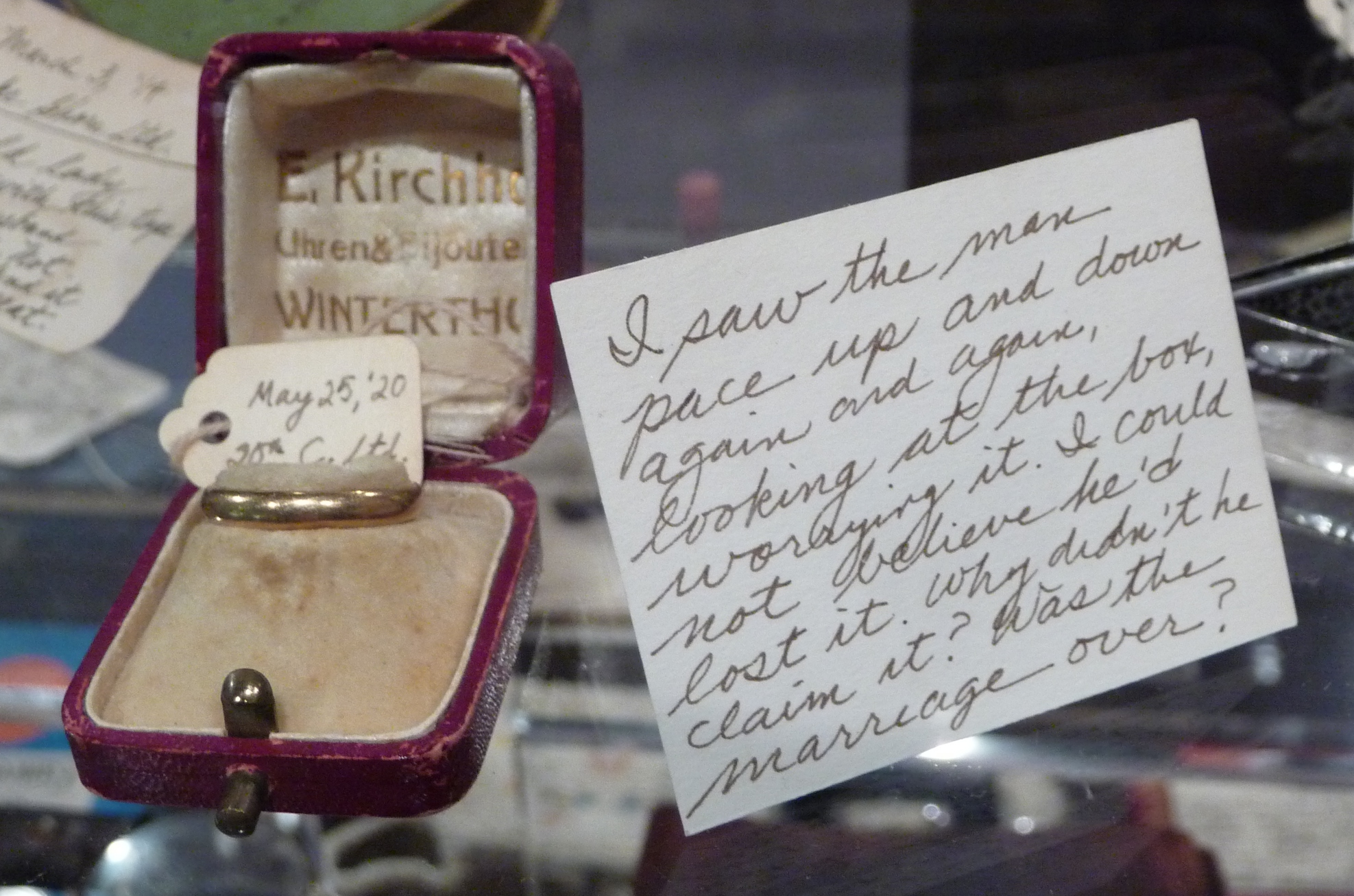
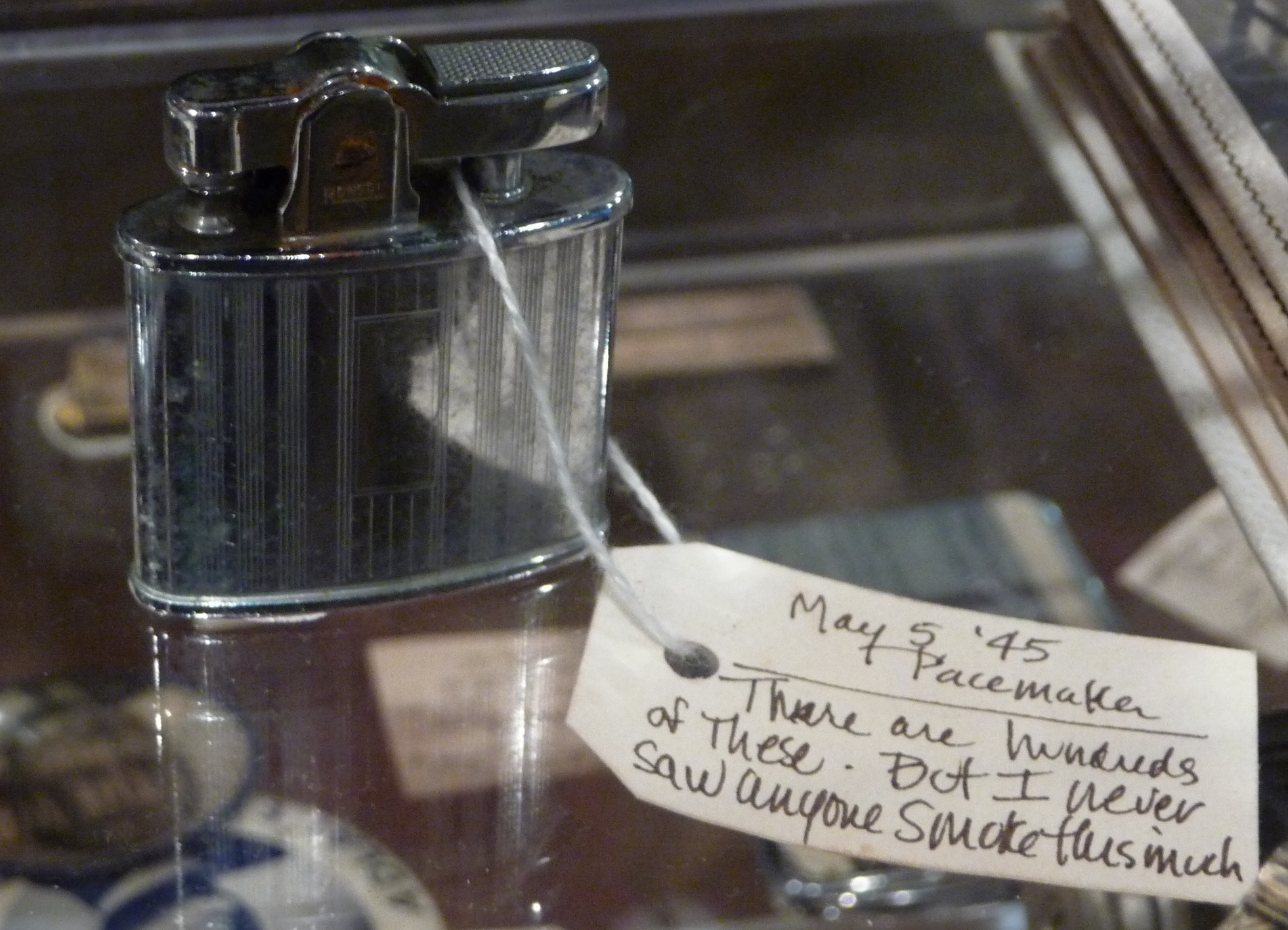
This is the sort of thing that will bring a smile to your face if you go see it in person. I love the fact that the Wenham family contemporarily tagged each item with where and when the object was found, along with their astute and sometimes witty observations. Below is a sample of objects from the collection.

The photograph caption recaps what is on the tag: the date and train the object was found on and a remark from the Wenham who found it. You can click on any picture to enlarge.
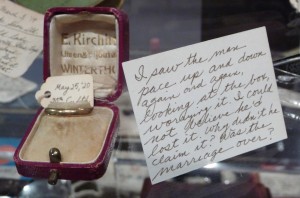
May 20, 1920 Twentieth Century Limited "I saw the man pace up and down again and again, looking at the box worrying it (sic). I could not believe he lost it. Why didn't he claim it? Was the marriage over?"

May 20, 1920 – Twentieth Century Limited
“I saw the man pace up and down again and again, looking at the box worrying it (sic). I could not believe he lost it. Why didn’t he claim it? Was the marriage over?”
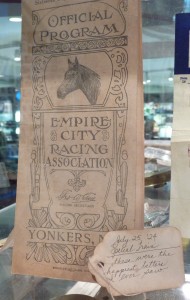
June 25, 1924 Special "These were the happiest bettors I ever saw"

June 25, 1924 – Special
“These were the happiest bettors I ever saw”
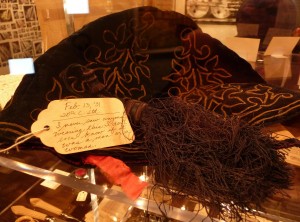
February 13, 1931 - 20th Century Limited "I never saw anyone wearing this. I don't even know if it is a man or a woman."

February 13, 1931 – 20th Century Limited
“I never saw anyone wearing this. I don’t even know if it was a man or a woman.”


May 5, 1945 - Pacemaker "There are hundreds of these. But I never saw anyone smoke this much"

May 5, 1945 – Pacemaker
“There are hundreds of these. But I never saw anyone smoke this much”


February 27, 1946 -  "I'd be so sad if I lost my babies photos."

February 27, 1946 – Pacemaker
“I’d be so sad if I lost my babies photos.”
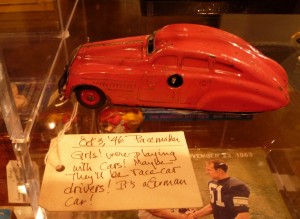
October 3, 1946 - Pacemaker "Girls! were playing with cars! Maybe they'll be race car drivers! It's a German car!"

October 3, 1946 – Pacemaker
“Girls! were playing with cars! Maybe they’ll be race car drivers! It’s a German car!”


March 3, 1947 - Empire State "The woman was as round as the bottle"

March 3, 1947 – Empire State
“The woman was as round as the bottle”

September 17, 1958 - 20th Century Limited "Boring travel diary of a spoiled 13 year old. Went to Europe on Queen Mary, lost diary on a fancy train. Must be a brat."

September 17, 1958 – 20th Century Limited
“Boring travel diary of a spoiled 13 year old. Went to Europe on Queen Mary, lost diary on a fancy train. Must be a brat.”


November 28, 1963 - Empire State "I talked to the

November 28, 1963 – Empire State
“I talked to the boy who had this. He’d planned to go to the game but then went home for comfort after the assassination. Wasn’t sure he’d go to the game now. I guess he didn’t.”


On Time /Grand Central at 100 is on view at the New York Transit Museum Gallery Annex & Store at Grand Central until July 7, 2013.

Mutilating The Main Branch Of The New York Public Library

Who Cares That New York’s Landmark Library Is About To Be Marred As Part Of A Sweetheart Land Grab Deal?

Library Protest1 May 8

Who cares? Apparently less than 100 people.

That is about the number of protesters who showed up on Wednesday, May 8 to try and bring about public awareness of the decision by the trustees of the New York Public Library to catastrophically alter one of New York’s greatest buildings, the main branch of  The New York Public Library at Fifth Avenue between 40th and 42nd street.

Library Protest4 May 8As the stoic group held up signs to the passing throng on Fifth Avenue, some pedestrians slowed or took photos, many just walked by without notice.

The group was protesting the closed door deal that will sell off the land and buildings of two libraries, the Mid-Manhattan branch at 40th Street and Fifth Avenue and the Science, Industry and Business Library at 34th Street and Madison Avenue. Their operations would be condensed and the main library would be remodeled into a circulating library in addition to being a research library. The main library would then store 3.5 million books off-site in New Jersey. This defeats the entire purpose of the building: to be a first-class, on-site repository of research materials critical to tens of thousands of patrons.

Library Protest2 May 8The small group of protesters was comprised of mostly older people. It is true that this was a weekday afternoon, but there were maybe ten people under the age of 40 in attendance and one or two in their teens. Continue reading →

May Day Parade New York City 1935

Or What’s Wrong With This Photograph?

May Day Parade 1935 5 1

New York City used to have an annual May Day Parade where Socialists, Communists, unions and other pro-labor forces would march down a route and finally assemble around Union Square. Most of the time the assemblies have been peaceful. There were some exceptions during the Depression when work was in short supply and occasional violence would break out on May Day.

In recent years, May 1 in New York City has turned into the flavor of the moment, general protest or demonstration for a wide array of left-wing causes.

In 1935 there were two May Day Parades both held without incident. One was held by the Socialists whose route took them along Eighth Avenue from 15th Street to Columbus Circle and then up Central Park West to 72nd Street. The Communists held their own parade starting at Madison Square on Fifth Avenue up to 32nd Street, across to 7th Avenue and then down to 17th Street and back across to Union Square.

There is no description on this May 1, 1935 photograph which parade this was taken at, but the buildings in the background tell us this is Union Square looking east along 17th Street, so it is surely the Communist parade.

Everyone seems to be paying a lot of attention to the parade…except the one man in the white fedora reading a newspaper.

If this picture was taken in 2013 instead of 78 years ago, I’m sure conspiracy theorists would say there is something very suspicious underfoot here.

7 Amazing, Little Known Facts Surrounding President McKinley’s Assassination

The Assassin’s Body: Destroyed or Preserved? 

Silence in New York City and The McKinley Islands

The McKinley Islands? It could have been, had Congress passed a bill to rename The Philippine Islands after the assassination of the 25th President of the United States, William McKinley.

The Assassination

McKinley assassinationOn September 6, 1901 President McKinley was holding a reception in the Temple of Music at the Pan-American Exposition held in Buffalo, New York. Leon Czolgosz, an anarchist, was in the greeting line and he approached McKinley with hand wrapped up to his right wrist in a handkerchief. As McKinley extended his hand to shake Czolgosz’s left hand, Czolgosz fired two shots at nearly point blank range, one that glanced off McKinley’s breastbone and never entered his body, the other penetrating his stomach.

After initial grave concerns by attending doctors and an operation to remove the bullet,  McKinley began showing signs of recovery after a couple of days. McKinley was declared in steady press releases by his doctors to be constantly improving in condition, when he suddenly took a  turn for the worse on September 13 and died from his wounds at the home of John G. Milburn, in Buffalo in the early morning hours of September 14, 1901.

Seven little known, interesting facts surrounding McKinley’s assassination

1. Friday’s

Four Presidents’ have been shot to death: Abraham Lincoln (1865), James A. Garfield (1881), William McKinley (1901), and John F. Kennedy (1963). Garfield was shot on Saturday, the other three were shot on a Friday.

2. The Mystery Bullet

An immediate operation was performed to remove the bullet that was lodged somewhere in McKinley’s body. Continue reading →

Old New York in Postcards #6 – Rare Views Of The Upper West Side & Harlem

Rare Postcards Of The Upper West Side And Harlem 1900 – 1915

Broadway and 141st Street Looking North circa 1903

Broadway and 141st Street Looking North circa 1903

Most old postcards depicting turn of the century New York City usually show the typical tourist attractions, landmarks and notable buildings of the city.

It was uncommon for the big postcard manufacturers to produce postcards of average streets, buildings or scenes in New York City for people to send to their friends back home. After all who wanted to see an apartment building on 117th Street and Seventh Avenue?

That is what makes these scenes of New York City and upper Manhattan rather unique. They feature the areas not frequented by tourists. They are photographs, rather than illustrations, and were typically produced in small quantities by smaller or unnamed card manufacturers. The absence of vehicles and people on the streets belies the rapid housing development that occurred in upper Manhattan during the time.  Click on any postcard to enlarge.

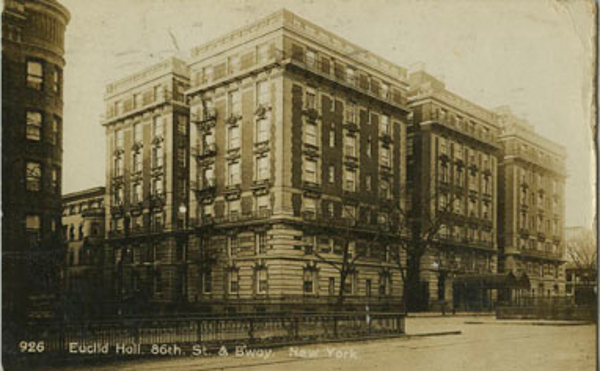
Broadway 86th St Euclid HallEuclid Hall Apartments 2349 Broadway, northwest corner of Broadway and 86th Street. This view shows the Euclid Hall Apartments which was built in 1903 by Hill and Turner is a heavily ornamented seven story red brick building. It is still standing and the ground floor has been modernized and now houses commercial businesses.

Broadway 98th Street The WilliamThe William Apartments looking west at 243 West 98th Street, northwest corner of Broadway and 98th Street. The William, a seven story building was completed in 1899 and is currently a condominium. To the right of The William behind the trees is the Arragon at 2611 Broadway. Continue reading →

Crime In New York In 1852

“Charged With The Most Heinous Crimes”

Fate of New York ThievesIn The New-York Daily Times of August 3, 1852 on page 3 there appears a summary of events occurring in New York City.

The most interesting parts comprising this article of brief news items is the crime news.

The flowery language used in the stories to describe the offenses have to be read to be fully appreciated.

Here are some interesting statistics in the first news item and a couple of crime stories which are excerpted below:

Crime in the City – The Court of General Sessions commenced its August term yesterday and a frightful array of crime awaits its action. No less than 67 individuals, charged with the most heinous crimes are to be tried. The following is the calendar:

Grand Larceny          24
Murder                         8
Burglary                       7
Attempt to Kill            4
Robbery                       4
False Pretences           3
Forgery                         3
Incest                            2
Carrying Slung-shot    2

Riot                              2
Bigamy                        1
Rape                             1
Bastardy                      1
Attempted Burglary  1
Abandonment             1
Manslaughter              1
Disorderly House        1
Arson                            1

Some of the crimes are unique to the time including: “Carrying Slung-shot,” (a striking weapon consisting of a small mass of metal or stone fixed on a flexible handle or strap), “Bastardy,” (the begetting of an illegitimate child) and “False Pretences” (an illegal, deliberate misrepresentation of facts, as to obtain title to money or property).

After some reports on license statistics, recent immigration, and admissions to the city hospital and the news report goes on with additional lists and details of crimes recently committed –

Crimes and Casualties

An unusual number of charges were made yesterday morning at the Jefferson Market Police Court, principally for assault and battery and for gross intoxication. Sunday night was evidently spent immorally. Over thirty cases of this kind were disposed of before the following were brought into Court: Michael Edwards residing at Manhattanville, was charged by James Kaiting for a violent assault with intent to kill. It appears the prisoner struck the complainant on the head with an ax, inflicting a severe, but not a dangerous wound. A struggle ensued, in which the complainant, with the help of some bystanders, arrested his cowardly assailant. He was locked up to answer…

Among the charges disposed of, was the following aggravated case of assault, in which Patrick Wheelan, John Trihan, Patrick Farrall, John Townsend and Bridget Crawley figured as assailants. It appears that the accused were having a nice little “muss” for their own private gratification, when they were accosted by police officers Atherton, Jones and Scott, who exhorted them , under the threat of various pains and penalties, to keep the peace. This aroused Bridget, who forthwith made a descent upon officer Atherton, and was followed by the male prisoners, when a general melée occurred. Some broken heads and other injuries were the result, but the assailants were captured an secured. They were committed to answer…

The Stowaway

Illegal Immigration 1931

Stowaway 4 16 1931

Stows Away in Box To Enter America

He tried to come to America in a box of hats, but now he has to go back to France. Louis Chianese nailed himself carefully in a wooden box, with biscuits, chocolate and water. On the outside was printed the legend that the box contained hats for a New York department store. Young Louis stood it for two days in the hold of the liner Lafayette – that was enough. He fired two revolver shots and was quickly released. Here he is on deck of the ship in New York, box and all. He says he will never try it again. – Associated Press Photo 4-16-31

20-year-old Louis Chianese said to his parents before leaving home without their knowledge, “I will go to America even if I have to go in a box!” His parents probably did not take him literally, but the box Chianese ended up in measured 7 by 2 by 3 feet. When the box was initially delivered to the pier in Havre, France, it was placed upside down.  Chianese said, “I thought my head was going to burst.” He almost accidentally burned himself to death when he struck a match inside the box to consult his watch to check the time. The box caught fire. Luckily he was able to extinguish the fire.

According to follow-up news reports, Chianese was actually in the box five days, not two, and it was his parents who alerted the shipping company to search for their son after he had been missing for days. The tip off was they received a packing and shipping bill for the box.

After he was returned to France, Chianese ended up in  a slightly larger confined space – he was sentenced to 15 days in prison.