Category Archives: History

Play At Your Own Risk – A Huge Playground Slide

Wait in Line For Your Turn at The Big Slide

This 1927 photo is captioned “Summer On A Children’s City Playground.”

I don’t know for sure what city this is in.  But it was typical of an early twentieth century playground.  No “helicopter mom’s” hovering over their precious children. Nothing but lots of kids experiencing fun on what is the biggest slide I’ve ever seen in a city park.

I wrote to the New York City Parks Department a few years ago and asked what happened to the monkey bars, see saws and tall slides along with all the other amusements that presented some sense of excitement and danger? Continue reading →

Permanent Street Signs in New York

Looking Above Street Level

There is nothing extraordinary about 1113 First Avenue, the building at the northwest corner of 61st Street and First Avenue. A late 19th century five story walk-up building with a restaurant at ground level. But if you look up to the corner between the second and third floors you will see the street name etched in stone and attached to the building, circled in red in the photo above.

The rectilinear street grid layout imposed upon Manhattan at the beginning of the nineteenth century assured the builder of this building that it would be located at 61st street and First Avenue seemingly forever.

Before the twentieth century street signs were not at every corner. There were in fact few street signs in New York and they were usually at major intersections or the nicer parts of town.  Continue reading →

Did That Song Just Make Fun of Stuttering?

Speech Impediments Were Fair Game For Early Songwriters

Forget The Who with “My Generation” or David Bowie with “Changes.” Stuttering lyrics were once blatant and over the top. Unlike today where some songs contain stuttering verses,  100 years ago, the stuttering was in the title or subtitle.

In 1907 an imaginative songwriter said to himself, “Hey. I’ve got an idea, I’ll write a song about stuttering, it will be a smash!” But he thought it over, “Hmmm,  that’s been done already. What if I added something about having a lisp?”Maybe that is the way the smash hit, The Boy Who Stuttered and The Girl Who Lisped by Louis Weslyn came to fruition.  Two speech impediments are better than one.

Today it seems politically incorrect (and in bad taste.) If songs like this were being produced today, protesters would be lining up to have the songs banned.

Back then, nothing was thought of it; a stutter or lisp would make perfectly acceptable lyrical content. The more outrageous the lyric, the better. Click here to listen to the song performed in 1908 by Billy Murray and Ada Jones.

The unusual thing is that Billy Murray seemed to be very good at fake stuttering and recorded one of the most popular stuttering songs of all-time, K-K-K-Katy “the sensational stammering song success” written by Geoffrey O’Hara in 1917. When you hear Murray’s rendition of K-K-K-Katy in the vocal break towards the end, you will be reminded of Mel Blanc, the famous Warner Brother’s cartoon voice of Porky Pig and Bugs Bunny, Daffy Duck etc. etc.) . You can be sure Blanc took a page from Murray to create Porky’s stammer as Blanc later recorded his own version of K-K-K-Katy.  Click here to listen to Murray’s K-K-K-Katy.

And while Murray was an accomplished early recording star and performer, and could sing in other styles, he recorded another stuttering song in 1922, You Tell Her I S-T-U-T-T-T-E-R which was written by Billy Rose and Cliff Friend. Continue reading →

New York City Middle Schools – As They Were Fifty Years Ago

1961 Documentary – New York City Junior High Schools

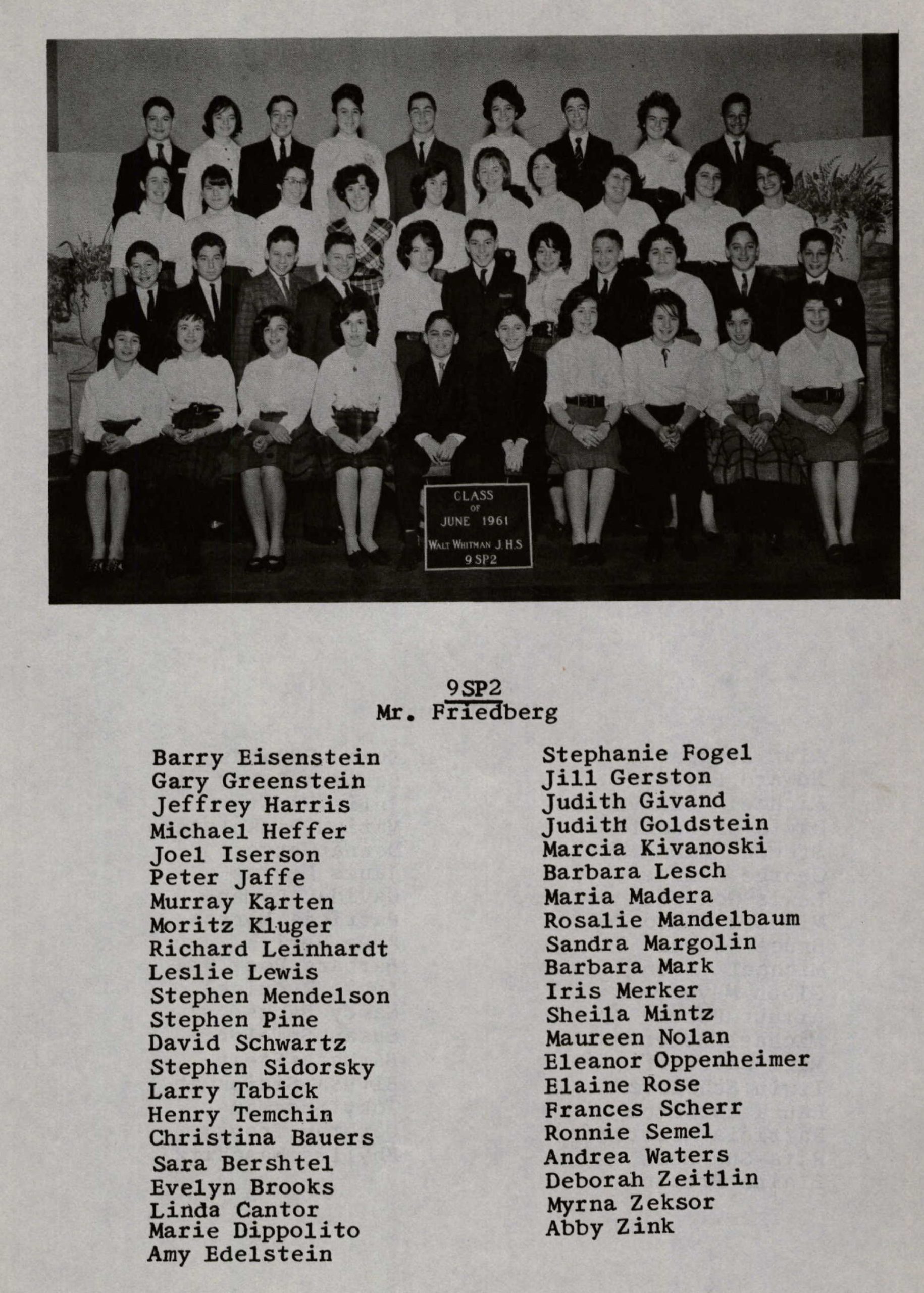
The New York City Junior High Schools or Middle Schools as they are called now,  were once the breeding ground for a well-rounded education. My parents and grandparents were the products of the old New York City public school system and they never went to college. Yet they could read and understand Latin, had beautiful handwriting, could type, played and studied music and developed “the lifelong habit of turning to books for the information they needed.”

Brooklyn, NY Walt Whitman JHS 1961 Yearbook page

In 1961 students learned how to make things because the U.S.A. was still an industrial society and could actually design and manufacture useful products.

As shown in this 20 minute film, everyone learned about electricity, the elements of printing and participated in the novelty shop; where they could “build things for use and for pleasure.” There was what would now be termed sexism – girls learned millinery work, domestic arts, dressmaking, respect for manual labor and “neatness,” while boys learned the manly arts of metal, wood,  print, plastics and electrical wire. But up until the 1970’s gender work roles were applied in most of the fields of employment.

The children were taught “ideas and facts in citizenship, current affairs, history, geography, and government, to appreciate democratic ideals.”

Okay, maybe they were brainwashed.

But compared to today’s middle schools, they got a fine education. Continue reading →

Old New York in Postcards #3 – A Tale of Three Buildings: Franconi’s Hippodrome, The Fifth Avenue Hotel & The Fifth Avenue Building

A Tale of Three Buildings: Franconi’s Hippodrome, The Fifth Avenue Hotel & The Fifth Avenue Building a.k.a. The Toy Center

The west side of Fifth Avenue between 23rd and 24th streets had been country land well into the middle of the 19th century. The land for many years had been occupied by a quaint tavern and horse changing station.

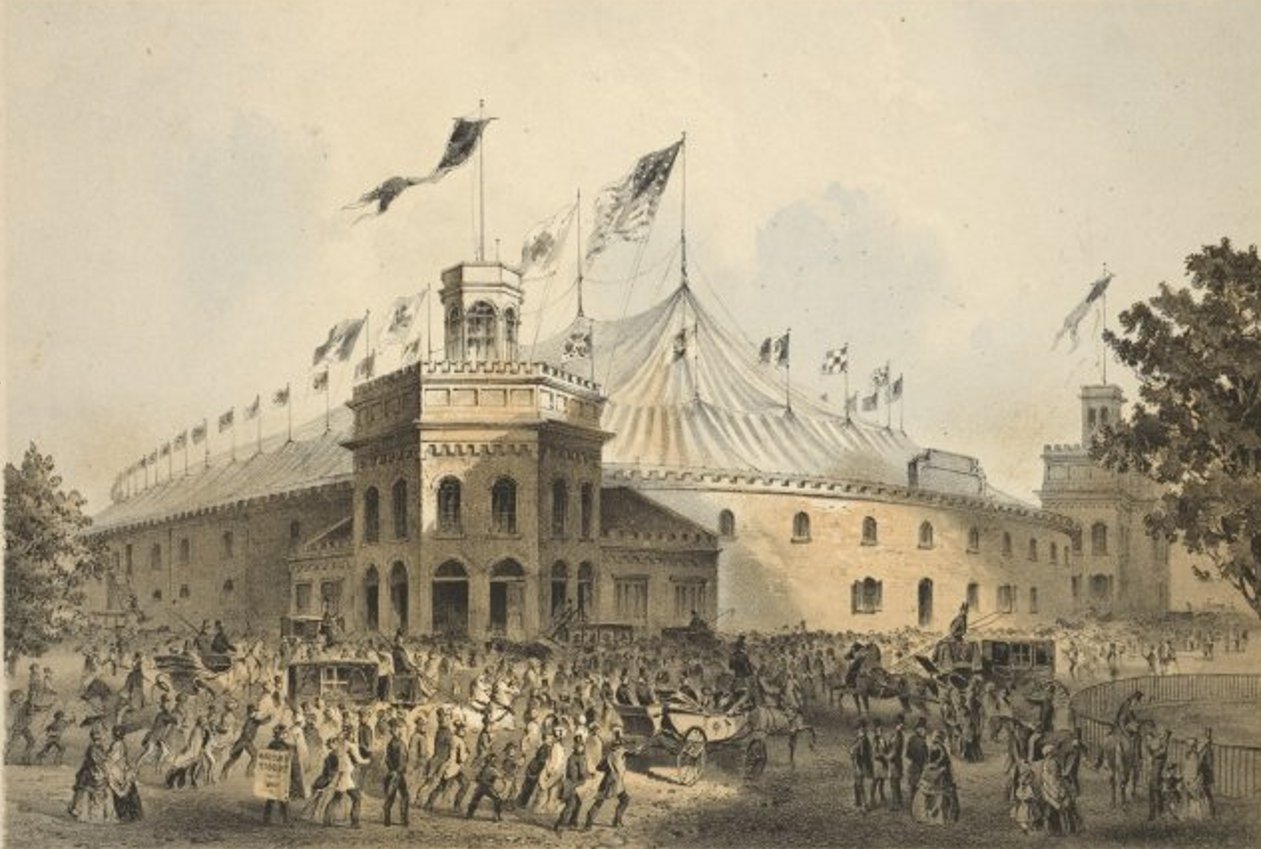
Franconi’s Hippodrome- Fifth Avenue 23rd -24th Streets (click to enlarge)

On this site in March 1853, Henri Franconi, a European from a long line of equestrian performers, arranged with investors to have an amphitheater built which was then called Franconi’s Hippodrome. This precursor of the modern day circus with performers, animals and chariot races was housed in a large structure shaped like an ellipse and was 338  feet by 196 1/2 feet that could seat 10,000 people and was covered by a red, white and blue canvas supported by a center pole 70 feet in height and a circle of smaller poles 40 feet in height.

It opened on Monday, May 2, 1853, and The New York Daily Times was not impressed with the class of people attending the Hippodrome shows. Attendees they said “…were blacklegs, gamblers, rowdies, and the miscellanea of polite roguery and blackguardism.”  The reporter added “The Hippodrome is badly conducted and Continue reading →

The Coney Island of Yesteryear – The Original Coney Island, Luna Park and Steeplechase Park In A Vintage Film

Coney Island in the Late 1930’s Early 40’s

Coney Island Luna Park entrance 1942On so many levels this is extraordinary. The time is somewhere between 1937 & 1941 based upon the rides shown at Luna Park at Coney Island. The original Luna Park closed in 1944.

When I first saw this film I re-watched it three times. What would it be like to experience the original Luna Park? This film gives you an idea.

Where is the time machine?

Death By A Fly Bite

115 Years Ago, A Boy Mysteriously Dies and a Fly is to Blame

In 1896 you could die at a moment’s notice. There were no antibiotics.  Doctors and scientists were slowly discovering how diseases were spread. Then, as now, the medical and scientific community gets stymied.

For instance, imagine  hundreds of people sharing a glass or cup to drink from a public place where healthy and sick people alike could spread their germs. Yes, people actually did that. And in the U.S. thousands every year got sick or died from that practice. The impetus to invent a disposable cup – to stop spreading disease via communal drinking apparatus led to the Dixie Cup which came on the market in 1907.

But in 1896, before West Nile Virus or Ebola Virus was discovered, something strange and horrible occurred Continue reading →

Q: Where Can You Buy Hires Root Beer? A: Nowhere. Killing A Product – The Demise of Hires

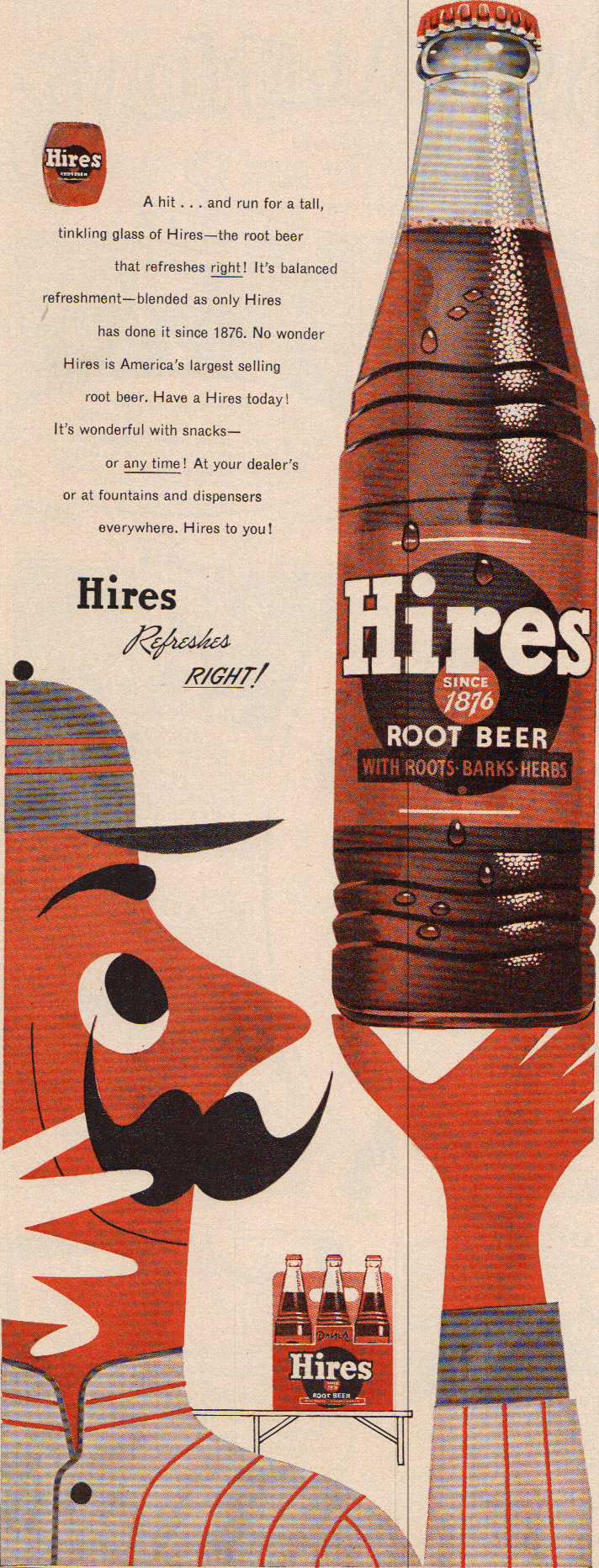
Hires – The First Root Beer, Dying A Slow, Prolonged Death

(This article is from 2011 and has updates at the end through 2025)

I know soda isn’t good for you. New York City Mayor Michael Bloomberg and many nutritionists would like to slap a soda tax on sugary beverages.

I try not to drink a lot of soda, but I have a sweet spot in my heart for Hires Root Beer. I love the stuff. It is by far the best root beer ever made and I have tried many of them:  IBC, Stewart’s, Mug, A&W, Dr. Brown’s and about a dozen or more other smaller regional brands, and none compare to the unique, smooth taste of Hires.  But I have not had a sip of Hires in over six years.

I did not forsake Hires.  Instead the brand has slowly been vanishing off the shelves of supermarkets in an ever widening circle over the past 20 years. It is now unavailable in most portions of the United States and Canada.

How did the oldest continually produced soft drink and for many years, most popular root beer Continue reading →

The Cost of Living in Manhattan Apartments – 1926

The Prices of Fancy New York  Apartments and Where You Could Live on a Decent Salary

As I continue to look through the Sunday October 10, 1926 New York Times real estate section, I wanted to get a better understanding of what a dollar could buy when it came to apartments.

First I did some income research.

According to FRASER (the Federal Reserve Archival System for Economic Research) , a little over 4 million individual tax returns were filed in 1926.

The average net income on those returns was $5,306.43.

The average amount of tax liability was – get this – only $176.11!

So you might think that everyone was doing Continue reading →

I Just Paid $13,530 For Some Rags

OR…Debbie Reynolds Hollywood Memorobilia Auction

Well, I didn’t pay that kind of money. But somebody did.

When movie star Debbie Reynolds abandoned her long-time dream of having a museum to showcase the history of Hollywood, the treasures which she had been accumulating for decades, went to the auction block. A good portion of the nearly 600 lots sold for significantly more than their high estimate.

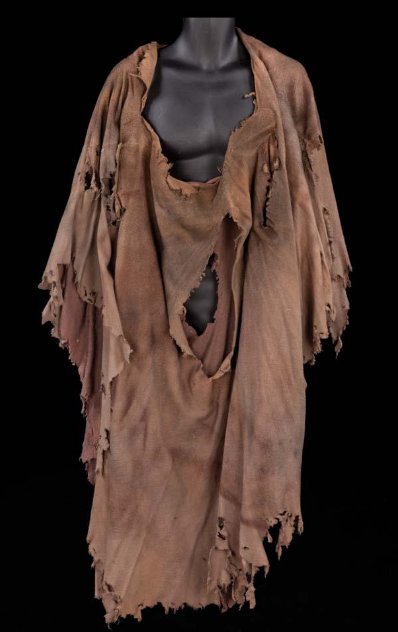
Charlton Heston’s robe from Planet of the Apes (1968) went for $13,530 (all prices include buyers premium). Yes it is the costume Heston’s character Taylor wears during much of the film, but it really is a rag isn’t it? There were fantastic costumes that were available and I suppose if you wanted to own movie history and you had a budget to adhere to, this raggy robe was as good as anything. I’d like to see the new owner actually wear it. In public. Continue reading →