Category Archives: History

The Transforming New York City Skyline 1880-2009

Lower Manhattan’s Skyline Evolution

On March 21, 1909 The New York Sun newspaper published an illustration (reproduced below) that showed the rapid growth of the New York City skyline as seen from New Jersey in four line drawings from 1880 -1909.

Click to greatly enlarge this illustration.

We have added a photograph from approximately 100 years later showing the same view.

Transforming New York City skyline 1880-1909 The Sun March 21 1909new york skyline 2009  photo HiltonThe two constants are Trinity Church and St. Paul’s Chapel Continue reading

Lois DeFee Bouncer At The Dizzy Club, New York City 1936

Don’t Mess With The Lady

woman bouncer Lois DeFee 1936 photo AcmeLois DeFee started her working life at the age of 18 in an unusual occupation – as a bouncer. A couple of years later she would achieve fame of another sort.

“Little Miss Bouncer”

Gentlemen guests at the Dizzy Club, New York night spot; are polite, especially to Miss Lois DeFee, (shown above), with a waiter of average size. Miss DeFee who stands six feet two inches, without high heels, is the official bouncer at the night club, and has acted in that capacity for seven weeks to the satisfaction of the management. Women drunks give her the most trouble, says Miss DeFee. She has been married twice; one of her husbands was a jockey who was only five feet tall. Yes– she enjoys her work, and Broadway night life in general. Credit Line: (ACME 5/15/36)

Lois DeFee was soon hired away from The Dizzy Club on 52nd street to go work across the street at the more famous Leon & Eddie’s performing the same duties at their nightclub.

Lois was later discovered by Harold Minsky of Minsky’s burlesque and she became a top burlesque star for many years, billed as a “glamazon.” Because of her great height, columnist Walter Winchell billed her as”The Eiffel Eyeful.” Lois died in Florida in 2012 at the age of 93.

New Year’s Eve Celebrations Of The Past, New York City 1906

Festivities In New York City On New Year’s Eve 1906

A couple of years ago we featured photos of Times Square and New Year’s celebrations from the 1950’s – 1960’s. This time we went back in time a bit further to New Year’s Eve 1906.

Probably something you never thought about: where else did New Yorkers celebrate New Year’s besides Times Square, which started drawing crowds in 1904 with the completion of the New York Times Tower Building?

The answer is all over the city at various churches, hotels, restaurants and clubs, with Trinity Church being a focal point for large crowds.

Seen below is the crowd outside of Trinity Church at Broadway and Wall Street on New Year’s Eve 1906 awaiting the arrival of 1907.

New Year's Eve 1907 outside Trinity Church

It proves again that celebrating the New Year has not changed that much over the years. People have always liked to congregate on New Year’s Eve in New York City even in freezing weather. It’s just that back then the majority of celebrants were New Yorkers, unlike today where many revelers are visiting from all over the globe.

Here is how the New York Tribune described Continue reading

How Much Did A Working Girl Need To Live On In 1922?

According To One Report – A Miniscule $468 Per Year Would Supply A Working Girl “All The Necessities Of Life.”

1922 Women Dressed NicelyIn 1922, a single working woman could live comfortably on $9 per week and, $17 a week with “luxuries” according to a report issued by the Minimum Wage Commission of Massachusetts.

Even without debt, an annual salary of $468 would barely keep you at subsistence level. $884 would afford you the luxuries of life? Talk about underestimating the needs of the working poor.

The New York Tribune of August 26, 1922 sarcastically mocks the report, as being completely unrealistic.

BOSTON, Aug. 25 – If you are a working girl, $9 a week is enough to supply you with all the necessities of life, according to an investigation just completed by Miss Ethel M. Johnson, assistant commissioner of the Minimum Wage Commission of Massachusetts, who fails to set down for public information just how much she, herself, is contented to earn for her services. For $17 a week the working girl should be able to keep herself well supplied with all the reasonable luxuries of life.

In order to live on the commission’s wage you are supposed, if you are a working girl, to make one pair of corsets last two years and a $2.98 kimono must be stretched over five
years of service.

Your principal recreation should be semi-annual trips to the dentist, and you may contribute 7 cents a week to charity, presumably that which does not begin at home.

According to the commission’s budget, you should spend $154.92 for your clothes and $1 a day for three meals –  breakfast, 25 cents; lunch, 30, and dinner 45. Your one dress and two hats should go through the 365 days- but your heavy coat, costing $40 is supposed to last three winters.

You must not have more than three union suits a year and six pairs of stockings Miss Johnson says few working girls know how to spend their money. “Working women waste most of their money because they actually do not know how they are spending it. They spend §1.50 for a jar of face cream and then quiet their consciences by saving 40 cents a week on cheap lunches.”

By the way, $468 in 1922 adjusted for inflation is equivalent to $6,608 in 2014 dollars.

In 1961 Dr. Richard W. Hamming Predicted The Harmful Effects of Computer Technology

Loss Of Privacy, Pooling Of Data And The Slow Blurring Of The Distinction Between Human And Machine “Thinking.”

Richard W. Hamming photo: Naval Postgraduate School

Richard W. Hamming photo: Naval Postgraduate School

In 1961, scientist and mathematician Dr. Richard W. Hamming of Bell Telephone Laboratories, had enormous foresight in predicting that computers would soon change our lives in ways that few people could have imagined half a century ago.

Dr. Hamming saw the future improvements that the computer revolution would bring, but he also warned of the coming dangers in that revolution.  Looking back at his insights today you will find them eerily accurate. In many ways Dr. Hamming merely scraped the surface on many of his suppositions.

Today we are all aware that marketers are tracking your movements on the internet. Unless you’ve set up blockers, all your clicks, all your searches, every site you visit is captured and analyzed. Big Data firms want that information, supposedly just to market to you. The government, banks, schools, brokerage firms, doctor’s offices, pharmacies, and merchants all collect information that you are obliged to provide in order to receive services. You just hope your information is secure and not compromised.

But then you voluntarily share information on Facebook, Twitter and Linked-In. We know that the information we provide is used to compile an aggregate online portrait of our lives that is available for the world to peer into and that includes stalkers, thieves and hackers and yet we still provide it!

Which leads us back to a symposium held in December 27-29, 1961 on “Man and the Computer” at the annual meeting of the American Association for the Advancement of Science held in Denver, CO. At the symposium Dr. Hamming’s observations were listened to attentively and the New York Times interviewed him afterwards. Summarizing  Hamming’s observations:

While computers will surely benefit mankind in ways not yet dreamed of he said, certain harmful effects of the computer revolution can be foreseen. One example he gave was a reduction in individual privacy that would be possible with the increasing storage of personal records even travel information in computers.

A major concern is that a growing amount of personal information was being committed to the memory of machines: various data collected by Selective Service; Social Security, Internal Revenue, insurance companies, places of employment, medical services and even airline companies.

“How do we know that this is always being used for the benefit of the individual?” he asked, “How can we be sure that this information will not be used against a person?”

Continue reading

Increase Your Bust Ad – 1915

Same Scam As Today, Perpetrated 100 Years Ago

Ad Increase Your Bust world almanac 1915 0115

World Almanac 1915 ad

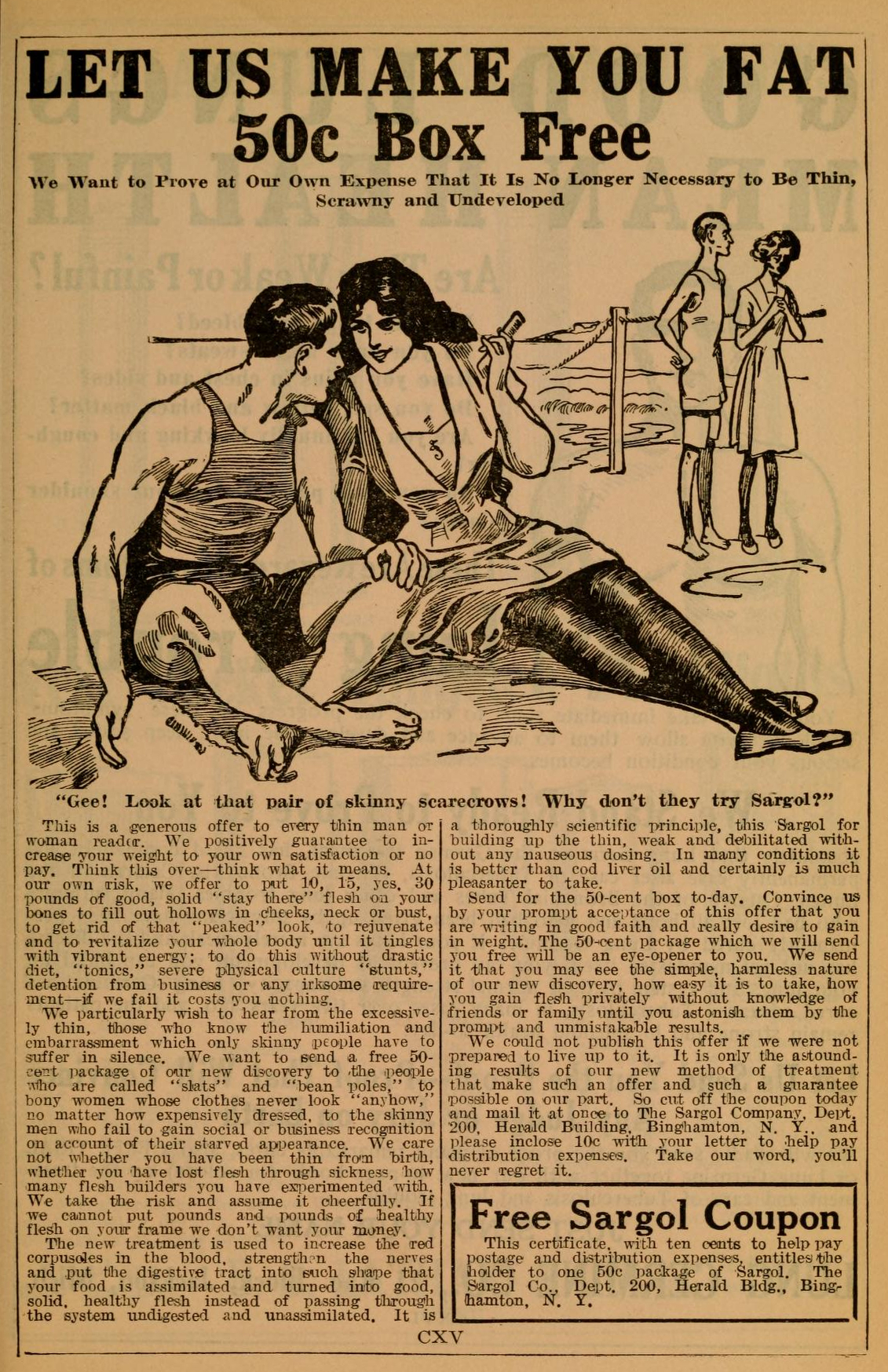
Before plastic surgery and breast implants became the way to change your natural assets, there were charlatans preying upon young girls and women’s insecurities. Growing up I remember reading magazines in the 1970’s and 80’s and constantly seeing the ads saying you can increase your bust size with creams, ointments or exercises. Most of the ads did not describe exactly how the transformation would occur.

Well this scam has been going on for a lot longer than you may think . Continue reading

Things You Should Know If Visiting New York City In 1873

“Thousands of children are imported from Italy each year to turn them into organ-grinders and street beggars.”

12 Helpful Hints And Notes From 1873

Standing on Broadway by New York City Hall circa 1870

A tourist standing on Broadway by New York City Hall circa 1870

From the wordily titled – Wood’s Illustrated Handbook To New York and Environs: A Guide For The Traveller or Resident With Minute Instructions For Seeing The Metropolis In One or More Days Together With Numerous Valuable Hints To Visitors On Nearly Every Topic That Arises Upon The Subject of Sight-Seeing, G.W. Carleton Publishers, 1873, we learn surprising things about New York City.

If you lost something of value in public there was an excellent chance that it would be returned to you.

Saturday was the fashionable day for ladies to attend public entertainments – alone!

Wood’s Handbook’s aim was to point out interesting things about New York City without preaching to the reader.

As the guidebook says;

We think the sight-seer may now be safely left with the “Handbook ” to the guidance of the Index and Map and to his own inclinations and judgment.

He will speedily discover that our object in the preparation of this volume has been not to confuse and weary him by stale remarks and hackneyed observations about this or that, but to put him in a position to see, and admire, and criticize from his own stand-point of taste and opinion. We think the sight-seer requires ready hints, not stupid essays; and if we conduct him to a remarkable locality or a well-known structure, he will not care to have us stand perpetually at his elbow telling him what to admire, and what he ought not to be pleased with.

Since the book contains no “hackneyed observations,” the section called “helpful hints” are what we thought were worth highlighting rather than the sights to be seen.

From among the many listed, we have culled, a dozen of the helpful hints for visiting New York:

1- A GLASS OF BRANDY, in an emergency, can be obtained at any apothecary. No wines, ales, or liquors are permitted to be sold in New York at any bar on Sunday. The guests of a hotel can be served with them, however, at table or in their rooms.

2- ORGAN-GRINDERS and STREET-BEGGARS — Thousands of children are annually exported from Italy to the United States for the purpose of making them organ-grinders and street-beggars, of whom a multiplicity are to be seen in New York. A bill has been brought before the Italian Parliament, designed to put a stop to this disgraceful traffic in children. It punishes with five years’ imprisonment all persons exporting children under twelve years of age to foreign countries, under any pretext. Continue reading

Old New York In Photos #43 – Times Square Advertising Billboards

Giant Times Square Advertising Billboards Of The Past

New York's Times Square at night 60 Years ago, 1954 photo: Charles Shaw

New York’s Times Square at night 60 Years ago, 1954 photo: Charles Shaw

The New York Times article about the new eight story high, block long, LED illuminated billboard that will be put into use on Tuesday night, November 18, 2014, made me think about some of the classic advertising signs that were in place during the 1940’s and 1950’s at the crossroads of the world.

Bond Clothiers sign, 1948, Times Square looking north

Bond Clothiers sign, 1948, Times Square looking north

Chief among these ads was the dramatic Bond Clothiers sign taking up the entire Broadway block between 44th and 45th Streets. The 200 foot wide, 50 foot high billboard was brightly lit up at night and had a waterfall cascading between the two large scantily clad statues flanking it. The figures appeared nude during by day and had electric lights draped around them which produced a quasi-covering effect on the statues when the lights went on.

With two miles of neon, it was a colorful spectacle to behold in person, especially at nigTimes Square 1948 Bond Clothiers at night billboardht. The sign was only up from 1948-1954.

We previously showed what the area looked like at night in our story about the giant New York snowstorm of 1948.

The Bond sign replaced an earlier sign for Wrigley’s Spearmint Gum that also was breathtaking with its neon aquatic design. Designed by Dorothy Shepard, it occupied the site from about 1936 to 1948.

Times Square Wrigleys Billboard sign Ad postcardThe other billboard Continue reading

Brooklyn’s Green-Wood Cemetery Epitaphs

To Be Remembered – Some Thoughts About Inscriptions On Tombstones

Green wood Henry Croatman epitaph 1120840
 
Henry Croatman                                                  Eddie Brewster Croatman 
Born January 17 1845                                                Died Dec. 2, 1878
Died June 4, 1876                                                        Aged 19 Mo’s 26 Days
 
Come view the grave and drop a tear                           Budded on earth
O’er your kind brother once so dear                              To bloom in heaven
Who once delighted in your charms
But now he’s bound in deaths cold arms
 

When wandering around Green-Wood cemetery in Brooklyn I especially take note of  monuments with epitaphs. Rather than gravitate towards the costly and grand monuments that abound in great numbers, I am drawn to those anonymous graves with no known fame attached to them. It is interesting to see how these people, buried long ago, are eulogized in stone.

Green wood John F Abbott epitaph 1100936John F. Abbott
Died Sept. 23rd, 1857
Aged 23 Years and 10 Months
A Good Life Hath But Few Days
But A Good Name Endureth Forever


Many of these monuments mark the last resting spots of common people with unextraordinary lives. But we all have a story to tell. Tombstones try to do that. How can you sum up a person’s life with a few sentences?

Green wood Ann Lee epitaph 1160006A Tribute of Love to
My Dear Wife
ANN LEE
Died Feb. 25, 1887
Aged 58 Years
A fond and faithful wife,
A dear devoted mother,  And a kind friend to all

Without their simple marker and words engraved upon them, these people’s lives would go completely unrecognized. Today, it is hard to fathom that thought, considering all the information that is now collected and shared about us.

Green wood C Ella Ellison epitaph 1120836C. Ella Ellison
Wife of John T. Ellison
Born March 22, 1846
Died December 20, 1900
 
A Loving Daughter,
A Devoted Mother,
A Faithful Wife


Continue reading