Category Archives: History

Old New York In Postcards #12 – 20 Historic Buildings That Were Demolished

20 Historic, Beautiful New York Buildings That Were Demolished

City Hall Newspaper Row Buildings (l-r) World Building (aka Pulitzer Building), Sun Building, Tribune Building - all demolished. New York Times and Potter Buildings are still extant

City Hall Newspaper Row Buildings (l-r) World Building (aka Pulitzer Building), Sun Building, Tribune Building – all demolished. New York Times and Potter Buildings are still extant

New York City real estate developers will always knock down a building if a buck can be made. So it really should come as no surprise that these buildings were demolished because they outlived their usefulness or more often than not, the land they sat upon was deemed more valuable than the building itself.

Nathan Silver’s must-own book, Lost New York (1967) Houghton Mifflin, was the first book to explicitly point out what New York City had lost architecturally over the years. If you have never read it, you should.

For our short postcard essay, there are hundreds of examples we could have chosen from and we picked 20. We omitted places of worship, theatres and restaurants which are the most transitory of buildings.

We’ve covered hotels before, and we could do another story on all the historic hotels that have been torn down, but we’ve included a few in this retrospective.

Rather than comment extensively on the buildings, a brief summary will suffice and the images should convey what we have lost. These postcards have been scanned at 1200 dpi in high resolution, click on any postcard to enlarge.

Singer Building hresSinger Building – 149 Broadway (corner Liberty Street),  A gem by architect Ernest Flagg, built 1908. Once the tallest building in the world. The Singer Building was elegant and sleek. Demolished 1967-68 and replaced by a ugly box of a building built by the Unites States Steel Corporation.

Produce Exchange hresProduce Exchange – 2 Broadway between Beaver and Stone Streets. Architect George B. Post’s splendid work of grace was constructed between 1882-84, and demolished 1957.

Gillender Building 2 hresGillender Building – northwest corner Wall Street and Nassau Street. Architects, Charles I. Berg and Edward H. Clark, built in 1897 at a cost of $500,000. The Gillender Building was the tallest office building in the world for a brief time. The 20-story tower lasted only 13 years. In 1910 it was the first modern fireproof building to be demolished and it was done at breakneck speed, in under 45 days. The Gillender Building was replaced by the Bankers Trust Tower. Continue reading →

New York’s Little Italy Described In 1898

“Not a word of English is heard — only a rough, gutteral Italian”

Busy Mulberry Street photo Detroit Publishing CoWhen we ran our story about Chinatown last week we knew it was inevitable we would cover the section on Little Italy as well. It has the same anti-immigrant undertones as the section on Chinatown.

It is probably best not to read the unpalatable descriptions and have modern judgments on 19th century attitudes. What would seem outright racist or prejudicial today was merely the predominant “native” view of anyone who was not a WASP or other accepted creed.

Once again, the guidebook we quote from is Rand, McNally Handy Guide to New York City, Brooklyn, Staten Island, and other suburbs included in the Greater New York edited by Ernest Ingersoll (1898). This section is from the same one as Chinatown and is called “A Ramble At Night”, where the visitor to New York is directed to tour the areas of New York that are off the beaten path after 9 p.m. The purpose of the night ramble is to “give some hints as how the dark, crowded, hard-working, and sometimes criminal portions of the city look at night.” Reproduced below is the section on the Little Italy. Continue reading →
Censored – What The Movies Couldn’t Show In 1921

An Incredible List of Things That Movies Were Not Allowed To Portray In 1921

Annette Kellerman the first "star" to do a nude scene 1916 "A Daughter of the Gods"

Famous swimmer, Annette Kellerman was the first “star” to do a nude scene 1916 “A Daughter of the Gods”

Looking at what was prohibited in the state of Maryland from being shown on movie screens in 1921 is overwhelming in its restrictiveness. It includes, but is not limited to: indecorous dancing; over passionate love scenes; exhibition of feminine underwear; gruesome murders; birth control; disrespect for the law; use of opium or other habit forming drugs; executions; profanity; excessive drunkeness especially in women; and maternity scenes.

The complete Maryland censorship rules is a laundry list of vice and of how people really behaved. Basically real life was prohibited in the movies.

Because there was no film industry set of standards, individual states set up their own board of censors to either insist on cuts to movies or block films from being exhibited entirely within that state.

In 1921 there were only six state censorship boards, and that number would greatly expand throughout the 1920’s. What was okay in one state, may not be playable in another. This set off a quagmire of problems for producers of films who needed to be able to show their films to the widest possible audience without having to make special edits to satisfy each state’s censorship board.

Rather than risk the creation of a national censorship board, the film industry eventually self monitored and created its own censorship code and a board to enforce the rules.

One of the last pre-code films. 1933 Roman Scandals with a young Lucille Ball in the chorus as a slave girl

One of the last pre-code films. 1933’s Roman Scandals with a young Lucille Ball in the chorus as a slave girl

The Hays Code (1930) and Joseph Breen, head of the Production Code Administration  standardized censorship rules and staved off an official national censorship board.

But even after the Production Code went into full effect (1934), local authorities or the Legion of Decency could still condemn a film and keep it from being exhibited. The city of Boston was a prime example of banning films with objectionable content.

Below is the complete list of Maryland’s censorship restrictions. Continue reading →

Marching In New York For Their Socialist Agenda May 1, 1934

May Day Parade 1934

May day parade Madison Ave May 1 1934 photo APWhile this may look like a group of Nazi women dressed like stormtroopers marching up Madison Avenue it is actually just a bunch of American socialists resembling the sieg heiling Nazi’s.

The original caption for this news photo reads as follows:

The Red Flag of Socialism

A general view of the parade of the Socialists up Madison Avenue in New York May 1.  A group of women Socialists carried red flags and sang and shouted as they marched. Parades were held throughout the city by various groups but there was no disorder of any kind. (Associated Press Photo 5-1-34)

In the first half of the 20th century, every May Day in New York would bring thousands of activists out into the streets to march and promulgate their ideas . Many were just plain old Socialists, however there would be smaller parades of Communists, anarchists, Industrial Workers of the World, or other labor groups who had a concern or cause.

In 1932, the Socialist party presidential candidate Norman Thomas received 884,895 votes, a little more than 2% of all ballots cast.

Mostly the May Day marches in New York Continue reading →

Lifebuoy Soap Body Odor Ad 1933

My Dear, You Smell of B.O.

Lifebuoy Soap Ad - Schenectady Gazette March 13, 1933

Lifebuoy Soap Ad – Schenectady Gazette March 13, 1933 (click to enlarge)

“What a kill-joy B.O. is!” says this 1933 Lifebuoy comic strip ad.

“Perhaps its your fault,” says Auntie to Mrs. B.O.

Nothing like being direct.

The Lifebuoy ad warns that B.O. make life miserable for its victims. I like that  it is whispered in parenthesis in case you don’t know that B.O. stands for body odor.

And to add a dramatic flair, B.O. “threatens their jobs, social positions – even their homes!”

Fortunately of course there is a Continue reading →

Old New York In Photos #49 – Broadway & 80th Street

Broadway & 80th Street 1898 and 1928

What A Difference 30 Years Makes

Broadway 80th 81st Street 1898 photo H. N. Tiemann

Broadway looking north and west between 80th & 81st Streets. 1898 photo: H.N. Tiemann

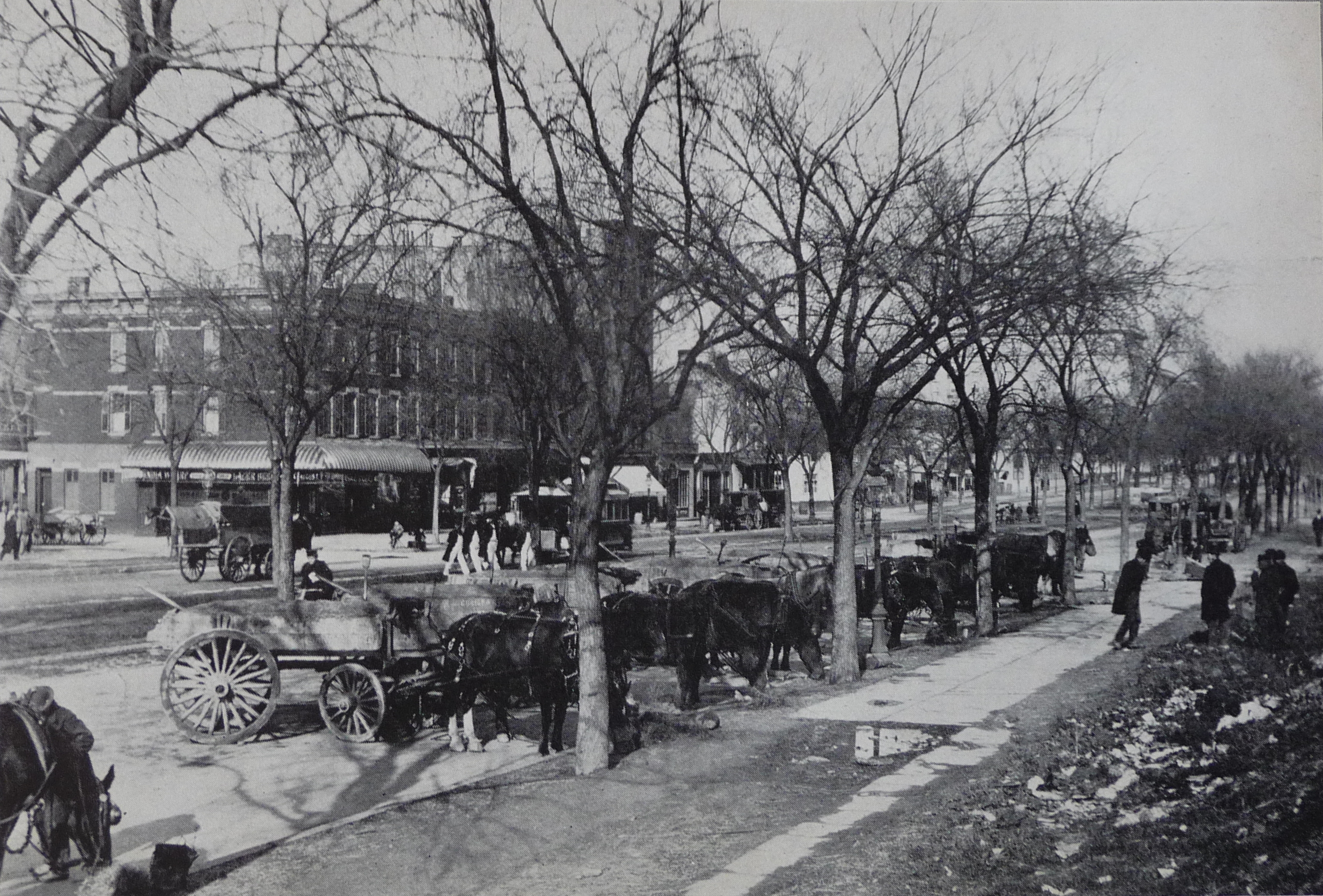
Up until the late 1800’s Broadway above 59th Street still retained much of its sleepy Dutch ways and was still called the Boulevard which followed the course of the Old Bloomingdale Road. The upper west side neighborhoods had their own unique character which were based upon the villages of Harsenville, Striker’s Bay, Bloomingdale and Manhattanville.

In the photo above from 1898 we see the Boulevard looking north and west from 80th Street with horses lined up along the curb. Building is sparse with low profile two and three story buildings. Commercial structures might contain blacksmith’s, grocery shops and tailors. Open land and farms were still nearby. In thirty years the change would be striking.

Land speculation and the coming of the subway would end the ruralness of the area.

Broadway 80th 81st Street 1928 photo H. N. Tiemann

Broadway looking north and west between 80th & 81st Streets. 1928 photo: H.N. Tiemann

This photograph taken in 1928 from the median of Broadway and 80th Street and looking in the same direction as the previous photo shows that almost everything from 1898 has vanished.

We see automobiles, but no horses. The trees that lined the street are gone and there is quite a bit of pedestrian activity along the street. Commercial stores line Broadway and 80th Street to the west and the north. The white building in the foreground is still standing today and now contains Zabar’s.

Continue reading →
Batman As 007 – Twelve Actors Who Turned Down The Role Of James Bond

Batman’s Adam West Is One Of Many Actors Who Were Offered The Role Of  Agent 007 James Bond, But Turned Down The Part

Adam West Batman

“The name’s West, Adam West”

There is a little of James Bond in every actor. That does not mean that every actor wants to play James Bond.

Bond is an expert in a wide range of subjects, an outstanding athlete and fighter, can drive any vehicle, land, air or sea and seems to have a way with the ladies. There are some critics who have complained that James Bond is a misogynist. If so, he has rarely used his “license to kill” on women. Out of 370 people Bond has killed on screen, only three have been women.

Recently while watching Diamonds Are Forever (1971), the extra features on the DVD mentioned that before Sean Connery agreed to return to the role of James Bond, several actors were considered to play 007 and some turned it down. The reasons varied, but I doubt that any of the actors regretted their decision.

The most surprising decline to me was Adam West who had brilliantly played the campy title role on Batman, ABC’s hit series which ran from 1966-1968. I can see how the producers considered him for the role, but I cannot imagine Adam West being James Bond. But then again neither could West and he was smart enough to pass on the part. On the other hand, some of the actors who turned down James Bond, I could see playing 007.

So here is a slideshow of just some of the actors who turned down the role of the world’s most famous secret agent.

A little more about Patrick McGoohan who had he accepted the role may have been the best actor to ever play the part. But it was not only the womanizing McGoohan objected to; he truly despised the character, calling Bond “contemptible and simplistic.”

McGoohan, a man of very strong ethics said in a 1960’s interview Continue reading →

70 Years Ago Today – President Franklin Delano Roosevelt Dies

The Nation Mourns After Learning of the Death Of  F.D.R.

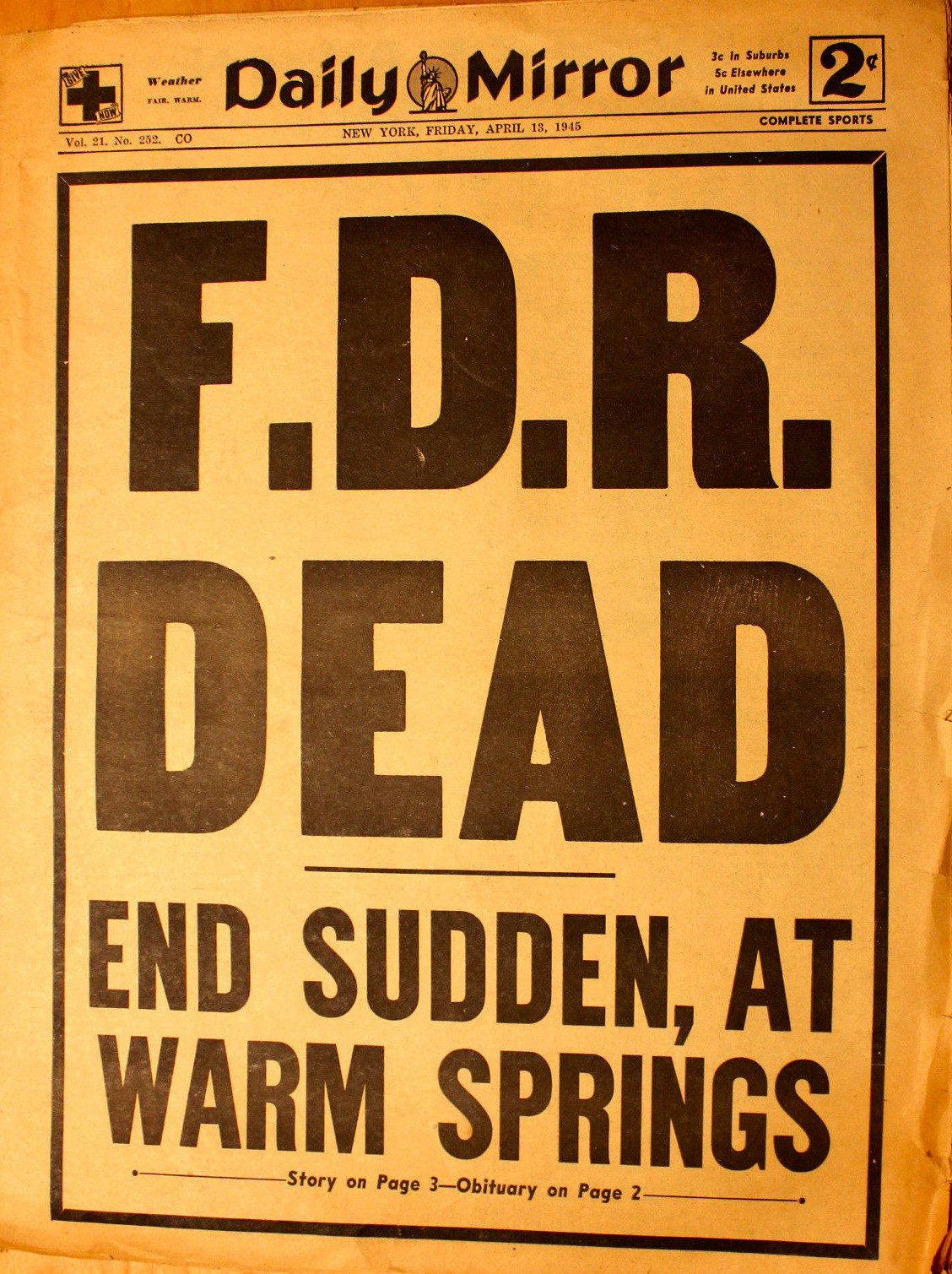
This is how the New York newspapers announced the death of F.D.R. on April 12, 1945.

70 years ago today when the 32nd President of the Unites States, Franklin Delano Roosevelt died suddenly of a massive stroke at the age of 63 in Warm Springs, GA  there was an overwhelming outpouring of grief across the globe.

With the exception of Adolf Hitler and a few die hard anti-FDR Republicans most of the world was saddened to learn of Roosevelt’s death. Roosevelt was held in high esteem by most Americans, even those that did not agree with many of his policies. There were also those who could not stand the man, but were in awe of Roosevelt as a shrewd politician and the job he had done in seeing the United States through the Great Depression and World War II.

It was especially sad that Roosevelt never got to witness the end of the war which brought final victory to the Allies. Less than four weeks after Roosevelt’s death, Hitler and Mussolini were dead and Victory in Europe Day was celebrated May 8, 1945. Japan unconditionally surrendered on August 15, 1945.

What I cannot imagine happening now in today’s world of partisan politics is having a universal outpouring of sorrow if a President were to die suddenly while in office. There is so much outright hatred and disrespect in modern politics that we will never see anything like this again.

FDR's funeral procession in Washington D.C.

FDR’s funeral procession in Washington D.C.

The Brooklyn Eagle Continue reading →

1,001 Ways To Die In New York City In 1855

 A Detailed Look At New York City Mortality For One Week In 1855

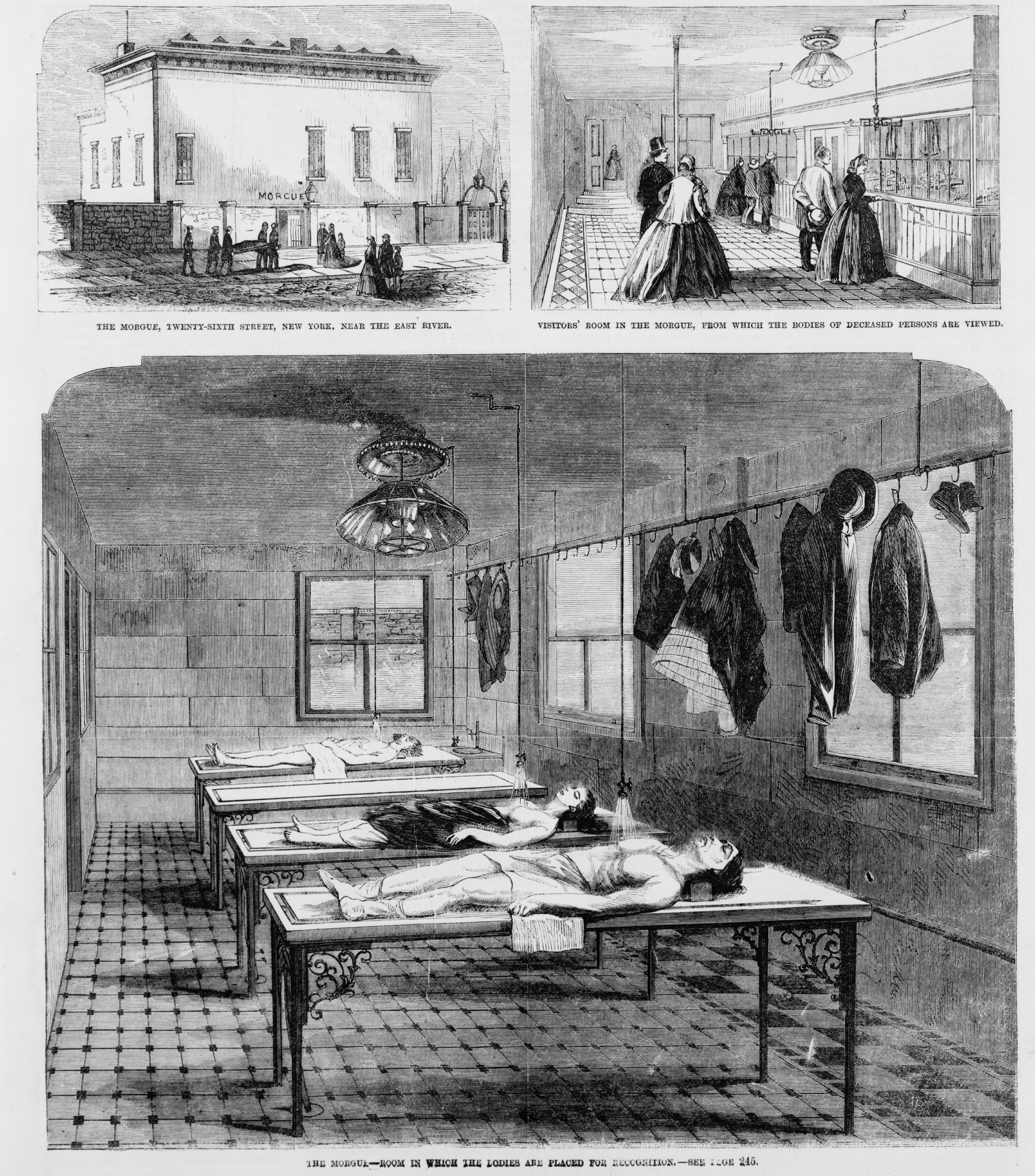
the new york city morgue Frank Leslies Illustrated Newspaper 1866

The New York City morgue

Maybe there weren’t 1001 ways to die, but in a typical week in New York’s death log 160 years ago there were at least 73 ways to enter into eternity. New York City was only the borough of Manhattan and the population was around 629,000.

355 people died during the week of September 22 – 29, 1855.

First looking at how people died we see things that are not predominant causes of death in the United States today.

The most common causes of death that week were: Consumption (38 dead); Infantile Marasmus (35 dead); Infantile Convulsions (31); Stillborn (25); Cholera (25) and Dysentery (20).

Consumption was the 19th century name for tuberculosis. What exactly is marasmus? It is severe malnutrition. Only 5 people died of cancer. Old age was listed only once as the cause of death.

Some other causes of death that week that are now relatively uncommon or in some cases all too common (i.e. shooting, suicide): Bleeding Bowels (1); Colic (1); Diarrhea (21); Dropsy of Head (9); Gravel (passing broken Kidney Stones) (1);  Hydrophobia (Rabies) (9); Scurvy (1); Suicide by arsenic (1); Killed or Murder by shooting (1); Casualty being run over (1); Drowned (1) and Teething (2). Teething?

Death came to both Continue reading →

1925 Police Chief Suggestion: Pay Bounties To NYPD For Killing Criminals

In 1925 A New York Police Chief Proposed Paying Cops Extra To Kill Criminals

Across the country complaints are rising against police officers using excessive force against alleged criminals. So it probably would not be politically correct today to make a suggestion that cops get paid extra to kill criminals. But that didn’t stop one top cop 90 years ago from making that proposal.

Second Deputy Police Commissioner George S. Dougherty c .1912

Second Deputy Police Commissioner George S. Dougherty c .1912

In January 1925 George S. Dougherty former NYPD Second Deputy Commissioner and Chief of Detectives wrote to the New York Times recommending that large bounties be paid to police officers who kill hold-up men.

Dougherty suggested that a police officer killing one hold-up man be paid $1,000, $2,500 for killing two and the astounding sum of $5,000 for killing three. This bounty would mean a regular patrolman could earn substantially more than the $2,500 annual base salary for killing a robber.

Though many citizens may have agreed and responded positively to the Chief’s populist proposal, it never gained any momentum. The New York Times commented that “of course no one goes into mourning when one of these land pirates meet the fate they deserve as enemies of the human race, and if a policeman in the exercise of his duty kills one of them it properly is regarded as a good job, well done. But Mr. Dougherty’s proposal is a very bad one.”

Several officials at the police department concurred with the Times opinion saying that if Dougherty’s suggestions were put into force, “they might incite indiscriminate shooting.”

Other positions advocated by Dougherty included: Continue reading →