
Union Square 14th Street & 4th Avenue 1905
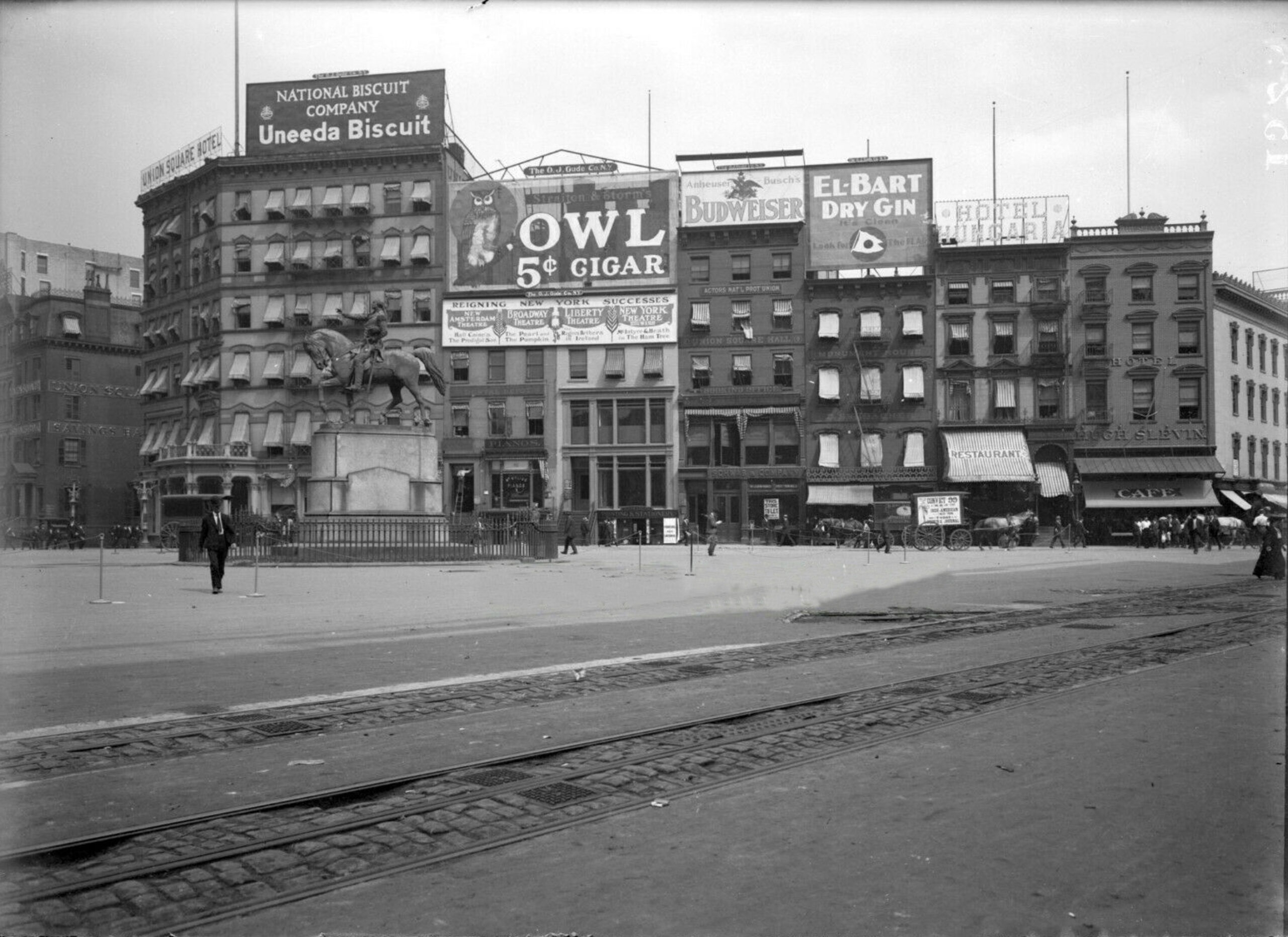 We are looking east along 14th Street towards Fourth Avenue. There are al least 50 people in the background, but the sparsity of pedestrians and traffic in this usually very busy area indicates that this was probably taken on a Sunday morning.
The seven small buildings between 14th and 15th Streets feature advertising of the day.
With street scenes as this, establishing a date is as simple as looking at the surroundings. Large signs from (l-r) advertise; The Union Square Hotel; Uneeda Biscuit; Owl Cigar; Budweiser; El-Bart Dry Gin; and Hotel Hungaria.
Though the billboard sign beneath the Owl 5¢ Cigar sign could have been left up beyond the plays it is advertising, it likely narrows the date of our photograph to autumn 1905.
The New Amsterdam Theatre is playing The Prodigal Son by Hall Caine which ran from September 4 – mid-October 1905. The Broadway Theatre has The Pearl and The Pumpkin from August 21 – November 1, 1905. The Liberty has The Rogers Brothers In Ireland running September 4, til its closing October 28 1905. The Ham Tree was playing at the New York Theatre from August 28 through November 11, 1905.
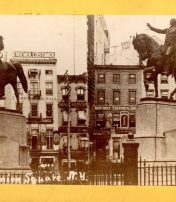
In the foreground is the bronze George Washington Equestrian Statue by sculptor Henry Kirke Brown in its original placement at the intersection of 14th St. and 4th Ave. The Barre granite base was built by famous church architect Richard Upjohn. The dedication of the statue was July 4, 1856. In 1929 Union Square underwent a redesign and the statue was moved out of harms way from the street to the central southern portion of the park.
 This entire block would be transformed beginning in 1912 when Samuel Klein set up shop at 10 Union Square.The enterprise grew.
S. Klein On The Square, the bargain department store, acquired and combined the hodgepodge of buildings seen above and was wildly successful. Klein’s Union Square closed in 1975.
All the buildings were demolished in 1986 to build Zeckendorf Towers in 1987.
I’ve lived in New York since 1981 and have no memory of the buildings that were razed in ’87. I guess that’s what happens when you live long enough — you just kind of forget what was there before. Always good to see Uneeda Biscuit, of course.
Here’s an idea that nobody will take me up on: put up revivals of plays from the early 20th century, just to show what people paid to see back then. I bet they’re mediocre at best.
The buildings that housed Klein’s were dingy, and entering them was a zoo-like experience, but very much “old” New York.
I am really glad you brought this up about the Broadway shows of 1900. I have thought about this hundreds of times.
The reality is we will never know how the old shows would play today for two reasons.
1) I have read many first person accounts of the New York stage from the late 19th and early 20th century from the players and those who saw the shows. I believe the stars of the stage combined with the impresario producers / writers / directors are what made these plays work in the first place.
I could name a hundred stars of the legitimate stage at the turn-of-the-century and I obviously never saw one of them. Very few of them lasted long enough to make sound films. So there is no record of them performing or if so only when they were much older and not leading players. But today there is no Martin Beck, David Belasco, B.F. Keith, Charles Frohman George M. Cohan or Clyde Fitch to put on these plays.
With the exception of John, Lionel and Ethel Barrymore very early few stage stars made the transition to film. And the big stars are not even known by anyone today, except theater historians. But at the time they were appearing, Julia Marlowe, Maude Adams, Minnie Maddern Fiske, Ellen Terry, Nat Goodwin, Frank Bacon, Elsie Janis, Clara Morris, Raymond Hitchcock, John Drew and dozens of other stage luminaries had huge followings and could literally make a play work.
Were the shows even good? I agree with you about the quality. They were appropriate for the time, but would be judged mediocre viewing them through a modern lens.
2) But here’s the real issue: we’ll never know. Even though these plays were copyrighted and are supposed to be filed with the Library of Congress, relatively few complete plays / musicals of that time are extant. Even a late example such as the Marx Brothers breakthrough 1924 play I’ll Say She Is, which was a revue with musical interludes, there is no complete script; just an outline.
The first play listed in the article, The Pearl and The Pumpkin, the book is available, the sheet music for the show is available, but good luck finding the show script and stage directions. I believe it is like this for the majority of these types of shows. The show itself is not preserved anywhere.
Peter Pan was written by J.M. Barrie and in the New York production Maude Adams made the role her own. It is one of the few shows from 100+ years ago that still gets revived. But I bet it was a special show with Maude Adams if not better than as a musical with Mary Martin or any other iteration of it.
With the lack of originality on Broadway, especially plays, you would think there is someone who might have researched the old “successful” plays to possibly revive.
Or maybe not.