Though your first guess of who might be behind this frightening mask may be Hannibal Lecter, Jason or Leatherface, it is actually hockey player Jacques Plante.
The legendary Montreal Candiens goalie was not the first to use a mask for protection, but Jacques Plante was the player to introduce the goalie mask as everyday equipment. Before Plante, the only goalie previously to wear a mask was the Montreal Maroons’ Clint Benedict who wore one briefly in 1930 to protect a broken nose.
This Associated Press photo was taken January 23, 1948 when Plante was just 19-years-old. He was playing organized hockey for the Quebec Citadelles and was still five years away from his NHL debut with the Canadiens.
This leather and fiber mask Plante wore in 1948, was used only in practices because there were so many pucks coming at him at once.
Plante first donned a mask in a game on November 1, 1959 against the New York Rangers at Madison Square Garden. Plante was struck on the left side of his nose and upper lip in the first period on a shot from Andy Bathgate. The game was delayed 20 minutes as Plante left the ice, received seven stitches and returned wearing a plexiglass mask (not the one seen in the photo above).
Montreal coach Toe Blake, a traditionalist, had been an ardent opponent of Plante wearing a mask. Continue reading →
A Horse Commits Suicide, A Man Falls 60 Feet From A Building And Is Uninjured & Instructions On How To Wash Your Face
Interesting “News” From The Lowville Times In The Summer of 1881
photo: Yester-Images of Lowville NY on postcards by Larry Myers
Lowville is a sleepy town in Lewis County, upstate New York, about 40 miles east of Lake Ontario and about 90 miles north of Syracuse. Just under 5,000 people call this town home. The most famous person associated with Lowville is probably Peter Ostrum, who played Charlie in the original Willy Wonka and the Chocolate Factory. Peter is a veterinarian at Countryside Veterinary Clinic in Lowville.
The town was founded in 1797 and by 1881 had a population which was a tad over 3,000 people, mostly comprised of assiduous farmers and merchants.
Like most aspiring small towns across America, Lowville had their own newspaper, a weekly journal comprised of four pages called the Lowville Times which existed from 1876-1884. It featured a smattering of national and international news, but the main feature for the citizens of Lowville and the surrounding towns of Copenhagen, Carthage, Constableville, Martinsburgh and Boonville, was the “local matters” section on page three.
It featured not so much news as it did gossip, illnesses, births, deaths, religious revivals, calls for temperance, arrivals and departures of visitors, and rumblings about town and other community news from larger towns around New York State.
An accurate statement in the newspaper of August 25, 1881 read “A stranger visiting Lowville on Wednesday, the day of the Band Boys’ excursion would have pronounced it a dull place.” What the paper doesn’t say is that this was probably true 360 days out of the year. But in the 19th century it was a beautiful town, with hills and rolling meadows. The pace of life was slow and hard work was rewarded with leisurely pleasures, like regular town picnics featuring music and refreshments.
Besides reporting local mundane items like, ” The picnic was well attended on Saturday last,” and “R.J. Richardson and Frank Doig killed 17 woodcock on Tuesday,” there are stories that are succinct, unusual and interesting.
Here are a selection of short news items with some editorial flair from the summer of 1881:
June 23 – Mr. Albert Eldridge, foreman in the Lowville Manufacturing Co.’s saw mill had a tussel with a hand spike, and we should judge by the looks of his eye that he got the worst of the bargain.Continue reading →
Hall-of-Famer Gabby Hartnett Signs Autographs For Al Capone and His Son – 1931
Associated Press Photo From Chicago
Al Capone takes his son to the ball game surrounded by his watchful lieutenants. Chicago’s gang chief and his 12-year-old son, Al Jr., get Gabby Hartnett of the Cubs to autograph a baseball just before the Cubs defeated the White Sox, 3 to 0, in a charity game before 35,000 spectators at Comiskey Park, Chicago, Sept. 9. Pictures of Capone before the public are not frequent, and a pose with his son is rare. He affectionately calls the boy “Sonny.”
Note the watchfulness of one of his bodyguards directly behind him. A pop-corn vendor evidently rubbed his shoulder and he looks ready to protect his chief. 9-9-31
This photograph made me wonder if Al Capone’s bodyguards were licensed to carry firearms and if they were packing heat when they visited Comiskey Park? It certainly looks like the bodyguard is reaching into his jacket to pull out his “roscoe” or maybe it was his wallet to pay for the popcorn.
One other thing to note: “Sonny,” does not look thrilled to be at the ballpark, much less getting an autograph from Gabby Hartnett.
Tuesday, November 9, 1965 – The Night The Lights Failed
Nov. 10, 1965 – New Yorkers During Blackout – People sleep sitting up and lying down in New York’s Grand Central Terminal early today during the power failure. This area is lit up with emergency lighting. (AP Wirephoto)
In the past 50 years New York has experienced three huge blackouts; August 14, 2003; July 13-14, 1977; and the first large scale blackout that affected much of the northeast, November 9-10, 1965.
30 million people were affected when the electricity went off, cascading from Ontario to Buffalo to New Hampshire and on through to New York City where at 5:40 pm the power failed, plunging the city into darkness. Trains, elevators, traffic lights and all electric ceased to function as many New Yorkers were literally stopped in their tracks.
Blackout: Using a candle for a light passengers look at another passenger sleeping on the floor of a stalled subway train during power failure. November 10, 1965 (AP Wirephoto)
Would you vote for any of these men based upon their photographs (or voices)?
Let’s not generalize and say modern Americans are shallow, but research confirms that public image and to a lesser extent how someone talks, does influence the electorate.
One classic, yet apocryphal example, is the first televised presidential debate in 1960, in which supposed surveys showed people listening on the radio thought Richard Nixon was the clear winner of the debate, whereas people watching on television thought John F. Kennedy was the victor.
Today we are bombarded by media 24/7. It has becomes a challenge to capture anyone’s attention. The current presidential debates have devolved into images and soundbytes that convey little when it comes to substantive ideas and solutions for making our country functional. The public and media analyze Donald Trump’s hair; if Hillary Clinton has “had work done” or why Ted Cruz “talks weird.”
So now, imagine life 100 – 125 years ago. Most Americans never ventured more than a few miles from where they were born. There was no internet, television or radio. Images were viewed in newspapers and magazines. If you heard a politician speak, it was, in person addressing an attentive crowd.
The technological revolutions around the turn of the century were stunning to the masses. The development of motion pictures, x-rays, electric appliances (beginning with the toaster), airplanes and audio recordings astonished people.
Maybe you’ve seen grainy silent films of the men who served as presidents of the United States at the turn-of-the-century. They are silent, stoic and graven in image. What did they sound like? How did they talk?
Most people do not realize that these early president’s voices were recorded and preserved for posterity, usually by the Edison Company on wax cylinder disks. The following recordings are part of the Vincent Voice Library at Michigan State University. It is very interesting to hear what these men sounded like.
Based upon their photographs and voices, could any of these men be elected today?
First we have President Grover Cleveland (the 22nd and 24th president 1885-1889 & 1893-1897) the only man ever to be elected twice in non-consecutive terms.
Cleveland was mayor of Buffalo and governor of New York before becoming president. In 1884 a book was published called Off-hand Portraits of Prominent New Yorkers by Stephen Fiske. The coda to the profile on Cleveland accurately predicted “If he shall make the same sort of a Governor as he has a Mayor, the road to the White House is open to him, and this sketch may yet be entitled the portrait of President Cleveland.”
Grover Cleveland’s voice, recorded during a campaign speech in 1892 is a bit hard to hear with all the static, but is comprehensible.
The way most politicians in the 19th century wrote, is the way Cleveland speaks. Cleveland puts out his speech with melodrama and clear diction.
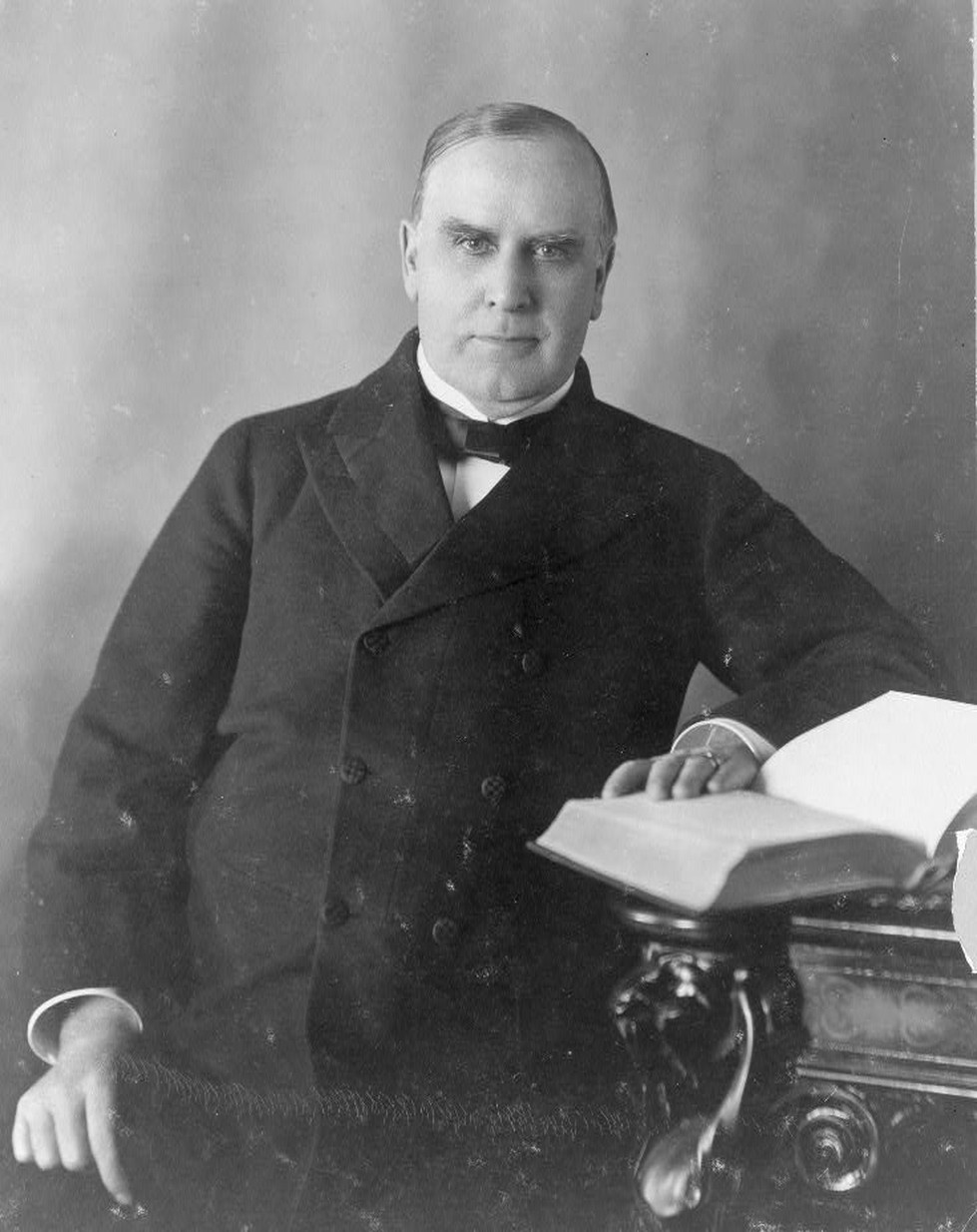
Next, the 25th President William McKinley (1897-1901) who never left his front porch at his home in Ohio to campaign. McKinley was assassinated by an anarchist in 1901, which put Theodore Roosevelt into the executive office.
McKinley on this recording from 1896, talks about the Republican platform. Similar to Grover Cleveland, McKinley speaks the way you’d imagine a 19th century politician would talk. McKinley’s speech pattern epitomizes the 20th century movie portrayal of 19th century diction, emphasizing certain words, and like Cleveland, drawing out his syllables.
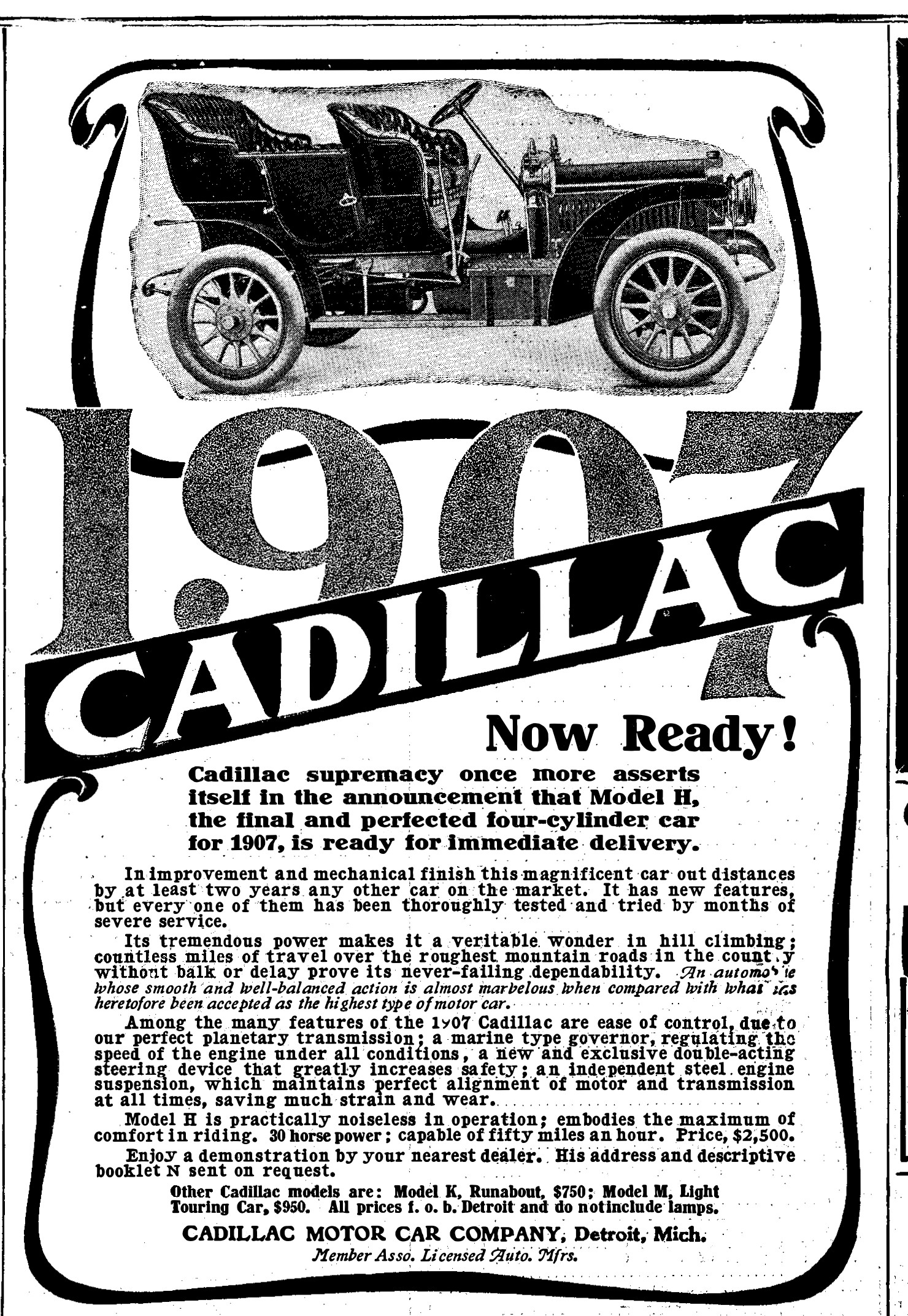
4 Cylinders, 30 Horsepower, With Speeds Reaching Up To 50 Miles Per Hour!
In the first couple of decades of U.S. automaking, there were so many car companies competing for what was originally a very limited business. From 1895-1930 it is estimated that there were over 1,800 car manufacturers in the United States alone. Cadillac is one of the few companies that survived those early days and have flourished into the 21st century.
I found this ad which appeared in the September 8, 1906 issue of Scientific American Magazine while researching the previous story on the Singer Building. Cadillac Motor Car Co. proclaims several things for the new Model H:
A veritable wonder in hill climbing!
Perfect planetary transmission
Double acting steering device that greatly increases safety
The Announcement of The Construction of The World’s Tallest Building 1906
The Singer Building: An Architectural Marvel When It Was Originally Constructed
When you think of tall buildings you probably don’t think a building 612 feet tall is all that important. In 1906 it was considered a staggering height, as a building that size had never been built before.
What is interesting when reading the account of the announced construction of the Singer Building in the Scientific American, is the sense of wonderment in describing how much taller than any other building The Singer Building would be.
Singer Tower Under Construction
The article speaks in flowery language of the proud achievement of being able to construct a building so “lofty.” Overcoming the posed difficulties in constructing tall buildings was merely a matter of “let’s sit down and figure out how to do this.” Coming through in the writing is the confidence that we are witnessing technical advancements coming in leaps and bounds. The reader palpably feels that not just in construction, but in all areas America itself has unlimited potential.
1867 Advice On How Often and When You Should Have Sex According to a Prominent New York Doctor
In Woody Allen’s masterpiece Annie Hall (1977), there is a split screen scene in which Diane Keaton (Annie Hall) and Woody Allen (Alvy Singer) are each separately talking to their respective therapists. The questions and answers overlap one another setting up the following exchange.
Alvy’s Therapist: How often do you sleep together?
Annie’s Therapist: Do you have sex often?
Alvy Singer: Hardly ever. Maybe three times a week.
Annie Hall: Constantly. I’d say three times a week.
Too much or too little sex is really in the mind of the beholder.
So what did one leading 19th century doctor feel was the right amount of sex? Apparently very little according to a book entitled Sexual Physiology A Scientific and Popular Exposition of the Fundamental Problems in Sociology by Russell Thacher Trall M.D, published by Miller, Wood and Co. 1867.
Doctor Trall (1812-1877), the author of the book, was a man well ahead of his time in many aspects, not so much in others; in 1853 he wrote a 118 page diatribe on the dangers of the “disease of masturbation,” which is a hoot to read. Trall who was religious but not a fanatic, maintained that drugs harmed the body; was a proponent of vegetarianism; vehement in his opposition to tobacco and alcohol; and in 1852 founded New York Hygieo-Therapeutic College, the first medical school to admit women on equal terms with men. In his Sexual Physiology book, Dr. Trall is quite frank about many topics; explaining the facts of life; divulging how the sexual organs work; and he even includes a very forward thinking chapter regarding women’s sexual rights.
What caught my attention was the chapter on sexual intercourse. Dr. Trall writes with an almost shocked tone that he knows of people who have “indulged in sexual intercourse as often as once in twenty-four hours, and some who have indulged still oftener. ”
Frequency of Sexual Intercourse
For those who live riotously ; who are constantly goading their sexual passions into abnormal intensity by means of gross food, stimulating viands, and obscene associations, no better rule can be given than the less indulgence the better.
The majority of young persons unite in matrimony with no education whatever on this subject; and habits, right or wrong, are soon formed which are apt to be continued through life. I have had patients who had for years indulged in sexual intercourse as often as once in twenty-four hours, and some who have indulged still oftener. Of course the result was premature decay, and often permanent invalidism. It was not because these persons were inordinately sensual, or unusually developed in the cerebellum, that they damaged themselves in this way. It was simply because they knew no better. Many a man who would have been a good husband if he had only known how, and who would not for his life, much less for the momentary pleasure it afforded, have endangered the health, or hazarded the happiness of a well beloved wife, has destroyed her health, happiness and life (some men several wives successively) by excessive sexual indulgence.
So with that introduction you should not be surprised by Dr. Trall’s opinion regarding the proper amount of sex for a married couple, which he finally gets to: Continue reading →
Over the years I’ve collected what I think are sound words of wisdom and pithy lines. These fall into the latter category. While you may not find many of these in Bartlett’s Quotations, I’m sure there will be a couple of quotes here that should go down in posterity as memorable and be included in that most famous of quotation books.
Thoughts to ponder:
“Being a woman is a terribly difficult task, since it consists principally in dealing with men” – Joseph Conrad
“A dose of poison can do its work only once, but a bad book can go on poisoning people’s minds for any length of time” – John Murray
“Some have been thought brave because they were afraid to run away.” – Ralph Waldo Emerson
Before There Was Central Park, There Was Green-Wood Cemetery
Greenwood Cemetery Bayside Ave. Fern Hill Mausoleums – print published 1855
While few New Yorker’s today take Central Park for granted, there was a time in the city’s history that open spaces where nature could be enjoyed unimpeded by noise and pollution were scarce.
Greenwood Cemetery The Angels Await stereoview circa 1870
The great public parks which we enjoy today did not come into existence until the late 1850’s with the creation of Central Park followed by Brooklyn’s Prospect Park in 1867. From the 1840s until the 1860s, the rural cemetery was the place to go if a New Yorker or visitor wanted to experience rolling hills, plains, lakes, fabulous artworks and stroll peacefully while contemplating life.
The oldest of these rural cemeteries in New York City is Brooklyn’s Green-Wood Cemetery which was founded in 1838.
Green-Wood itself put out its own tour book soon after its creation to give visitors what they called “the tour.”
Green-Wood Cemetery admission ticket 1886
What could you expect when you got there besides mausoleums and tombstones?
Nature in abundance.
To give you an idea of how popular it was to visit Green-Wood, this section of Appleton’sNew York City and Vicinity Guide by W. Williams, published by D. Appleton and Co. (1849) extols some of Green-wood’s virtues: Continue reading →

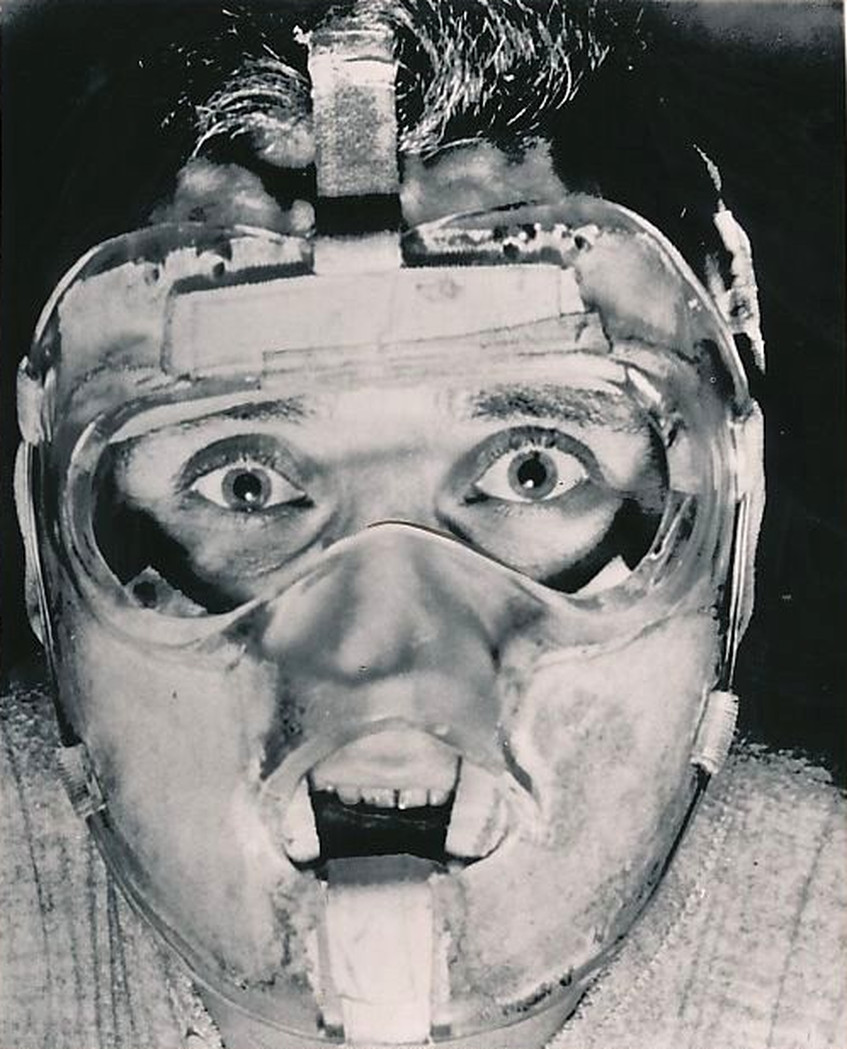 Though your first guess of who might be behind this frightening mask may be Hannibal Lecter, Jason or Leatherface, it is actually hockey player Jacques Plante.
 Plante first donned a mask in a game on November 1, 1959 against the New York Rangers at Madison Square Garden. Plante was struck on the left side of his nose and upper lip in the first period on a shot from Andy Bathgate. The game was delayed 20 minutes as Plante left the ice, received seven stitches and returned wearing a plexiglass mask (not the one seen in the photo above).
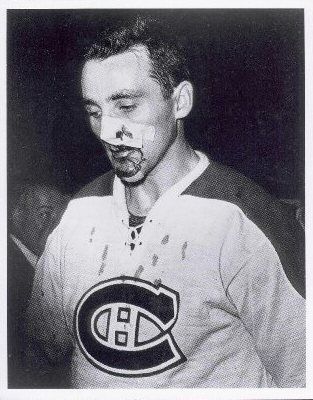 Montreal coach Toe Blake, a traditionalist, had been an ardent opponent of Plante wearing a mask. Continue reading