Author Archives: Max

Things You Should Know If Visiting New York City In 1873

“Thousands of children are imported from Italy each year to turn them into organ-grinders and street beggars.”

12 Helpful Hints And Notes From 1873

Standing on Broadway by New York City Hall circa 1870

A tourist standing on Broadway by New York City Hall circa 1870

From the wordily titled – Wood’s Illustrated Handbook To New York and Environs: A Guide For The Traveller or Resident With Minute Instructions For Seeing The Metropolis In One or More Days Together With Numerous Valuable Hints To Visitors On Nearly Every Topic That Arises Upon The Subject of Sight-Seeing, G.W. Carleton Publishers, 1873, we learn surprising things about New York City.

If you lost something of value in public there was an excellent chance that it would be returned to you.

Saturday was the fashionable day for ladies to attend public entertainments – alone!

Wood’s Handbook’s aim was to point out interesting things about New York City without preaching to the reader.

As the guidebook says;

We think the sight-seer may now be safely left with the “Handbook ” to the guidance of the Index and Map and to his own inclinations and judgment.

He will speedily discover that our object in the preparation of this volume has been not to confuse and weary him by stale remarks and hackneyed observations about this or that, but to put him in a position to see, and admire, and criticize from his own stand-point of taste and opinion. We think the sight-seer requires ready hints, not stupid essays; and if we conduct him to a remarkable locality or a well-known structure, he will not care to have us stand perpetually at his elbow telling him what to admire, and what he ought not to be pleased with.

Since the book contains no “hackneyed observations,” the section called “helpful hints” are what we thought were worth highlighting rather than the sights to be seen.

From among the many listed, we have culled, a dozen of the helpful hints for visiting New York:

1- A GLASS OF BRANDY, in an emergency, can be obtained at any apothecary. No wines, ales, or liquors are permitted to be sold in New York at any bar on Sunday. The guests of a hotel can be served with them, however, at table or in their rooms.

2- ORGAN-GRINDERS and STREET-BEGGARS — Thousands of children are annually exported from Italy to the United States for the purpose of making them organ-grinders and street-beggars, of whom a multiplicity are to be seen in New York. A bill has been brought before the Italian Parliament, designed to put a stop to this disgraceful traffic in children. It punishes with five years’ imprisonment all persons exporting children under twelve years of age to foreign countries, under any pretext. Continue reading

Old New York In Photos #42 – Central Park Transverses

Central Park Transverses 1863

Central Park Transverse at 79th St looking east 1863

Central Park Transverse 79th St looking east 1863

Central Park Transverse (which one?) 1863

Central Park Transverse (which one?) 1863


Frederick Law Olmstead and Calvert Vaux, the designers of Central Park, had amazing foresight to build transverses through the park so that omnibus, carriage and horse traffic, could get crosstown without disrupting the flow of the landscape. Users of the park today are the beneficiaries of the uninterrupted paths and vistas as automobile traffic crosses the park out of sight and mind.

These two photographs are from stereoviews taken in 1863 by E. & H.T. Anthony & Co. who took some of the best images of mid-nineteenth century New York. They show the recently opened Central Park with little activity and just a few buildings in the background. Continue reading

October 3, 1951 A Day Brooklyn Dodgers Fans Would Love To Forget

The Moment Bobby Thomson Hit His “Shot Heard Round The World”

Bobby Thomson connects, Oct. 3, 1951, catcher is Rube Walker, umpire is Lou Jorda photo: Wide World

Bobby Thomson connects, Oct. 3, 1951, catcher is Rube Walker, umpire is Lou Jorda photo: Wide World

This article is titled “A Day Brooklyn Dodgers Fans Would Love To Forget” but in actuality Brooklyn Dodgers fans are dwindling in number.

You’d have to be at least 60 years old to have any memory of “dem bums” playing at that great ballpark known as Ebbets Field. The team moved to Los Angeles in 1958, breaking everyone in Brooklyn’s hearts.

The day the Dodgers left Brooklyn for smoggy L.A. was a horrible moment, but no moment was as painful for Dodgers fans as the Giants bottom of the ninth inning comeback of a best two out of three playoff series with the Dodgers.

On Wednesday October 3, 1951 one of the most memorable events in all of baseball history occurred. As seen in the photo above, Dodgers fans were devastated when the New York Giants third baseman Bobby Thomson hit a one out, three run home run to left field off of Dodgers pitcher Ralph Branca, to give the Giants a 5-4 miracle win at the Polo Grounds and propel them into the World Series against the Yankees. Continue reading

One Of The Greatest Pitching Performances Ever

49 Years Ago, Satchel Paige Shut Out The Red Sox For Three Innings. 

No Big Deal, Except That He Was 59

Satchel Paige, age 59 warming up on September 13, 1965 two weeks before facing the Red Sox photo: AP

Satchel Paige, age 59 warming up on September 13, 1965 two weeks before facing the Red Sox photo: AP

To hold “a day” for a ballplayer years after he last played in the major leagues is a special treat for the player. What makes it even more special is when the player participates in the game.

Forty nine years ago on September 25, 1965, Satchel Paige stepped on to the field at Kansas City’s Municipal Stadium on Satchel Paige Night as the starting pitcher for the Kansas City Athletics. It was supposed to be a publicity stunt conceived by Athletics owner Charlie Finley to boost attendance, but Paige took his pitching seriously and would not be embarrassed.

Paige considered by many to be the Negro League’s best pitcher for over two decades, came to the Major Leagues when he was 42-years-old in 1948 when he was signed by Indians owner Bill Veeck.

Paige went 6-1 with a 2.48 ERA that year and helped Cleveland win the pennant. Paige stayed in the majors until he was 46 and continued playing in the minors and barnstorming into the early 1960’s.

At Satchel Paige Night, Charlie Finley had provided a rocking chair for Paige to sit in before the ball game began and a nurse was stationed next to Paige to massage him and keep his arm loose.

The visiting Boston Red Sox did not lay down for Paige. They tried, but the crafty 59-year-old was not going to let a bunch of kids show him up on his own night.

In the first three innings the Red Sox managed to get a runner on with an error and a double by Sox star Carl Yastrzemski.

At the beginning of the fourth inning with the A’s winning one to nothing, Paige went to the mound Continue reading

Thurman Munson And Billy Martin Argue A Call

Thurman Munson Is Out And Billy Martin Does Not Agree

Thurman Munson Billy Martin argue call July 21 1978

There was no instant replay back when this scene occurred on July 21, 1978 as Billy Martin pleads his case in vain to umpire Durwood Merrill. Believe it or not, they are arguing that Munson should have been called safe when he attempted to steal home.

The Yankees were playing the Minnesota Twins at Metropolitan Stadium, a place very familiar to Yankees manager Billy Martin and the theft of home. When Martin managed the Twins in 1969 he taught Rod Carew how to swipe home and Carew ended up with a record seven steals of home.

It was not a big deal that Munson was called out in this instance, as the Yankees won the game 4-0.

Classic Hollywood #33 – James Stewart, James Cagney & Orson Welles

James Stewart & Orson Welles Visit James Cagney On The Set Of His New Movie – 1957

James Stewart James Cagney Orson Welles August 20 1957

STEWART AND WELLES HELP CAGNEY “GET THE SHOW ON THE ROAD”

Jimmy Stewart, left, and Orson Welles, right, paid a surprise visit to the famed Phantom Stage at Universal-International Studio to extend best wishes to Jimmy Cagney at the start of production on “Man Of A Thousand Faces,” the life story of Lon Chaney, Hollywood’s famed man of mystery. Stewart was filming “Night Passage” on an adjoining stage at the studio and Welles was on the lot starring with Jeff Chandler and Colleen Miller in “Pay The Devil.” “Man Of A Thousand Faces,” also starring Dorothy Malone, “Oscar” winner for her portrayal in “Written On The Wind,” and Jane Greer. Joseph Pevney directed for Producer Robert Arthur. (credit: Universal-International Photos August 20, 1957)

Lon Chaney and his makeup kitMan Of A Thousand Faces was not one of Jimmy Cagney’s better films. As good as Cagney was, he was miscast as Lon Chaney who he did not even remotely resemble. Here is a rare photograph of Lon Chaney with his famed make-up kit. Continue reading

1949 Yankees All-Stars – DiMaggio, Berra, Henrich, Reynolds & Raschi

New York Yankees All-Stars Of Yesteryear

Vic Raschi Tommy Henrich Joe DiMaggio Allie Reynolds Yogi Berra Yanks All Stars July 6 1949 photo © Acme

In 2014, the struggling New York Yankees have three players that were named to the All-Star team: Derek Jeter, Dellin Betances and Masahiro Tanaka, who will not play because of an elbow injury.

In 1949 the Yankees had five players play on the All-Star team. Seen in this photo from left to right are Vic Raschi, Tommy Henrich, Joe DiMaggio, Allie Reynolds and Yogi Berra.

There were 32,577 fans in attendance in what turned out to be a slugfest at Brooklyn’s Ebbets Field, as the American League topped the National League 11-7. Joe DiMaggio drove in three runs and Vic Raschi pitched three scoreless innings to get the save.

Old New York In Photos #38 – Fifth Ave. & 44th St. 1923

Fifth Avenue Looking North From 44th Street 1923

Fifth Ave north from 44th st 1923

There is a lot of activity in this photograph taken in 1923 showing Fifth Avenue looking north from 44th Street.

No traffic signals impede the two way traffic which runs on the avenue. A Fifth Avenue double-deck bus is heading northbound packed with passengers. Pedestrians walk along on the avenue while deliveries are being made from trucks, like the one in the lower center of the photograph.

Among the buildings seen are H. Jaeckel and Sons Furriers which occupied the west side corner of Fifth Avenue at 45th street and further in the distance at 48th street is the spire of the Collegiate Reformed Protestant Dutch Church of Saint Nicholas. The church was designed by architect Wheeler Smith and was built from 1869-1872. Theodore Roosevelt and his family occupied pew number number 39. The church was demolished in 1949 and the land was leased to Rockefeller Center.

Book Advertisement From 1915: How To Make Love

“What To Do Before And After The Wedding” Among Other Things

Ad Book How To Make Love world almanac 1915So, how did people learn about sex and seduction 100 years ago? From a book of course. This ad appears in the 1915 World Almanac and was just too good not to share.

The text reads:

How To Make Love

(NEW BOOK) Tells how to Get Acquainted; How to Begin Courtship; How to Court a Bashful Girl; to Woo a Widow; to Win a Heiress; how to catch a Rich Bachelor; how to manage your beau to make him propose; how to make your fellow or girl love you; what to do before and after the wedding. Tells other things necessary for Lovers to know. Sample copy by mail, 10 cents.

Royal Book Co. Box 10 So. Norwalk, Conn.

The Simplicity Of The First Federal Income Tax

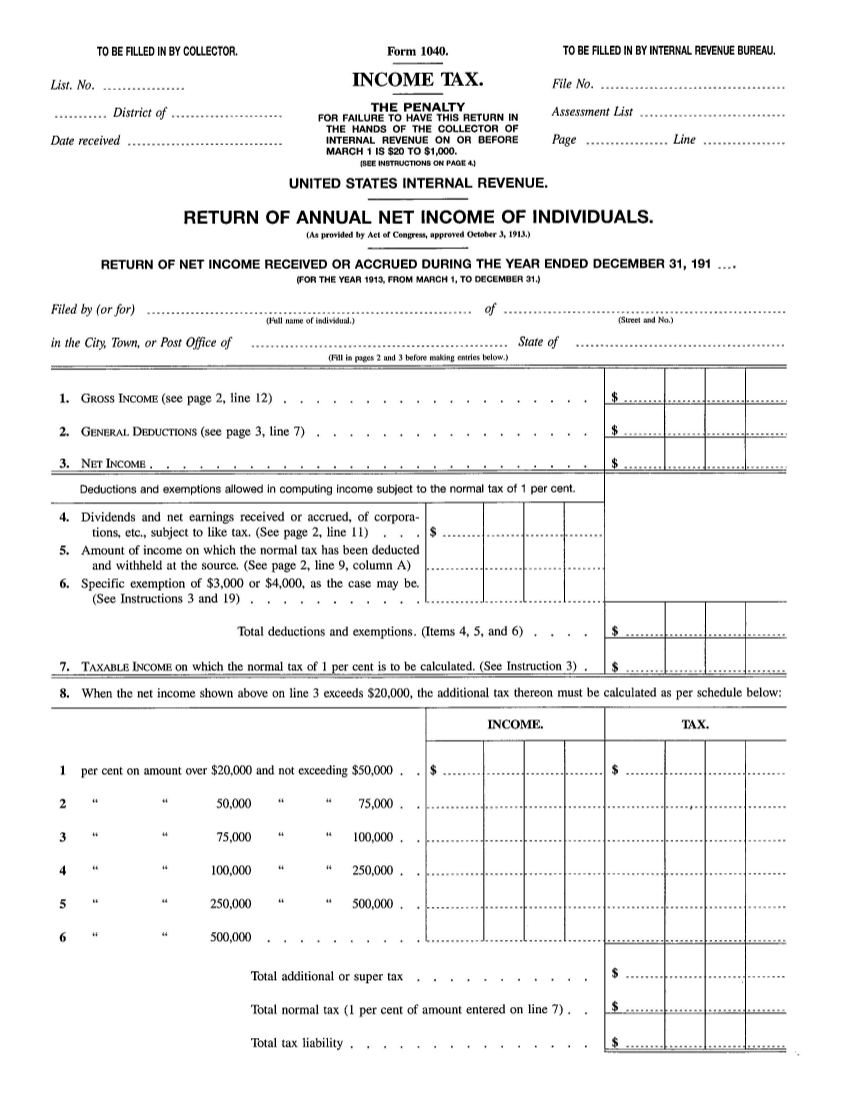
The First Income Tax Form Of 1913 And How Much The IRS Collected

1913 tax form pg 1

click to enlarge

It was 100 years ago that the 1040 individual tax form many Americans dread filling out was introduced.

One thing is for sure, it was a lot simpler to file taxes in 1914 than today.

Pictured above is the 1913 1040 tax form which was due March 1, 1914.

With only three short pages to complete and one page of instructions, for most people who had to file, the average time to complete their taxes would take about an hour.

Had to file is an important term here, because the first $2,500 or $3,333.33 of income in 1913 for single and married couples respectively, was exempt. After 1914 the rate was $3,000 and $4,000 respectively. Considering very few Americans made more than $1,000 per year in income, the vast majority of Americans were exempt from paying any tax.

According to the Department of Labor in 1913, the average family household income was $827. Continue reading