Author Archives: Max

Mel Ott Rare Batting Photos

The Unusual Swing Of New York Giants Star Mel Ott

Mel Ott swing sequence 1

It’s hard to imagine in this era where everyone is recording everything, that there is very little film of the old time great players (pre-1950) actually playing.

Because of this when all-time, all-star lists are drawn up the players, modern ballplayers usually get picked over old-timers because there are few people alive who saw those old-timers play. There are exceptions like Babe Ruth, Ty Cobb, Christy Mathewson, Walter Johnson and other greats who have superb stats or reputations that have carried into the 21st century. They get named to those all-time lists. But many of the early 20th century’s great players are mostly forgotten.

A case in point is Mel Ott, the  slugger who played his entire career with the New York Giants from 1926 until 1947. Ott had 2,876 hits, 511 home runs, drove in 1860 runs and hit .304 in his 22 year career.

The left-handed hitting Ott had one of the strangest batting stances in baseball, lifting his right leg high in the air while the pitch was on the way to the plate.

In this rare sequence of photos Continue reading

Mickey Mantle In Glorious Kodachrome Color Photos

25 Color Photographs of Mickey Mantle In The 1950’s & 60’s

Mickey Mantle portrait 1956 photo Marvin Newman

Mickey Mantle portrait 1956. photo: Marvin Newman

The name Mickey Mantle still evokes strong emotions for baseball fans of a certain age.

For if you ever saw Mickey Mantle play, you would never forget it. If you never had the pleasure, I’ll try and describe it.

Mickey Mantle powerful swing photo Marvin Newman

Mickey Mantle’s powerful swing. photo: Marvin Newman

Mantle swung the bat literally as hard as anyone who ever played the game. You would see his forearms and biceps bulge as he whipped the bat through the strike zone on a slight incline. Watching Mantle swing you could literally see that every muscle in his six foot frame was converging to pulverize the baseball.

When Mantle connected cleanly with the ball, the sound was unique. There was a sharp crack that resonated through the entire ballpark and that ferocious swing would drive countless baseballs deep into the gaps or frequently farther, with balls settling in the outfield stands or bleachers for a home run. There was no home run, like a Mickey Mantle home run.

Mickey Mantle stealing 2nd base and slides hard 1950s photo Marvin Newman

Mickey Mantle steals 2nd base and slides hard 1950s. photo: Marvin Newman

In his prime there were few fielders like Mickey Mantle, who could come out of seemingly nowhere to snag a drive hit in the gap, that when first hit, was thought to be uncatchable. Mantle’s arm could throw bullets, so runners had to think twice about taking an extra base or tagging up when the ball was hit to Mickey.

Mantle played hard breaking up double plays and stealing bases when necessary, even though he was playing on notoriously bad legs which would hamper his entire career. Continue reading

Jackie Robinson Forced Out At Second By Ernie Banks 1955

May 11, 1955 Brooklyn Dodgers 11 Game Winning Streak Comes To An End

Jackie Robinson forced out at second base as Ernie Banks leaps over him May 11, 1955 photo: UPI

Jackie Robinson forced out at second base as Ernie Banks leaps over him May 11, 1955 photo: UPI

The New York Mets recent 10 game winning streak in 2015 may be a sign from the baseball gods that good things are in store for them. For inspiration the Mets can look back 60 years to the winning streak the Brooklyn Dodgers assembled on their way to their only World Series Championship.

The caption for this news photo says:

Chicago: Jackie Robinson, Brooklyn, forced at second in 7th inning of Dodgers – Cubs game here 5/11 as shortstop Ernie Banks throws to first for double play on grounder hit to second baseman Gene Baker by Carl Furillo. Umpire Art Gore calls the play. Cubs won 10-8 halting Dodgers’ winning streak at 11. photo United Press 5/11/55

What many fans may forget is that the Dodgers opened the season on April 13 and won their first ten games. By the time their 11 game winning streak was broken by the Cubs on May 11 they were 22-3 and held on to first place for the entire season. Continue reading

Censored – What The Movies Couldn’t Show In 1921

An Incredible List of Things That Movies Were Not Allowed To Portray In 1921

Annette Kellerman the first "star" to do a nude scene 1916 "A Daughter of the Gods"

Famous swimmer, Annette Kellerman was the first “star” to do a nude scene 1916 “A Daughter of the Gods”

Looking at what was prohibited in the state of Maryland from being shown on movie screens in 1921 is overwhelming in its restrictiveness. It includes, but is not limited to: indecorous dancing; over passionate love scenes; exhibition of feminine underwear; gruesome murders; birth control; disrespect for the law; use of opium or other habit forming drugs; executions; profanity; excessive drunkeness especially in women; and maternity scenes.

The complete Maryland censorship rules is a laundry list of vice and of how people really behaved. Basically real life was prohibited in the movies.

Because there was no film industry set of standards, individual states set up their own board of censors to either insist on cuts to movies or block films from being exhibited entirely within that state.

In 1921 there were only six state censorship boards, and that number would greatly expand throughout the 1920’s. What was okay in one state, may not be playable in another. This set off a quagmire of problems for producers of films who needed to be able to show their films to the widest possible audience without having to make special edits to satisfy each state’s censorship board.

Rather than risk the creation of a national censorship board, the film industry eventually self monitored and created its own censorship code and a board to enforce the rules.

One of the last pre-code films. 1933 Roman Scandals with a young Lucille Ball in the chorus as a slave girl

One of the last pre-code films. 1933’s Roman Scandals with a young Lucille Ball in the chorus as a slave girl

The Hays Code (1930) and Joseph Breen, head of the Production Code Administration  standardized censorship rules and staved off an official national censorship board.

But even after the Production Code went into full effect (1934), local authorities or the Legion of Decency could still condemn a film and keep it from being exhibited. The city of Boston was a prime example of banning films with objectionable content.

Below is the complete list of Maryland’s censorship restrictions. Continue reading

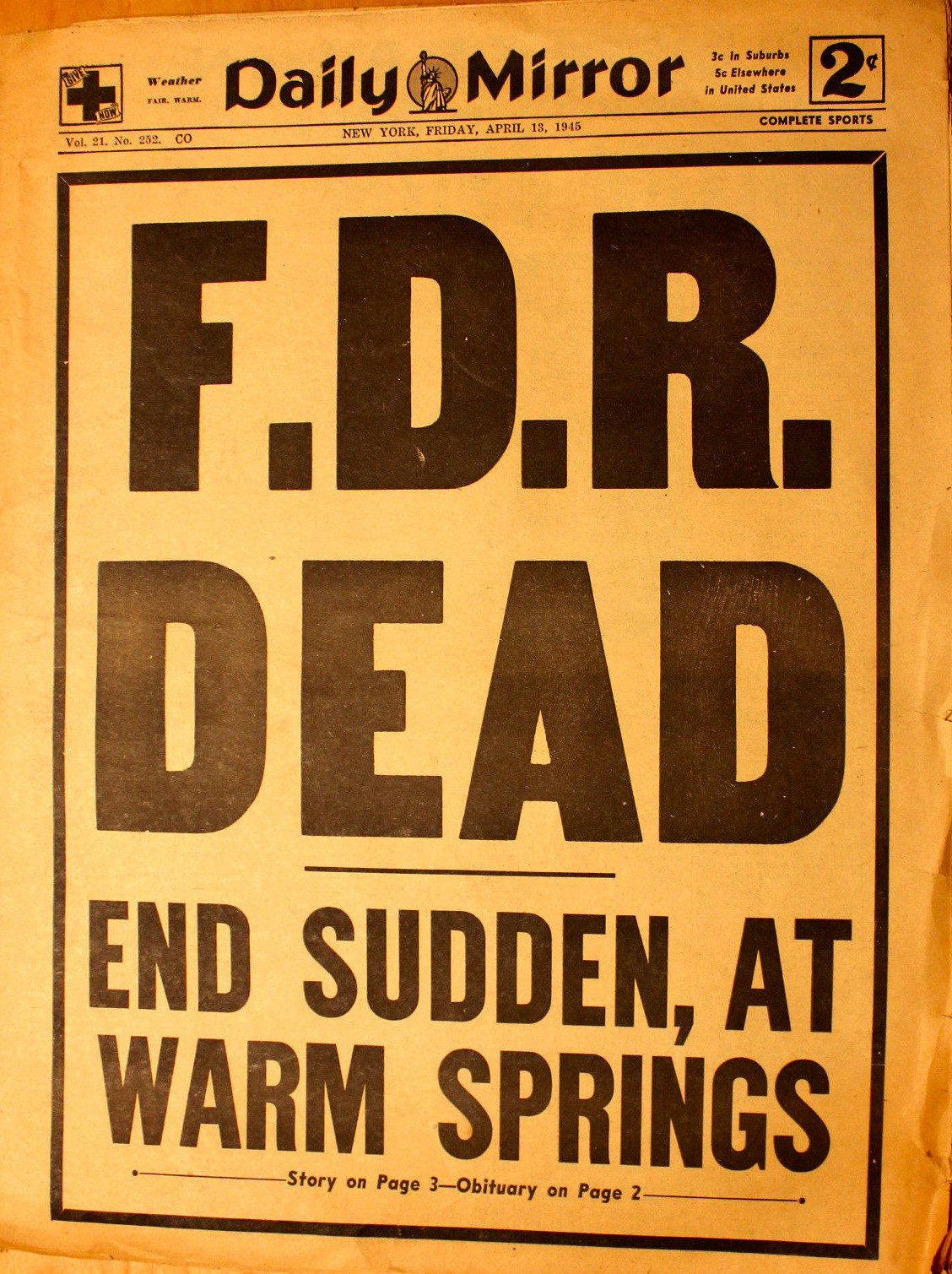
70 Years Ago Today – President Franklin Delano Roosevelt Dies

The Nation Mourns After Learning of the Death Of  F.D.R.

This is how the New York newspapers announced the death of F.D.R. on April 12, 1945.

70 years ago today when the 32nd President of the Unites States, Franklin Delano Roosevelt died suddenly of a massive stroke at the age of 63 in Warm Springs, GA  there was an overwhelming outpouring of grief across the globe.

With the exception of Adolf Hitler and a few die hard anti-FDR Republicans most of the world was saddened to learn of Roosevelt’s death. Roosevelt was held in high esteem by most Americans, even those that did not agree with many of his policies. There were also those who could not stand the man, but were in awe of Roosevelt as a shrewd politician and the job he had done in seeing the United States through the Great Depression and World War II.

It was especially sad that Roosevelt never got to witness the end of the war which brought final victory to the Allies. Less than four weeks after Roosevelt’s death, Hitler and Mussolini were dead and Victory in Europe Day was celebrated May 8, 1945. Japan unconditionally surrendered on August 15, 1945.

What I cannot imagine happening now in today’s world of partisan politics is having a universal outpouring of sorrow if a President were to die suddenly while in office. There is so much outright hatred and disrespect in modern politics that we will never see anything like this again.

FDR's funeral procession in Washington D.C.

FDR’s funeral procession in Washington D.C.

The Brooklyn Eagle Continue reading

New York Teams Spring Training Photos 1910’s, 20’s and 30’s

Old Photos Of New York Yankees, Brooklyn Dodgers and New York Giants Getting Ready For The Season

New York baseball teams have been heading south for spring training for over 100 years.

Here are some photographs showing the Yankees, Dodgers and Giants during spring training from the teens until the thirties.

Yankees spring training St Petersburg March 5 1930The New York Yankees doing their running drills March 5, 1930 St. Petersburg, Fl

Brooklyn Dodgers spring training 1920sThe Brooklyn Dodgers at their spring training complex circa early 1920’s.

Carl Hubbell winding up in Havana Feb 20 1937New York Giants ace Carl Hubbell warming up in Havana Cuba Feb 20, 1937. Continue reading

The Woman Who Almost Killed Dr. Martin Luther King Jr.

The Story Of Izola Ware Curry and The Stabbing of Dr. Martin Luther King Jr.

Arrest Ms Curry stabbed Martin Luther King 1958

Dr. Martin Luther King’s attacker being booked

As we observe Martin Luther King Jr. Day we’ll recount a story many people are not familiar with.

It’s a forgotten story in which the Civil Rights movement narrowly escaped a crippling blow in 1958.  It’s also the story of the woman who tried to be an assassin and failed and is now very old, free, and living a mostly anonymous life here in New York City.

Ten years before being cut down by an assassin’s bullet in 1968, Reverend Dr. Martin Luther King Jr. came within a fraction of an inch of losing his life in an assassination attempt in New York City.

At 3:30 pm on September 20, 1958 Dr. King was in Harlem on the ground floor of  Blumstein’s Department store at 230 West 125th Street signing copies of his new book Stride Toward Freedom: The Montgomery Story. With about 20 people on line, a 42 year-old woman, Izola Ware Curry burst through the line, asking Dr. King if he was in fact Martin Luther King. When King affirmed he was, Curry said either “Why do you annoy me” or “I’ve been after you for six years,” and opened her purse, took out a letter opener, closed her eyes and suddenly plunged the steel blade into his left chest.

The stunned Dr. King remained seated in his chair with the blade buried deep into his chest. Curry tried to leave the store but was seized quickly by those standing near Dr. King and held for the police. It was later discovered Curry also had an automatic handgun hidden in her bra.

At the book signing there was no police protection for Dr. King and the first police officers who responded to the scene, Al Howard and Phil Romano, were nearby in their police car when they received a report of a disturbance at Blumstein’s. They arrived to see King sitting in a chair with the steel letter opener protruding from his chest. Officer Howard told King, “Don’t sneeze, don’t even speak.”

Officer’s Howard and Romano escorted Dr. King, still in the chair, down to an ambulance and rushed him to Harlem Hospital. After waiting for the proper surgical team to arrive to perform the delicate operation, the Chief of Surgery Aubre Maynard attempted to pull out the letter opener, but cut his glove on the blade. At 6:30 pm Dr. King underwent a two and a quarter hour operation. A surgical clamp was finally used to pull out the blade.

After the surgery Dr. King was listed in critical condition. He contracted pneumonia while convalescing, but recovered completely and was released from the hospital two weeks after the attack.

In his posthumously published autobiography King wrote, “Days later,when I was well enough to talk with Dr. Aubre Maynard, the chief of the surgeons who performed the delicate, dangerous operation, I learned the reason for the long delay that preceded surgery. He told me that the razor tip of the instrument had been touching my aorta and that my whole chest had to be opened to extract it. ‘If you had sneezed during all those hours of waiting,’ Dr. Maynard said, ‘your aorta would have been punctured and you would have drowned in your own blood.'” Continue reading

Second Avenue Elevated, 100 Years Ago

A View Of The Second Avenue El From 14th Street

Second Avenue El from First Ave 14th Street Station Jan 13 1915The Second Avenue Elevated (El for short) was one of four elevated train lines that ran in Manhattan. This photo was taken 100 years ago today on Wednesday, January 13, 1915, and shows the view looking north from the 14th street station and First Avenue. That is correct, the Second Avenue El ran on First Avenue up until it turned west on 23rd Street to continue north on Second Avenue.

Enlarging the photo, at track level we can see the next station at 19th Street. At street level there is little activity, with a few people going about their errands. We see on the left side of the street a wall advertisement for Mecca Cigarettes and on the right side of the street on the second floor, a pawn shop window advertisement saying they’ve been “here since 1880” and a warning to any criminals that they have Holmes Electrical Protection (inventors of the modern burglar alarm).

The Els in Manhattan were discontinued over a 17 year period. The first to shut down was the Sixth Avenue El in 1938, followed by the Ninth Avenue El in 1940 and the Second Avenue El in 1942. The Third Avenue El ceased service in 1955 (the Bronx part of the Third Avenue line continued running until 1973), bringing a close to the era of Manhattan elevated trains.

The Transforming New York City Skyline 1880-2009

Lower Manhattan’s Skyline Evolution

On March 21, 1909 The New York Sun newspaper published an illustration (reproduced below) that showed the rapid growth of the New York City skyline as seen from New Jersey in four line drawings from 1880 -1909.

Click to greatly enlarge this illustration.

We have added a photograph from approximately 100 years later showing the same view.

Transforming New York City skyline 1880-1909 The Sun March 21 1909new york skyline 2009  photo HiltonThe two constants are Trinity Church and St. Paul’s Chapel Continue reading

Classic Hollywood #37 – Lilian Harvey

Lilian Harvey – “I Am Suzanne” 1934

Lilan Harvey 1934 I Am SuzanneLilian Harvey was born Helene Lilian Muriel Pape on January 19, 1906 in England. Her mother was British and her father German and Lilian was schooled in Switzerland. Lilian became a leading star in Germany in the 1920’s and 1930’s.

A Hungarian nobleman once offered to give Lilian a castle and a whole village to go along with it. Speaking 13 different languages, Lilian was able to make films in four. She left Germany permanently after the outbreak of World War II. Continue reading