Tag Archives: Brooklyn

Proposed Bridges Of New York City In 1911

In 1911 The Proposed McCarren Bridge Was To Replace The “Old” Brooklyn Bridge So It Could Be Reconstructed

Existing and Proposed Bridges New York City 1911

Existing & proposed bridges New York City 1911 – note the four lower Manhattan bridges instead of three (click to enlarge)

From the New York Tribune of January 1, 1911 comes this illustration showing New York City with its existing bridges and some proposed new ones.

Sandwiched very tightly between the Brooklyn Bridge and the Manhattan Bridge  connecting lower Manhattan with Brooklyn, is a proposed new bridge which was to be called the McCarren Bridge named after “Long Pat” McCarren (1847-1909) a state senator who was Brooklyn’s Democratic political boss during the late 1800’s.

Once the proposed McCarren Bridge became a reality, city engineers planned to close and rebuild the Brooklyn Bridge.  The engineers feared that the increase in heavy traffic on the Brooklyn Bridge would necessitate additional strength being added, otherwise a support or cable might give way causing a horrible catastrophe.  Borings were even made at the site, but the McCarren Bridge was never built.

Other proposed bridges in the illustration show the Hell Gate Bridge which was begun in 1912 and completed in 1916.

Further north on the Harlem River connecting upper Manhattan with the Bronx is another proposed bridge that was never built nestled between the University Heights/West 207th Street Bridge and Washington Bridge. This bridge would have been located at 177th Street in the Bronx and was to be called The Morris Heights Bridge. Continue reading

May Day In Brooklyn -1919

10,000 Girls Celebrate May Day In Prospect Park, 1919

Brooklyn May Day celebration 10,000 girls at  Prospect Park 1919

Brooklyn May Day celebration 10,000 girls at Prospect Park 1919

I may not be 100 years old, but I do remember being in public school celebrating May Day with a traditional maypole dance.

May Day in New York has other connotations and since the 1890’s May Day has been known for communists, socialists, union activists and workers marching (sometimes together, sometimes separately) around the city protesting and trying to bring attention to their causes.

But here we see a time when the world was finally at peace, a few months after the conclusion of the Great War (World War I).  Soldiers with their hats on can be seen in the extreme foreground observing and enjoying the festivities.

10,000 Girls in Brooklyn, N.Y. May Day fete

Shouts of joy ring through Prospect Park as happy children dance, play games and sing. Photo shows a general view of thousands of girls of the Brooklyn Girls’ Branch of the Public Schools Athletic League in their annual May Day fete in Prospect Park, Brooklyn, New York.  (photo credit: Central News Photo Service May 2, 1919)

At Death’s Door: Beautiful Mausoleum Doors & Gates At Brooklyn’s Green-Wood Cemetery

An Artistic Treasure – Brooklyn’s Green-Wood Cemetery Mausoleum Doors And Gates

Frederick Kampfe mausoleum door Green-Wood Cemetery, Brooklyn

Frederick Kampfe mausoleum door Green-Wood Cemetery, Brooklyn

Ambrose Bierce in his Devil’s Dictionary defined a mausoleum as “the final and funniest folly of the rich.”

Of course some of the mausoleums at Green-Wood Cemetery in Brooklyn are elaborate and cost as much as a nice house back in the day. But regardless of Bierce’s cynicism, many of the wealthy spent large amounts of money hiring top architects to design and build their final resting places in hopes of producing eternal shrines to themselves. While many names emblazoned on the tombs are now forgotten, their inhabitants ended up with some beautiful and memorable architectural work that because of their location, a cemetery, is not seen by many.

Thorne - Smith mausoleum door Green-Wood Cemetery, Brooklyn

Thorne – Smith mausoleum door Green-Wood Cemetery, Brooklyn

Here we are focusing on the doors and gates to these mausoleums which were done by artisans of the highest caliber. Some are ornate, some are ostentatious, and some are simple yet elegant.

While some of the decorations on the doors are purely artistic in form, others display symbols which have deeper meanings. Because these mausoleums were commissioned works, the symbolism displayed on the doors was usually well thought out by their owners.

In the 19th and early 20th century many people who visited cemeteries understood the subtle meanings of the icons. It is now mostly a lost art, with crosses, Stars of David, and other common symbols dominating newer funeral markers.

Let us pause and gaze at a few examples of mausoleum portals featuring old school craftsmanship at fabulous Green-Wood Cemetery in Brooklyn. (click any ph0to to enlarge)

Peter Moller mausoleum door Green-Wood Cemetery, Brooklyn

Peter Moller mausoleum door Green-Wood Cemetery, Brooklyn

Valentine Mott mausoleum door Green-Wood Cemetery, Brooklyn

Valentine Mott mausoleum door Green-Wood Cemetery, Brooklyn

The large angel in relief is flanked on top by two smaller angels blowing trumpets representing the Call to the Resurrection.

Acea mausoleum door Green-Wood Cemetery, Brooklyn

Acea mausoleum door Green-Wood Cemetery, Brooklyn

Continue reading

Old New York In Postcards #8 – Dreamland Coney Island Part 2

Coney Island’s Dreamland Amusement Park 1904-1911 – Part 2

Coney Island Dreamland general view

Coney Island- Dreamland midway on a crowded day

Continuing from part one of our postcard journey through Dreamland Amusement Park at Coney Island, we examine the other features of the park.

Coney Island Dreamland The Ballroom InteriorConey Island Dreamland Bathing Beach

At the turn of the century, dancing was possibly the most popular amusement at Coney Island, even more so than bathing at the beach. The Dreamland ballroom reflected this popularity by being the largest ballroom ever built in the United States. Continue reading

Old New York In Postcards #7 – Dreamland Coney Island Part 1

Coney Island’s Dreamland Amusement Park 1904-1911

Coney Island Dreamland at night

Dreamland Map from Jeffrey Stanton's site http://www.westland.net/coneyisland/index.html

Dreamland Map from Jeffrey Stanton’s site
http://www.westland.net/coneyisland/

Dreamland was built on a 15-acre parcel at Surf Avenue and West 8th Street and opened on May 14, 1904. It cost over $3.5 million to build. The park could accommodate over 250,000 people. Ex-State Senator William H. Reynolds was the man behind Dreamland. The original name of the park was to be the Hippodrome, as Reynolds originally wanted chariot races around a lagoon. On the architect’s plans the name was changed to Wonderland, but the name that stuck was Dreamland. With its bright lights and a dizzying array of exhibits and amusements Dreamland was an apropos name.

On the right is a map of how Dreamland was laid out.

Coney Island Dreamland opening ad 1904 05 08 NY Sun

The week before Dreamland opened, this ad in the May 8, 1904 New York Evening Sun heralded the pleasures that awaited visitors.

Coney Island Dreamland Tower Night 2 Coney Island Dreamland Tower Night 1Coney Island Dreamland Tower side view

The defining feature of Dreamland was the White Tower built by architects Kirby, Petit and Green and modeled after the Giralda Tower in Seville. It was 370 feet high and had over 100,000 electric lights. Continue reading

Prophetic Words About Lying Politicians From T. De Witt Talmage

Our 21st Century Dysfunctional Politicians Accurately Described

DeWitt TalmageHe described our lying politicians better than anyone today could have. And he did it 140 years ago.

T. De Witt Talmage (1832-1902) was a sanctimonious Brooklyn preacher who attained a huge following in the 19th century as an orator and prolific author. Overflow crowds attended his Sunday sermons at The Brooklyn Tabernacle.

Talamge's Brooklyn Tabernacle courtesy New York Public Library

Brooklyn Tabernacle


While many people were quite enthralled by Talmage, there were just as many critics who called him a “pulpit clown” and a “mountebank.”

As would be expected from any of the crusading Victorian holy rollers, Talmage railed against vice and crime in his writings and firebrand speeches. His verse contains the typical road to ruin warnings that make reading his books unbearable today. However, Talmage did manage to string together some words that still ring true. Especially about lying.

If you didn’t know any better, you would swear that Talmage is describing our modern day politicians. This short passage is from 1872.

LIES: WHITE AND BLACK.

Abominations of modern Society Talmage

There are ten thousand ways of telling a lie. A man’s entire life may be a falsehood, while with his lips he may not once directly falsify. There are those who state what is positively untrue, but afterwards say, “may be,” softly. These departures from the truth are called “white lies;” but there is really no such thing as a white lie. Continue reading

Woodlawn Cemetery Memorial Tells A Coney Island Story Of Unusual Death

Brighton Beach Lightning Strike Felt By Thousands, Kills Six – July 30, 1905

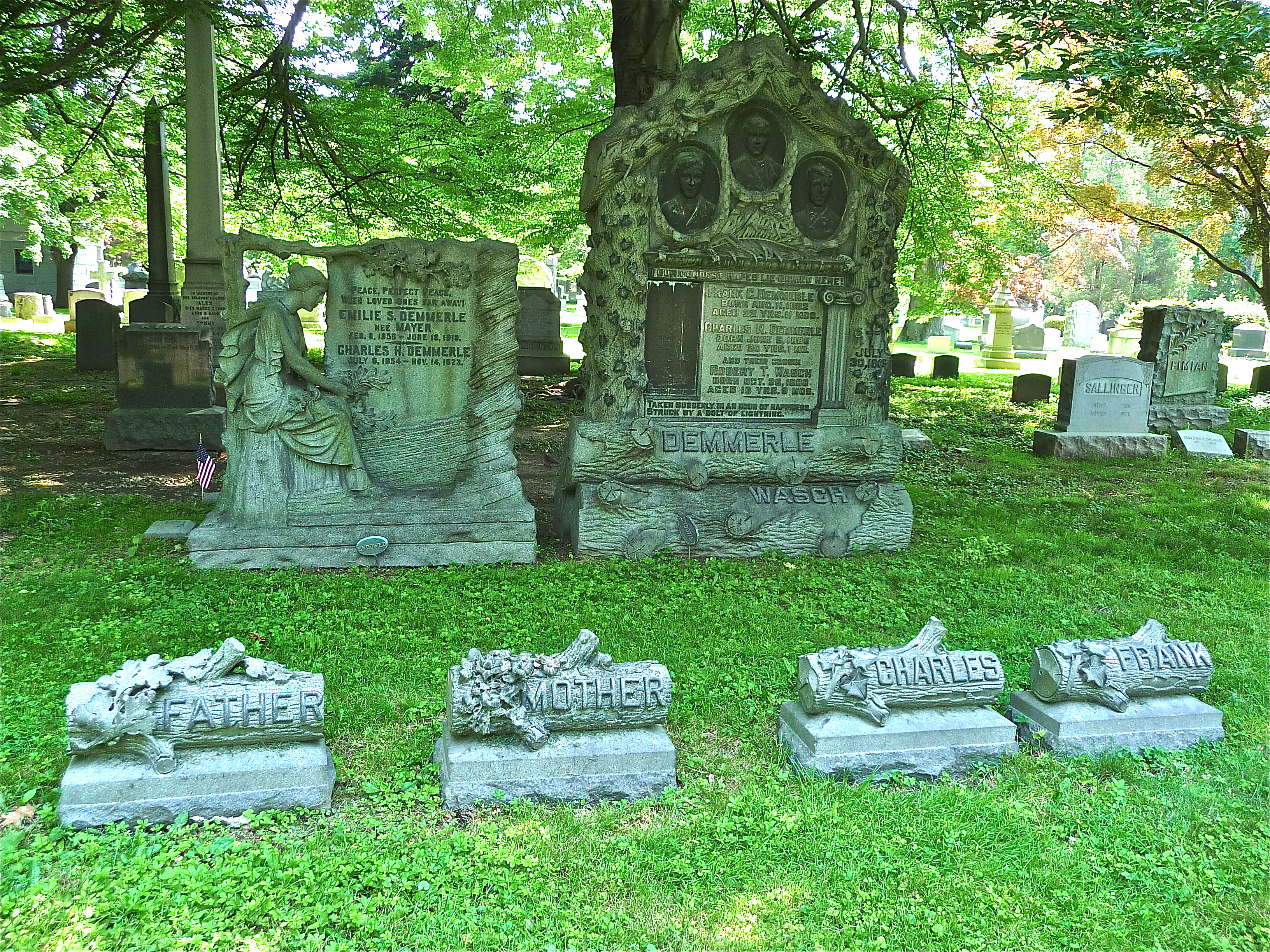
When walking through Woodlawn Cemetery in the Bronx, you can come across fancy mausoleums and simple grave markers of the famous and infamous. F.W. Woolworth, Fiorello LaGuardia, Duke Ellington, Bat Masterson and Herman Melville are among the half million souls interred in this historic place.Demmerle Memorial

Then out of the blue you may stumble across the lives of ordinary New Yorker’s memorialized in an extraordinary way. Such is the Demmerle monument.

Unlike many other tombstones which record a name and birth and death years with a short epitaph, the Demmerle memorial is an ornate series of carved monuments which tells and shows the story of one family’s tragedy.

Demmerle Charles and EmilieSunday July 30, 1905 started out as a beautiful, sun-filled, hot day Continue reading

The Day Brooklyn Will Never Forget – October 4, 1955 The Brooklyn Dodgers Become World Champions

Johnny Podres Shuts Out The Yankees to Win Game 7 of The 1955 World Series

Cover Daily News Oct 5 1955

The Brooklyn Dodgers had appeared in seven World Series previous to 1955. They had lost all of them. But on Tuesday, October 4, 1955, a magical afternoon (yes the World Series was always played in the daytime until 1971) occurred at Yankee Stadium in front of 62,485 fans. Amazingly the game was not sold out.

Johnny Podres, after winning game three of the World Series, was matched up in game seven against Yankee veteran Tommy Byrne. An interesting side note: Byrne rode the IND subway from 59th Street to Yankee Stadium unrecognized by anyone. Podres ended up pitching the game of his life – an eight hit, 2-0 shutout. The Dodgers had finally vanquished the Yankees who had beaten them in five previous World Series.

The Dodgers played without Jackie Robinson who was nursing a strained Achilles tendon. And the Yankees were equally handicapped without Mickey Mantle, who, even though he pinch hit in this game, missed most of the Series with a torn leg muscle. Other Yankees and Dodgers stars like Duke Snider and Hank Bauer played despite being injured.

First pitch of Game 7, 1955 World Series Yankee Stadium. Tommy Byrne throws a strike past Jim Gilliam

The Dodgers scored one run in the fourth when Roy Campanella doubled and a single by Gil Hodges drove him home. The Dodgers added a run in the sixth with Hodges hitting a sacrifice fly to drive in Pee Wee Reese.

Sandy Amoros Catch 10 4 55

The acknowledged defensive play of the game was made by Dodgers left fielder Sandy Amoros.

Continue reading

The Forgotten Brooklyn Elevated Train Crash Of 1923

June 25, 1923 Intersection of Atlantic and Flatbush Avenues

Photo © Osmund Leviness

“Those who died were fortunate it seemed to me when I looked inside the cars. As long as I live I can never forget it. All the people were in a mass there, struggling and screaming, with blood running over them. They all seemed to be bleeding or stained with blood. One woman’s head was terribly cut on top, and one jaw seemed to be crushed in. The hand of another woman was almost cut off. One woman I took out through a window died a few minutes after I carried her into the post office. I can’t forget the inside of those cars. They looked like my idea of purgatory.” –  Traffic Officer Joseph J. Ryan who was on the scene immediately after the crash.

This incredible accident happened 89 years ago, Monday, June 25, 1923  as two cars of the BMT derailed and plunged 35 feet into the street at the intersection of Atlantic and Flatbush Avenues in Brooklyn. Continue reading