Category Archives: Books

Why Few Of Us Are “Normal” Human Beings (And That’s A Good Thing)

According To Writer Donald Henderson Clarke, Normal Human Beings Are A Rare Breed

Man of the world bookDonald Henderson Clarke (1887-1958) enjoyed telling a good story. Clarke was able to accomplish that as a successful reporter for many New York newspapers including The New York World, New York Times, and the New York American. After his newspaper stint from 1907 through the 1920s, Clarke began writing books and screenplays which made him a tidy sum.

Born to a wealthy New England family, Clarke lived the life of a bon vivant, but always held a fascination for the underbelly of life. Besides writing about the famous and newsworthy, Clarke spent quite a bit of time with bootleggers, gangsters and prostitutes. Out of nowhere in his autobiography, Man of the World: Recollections of an Irreverent Reporter, 1951, Vanguard Press, Clarke makes an astute observation about the human condition.

64 years after this was written, this timeless description of normalcy and humanity still strikes a strong chord. Clarke’s quirky style comprises the longest run-on sentence I’ve read by a journalist, but I’ll forgive him the run-on, because he is right on the mark.

Good, normal human beings are a rarity, and we all should be thankful for that. They are dull, monotonously successful, exasperatingly even-keeled, always in good health. Of course, they should not be called normal.

Most human beings suffer from anxieties, worries, fears, suppressed desires, regrets for past sins, secret yearnings for future sins, aches, pains, toothaches, flat feet, ingrowing toe nails, body odors, hair in the wrong places, too little hair in the right places; they are too short or too tall or too plump or too lean; they wish they were married, wish they were unmarried, wish they could have a successful careers, are bored silly with successful careers, wish they had children, wish their children would hurry up and get married, wish their children would never marry, are afraid of hell, are afraid of the dark, are afraid of poverty, wish their noses were different, wish they were in society, are bored with society, wish they could know actors and actresses, wish they could get away from actors and actresses, shoot and poison their husbands, shoot and cut the throats of their wives, make love to the cook, make love to the chauffeur, talk virtue and think of vice, howl because Rossellini and Bergman have a baby without benefit of clergy – and wish they could be Bergmans or Rossellinis.

The average human being is full of imperfections which make him-her interesting. When the imperfections lead to explosions small or large, it makes the kind of news I like – the sort of news that reveals the human being for what he is – mortal and finite but clinging desperately to the idea that he is immortal and infinite; possessing nothing, no matter if he has millions of dollars, but soothing his fears with the false idea that he has possessions.

He is suddenly gone. Nothing is more ridiculous than the carcass left behind, unless it be the strangely patterned bits of cloth and leather with which he or she concealed that carcass from view. The discarded garments of one suddenly dead look tiny and silly.

Where did the spirit flit? Even several Christians will not give you the same answer. It depends on the particular belief of the particular Christian. Mohammedans will tell you Paradise, where warriors will have a bevy of houris to amuse them. Other religions, whose followers outnumber Christians, will give you other answers.

No human being ever went wherever it is and came back to tell about it in plain, everyday language. That would be one big, important, serious newspaper story I would like to cover.

Continue reading

“He Ruined My Wife.” The 109th Anniversary of The Crime Of The Century

Millionaire Harry K. Thaw Shoots Architect Stanford White At Madison Square Garden  June 25, 1906

The Beautiful Evelyn Nesbit Is At The Center Of It All

Evelyn Nesbit happy

In the annals of 20th century crime there are many cases that claim the title of the “crime of the century.” From the Lindbergh kidnapping case to the O.J Simpson saga, the public has always had an unquenchable thirst for following the media coverage of lurid crimes.

Madison Square Garden photo H.N. Tiemann

Madison Square Garden 1909 photo H.N. Tiemann

Harry Thaw’s murder of Stanford White at the roof garden theater of White’s creation, Madison Square Garden on June 25, 1906, was as big a story that has ever played out in the public eye. If it was not the “crime of the century,” it certainly qualifies for being in the top five.

A brief summary of the principal players in this drama and the events leading up to the murder goes like this.

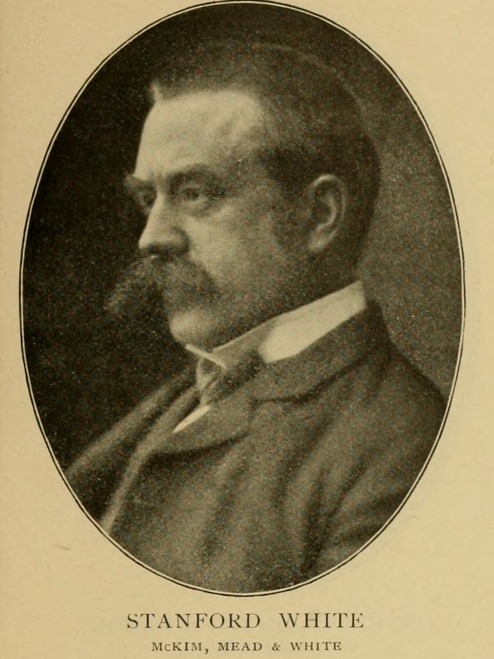
In 1901, Stanford White, partner in the renowned architectural firm of McKim, Mead & White wants to meet artist’s model and showgirl Evelyn Nesbit, who is 16. White is known in certain circles for being a scoundrel and having many sexual affairs with actresses, models and other pretty girls. Stanford White photo Kings Notable New YorkersAfter meeting Nesbit under the approval of Evelyn’s mother, White becomes Evelyn’s benefactor over the course of several months paying for a multitude of things for Evelyn, her brother and mother. White arranges for Evelyn’s mother to take a trip back home to Pennsylvania while he promises to “look after Evelyn.” One night, while Evelyn’s mother is away and Evelyn is at White’s bachelor apartment, he plies Evelyn with liquor.  Evelyn passes out and White has his way with his virgin teen beauty. Evelyn wakes up in bed naked with White and is in shock after being raped. White begs Evelyn not to talk about what has happened. Continue reading

New York’s Little Italy Described In 1898

“Not a word of English is heard — only a rough, gutteral Italian”

Busy Mulberry Street photo Detroit Publishing CoWhen we ran our story about Chinatown last week we knew it was inevitable we would cover the section on Little Italy as well. It has the same anti-immigrant undertones as the section on Chinatown.

It is probably best not to read the unpalatable descriptions and have modern judgments on 19th century attitudes. What would seem outright racist or prejudicial today was merely the predominant “native” view of anyone who was not a WASP or other accepted creed.

Once again, the guidebook we quote from is Rand, McNally Handy Guide to New York City, Brooklyn, Staten Island, and other suburbs included in the Greater New York edited by Ernest Ingersoll (1898). This section is from the same one as Chinatown and is called “A Ramble At Night”, where the visitor to New York is directed to tour the areas of New York that are off the beaten path after 9 p.m. The purpose of the night ramble is to “give some hints as how the dark, crowded, hard-working, and sometimes criminal portions of the city look at night.” Reproduced below is the section on the Little Italy. Continue reading

New York’s Chinatown Described In 1898

Joss Houses, Chinese Restaurants and Opium Smoking

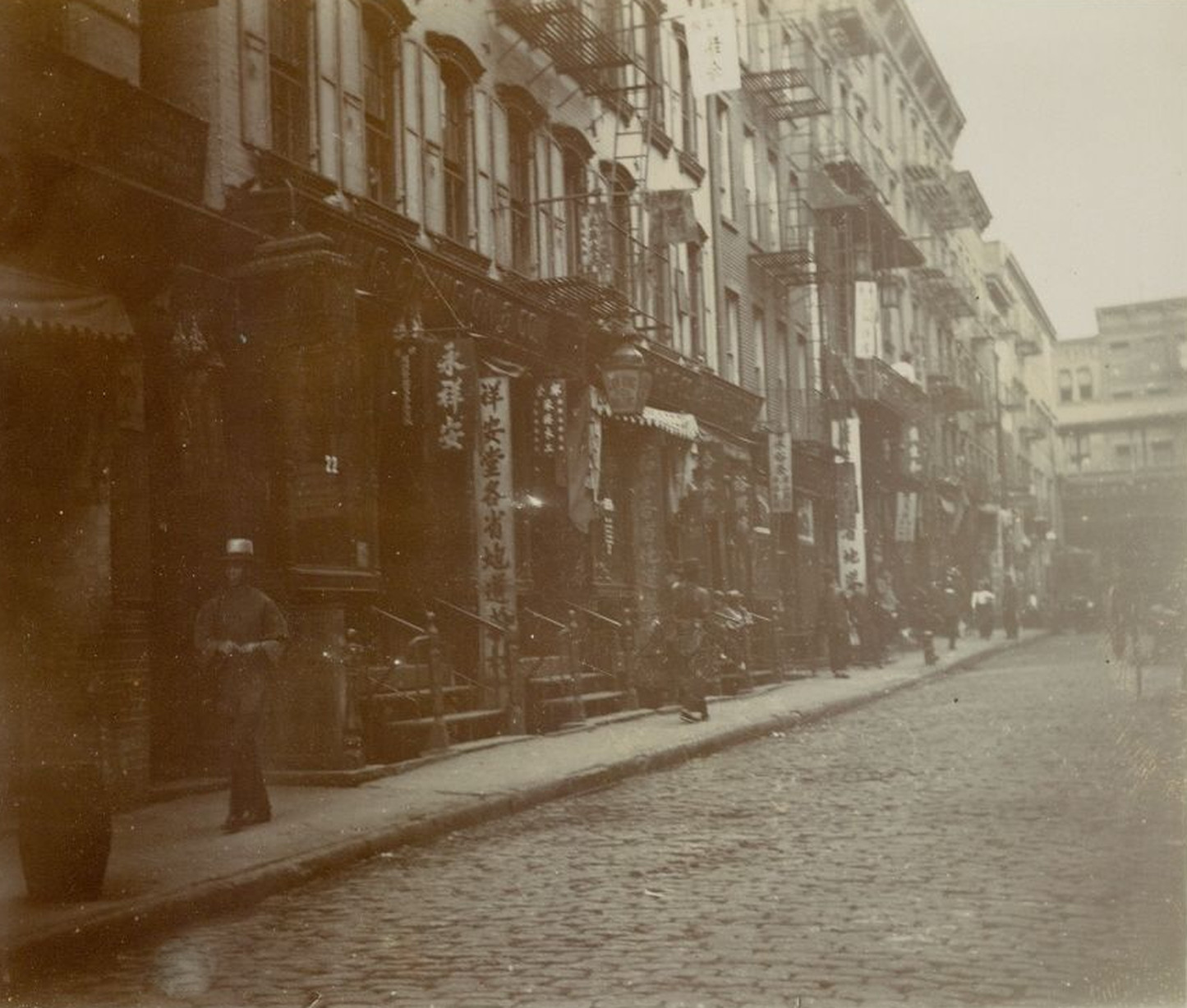
Chinatown 1896 looking at 22 Mott Street

Bing Chung Importers (near left) in the heart of Chinatown at 22 Mott Street in 1896

The great thing about reading old guidebooks to New York City is that you can see the world through contemporary eyes. This usually means all foreigners were viewed as curiosities with their exotic customs and provincial ways.

In 1897 the Chinese population in New York City was only 7,000 – almost all living in Chinatown centered around Mott Street. In 2015, New York City’s Chinese population is now over 500,000 people spread throughout the five boroughs.

The guidebook we quote from is Rand, McNally Handy Guide to New York City, Brooklyn, Staten Island, and other suburbs included in the Greater New York edited by Ernest Ingersoll (1898). This portion is called “A Ramble At Night”, and the visitor to New York is directed to tour the areas of New York that are off the beaten path after 9 p.m. such as Little Italy and The Bowery. The purpose of the night ramble is to “give some hints as how the dark, crowded, hard-working, and sometimes criminal portions of the city look at night.” Reproduced below is the section on the Chinatown.  Continue reading

A Visit To The New York City Book and Ephemera Fair

Three Antiquarian Book Shows In New York City This Weekend – A Quick Look At The Newest One

A view of the floor of the New York City Book and Ephemera Fair  - Wallace Hall St. Ignatius Loyola Church April 11, 2015

A view of the floor of the New York City Book and Ephemera Fair – Wallace Hall St. Ignatius Loyola Church April 11, 2015

With book lovers from all over the world descending upon New York York City for the ABAA’s New York Antiquarian Book Fair from April 9 -12 2015, two satellite shows containing about 50 dealers each displayed their wares at nearby locations.

Display of fine books at the New York City Book and Ephemera Fair

Display of fine books at the New York City Book and Ephemera Fair

So this morning I had a chance to check out one of the shows The New York City Book and Ephemera Fair, at a location that to my knowledge has never held a book show; Wallace Hall at St. Ignatius Loyola Church on Park Ave and 84th Street.

The show produced by Marvin Getman, was well lit, spacious and chock full of top book dealers from all over the country and Canada.

Many dealers seemed happy with the turnout and for a $15 admission fee the public was able to see some high quality books at mostly affordable prices.

The display case of Wiggins Fine Books, Shelburne Falls, MA

The display case of Wiggins Fine Books, Shelburne Falls, MA

The selection was wide, ranging from signed and first editions to ephemeral early punk rock magazines to science fiction classics to incunabula.

Several dealers featured art, photography and architecture books which seemed to moving briskly.

Children’s books were carried by many dealers and selling for fair prices. A first edition A Pocket for Corduroy a classic by Don Freeman with the dustjacket was offered at $600. Continue reading

How To Behave And Act Like A Lady – 1847

35 Rules To Be Followed, Etiquette For Ladies – 1847

Book Etiquette For LadiesHow were women supposed to conduct themselves in the middle of the 19th century?

Well for starters; No kissing other women in the presence of men you don’t know; never sing two songs consecutively; if newly married do not display conspicuous public affection; avoid the “horse laugh”; and if you break something at someone else’s house, ignore that you have done it.

Those are some of the suggestions for proper ladies that were laid out 168 years ago by an anonymous woman author.

They are all from the book “True Politeness, A Hand-Book of Etiquette For Ladies” by an American Lady published in 1847 by Leavitt & Allen.

This fascinating book covers everything a proper lady should know when it comes to etiquette, behavior and fashion. Some of the chapters include; Introductions; Recognitions and Salutations; Conversation-Tattling; The Dinner Table; Courtship and Marriage and a dozen other subjects.

How much has life changed in just a century and a half? Read on and discover 35 of these somewhat practical, but many archaic, rules and suggestions to make the present day reader scratch your head and wonder, did women really act like this?

1. It is, in general, bad taste for ladies to kiss each other in the presence of gentlemen, with whom they are but slightly acquainted.

2. If on paying a morning visit you meet strangers at the house of your friend and are introduced, it is a mere matter of form, and does not entitle you to future recognition by such persons.

3. The plainest dress is always the most genteel, and a lady that dresses plainly will never be dressed unfashionably. Next to plainness, in every well-dressed lady, is neatness of dress and taste in the selection of colors.

4. Never wear mosaic gold or paste diamonds; they are representatives of a mean ambition to appear what you are not, and most likely what you ought not to wish to be.

5. Perfumes are a necessary appendage to the toilet; let them be delicate, not powerful ; the Atta of roses is the most elegant ; the Heduesmia is at once fragrant and delicate. Many others may be named; but none must be patronized which are so obtrusive as to give the idea that they are not indulged in as a luxury but used from necessity.

6. Keep your finger-nails scrupulously clean, and avoid the disagreeable habit of allowing them to grow to an unnatural length.

7. It is better to say too little than too much in company: let your conversation be consistent with your sex and age.

8. Avoid pedantry and dogmatism. Be not obtrusively positive in the assertion of your opinions — modesty of speech, as well as manner, is highly ornamental in a woman.

9. Double entendre is detestable in a woman, especially when perpetrated in the presence of men; no man of taste can respect a woman who is guilty of it: though it may create a laugh, it will inevitably excite also disgust in the minds of all whose good opinions are worth acquiring. Therefore not only avoid all indelicate expressions, but appear not to understand any that may be uttered in your presence.

10. Rather be silent than talk nonsense, unless you have that agreeable art, possessed by some women, of investing little nothings with an air of grace and interest; this most enviable art is indeed very desirable in a hostess, as it often fills up disagreeable pauses, and serves as a prelude for the introduction of more intellectual matter. Continue reading

Part 2 – An Interview With Avery Corman “My Old Neighborhood Remembered A Memoir”

Avery Corman Talks About: Dating, Restaurants, High School in The Bronx, The Advertising World, Getting Published and Having His Books Adapted To Film

We continue our interview with Avery Corman, author of the new book My Old Neighborhood Remembered A Memoir (Barricade Books) 2014, and his story of growing up in the Bronx during the 1940’s and 50’s.

Divided into 5 parts the first two parts of the interview can be seen here.

In part 3 Avery Corman discusses dating, blind dates, sex, going to the movies, the differences between eating out and restaurants, dessert havens like Krum’s, Addie Vallins and Jahn’s and the coming of television.

Part 4 Avery Corman recalls his high school years at DeWitt Clinton High School and his decision to go to New York University. Upon graduating Continue reading

An Interview With Avery Corman “My Old Neighborhood Remembered A Memoir”

Avery Corman, Author of Kramer vs. Kramer, Talks About His Latest Book: My Old Neighborhood Remembered A Memoir

My Old Neighborhood RememberedThe neighborhood is the Bronx. The time is World War II and the post war years. And the writer is Avery Corman. His newest book My Old Neighborhood Remembered A Memoir (2014) Barricade Books, is his first non-fiction book and is filled with wonderful recollections of growing up.

After graduating college Corman was working on the fringes of advertising and with the encouragement of a friend, Herb Gardner (A Thousand Clowns; I’m Not Rappaport; etc), he took a stab at writing a book. That effort was published as Oh God! A Novel (1971). After that hurdle Corman never looked back and he became a full-time novelist. Oh God! was eventually made into a very popular movie in 1977 starring George Burns and John Denver.

Some of Corman’s other acclaimed novels include The Bust-Out King (1977), The Old Neighborhood (1980); 50 (1987); Prized Possessions (1991); The Boyfriend from Hell (2006) and his most famous work, Kramer vs. Kramer (1977) which was adapted into a movie in 1979 and was the winner of five Academy Awards including Best Picture.

Avery Corman’s success must partially stem from his middle-class upbringing in the Fordham section of the Bronx during the 1940’s and 50’s, where he admits he was not the best student when it came to math and science, but did well in the humanities and was surrounded by a loving, extended family.

My Old Neighborhood Remembered A Memoir is more a series of vignettes rather than a straight autobiography and that style comes off well. Corman shares his memories of childhood during World War II up until he becomes a successful author in the late 1960’s. He paints beautiful word pictures, sometimes tinged with sadness, of growing up in a wondrous place that no longer exists. Most of the stories offer short bursts of family life, games, food, education, sports and all the things that contributed to making the Bronx a special place to grow up in.

Corman’s stories resonate with a tender glow of friendships, family and the feeling that neighborhoods were once really neighborhoods, where the familiarity of rituals, people and places were ingrained in the surroundings.

Here are parts one and two of an exclusive interview with Avery Corman.

Part I, Avery Corman talks about what made the Bronx a special place during the war. His unique living situation and school life.

In part II Corman Continue reading

Things You Should Know If Visiting New York City In 1873

“Thousands of children are imported from Italy each year to turn them into organ-grinders and street beggars.”

12 Helpful Hints And Notes From 1873

Standing on Broadway by New York City Hall circa 1870

A tourist standing on Broadway by New York City Hall circa 1870

From the wordily titled – Wood’s Illustrated Handbook To New York and Environs: A Guide For The Traveller or Resident With Minute Instructions For Seeing The Metropolis In One or More Days Together With Numerous Valuable Hints To Visitors On Nearly Every Topic That Arises Upon The Subject of Sight-Seeing, G.W. Carleton Publishers, 1873, we learn surprising things about New York City.

If you lost something of value in public there was an excellent chance that it would be returned to you.

Saturday was the fashionable day for ladies to attend public entertainments – alone!

Wood’s Handbook’s aim was to point out interesting things about New York City without preaching to the reader.

As the guidebook says;

We think the sight-seer may now be safely left with the “Handbook ” to the guidance of the Index and Map and to his own inclinations and judgment.

He will speedily discover that our object in the preparation of this volume has been not to confuse and weary him by stale remarks and hackneyed observations about this or that, but to put him in a position to see, and admire, and criticize from his own stand-point of taste and opinion. We think the sight-seer requires ready hints, not stupid essays; and if we conduct him to a remarkable locality or a well-known structure, he will not care to have us stand perpetually at his elbow telling him what to admire, and what he ought not to be pleased with.

Since the book contains no “hackneyed observations,” the section called “helpful hints” are what we thought were worth highlighting rather than the sights to be seen.

From among the many listed, we have culled, a dozen of the helpful hints for visiting New York:

1- A GLASS OF BRANDY, in an emergency, can be obtained at any apothecary. No wines, ales, or liquors are permitted to be sold in New York at any bar on Sunday. The guests of a hotel can be served with them, however, at table or in their rooms.

2- ORGAN-GRINDERS and STREET-BEGGARS — Thousands of children are annually exported from Italy to the United States for the purpose of making them organ-grinders and street-beggars, of whom a multiplicity are to be seen in New York. A bill has been brought before the Italian Parliament, designed to put a stop to this disgraceful traffic in children. It punishes with five years’ imprisonment all persons exporting children under twelve years of age to foreign countries, under any pretext. Continue reading

The 1904 General Slocum Disaster Had Survivors That Lived Into The 21st Century

Catherine Connelly & Adella Wotherspoon, General Slocum Survivors, Lived To Ages 109 & 100

The Story of The General Slocum Steamship Disaster

General Slocum Disaster

June 15, 2014 marks the 110th anniversary of what had been New York’s biggest disaster and loss of life until the September 11 attacks occurred. We think it is worth remembering the ill-fated General Slocum steamship fire. Here is the story of the General Slocum and  a brief summary of the lives of the last two survivors of the disaster who amazingly lived into the 21st century.

A Beautiful Day For A Picnic

“Kleindeutchland,” as the area of Little Germany was called on the lower east side, was bounded approximately by the East River and Third Avenue and stretched from Houston Street to about 23rd Street. It was a working class, close-knit community of laborers and business owners. The German families that lived in this neighborhood made Tompkins Square Park their center for congregating and relaxation. But for special occasions they would embark on a trip to get out of the city.

Wednesday, June 15, 1904 was a sunny day and the members of the Sunday School of St. Mark’s Evangelical Lutheran Church at 323 E. 6th Street were looking forward to a day filled with games, music and a large picnic for their 17th annual excursion to bucolic Locust Grove, Long Island.

To get there, the church had chartered a steamship built in 1891, the three decked white paddle-wheeler, General Slocum.

Sudden Disaster

New York Tribune June 16, 1904 (click to enlarge)

New York Tribune June 16, 1904 (click to enlarge)

The General Slocum was filled with around 1,400 passengers, mostly women and children as the men generally had to work on a weekday. The Slocum headed out from its berth at 3rd Street on the East River at about 9:30 am with a band playing and the passengers joyously celebrating the smooth ride and beautiful weather.

Thirty minutes after setting out, the ship caught fire Continue reading