Category Archives: Books

Book Advertisement From 1915: How To Make Love

“What To Do Before And After The Wedding” Among Other Things

Ad Book How To Make Love world almanac 1915So, how did people learn about sex and seduction 100 years ago? From a book of course. This ad appears in the 1915 World Almanac and was just too good not to share.

The text reads:

How To Make Love

(NEW BOOK) Tells how to Get Acquainted; How to Begin Courtship; How to Court a Bashful Girl; to Woo a Widow; to Win a Heiress; how to catch a Rich Bachelor; how to manage your beau to make him propose; how to make your fellow or girl love you; what to do before and after the wedding. Tells other things necessary for Lovers to know. Sample copy by mail, 10 cents.

Royal Book Co. Box 10 So. Norwalk, Conn.

Classic Hollywood #30 – Alec Guinness Predicted James Dean’s Death

The Strange Tale Of How Obi-Wan Kenobe (Sir Alec Guinness) Eerily And Accurately Told James Dean He Was Going To Die In His New Car

James Dean Ursula Andress 1955 8 29 ph Earl Leaf

James Dean and Ursula Andress attend a benefit, one month before Dean’s death in a auto crash

James Dean is seen here talking to one of his “girlfriends,” the 19-year-old Swiss actress Ursula Andress. This photograph was taken at a benefit for the “Thalian’s Ball” on August 29, 1955 at Ciro’s in Hollywood and shows them in a non-combative mood. The sexually ambiguous Dean may have been set up on dates with Andress by the studio publicity department. Regardless, press accounts at the time refer to Andress and Dean as dating one another.

Even though Andress spoke very little English, their relationship was considered very stormy.  At one time it was reported by a tabloid that Dean was said to be taking German language lessons so that they could “argue in another language.” Andress would go on to fame as Honey Ryder, the first “Bond Girl” in 1962’s Dr. No.

Dean, an avid auto racer, agreed to purchase a new sports car on September 21 1955, a silver Porsche 550 Spyder that he nicknamed “Little Bastard” which was then painted on the car.

Two days later on September 23, Dean was eating at the trendy Villa Capri Restaurant on McCadden Street in Hollywood and spotted actor Alec Guinness trying to get a table without any success. Guinness was exhausted having just arrived from London on a 16 hour flight for his first trip to Hollywood. As Guinness and his companion, screenwriter Thelma Moss exited the restaurant, Dean ran after them to intercede. Continue reading

Book Review – Yorkville Twins

Twins Grow Up In An Exciting, Post-WWII New York City

Yorkville twins coverIf there were more books like Yorkville Twins we would have a clearer picture and better understanding of what it was like for the everyday existence of ordinary people living in Manhattan in post-war New York City. Twins Joseph G. Gindele and John F. Gindele, weave funny, touching and poignant stories of growing up in Yorkville on the upper east side of Manhattan from 1944-1962 with their three siblings and immigrant parents.

Unlike many New York memoirs written by famous or infamous personages who lay their memories of privileged upbringings or Dickensian struggles in print, the Gindele’s recount the daily experiences of middle class family life in a New York that has now largely vanished. This is the New York of cobblestone paved streets where the milkman and the iceman made deliveries with horse drawn wagons. Pushcarts sold vegetables and kids played with erector and chemistry sets and took the time to cut out the backs of cereal boxes and  redeem them in the mail for prizes. Continue reading

Historic List Of Every Hotel In Manhattan In 1964

All The Hotels In Manhattan With Addresses and Telephone Numbers From 50 Years Ago

New York Guidebook John KouwenhovenFrom one of the best (and for some reason uncommon) guidebooks to New York City ever published, The New York Guidebook edited by John A. Kouwenhoven (Dell) 1964, comes this useful list of every hotel in Manhattan. We should clarify “every” with the word “approved” hotel and motel. In other words, the flop houses on The Bowery or other squalid hotels did not make the final cut.

The New York Guidebook was published with the 1964 New York World’s Fair visitor in mind as there is a special section devoted to it.

All together there are 183 hotels listed in the book. If you are wondering about the prices, they are not listed. But by checking another pamphlet from the time I discovered The Plaza Hotel was charging from $20 – $34 per night for a double room, while The Madison Square Hotel was charging $7 – $8 per night for a double.

You will note that all the telephone numbers begin with the letter prefix’s such as GR for Gramercy, BU for Butterfield, CI for Circle and RH for Rhinelander. This was because the telephone exchange corresponded with the neighborhood a person or business was located in.  It is a much more picturesque way of assigning a phone number and made remembering the number much easier. PEnnsylvania 6-5000 anybody?

What is also interesting to notice is how many of these hotels are still in existence today and how many which had been in business for such a long time have now vanished.

This is presented as a research tool, but for many the list will bring up a wisp of nostalgia when you see the names Hotel Astor, The Drake, Biltmore and Savoy. I wish there was a list like this available online for every decade in New York City from the 1800’s and on.

So here is our online contribution to researchers or those who are just curious.

Hotels of Manhattan –  1964:

Abbey Hotel, 151 W. 51st St., N. Y. 19, N. Y., (CI 6-9400)

Aberdeen Hotel, 17 W. 32nd St., N. Y. 1, N. Y., (PE 6-1600)

Adams Hotel, 2 E. 86th St., N. Y. 28, N. Y., (RH 4-1800)

Alamac Hotel, 71st St. & Broadway, N. Y. 23, N. Y., (EN 2-5000)

Albert Hotel, 23 E. 10th St., N. Y. 3, N. Y., (OR 7-0100)

Alden Hotel, 225 Central Park W., N. Y. 24, N. Y., (TR 3-7300)

Algonquin Hotel, 59 W. 44th St., N. Y. 36, N. Y., (MU 7-4400) Continue reading

7 Old Ads Of New York Businesses From 1874

How Macy’s, Tiffany & Co. And Other New York Firms Advertised Their Businesses In 1874

Macy's Ad 1874 The 1874 book New York Past and Present by Charles Edwin Prescott (Mercantile Publishing) contains interesting advertising which provides a look at how various companies sold their wares.

Some companies or the buildings they occupied in 1874 are still here today, other companies vanished long ago without a trace and are completely forgotten.

Click on any advertisement to enlarge.

R. H. Macy was down on 14th Street at the corner of Sixth Avenue. They had a collection of buildings joined together on 14th Street as the company kept growing throughout the late 1800’s. They moved to their Herald Square location in 1902. I remember up until the 1980’s looking up at some of the buildings on 14th Street and still being able to see the Macy’s red star emblazoned on the facades of a few buildings.

In 1874 Macy’s top line for advertising was that they were “importers and dealers of embroideries and lace goods.” The rest of the ad goes on to describe carrying goods:”various ladies’, gents’ and childrens’ furnishing goods,” “white goods,” “fancy goods” and “kid gloves”

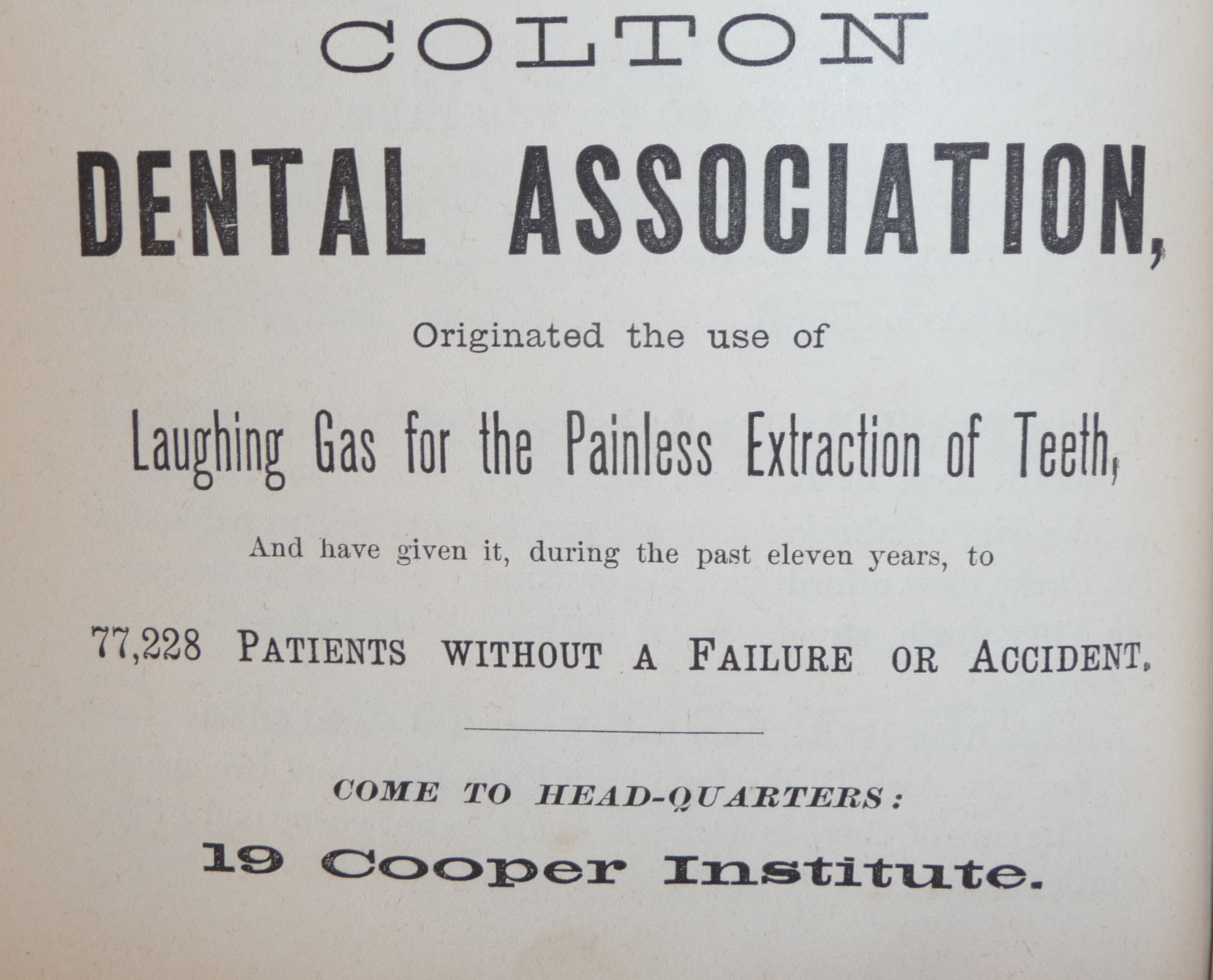
Colton Dental Ad 1874The advertisement for the Colton Dental Association located at 19 Cooper Institute says they originated the use of “laughing gas for the painless extraction of teeth.” Who knew?

In the 19th century, people were really scared of the dentist because it was generally a painful experience. The interesting part of the ad: “77,228 patients without a failure or an accident.”

Zero Refrigerator Ad 1874Seeing the word “refrigerator” in an 1874 ad may cause you to do a double take. But this is not a modern refrigeration system advertised by Alex M. Lesley, the manufacturer of the Zero Refrigerator with offices located at 224 -226 West 23rd Street. The Zero Refrigerator was merely an icebox with “water, wine and milk cooler.” Mr. Lesley simply says the Zero “is the best food and ice keeper in the world.” The world’s first refrigerator was built in 1834. Refrigerators for home use didn’t come into existence until 1913.    Continue reading

Vanishing America: A Great, General Used Book Store

The Bookman – Orange, CA -Still Selling Used Books

The Bookman Exterior Orange CA

The Bookman’s old store at Tustin Ave – new location is 320 E Katella Ave Ste M Orange, CA

In the middle of a strip mall on the perpetually sun-baked streets of Orange CA, stands The Bookman. It is a survivor of an earlier era when real used and second-hand book stores dotted the landscape. Continue reading

The Devil’s Dictionary – Giving Words New Meanings

25 Definitions From The Devil’s Dictionary By Ambrose Bierce

Ambrose Bierce ph - Topham _ Cordon PressAmbrose Bierce (1842-1913?) was the cynic’s cynic. A writer and reporter of immense talent, Bierce served in the Union army during the American Civil War and was seriously wounded in the head. Bierce’s most famous work is the short war story “An Occurrence At Owl Creek Bridge.”

Satiric and biting in his verse, Bierce first published The Cynic’s Word Book in 1906 which contained uninhibited definitions of words from A-L. The second half of the work containing words from M-Z was published as The Devil’s Dictionary in 1911, which was the title Bierce preferred. It has been in print now for over 100 years and many of it’s tongue-in-cheek definitions are still quoted today. It is now in the public domain, so the book is available online for free and worth reading.

Bierce traveled to Mexico in 1913 to witness the Mexican Civil War and vanished without a trace.

Here are 25 of the best definitions from The Devil’s Dictionary:

APOLOGIZE, v.i.  To lay the foundation for a future offence.
BELLADONNA, n.  In Italian a beautiful lady; in English a deadly
poison.  A striking example of the essential identity of the two
tongues.
CAPITAL, n.  The seat of misgovernment.  That which provides the 
fire, the pot, the dinner, the table and the knife and fork for
the anarchist; the part of the repast that himself supplies is
the disgrace before meat.
CHRISTIAN, n.  One who believes that the New Testament is a 
divinely inspired book admirably suited to the spiritual needs of 
of his neighbor. One who follows the teachings of Christ in so  
far as they are not inconsistent with a life of sin.
DIPLOMACY, n.  The patriotic art of lying for one's country.
FAITH, n.  Belief without evidence in what is told by one who
speaks without knowledge, of things without parallel.
FRIENDLESS, adj.  Having no favors to bestow. Destitute of 
fortune. Addicted to utterance of truth and common sense.
HAPPINESS, n.  An agreeable sensation arising from contemplating
the misery of another. Continue reading 

Roger Maris Hits His 61st Home Run

October 1, 1961, A Home Run Record Is Set & Baseball Blows Its Big Moment

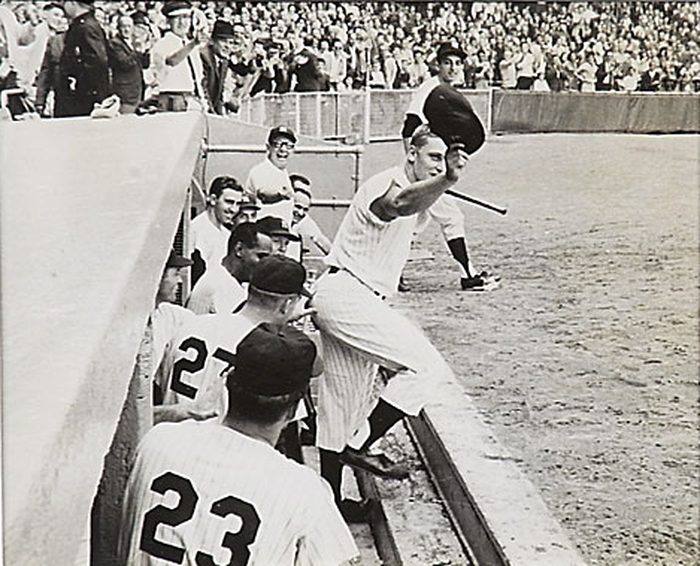
Roger Maris emerges from the dugout to tip his cap after hitting his 61st home run of the season. October 1, 1961

Roger Maris emerges from the dugout to tip his cap after hitting his 61st home run of the season. October 1, 1961

52 years ago today, on the last day of the regular season October 1, 1961, Roger Maris hit his 61st home run of the season off of the Red Sox hurler Tracy Stallard in the fourth inning. For those who were fortunate enough to be there, it was a great moment in baseball history.

Unlike many of today’s players who will take a curtain call without any prodding for driving in the go-ahead run, Maris had to literally be pushed out of the dugout to acknowledge the 23,154 cheering fans at Yankee Stadium.

So why were there only 23,154 fans to see Babe Ruth’s record eclipsed?

That has to do with former sportswriter and then baseball Commissioner, Ford Frick who was a great friend of Babe Ruth and his ghost-writer.

Frick had declared that an asterisk be placed next to any home run record set, if it was not accomplished in 154 games, which was the number of games Ruth played in 1927 when he set his home run mark at 60.

Legendary baseball owner Bill Veeck tells this scathing and hilarious story in his wonderful memoir, Veeck as in Wreck written with Ed Linn (G.P. Putnam’s Sons) 1962.

Let us be fair. Ford Frick does not try to do the wrong thing. Given the choice between doing something right or something wrong, Frick will usually begin by doing as little as possible. It is only when he is pushed to the wall for a decision that he will always, with sure instinct, and unerring aim, make an unholy mess of things.

Suppose that, purely as an exercise, I had put the following baseball question to you at any time during the past twenty-five years.

Suppose, starts the question, that someone comes along to challenge Babe Ruth’s record- which is THE record the same way Mt. Everest is THE mountain. Continue reading

The Greatest TV Game Show Ever

What’s My Line 1950 – 1967

Whats-My-Line-Cast-Dorothy-Kilgallen-death-November-8-1965 cr

A few years ago my Tivo was tuned into the Game Show Network weeknights at 3:00 a.m., taping every episode of the greatest TV game show ever made, What’s My Line.

Let me state it was not just a great game show, but one of the best television shows ever.

Unfortunately the series is not being broadcast now, but many segments of the show are available on Youtube.

To describe the brilliance of the show better than I ever could, we will refer to The Complete Directory to Prime Time Network TV Shows 1948 – Present by Tim Brooks and Earle Marsh (Ballantine 1988), an indispensable television reference book.

What’s My Line was the longest-running game show in the history of prime-time network television. It ran for 18 seasons, on alternate weeks from February to September 1950, then every Sunday at 10:30 p.m. for the next 17 years. The format was exceedingly simple. Contestants were asked simple yes-or-no questions by the panel members, who tried to determine what interesting or unusual occupation the contestant had. Each time the contestant could answer no to a question, he got $5, and a total of 10 no’s ended the game. The panel was forced to don blindfolds for the “mystery guest,” a celebrity who tried to avoid identification by disguising his voice.

That little game, by itself, hardly warranted an 18-year run, when other panel shows of the early 1950’s came and went every month. But What’s My Line was something special, both for the witty and engaging panel, and for a certain élan which few other shows ever captured. There were no flashy celebrities-of-the-moment or empty-headed pretty faces on this panel; they were obviously very intelligent people all, out to have some genteel fun with an amusing parlor game. Like (moderator) John Daly with his bow tie and perfect manners, it reeked of urbanity [“that’s three down and seven to go, Mr. Cerf?”]

The panelists who created this special atmosphere were an elite group. Continue reading

The Difficulties Of The Used Book Store Business

Thinking Of Opening A Used Bookstore? “Don’t Do It!” Advises Bookseller Greg Gibson

Interior of Iliad Bookshop North Hollywood California

Interior of Iliad Bookshop North Hollywood California

Greg Gibson, the owner of the Ten Pound Island Book Company wrote about his nearly 40 year odyssey in the world of second hand books and used book stores in an excellent article called “Don’t Do It!” published here. You don’t have to be interested in collecting or  the book business to enjoy this very well written story.

Many people who love books, daydream about setting up a second hand book shop. Not the paperback emporiums or remainder stores that dot many towns throughout the country, but a real general used book store where when you walk in there is an aroma of old books and the possibility that a customer will find a long sought after treasure.

Running a used book store is a profession that will not make you rich and runs counter-intuitive to the notion that publishing is in a perpetual state of decline and printed books are dying.

Used bookstores that keep regular hours that are open to the public are called open shops. Where there were literally thousands of open shops in the United States twenty years ago,  there are about 1,000 in existence today, victims of a combination of an aging populace; both proprietors and collectors/readers, changing technology and rising rents.

Fewer people have the opportunity to apprentice in a used book store and get the experience necessary to open their own book business. Barely making enough money to survive also discourages many young people from considering books as a career. This is why it is mostly retirees who will entertain the book store notion as a career. The internet has changed the pricing structure for used books and many people who deal in used books do so via mail order through the internet or by eBay without a thorough knowledge of books.

While not completely a warning against going into the book business, the article does describe the lessons Gibson took many years to learn. If you still have dreams of running a used book store, you can get some valuable advice from Gibson before you start on your venture.