Brilliant Re-Working Of A Film Classic
This video first appeared four years ago, but I just discovered it. If you have ever watched a silent film you will appreciate this. Continue reading

This video first appeared four years ago, but I just discovered it. If you have ever watched a silent film you will appreciate this. Continue reading
You Have To Hear It To Believe It…
Shatner, The Transformed Man, continues his musical career. His new album is called, Continue reading

In this January 7, 1957 photograph Jackie Robinson packs up the contents of his locker from Ebbets Field, his home for his entire ten year major league career.
After the 1956 season Jackie Robinson’s legs were gone. He was no longer the player he once was and he knew it. He batted a respectable .275 with ten homers. But rather than continue playing with eroding skills, Robinson would retire at the age of 37.
One problem: except for his family and future non-baseball employer, Robinson didn’t tell anyone of his decision.
The Dodgers shocked everyone including Robinson, with a December 13, 1956 trade to the New York Giants for Dick Littlefield and $35,000 for the Dodger legend. After the trade announcement, fans of the Dodgers were outraged. Brooklynites believed that Robinson would retire rather than play for the hated crosstown rival Giants. But they did not know Robinson had already decided before the trade that he was retiring.
All Robinson would publicly say was he would “inform the Giants by January 14, if he would play in 1957.”
The reason Robinson couldn’t announce his retirement was because he had signed a contract to write an exclusive article for Look magazine, about his retirement in December which would not hit the newsstands until January 8.
Announcing his retirement on January 7, many Dodger fans were happy Robinson would not be playing for the Giants. Robinson said he had decided to take a position with Chock full O’Nuts as Vice President of personnel rather than play baseball.
Whether Robinson would have played for the Giants had he not retired is open to speculation.

click to read Robinson’s letter
Robinson’s January 14, 1957 letter to Giants owner Horace Stoneham takes the high road. Robinson says he appreciates being offered the chance to play for the Giants, but he has “decided to devote his full time to business opportunities.”

 Marbles is a game that I have never seen anyone play in person in my entire life. When I was a young boy, I had a collection of marbles that my grandparents gave me. I would roll them around and marvel at the beautiful orbs of color, but no one ever taught me how to play marbles. Somewhere among my many apartment moves I did lose my marbles. American children seem to have lost their marbles too, for the game is clearly not popular anymore.

click to enlarge
Marbles as a competitive game is still played, but there are probably more collectors of marbles than there are players worldwide. Continue reading
 Almost everyone in the United States who was living on November 22, 1963 can tell you exactly where they were and what they were doing when they heard the shocking news that John F. Kennedy had been assassinated.
That is everyone except Richard Nixon.
Forget the conspiracy theories and all the other unsolvable aspects of the JFK assassination. Nixon’s supposed amnesia of that day is one of the oddest stories related to the assassination.
When I say everyone remembers where they were, I mean everyone. If you think I am mistaken about this, ask anyone who is over the age of 55, and you shall see this is no exaggeration. Continue reading
New Watered Down Playoff System Brings Lesser Teams New Hope
In 2011 the team that tied for the tenth best record in major league baseball won the World Series. The St. Louis Cardinals were a good team at 90-72, but were they the best team in baseball? If your measurement is winning the World Series the answer is yes. Using any other criteria the answer is definitely not. They were a team that got hot at the end of the year and that carried over throughout the postseason.
The real question is: should a team that has the tenth best record in baseball have the right to play in the World Series? Continue reading
The Day After The Yankees Were Swept in a Late Season Doubleheader – 1954
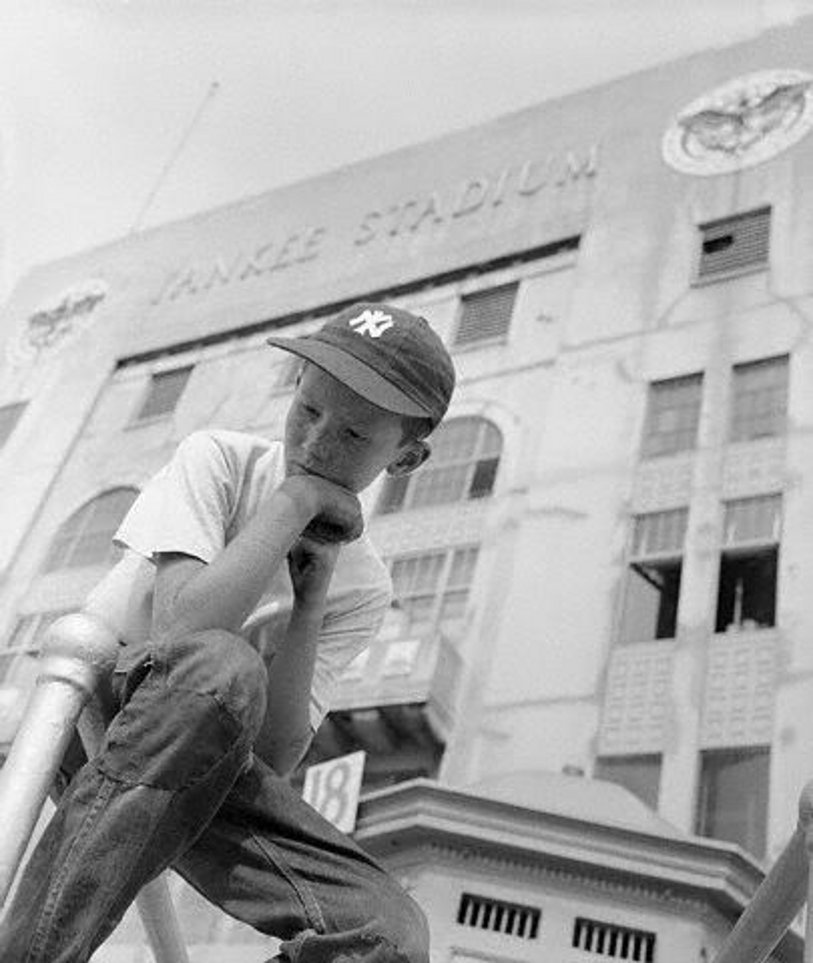
The day of September 13, 1954 was not a happy one for Yankees fans as can be seen above. Reality sank in for eleven-year-old Walter Golle as he sat in front of Yankee Stadium. The dejection shown in Walter’s face reflected the fact that the Yankees would not be in the World Series for the first time since 1948 when Walter was five-years-old. The Yankees had won five consecutive World Series from 1949-1953.
 The day before, on September 12, the Cleveland Indians had swept the Yankees in a doubleheader in Cleveland. The games were witnessed by 86,563 fans, the largest crowd to ever see a baseball game in the cavernous Municipal Stadium.

September 12, 1954 Municipal Stadium Filled
Bob Lemon won the first game 4-1 for his twenty-second win of the year and Early Wynn triumphed 3-2 in the second game for his twenty-first victory. The Yankees ended the day being 8 and a half games behind the Indians, reducing Cleveland’s magic number for clinching the pennant to three games.
The Indians would go on to win an American League record 111 games. They finished the season eight games ahead of the Yankees. Miraculously the New York Giants defeated the heavily favored Indians four games to none in the World Series.
 Walter eventually got over the Yankees 1954 failure. Maybe that is an assumption.
Here is what Walter looked like 46 years later in 2000 featured in The Norwood News Inquiring Photographer section.

This 1927 photo is captioned “Summer On A Children’s City Playground.”
I don’t know for sure what city this is in. But it was typical of an early twentieth century playground. No “helicopter mom’s” hovering over their precious children. Nothing but lots of kids experiencing fun on what is the biggest slide I’ve ever seen in a city park.
I wrote to the New York City Parks Department a few years ago and asked what happened to the monkey bars, see saws and tall slides along with all the other amusements that presented some sense of excitement and danger? Continue reading

Look at that concentration and determination. Did anyone ever make swinging a bat look so graceful? Continue reading

There is nothing extraordinary about 1113 First Avenue, the building at the northwest corner of 61st Street and First Avenue. A late 19th century five story walk-up building with a restaurant at ground level. But if you look up to the corner between the second and third floors you will see the street name etched in stone and attached to the building, circled in red in the photo above.


The rectilinear street grid layout imposed upon Manhattan at the beginning of the nineteenth century assured the builder of this building that it would be located at 61st street and First Avenue seemingly forever.
Before the twentieth century street signs were not at every corner. There were in fact few street signs in New York and they were usually at major intersections or the nicer parts of town. Continue reading