Author Archives: B.P.

Batman As 007 – Twelve Actors Who Turned Down The Role Of James Bond

Batman’s Adam West Is One Of Many Actors Who Were Offered The Role Of  Agent 007 James Bond, But Turned Down The Part

Adam West Batman

“The name’s West, Adam West”

There is a little of James Bond in every actor. That does not mean that every actor wants to play James Bond.

Bond is an expert in a wide range of subjects, an outstanding athlete and fighter, can drive any vehicle, land, air or sea and seems to have a way with the ladies. There are some critics who have complained that James Bond is a misogynist. If so, he has rarely used his “license to kill” on women. Out of 370 people Bond has killed on screen, only three have been women.

Recently while watching Diamonds Are Forever (1971), the extra features on the DVD mentioned that before Sean Connery agreed to return to the role of James Bond, several actors were considered to play 007 and some turned it down. The reasons varied, but I doubt that any of the actors regretted their decision.

The most surprising decline to me was Adam West who had brilliantly played the campy title role on Batman, ABC’s hit series which ran from 1966-1968. I can see how the producers considered him for the role, but I cannot imagine Adam West being James Bond. But then again neither could West and he was smart enough to pass on the part. On the other hand, some of the actors who turned down James Bond, I could see playing 007.

So here is a slideshow of just some of the actors who turned down the role of the world’s most famous secret agent.

A little more about Patrick McGoohan who had he accepted the role may have been the best actor to ever play the part. But it was not only the womanizing McGoohan objected to; he truly despised the character, calling Bond “contemptible and simplistic.”

McGoohan, a man of very strong ethics said in a 1960’s interview Continue reading

A Visit To The New York City Book and Ephemera Fair

Three Antiquarian Book Shows In New York City This Weekend – A Quick Look At The Newest One

A view of the floor of the New York City Book and Ephemera Fair  - Wallace Hall St. Ignatius Loyola Church April 11, 2015

A view of the floor of the New York City Book and Ephemera Fair – Wallace Hall St. Ignatius Loyola Church April 11, 2015

With book lovers from all over the world descending upon New York York City for the ABAA’s New York Antiquarian Book Fair from April 9 -12 2015, two satellite shows containing about 50 dealers each displayed their wares at nearby locations.

Display of fine books at the New York City Book and Ephemera Fair

Display of fine books at the New York City Book and Ephemera Fair

So this morning I had a chance to check out one of the shows The New York City Book and Ephemera Fair, at a location that to my knowledge has never held a book show; Wallace Hall at St. Ignatius Loyola Church on Park Ave and 84th Street.

The show produced by Marvin Getman, was well lit, spacious and chock full of top book dealers from all over the country and Canada.

Many dealers seemed happy with the turnout and for a $15 admission fee the public was able to see some high quality books at mostly affordable prices.

The display case of Wiggins Fine Books, Shelburne Falls, MA

The display case of Wiggins Fine Books, Shelburne Falls, MA

The selection was wide, ranging from signed and first editions to ephemeral early punk rock magazines to science fiction classics to incunabula.

Several dealers featured art, photography and architecture books which seemed to moving briskly.

Children’s books were carried by many dealers and selling for fair prices. A first edition A Pocket for Corduroy a classic by Don Freeman with the dustjacket was offered at $600. Continue reading

Old New York In Photos #48 – Brooklyn’s Fulton Ferry House

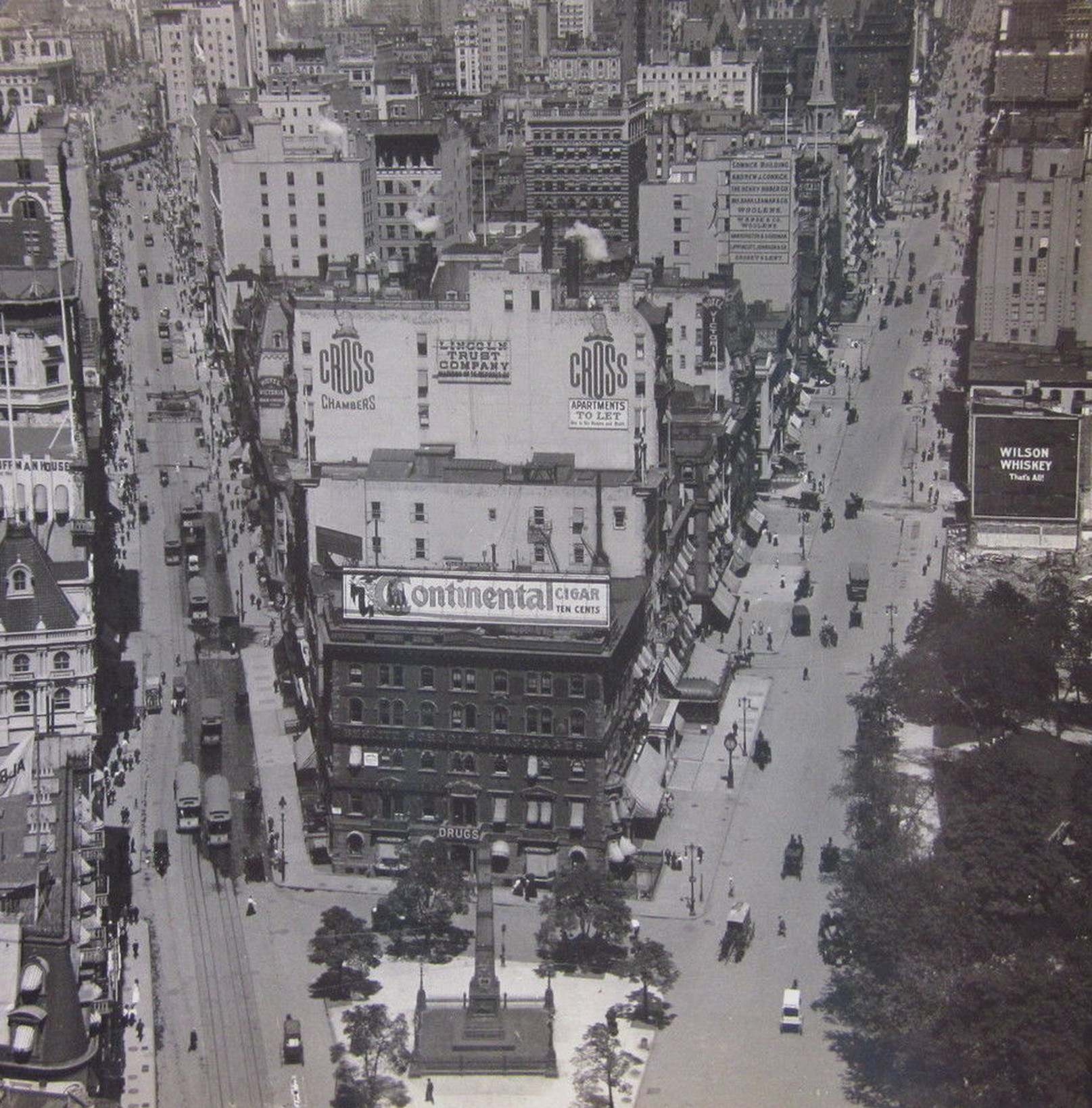
Brooklyn’s Fulton Ferry House and Brooklyn Bridge circa 1885

Brooklyn Fulton Ferry House and Brooklyn BridgeThis view captures the newly built Brooklyn Bridge and Brooklyn’s Fulton Ferry House, a beautiful Queen Ann style Victorian building with its ornate mansard roof.

This picturesque scene showing street railways, horse carts, telegraph poles and light fixtures are all vestiges of the 19th century that vanished long ago. The photo was taken around 1885 from the corner of Everett Street (that is the original spelling) and Fulton Street (now called Old Fulton Street) looking north toward Water Street and the Brooklyn Bridge. Besides the Brooklyn Bridge, the small hotel on the corner of Water and Fulton Street on the extreme right with the striped awning, is the only structure in this photo that is still standing.

The service that became the Fulton Ferry began in 1642. The ferry service moved location several times and Robert Fulton inventor of the steamboat, in the 1810’s secured the lease on the land at the foot of Fulton Street for East River ferry service. William Cutting established a ferry line there starting in 1819.

The Brooklyn Fulton Ferry House building was constructed in 1871 by the Union Ferry Company. Called “The Great Gateway to Brooklyn,” the Ferry House was designed by architect William Belden Olmsted a distant relative of Central Park and Prospect Park landscape designer Frederick Law Olmsted.

At a time when fire laws generally prevented construction of any wooden structures, the Ferry House was built of wood rather than iron because the company believed that vapors from the sewage deposited directly into the river and the salt water would cause iron to rust! It was probably more of an economic ploy to save on building costs as iron or brick was much more expensive than wood. The three story building measured 173 feet wide and 35 feet high, with the tower reaching a height of 86 feet and the main floor containing large waiting rooms featuring every modern convenience. Even opting for the cheaper wood construction, the final cost was a lofty $138,000.

As the new Fulton Ferry House building was opening its demise was literally right behind it. The construction of the Brooklyn Bridge which began in 1869 led to an inevitable and slow decline of the viability of Fulton Ferry service.

With the 1883 completion of the Brooklyn Bridge Continue reading

1,001 Ways To Die In New York City In 1855

 A Detailed Look At New York City Mortality For One Week In 1855

the new york city morgue Frank Leslies Illustrated Newspaper 1866

The New York City morgue

Maybe there weren’t 1001 ways to die, but in a typical week in New York’s death log 160 years ago there were at least 73 ways to enter into eternity. New York City was only the borough of Manhattan and the population was around 629,000.

355 people died during the week of September 22 – 29, 1855.

First looking at how people died we see things that are not predominant causes of death in the United States today.

The most common causes of death that week were: Consumption (38 dead); Infantile Marasmus (35 dead); Infantile Convulsions (31); Stillborn (25); Cholera (25) and Dysentery (20).

Consumption was the 19th century name for tuberculosis. What exactly is marasmus? It is severe malnutrition. Only 5 people died of cancer. Old age was listed only once as the cause of death.

Some other causes of death that week that are now relatively uncommon or in some cases all too common (i.e. shooting, suicide): Bleeding Bowels (1); Colic (1); Diarrhea (21); Dropsy of Head (9); Gravel (passing broken Kidney Stones) (1);  Hydrophobia (Rabies) (9); Scurvy (1); Suicide by arsenic (1); Killed or Murder by shooting (1); Casualty being run over (1); Drowned (1) and Teething (2). Teething?

Death came to both Continue reading

Classic Hollywood #41 – Marilyn Monroe In Acting Class

Marilyn Monroe At The Actors Studio

These three candid photographs of Marilyn Monroe at The Actors Studio in New York were taken by Roy Schatt (1909 -2002).

They are currently being offered at auction on April 15, 2015 by Doyle New York Auctioneers & Appraisers. The estimate for all three photos are between $800 – $1,200. The first two photos of Marilyn in the audience is being offered as one lot (lot 569). The other photo (lot 570) captures Marilyn eating lunch.

Because Actors Studio chief Lee Strasberg thought Schatt had real talent as a photographer he was given access to photograph the classes where actors could hone their craft.

Marilyn stands out in the first photograph Continue reading

Orioles Practice Sliding – March 1960

Baltimore Orioles – Hansen, Adair and Breeding, Spring Training 1960

Orioles in spring training March 1960 (l-r) Ron Hansen, Jerry Adair, Marv Breeding

Orioles in spring training March 1960 (l-r) Ron Hansen, Jerry Adair, Marv Breeding

Three Baltimore Orioles show off their sliding skills at spring training in 1960, Ron Hansen, Jerry Adair and Marv Breeding.

Hansen didn’t need to practice his sliding – he stole only nine bases in a 15 year career, but led the Orioles in home runs in 1960 with 22 and won the Rookie of the Year Award. When he was playing for the Washington Senators, Hansen turned an unassisted triple play on July 29, 1968 against the Cleveland Indians. It was the first unassisted triple play in the major leagues in 41 years.

I love those vintage flannel uniforms the Orioles are wearing. Marv Breeding Continue reading

The 5 Best Cover Songs By Iron Maiden

Iron Maiden Plays Other Band’s Songs Better Than The Originals

Iron Maiden 1986 - (from l-r) Dave Murray, Bruce Dickinson, Steve Harris, Nicko McBrain, Adrian Smith

Iron Maiden 1986 – (from l-r) Dave Murray, Bruce Dickinson, Steve Harris, Nicko McBrain, Adrian Smith

Like Metallica who seem to excel at playing cover songs, Iron Maiden has covered songs from many well known groups including Led Zeppelin, The Who and UFO. But it is usually the lesser known bands that Iron Maiden have been able to bring to the limelight with their covers, usually improving the song substantially in the process.

Of course it certainly helps if the song you’re covering is a good song to begin with. Many of these songs are just that: well written songs.

Here in no particular order are the five best Iron Maiden cover songs where Maiden generally took the original song up a notch.

1) I’ve Got The Fire (1981 and 1983) – originally done by the band Montrose featuring Sammy Hagar on lead vocals. This is the only Iron Maiden cover song recorded by both the original Maiden singer Paul Di’Anno and his successor Bruce Dickinson. First Paul Di’Anno:

Next, Bruce Dickinson’s version which was recorded in 1983.

2) Women In Uniform (1980) – originally performed by the Australian band Skyhooks, Maiden’s version bumps the tempo up and improves Continue reading

Classic Hollywood #40 – Bette Davis

Bette Davis Might Get Fat

Bette Davis early 1930sYou may be familiar with the dated synth infused 1981 #1 hit song Bette Davis Eyes which brought attention to those magnificent eyes of screen legend Bette Davis, but in the 1930’s Bette’s movie studio was more concerned with Bette Davis Thighs.

In 1933 Warner Brothers asked Lloyd’s of London for a policy on the five foot three and a half, 106 pound star to insure that her weight would not go over 120 pounds. If it did Davis’ producers would get $50,000. Continue reading

1925 Police Chief Suggestion: Pay Bounties To NYPD For Killing Criminals

In 1925 A New York Police Chief Proposed Paying Cops Extra To Kill Criminals

Across the country complaints are rising against police officers using excessive force against alleged criminals. So it probably would not be politically correct today to make a suggestion that cops get paid extra to kill criminals. But that didn’t stop one top cop 90 years ago from making that proposal.

Second Deputy Police Commissioner George S. Dougherty c .1912

Second Deputy Police Commissioner George S. Dougherty c .1912

In January 1925 George S. Dougherty former NYPD Second Deputy Commissioner and Chief of Detectives wrote to the New York Times recommending that large bounties be paid to police officers who kill hold-up men.

Dougherty suggested that a police officer killing one hold-up man be paid $1,000, $2,500 for killing two and the astounding sum of $5,000 for killing three. This bounty would mean a regular patrolman could earn substantially more than the $2,500 annual base salary for killing a robber.

Though many citizens may have agreed and responded positively to the Chief’s populist proposal, it never gained any momentum. The New York Times commented that “of course no one goes into mourning when one of these land pirates meet the fate they deserve as enemies of the human race, and if a policeman in the exercise of his duty kills one of them it properly is regarded as a good job, well done. But Mr. Dougherty’s proposal is a very bad one.”

Several officials at the police department concurred with the Times opinion saying that if Dougherty’s suggestions were put into force, “they might incite indiscriminate shooting.”

Other positions advocated by Dougherty included: Continue reading

A Forgotten 1915 Brooklyn Tragedy: Four Boys Die In An Accident, Shattering Two Families Forever

Two Pairs of Brothers, Together In Life And Death

100th Anniversary Of The Forgotten Brooklyn Explosion That Killed Two Sets Of Young Brothers

While wandering the bucolic grounds of the Evergreens Cemetery on the Brooklyn – Queens border you come across many interesting monuments. There are Triangle shirtwaist fire victims, General Slocum memorials and many historic notables. And then there are the monuments like this one that are inexplicable on first inspection.

Zimmer inscription monument

Zimmer inscription monument

Higgins inscription monument

Higgins inscription monument


Two sets of brothers each between 7 and 11-years-old all dying on March 13, 1915 and are buried together. This unique memorial has an angel, with a few fingers and toes missing, head bowed in sorrow, standing between the two columns that are connected at the top by a triangular stone with the Gospel of Luke quotation inscribed across it, “Suffer Little Children To Come Unto Me”.

Oil Explosion kills boys March 13 1915 memorial at Evergreens cemeteryMy first thought was that the boys were probably cousins or related in some other way and died in a house fire.

But checking the news accounts from the following days reveals a senseless tragedy of two unrelated families children just being in the wrong place at the wrong time.

The Zimmer boys, Henry age 11 and Herbert age 7, of 186 Warwick Street and the Higgins boys, Alex age 11 and Arthur age 8 of 174 Warwick Street were close friends and neighbors growing up a few doors from each other. Continue reading