Author Archives: Max

On Patriotism, Loyalty and the U.S. Constitution

2012 – Republican or Democrat?

On May Day (also called International Workers’ Day) which is now morphing into a day of general protest, not just workers rights, I found this nugget of wisdom from an 1864 magazine article. It makes you realize how far we have gone off track as a country when it comes to partisan politics and what is best for the country.

“Patriotism means love of the institutions and customs and peoples of one’s country in general. Loyalty is allegiance, not, as elsewhere or in former times, to kings and nobles, but to the Constitution and laws of our country in both its State and Federal forms. Loyalty to an administration or party may be disloyalty in the true sense of the word, and must be so, if the administration or party be itself unfaithful to the Constitution and laws. Our oath and duty of allegiance are to the Constitution, and not to any administration. The President is not the government, but an administrator of it, according to the laws of the Constitution, and he, as every other officer is sworn to administer it according to that standard and in allegiance to it. They owe the same allegiance we do.”

“The Causes and Dangers of Social Excitement” The Knickerbocker Vol. LXIII No. 6 June 1864 – Page 486

Subway Song

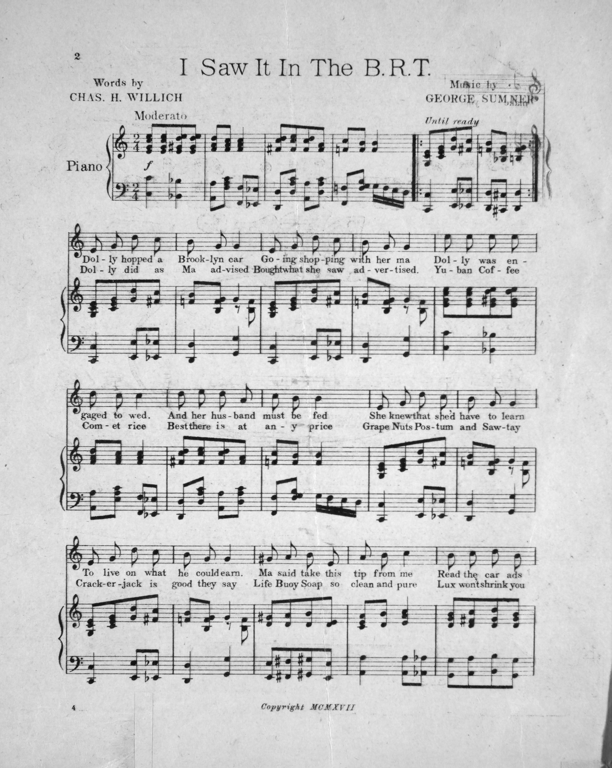
“I Saw It in The BRT”

An ode to the subway.

This 1917 ditty was written about the BRT (Brooklyn Rapid Transit System), which was the former name to the BMT (Brooklyn Manhattan Transit System).  The words which extoll the virtues of the advertising you would see on the train were written by Charles H. Willich and the music by George A. Sumner.

It is amazing how many products mentioned in the song are still around from almost 100 years ago: Grape Nuts, Wrigley’s Gum, Cracker Jacks, Aunt Jemima Pancake Mix and many others.

New Yorker’s have no more BRT, BMT, IND (Independent) or IRT (Interboro Rapid Transit). Now we just call it the subway, run by the oligarchal fiefdom called the MTA (Metropolitan Transit Authority).  And most of the ads you see are for acne treatments, learning English, and filing lawsuits.

Lyrics can be read here (click to enlarge):


Old New York In Photos #17 – Where Was The Easter Parade Held In The 19th Century

The Easter Parade, circa 1900

This view looking north on Fifth Avenue taken at the turn-of-the-century shows New York City holding its famous Easter Parade. The parade, known for its display of beautiful bonnets and fancy hats, has been occurring since the 1870’s in New York.  You can see how packed the streets near St. Patrick’s Cathedral.

Anyone could walk Fifth Avenue on Easter, but it was generally the well to do who participated in the exhibition. Fifth Avenue being home to some of the most expensive homes made this a natural gathering spot for the wealthy. But is that where the tradition began?

One of the first places crowds gathered to display their Easter finery in New York City was not Fifth Avenue, but Central Park. Continue reading

Old New York In Photos #16 – Sixth Avenue Jewelers 1937

Gold & Silver – Highest Prices Paid – 1937

The year is 1937 and we are looking north on the west side of Sixth Avenue.  The Sixth Avenue Elevated in the background will soon be torn down. Sitting out in front of Roxy Jewelers is a man trying to drum up business to “sell your diamonds, pawn tickets, gold, silver, jewelry & antiques for the highest prices paid.”  The Great Depression saw many people selling off whatever valuables they had to pay the rent or just have enough to eat. Continue reading

Death By Root Beer

A Soda Tax Would Not Have Prevented Henry Koerner’s Death

New York City Mayor Michael Bloomberg doesn’t like soda and would like to tax people to discourage them from drinking it. But it wasn’t obesity or the root beer itself that caused Henry Koerner’s demise, it was a bizarre accident.

In the August 20, 1892 New York Times, a brief story appears about Henry Koerner, who worked for Lighte Brothers (a mineral water manufacturer) at 509 East 17th Street and how he was killed when the root beer he was loading on to a wagon exploded.

When Koerner slipped on a fruit peeling on the sidewalk, the ten pound pressurized tank of root beer he was carrying dropped on the stone pavement and exploded like a charge of dynamite.  The tank shattered in all directions with one piece going right through Koerner’s head, killing him instantly. The explosion was so powerful, the top of the tank went 150 feet into the air and fell to the ground with a deafening crash.  The poor man left behind a wife and three children.

I’m sure there was little if any compensation for his loss of life, as accidents like this were dismissed as being part of the hazards of working.  Below is the original newspaper story.

Hair Pulling Contest 1940

And They Are Doing This Because?

On a hot July day, is there anything more entertaining than a contest featuring beautiful women pulling each others hair?

If you agree, then this July 11, 1940 news photograph entitled “Models in Hair Pulling Match” should fit the bill.

The caption reads as follows:

Palisades Park, N.J. – In the first official contest of its kind, two dozen beautiful New York models competed in a hair pulling contest at the Palisades Amusement Park on July 11th. Object of the contestants was to drag their opponents across a finish line by their lustrous locks. Here are Florence Goodman (top) and Alice Schinkel battling it out for championship near the finish line. Florence was declared the winner of the knock-down, drag ’em across contest. 7-11-40 credit: Acme

Old New York In Photos #15 – Fifth Ave. & 42nd St. 1928

42nd Street and Fifth Avenue, 1928

A street level photograph looking east on 42nd Street towards 5th Avenue on a chilly day in 1928. On the left side of the photograph and just to the right of the twin street lamp globes is one of the early traffic towers which would control vehicular traffic flow with colored signals. Continue reading

Old New York In Photos #14 – Presbyterian Hospital 1872

The Old Men And Women’s Hospital (Presbyterian Hospital) Circa 1872

This photograph is from a stereoview which captioned the Presbyterian Hospital as “the old men and women’s hospital.” This photo was taken by E. & H.T. Anthony Co. about 1872, shortly before the hospital’s first complex of buildings was completed.  The hospital was built by the leading architect of the day, Richard Morris Hunt. Though you cannot tell from the black and white photograph, the contrasting color scheme had bricks that were very red and others that were pale. Continue reading

Old New York in Photos #13 -Herald Square Before The New York Herald

Herald Square, Before It Became Herald Square circa 1888

34th Street where Sixth Avenue and Broadway intersect is known as Herald Square because the New York Herald newspaper had their building located there. It was designed and completed in 1894 by the famous architectural firm of McKim, Mead & White.  The building was torn down in two phases, 1928 and 1940. Continue reading