Author Archives: Max

All New York City Sidewalks Are Not Created Equal

What Is The Width Of The Sidewalks In Manhattan?

Following up on our November 19, story, All New York City Streets Are Not Created Equal, the 1904 World Almanac has a list of the width of Manhattan’s sidewalks. The chart can provide the answer to which avenue has wider sidewalks Fifth Avenue or Lenox Avenue? While this may not be a burning question on anyone’s mind, it is interesting to see how much the sidewalk width varies from street to street and avenue to avenue.  The obvious differences are plainly apparent to any New Yorker walking the streets so we thought it would be worth it to reproduce this list with the actual measurements.

Width of Sidewalks in Manhattan Borough

In streets 40 feet wide 10 ft.
In streets 50 feet wide 13 ft.
In streets 60 feet wide 15 ft.
In streets 70 feet wide 18 ft.
In streets 80 feet wide 19 ft.
In streets above 80 feet, not exceeding 100 feet. 20 ft.
All streets more than 100 feet 22 ft.
 
Lenox and 7th Avenues, north of W. 110th St 35 ft.
Grand Boulevard (Broadway above 59th Street) 24 ft.
Manhattan St. 15 ft.
Lexington Avenue 18 ft. 6 in.
Madison Avenue 19 ft.
5th Avenue 30 ft.
St. Nicholas Avenue 22 ft.
Park Avenue from E. 49th to E. 56th St. and from E. 96th St. to Harlem River 15 ft.
West End Avenue 30 ft.
Central Park West, from W, 59th St. to W. 110th, East side 27 ft.
Central Park West, from W. 59th St. to W. 110th, West side 35 ft. 6in.

How many of these sidewalk measurements remained the same throughout the 20th century is open to conjecture. I would imagine that many sidewalks have had their original dimensions changed due to the high value of Manhattan real estate.

click to enlarge

This photograph, taken November 10, 1914 at the corner of Fifth Avenue and 59th Street looking south, has a clear view of the sidewalk. The men near the carriage are standing in front of the Hotel Savoy (built 1892 – demolished 1927). On the right at 58th Street is the Cornelius Vanderbilt II mansion (built 1893 – demolished 1926).  It does not appear that the sidewalk is actually 30 feet wide.
How The Super Wealthy Woman Of 1903 Lived

“Free To Indulge Her Whims and Fads In Whatever Way The Gay World Of Society, And Her Own Inclination, May Lead Or Tempt Her”

Let’s say you are the wife of a turn of the century financier. How do you run your household and spend your time and money? Is there no one to teach you except your family or contemporary one percenters?

Fortunately there was a book written just for the rare woman who needed such advice.

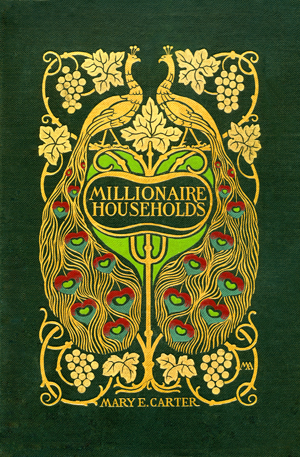
The book which could now be slightly updated and reprinted for today’s super wealthy billionaires is called, Millionaire Households and Their Domestic Economy With Hints Upon Fine Living by Mary Elizabeth Carter published by D. Appleton & Company 1903.

Miss Carter was not a society lady, but had managed a house for the wealthy Vanderbilt family.

With chapters such as Fine Living or Housekeeping; The Hostess’s Wardrobe; The Lady’s-Maid; The House-Maid; The Parlor-Maid; The Servant’s Dining Hall-Maid; The Butler and His Staff; The Valet; Monsieur Le Chef and His Aids; Side-Lights and Shifting Scenes When The “Smart Set” Dine; the book has everything you would need to know as the grande dame running an American version of Downton Abbey.

We learn from Miss Carter that a butler is more than just a servant. She writes, “When the ubiquitous newspaper reporter appears the butler knows how to get rid of him with as little information imparted as will spare the family from false statements or ridicule. During these interviews he requires his entire stock of aplomb. He must withhold all information possible, while appearing to give it out freely.”

This book was not for the 1% that we hear so much about today. In 1903, Millionaire Households and Their Domestic Economy would apply to only o.oo5% of Americans, since there were about 4,000 millionaires out of 80 million people living in the United States at the turn of the century. Approximately half of those millionaires resided in New York State. It is safe to say this book probably did not sell very many copies. It is also important to remember how much a million dollars was back in 1903. One would need to have about twenty million dollars today to have the purchasing power of a millionaire in 1900.

Comparatively today, globally there are about 10 million people (exclusive of their home) with a net worth  of one million dollars or more and approximately 3.1 million of them reside in North America.

The book gives a complete view into the way the millionairess should conduct her household. While the advice the book offers might seem frivolous and somewhat outrageous to read today, Continue reading

Game 1 Of The 1957 World Series Yankees vs. Braves

Action At Second Base, Fifty Five Years Ago Today

Don’t let anyone tell you that the players of yesteryear weren’t as good as today’s players.

They were.

And they played as hard then as they do now. Considering an average player’s salary was around $15,000, the World Series provided extra lucrative income for ballplayers, many of  whom worked at regular jobs in the off season. The winning player’s share of the 1957 World Series was $8,924, the losing player’s share was $5,606.

This news photograph captures the Milwaukee Braves Wes Covington sliding hard into second base to break-up a double play. The news photo is captioned as follows:

Got One, Trying For Two

NEW YORK: New York Yankees second baseman Jerry Coleman leaps to get off the ball (lower center) to first after putting out sliding Milwaukee Braves’ Wes Covington on a force play at second in the fifth inning of the first World Series game of 1957 here at Yankee Stadium October 2nd. Bill McKinley umpires.  McDougald took Crandall’s bouncer and threw to Coleman. The Yanks missed a double play when Elston Howard dropped Coleman’s throw for an error. The Yanks took this opener, 3-1.

United Press Photo      10/2/57

The Braves would end up coming back to win the Series in seven games. Braves right-handed ace Lew Burdette won three games.

The Dangers And Lures Of New York City In 1957

Stay Out of the Parks At Night!

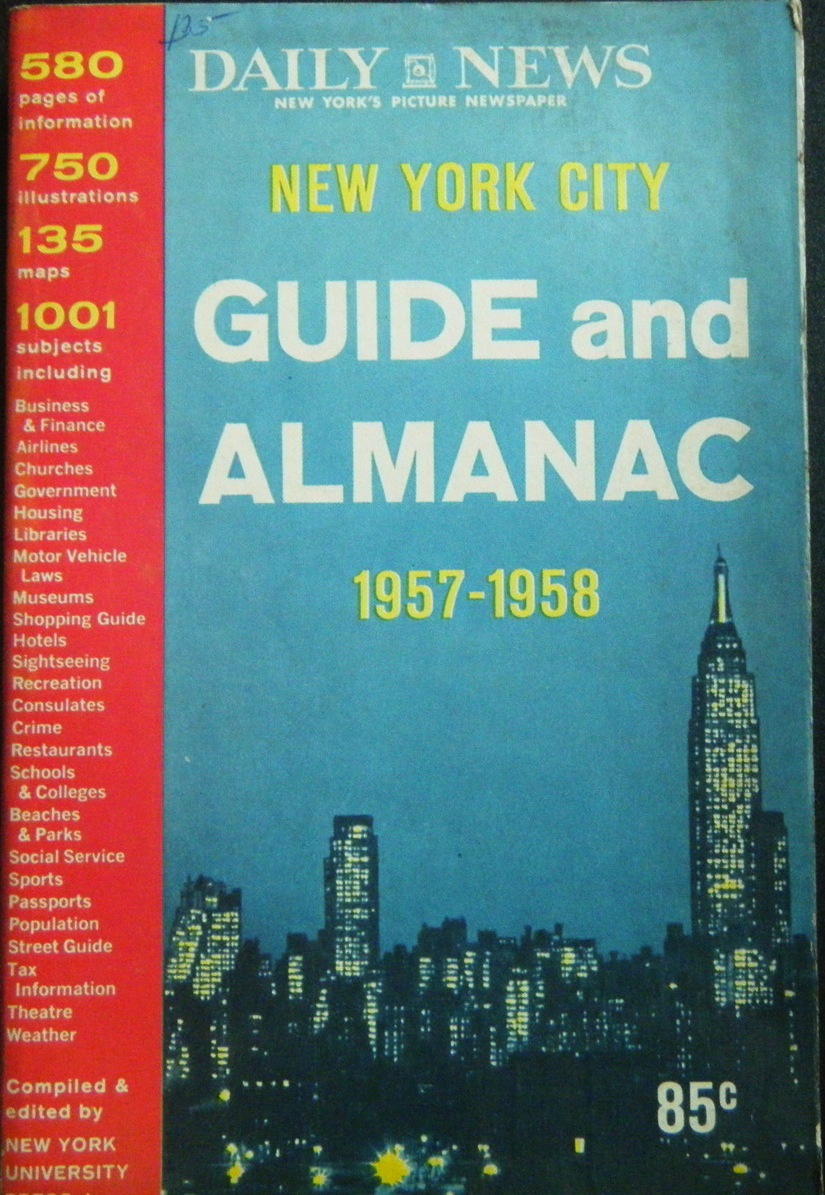
From the New York City Guide And Almanac 1957 – 1958

This vintage book is a great snapshot of New York City in the late 1950’s. I wish they would have printed this annually, but it was published for only one year by New York University Press in conjunction with The Daily News. It is 378 pages chock-full of fascinating facts and figures. The paperback version was originally 85 cents, while the hardcover version would set you back $2.75.  There are a few copies of this out of print gem for sale on abebooks.com ranging from$8.00 – $14.00. A veritable bargain.

Here is a snippet on crime from pages 197 – 198:

Traps for the Unwary

New York City is full of traps for the unwary visitor. It is doubtful if there are proportionately more crooks and criminals in New York than any other large city, but the metropolis is so large that the total is impressive. The bait generally used is greed, and the victims are most often people who regard themselves as sophisticated. Most effective traps for the unwary:

Auctioneers: Dishonest “auction stores” especially in the mid-town sections, where salesmen pretend to auction off “amazing” bargains, which often are samples of “flash goods” turned out for the carnival trade. Articles of genuine value are knocked down to stooges in the crowd, who later return them to be used again. The stranger who obtains a “bargain” is likely to find that a cheap duplicate was substituted during the process of wrapping up his purchase. He usually discovers that he has actually bought a garish gold-washed watch that will not run or an impressive pipe set made of celluloid. These shops should not be confused with operations of reputable auctioneers who preside over genuine sales which are usually advertised in honest fashion.

Confidence Men: Most of these offer money-making machines or counterfeit currency. They also offer to share rewards for well-filled pocketbooks lying on the pavement and “found” by the con man and the victim simultaneously. Continue reading

Classic Hollywood #15 – Robert Morse, Angela Lansbury & Duke Ellington

Mad Men, Murder And The Duke – 1967

Before Robert Morse became known to a generation of television viewers as Mad Men agency head Bertram Cooper, he had a distinguished stage and movie career. The Loved One (1965) a disturbing black comedy about the funeral industry has Morse at his best. Continue reading

Madison Square In A Vintage Painting – Paul Cornoyer

Paul Cornoyer Madison Square in the Afternoon – 1910

Paul Cornoyer (1864-1923) was an impressionist painter who worked primarily in New York City. This beautiful scene was painted in 1910 and is looking east across Madison Square Park, towards the tower of Madison Square Garden. Continue reading

Old New York in Photos #20 – The Boulevard & 104th Street

The Boulevard Looking South From 104th Street

Looking at this tree filled landscape it is hard to believe this is New York City. This idyllic scene was photographed on the morning of July 4, 1888. Until 1899, Broadway above 59th Street was known as The Boulevard. Continue reading

Old New York In Photos #18 – Henry Hudson Parkway Improvement 1937

Henry Hudson Parkway and Riverside Park December 6, 1937

Photo © Ben Heller (Underwood & Underwood)

Looking north from 72nd Street on December 6 , 1937 we see the newly opened stretch of The Henry Hudson Parkway. Continue reading