Yankee Stadium On Edge As Waite Hoyt Pitches To Cardinals Slugger Rogers Hornsby
And The Story of The Strangest End To A World Series
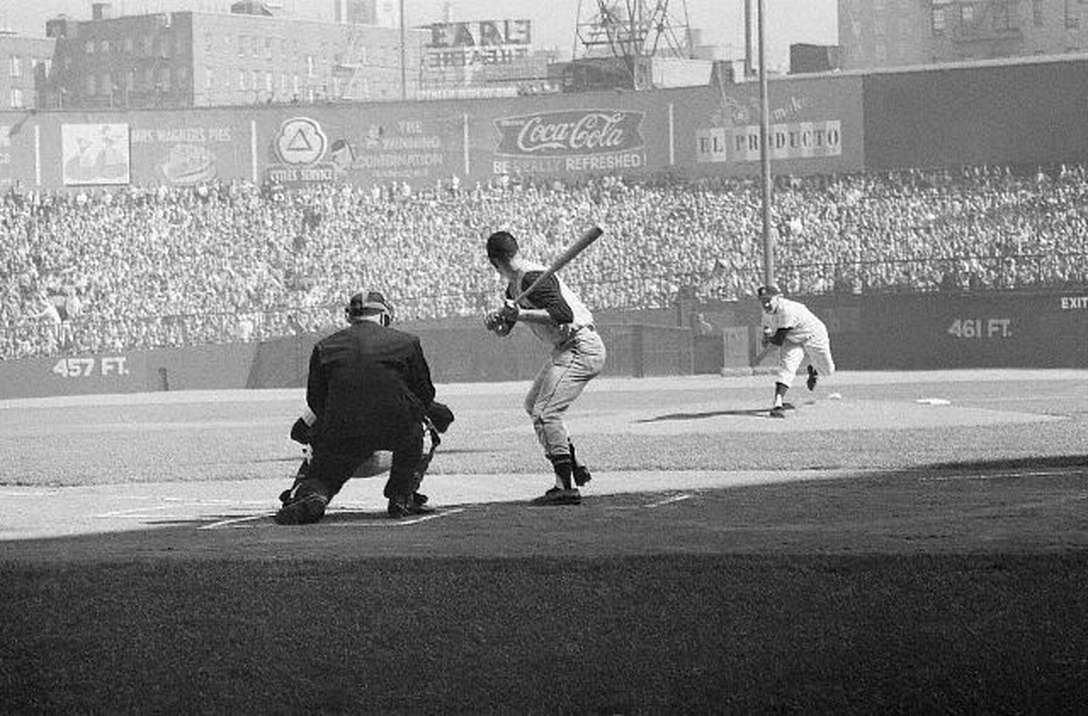
It is October 10, 1926 and it seems everyone is wearing a hat at game seven of the 1926 World Series at Yankee Stadium. Although the stadium looks packed, rainy, gray and chilly weather kept the attendance for the deciding game down to 38,093.
In this rare photo, Yankee star pitcher Waite Hoyt is unleashing a pitch to the Cardinals Rogers Hornsby. The Yankees would lose this game 3-2 and the game would include one of the most dramatic moments in World Series history and one of, if not the strangest play to end a World Series.
The drama occurred when Cardinals starter Jess Haines had loaded the bases in the bottom of the seventh with two outs and was lifted for the veteran pitcher Grover Cleveland Alexander. Old Alex had pitched a complete game victory the day before and was tired, but relaxed as he came into the game to face Yankees slugger Tony Lazzeri. The crowd fell silent as Alexander demonstrated his mastery and struck out Tony Lazzeri ending the threat. Continue reading →
Yogi Berra Dies At 90 – A Remembrance In Rarely Seen Photos Of The Yankee Great
Yogi Berra during the 1960 World Series – photo Marvin E. Newman
Lawrence Peter “Yog”i Berra died Tuesday, September 22, 2015 at the age of 90 in West Caldwell, New Jersey where he had been living in an assisted-living facility.
While countless obituaries will appear over the next few days recounting Berra’s storied baseball career, business acumen and quotable life, we thought it best not to dwell on Berra’s passing or try and tell all about his amazing life in just a few paragraphs. Yogi’s life story will be be well covered by his former teammates, friends, journalists and colleagues.
We will tell you that Yogi was not a great catcher when he first arrived in the majors. Yogi worked hard with former Yankee catcher Bill Dickey to make himself into a great defensive catcher. Also three American League MVP awards tell you that Yogi was extremely valuable to the Yankees. What those awards will not tell you was that Yogi was one of the best bad ball hitters ever – whether the ball was up by his eyes or literally in the dirt – Yogi could do massive damage on a pitch that most batters would not be able to do anything with.
We decided the best way to remember this Hall of Famer was with some old press photos that appeared long ago in magazines and newspapers and mostly have not been seen since.
Frank “Spec” Shea and Yogi Berra before game 1 of the 1947 World Series at Yankee Stadium. 1947 marked the first of a record 10 world championships for Berra.
Yogi Berra and Phil Rizzuto enjoy playing cards on a Yankees charter flight from New York to St. Louis, May 15, 1950 – photo Acme
Clockwise – Yogi Berra (without cap), Mickey Mantle, Vic Raschi and Allie Reynolds celebrate 3-2 World Series game 6 victory over Brooklyn Dodgers at Ebbets Field – October 6, 1952. Berra homered in the seventh inning, Mantle homered in the eighth, Raschi got the victory and Reynolds the save.
September 6, 1955 – Yogi’s Off And Running – Yogi Berra the New York Yankees formidable catcher, shows the wrist action that provides the power that makes him one of the club’s long ball hitters. Berra currently hitting .273 has pounded out 23 homers and driven in 94 runs. He has hit 18 doubles and two triples. – AP wirephoto Continue reading →
A Dying Babe Ruth In Memorial Hospital July 29, 1948
New York – Babe’s Most Recent Picture – This picture, taken at Memorial Hospital here July 29, is believed to be the last picture of the baseball idol. It was made just before the Babe’s most recent relapse. With him is Steve Broidy of Allied Artists movie studio, who is presenting Ruth with a check for the Ruth Foundation for underprivileged children. The homerun king’s condition today was critical. photo – AP, August 11, 1948
Babe Ruth June 13, 1948 in Yankee locker room
On June 13, 1948 just six weeks prior to the above photograph being taken, Ruth made his final appearance at Yankee Stadium and put on his old uniform for the last time as his number three was retired by the Yankees. After the ceremony the uniform would be shipped off to Cooperstown to the Baseball Hall of Fame. The day was hailed as Silver Anniversary Day at Yankee Stadium officially marking the 25th anniversary of “The House That Ruth Built.” Sixteen members of the 1923 Yankees came to the ceremony and even participated in a two inning old-timers game against a team of Yankee all-stars from other years. But everyone was there to see the man himself, Babe Ruth.
Friends and old teammates lined up and approached Babe before the ceremony and he obligingly signed autographs for everyone. After others had spoken, Ruth emerged from the dugout to a huge ovation and made a short speech in a raspy voice telling the crowd how happy he was to be present, how proud he was to be the first man to have hit a home run at Yankee Stadium and how glad he was to be with his old friends again.
Babe Ruth, William Bendix and a studio executive on the set of The Babe Ruth Story
Returning to the story of our original photograph, the last one of Babe Ruth, the emaciated Babe was probably happy to receive a check for the film The Babe Ruth Story, based on his life . But he could not have been pleased with the film which starred William Bendix. Continue reading →
Mantle swung the bat literally as hard as anyone who ever played the game. You would see his forearms and biceps bulge as he whipped the bat through the strike zone on a slight incline. Watching Mantle swing you could literally see that every muscle in his six foot frame was converging to pulverize the baseball.
When Mantle connected cleanly with the ball, the sound was unique. There was a sharp crack that resonated through the entire ballpark and that ferocious swing would drive countless baseballs deep into the gaps or frequently farther, with balls settling in the outfield stands or bleachers for a home run. There was no home run, like a Mickey Mantle home run.
Mickey Mantle steals 2nd base and slides hard 1950s. photo: Marvin Newman
In his prime there were few fielders like Mickey Mantle, who could come out of seemingly nowhere to snag a drive hit in the gap, that when first hit, was thought to be uncatchable. Mantle’s arm could throw bullets, so runners had to think twice about taking an extra base or tagging up when the ball was hit to Mickey.
Mantle played hard breaking up double plays and stealing bases when necessary, even though he was playing on notoriously bad legs which would hamper his entire career. Continue reading →
Avery Corman, Author of Kramer vs. Kramer, Talks About His Latest Book: My Old Neighborhood Remembered A Memoir
The neighborhood is the Bronx. The time is World War II and the post war years. And the writer is Avery Corman. His newest book My Old Neighborhood Remembered A Memoir (2014) Barricade Books, is his first non-fiction book and is filled with wonderful recollections of growing up.
After graduating college Corman was working on the fringes of advertising and with the encouragement of a friend, Herb Gardner (A Thousand Clowns; I’m Not Rappaport; etc), he took a stab at writing a book. That effort was published as Oh God! A Novel (1971). After that hurdle Corman never looked back and he became a full-time novelist. Oh God! was eventually made into a very popular movie in 1977 starring George Burns and John Denver.
Some of Corman’s other acclaimed novels include The Bust-Out King (1977), The Old Neighborhood (1980); 50 (1987); Prized Possessions (1991); The Boyfriend from Hell (2006) and his most famous work, Kramer vs. Kramer (1977) which was adapted into a movie in 1979 and was the winner of five Academy Awards including Best Picture.
Avery Corman’s success must partially stem from his middle-class upbringing in the Fordham section of the Bronx during the 1940’s and 50’s, where he admits he was not the best student when it came to math and science, but did well in the humanities and was surrounded by a loving, extended family.
My Old Neighborhood Remembered A Memoir is more a series of vignettes rather than a straight autobiography and that style comes off well. Corman shares his memories of childhood during World War II up until he becomes a successful author in the late 1960’s. He paints beautiful word pictures, sometimes tinged with sadness, of growing up in a wondrous place that no longer exists. Most of the stories offer short bursts of family life, games, food, education, sports and all the things that contributed to making the Bronx a special place to grow up in.
Corman’s stories resonate with a tender glow of friendships, family and the feeling that neighborhoods were once really neighborhoods, where the familiarity of rituals, people and places were ingrained in the surroundings.
Here are parts one and two of an exclusive interview with Avery Corman.
Part I, Avery Corman talks about what made the Bronx a special place during the war. His unique living situation and school life.
It’s Been 30 Years Since The Last Outdoor, Daytime World Series Game Was Played – Who’s to Blame? MLB, FOX & “TV Research People”
World Series baseball the way it used to be played – during the day. Pirates center fielder Bill Virdon awaits the first pitch from Yankees ace Whitey Ford to begin game 3 of the 1960 World Series at Yankee Stadium, October 8, 1960.
30 years ago on October 14, 1984 the Detroit Tigers and San Diego Padres played game 5 of the World Series at Tigers Stadium under what used to be normal circumstances – they played a day game.
Three years later in 1987 the Minnesota Twins and St. Louis Cardinals also played a day game in the World Series, but you would not have known it because the Twins played their home games indoors at the Hubert H. Humphrey Metrodome.
Since then, every World Series game has been played at night. Continue reading →
Scorecard vendor at the Polo Grounds 1949 – photo William C. Greene
Recently I went to a baseball game at that imitation ballpark in the Bronx they call Yankee Stadium. After being gently frisked at the admission gates and going through the turnstiles, the thing that did not greet me was what you see above: a vendor selling scorecards.
You could buy a scorecard, but not for 10 cents as it was at the Polo Grounds in 1949. The archaic idea of a scorecard costs $10 at Yankee Stadium and is available at the souvenir shops spread throughout Yankee Mall Stadium. The scorecard is buried in some glossy souvenir publication which I did not purchase, nor did anyone else.
When I used to attend a lot of games in the 1970’s and 80’s buying a scorecard was a no-brainer. From anywhere from a reasonable 25 cents in the early 1970’s to two dollars in the late 80’s, filling out that scorecard and having a program was a nice memento of a game I went to. There is a certain enjoyment derived from scorekeeping and having a permanent record of a game you are attending.
Yankees program 1973 Murcer & Munson on cover
Yankees Scorecard September 6 1973 Yanks beat Brewers 8-6
1973 Yankees program listing broadcasters / pitching rosters
1973 Yankees program schedule with ticket prices
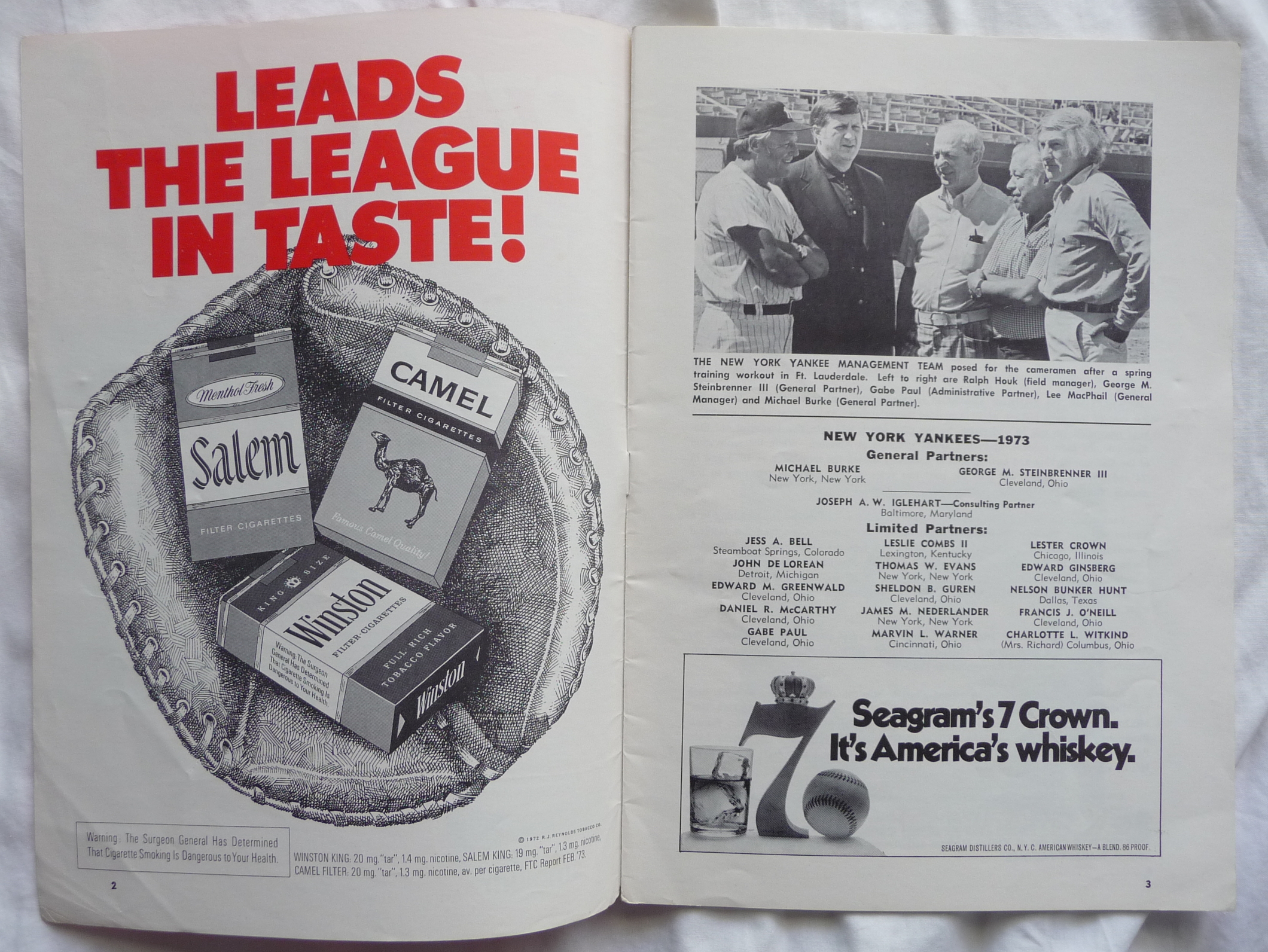
1973 Yankees program cigarette ad and management team Steinbrenner, Paul, Houk Burke. McPhail
I just dug this program of my closet from a game I went to on Thursday evening September 6, 1973. The Yankees came back in the bottom of the eighth inning after trailing 6-5 on a three run home run from Mike Hegan to beat the Milwaukee Brewers 8-6. Bobby Murcer and Roy White also homered for the Yanks. The time of the game was 2:22.
In my childish way I merely recorded outs as fly outs, ground outs or line outs without denoting the fielders who made the play. As you can see my scorekeeping leaves a lot to be desired, but for a little kid I think I did a pretty good job. Eventually I learned to score correctly.
October 1, 1961, A Home Run Record Is Set & Baseball Blows Its Big Moment
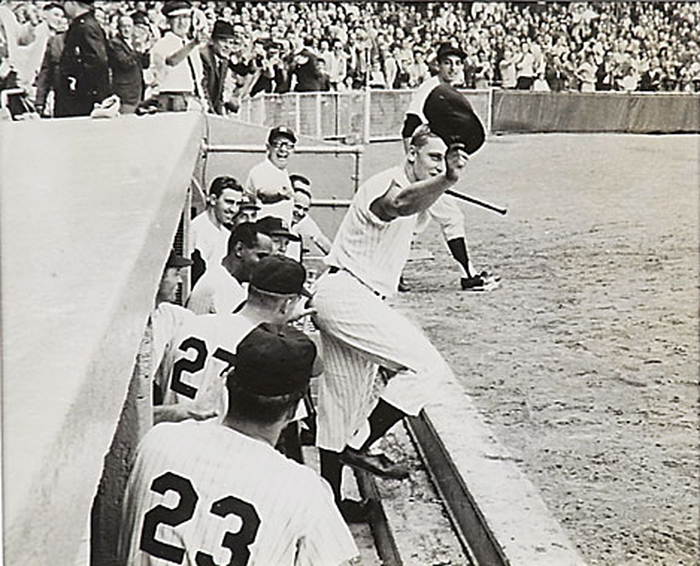
Roger Maris emerges from the dugout to tip his cap after hitting his 61st home run of the season. October 1, 1961
52 years ago today, on the last day of the regular season October 1, 1961, Roger Maris hit his 61st home run of the season off of the Red Sox hurler Tracy Stallard in the fourth inning. For those who were fortunate enough to be there, it was a great moment in baseball history.
Unlike many of today’s players who will take a curtain call without any prodding for driving in the go-ahead run, Maris had to literally be pushed out of the dugout to acknowledge the 23,154 cheering fans at Yankee Stadium.
So why were there only 23,154 fans to see Babe Ruth’s record eclipsed?
That has to do with former sportswriter and then baseball Commissioner, Ford Frick who was a great friend of Babe Ruth and his ghost-writer.
Frick had declared that an asterisk be placed next to any home run record set, if it was not accomplished in 154 games, which was the number of games Ruth played in 1927 when he set his home run mark at 60.
Legendary baseball owner Bill Veeck tells this scathing and hilarious story in his wonderful memoir, Veeck as in Wreck written with Ed Linn (G.P. Putnam’s Sons) 1962.
Let us be fair. Ford Frick does not try to do the wrong thing. Given the choice between doing something right or something wrong, Frick will usually begin by doing as little as possible. It is only when he is pushed to the wall for a decision that he will always, with sure instinct, and unerring aim, make an unholy mess of things.
Suppose that, purely as an exercise, I had put the following baseball question to you at any time during the past twenty-five years.
Suppose, starts the question, that someone comes along to challenge Babe Ruth’s record- which is THE record the same way Mt. Everest is THE mountain. Continue reading →
Yankees Win Game 1, But Brooklyn Wins Their Only World Series
The World Series began on September 28, 1955. Yes, they actually used to begin the “fall classic” right after fall began. Yankee first baseman Joe Collins slugged his second home run of the game, a two run shot in the bottom of the sixth, to put the Yankees up 6-3 in a game they would go on to win 6-5. The outfielder in the photograph leaping in vain for the baseball is Dodger centerfielder Duke Snider.
This was also the game where Jackie Robinson stole home, which to this day is still disputed by Yankees catcher Yogi Berra who insists Robinson was out.
As covered previously by stuffnobodycaresabout, this World Series would be the Brooklyn Dodgers moment of glory as they ended up beating the Yankees in seven games.
Unlike Mariano Rivera’s Farewell, No Fanfare And Only 5,723 Fans At Yankee Stadium – September 25, 1968
Mickey Mantle looks on as his longtime teammate Whitey Ford announces his retirement May 30, 1967.
With all the celebrations surrounding Mariano Rivera’s retirement and last game at Yankee Stadium, it got me thinking about Mickey Mantle’s last game at Yankee Stadium.
It was a sunny day on Wednesday, September 25, 1968 and not being able to attend school yet because I was too young, my father who worked a night shift took me to Yankee Stadium to see a meaningless 2:00 pm game between the Cleveland Indians and the New York Yankees. It was the last home game of the season for the 5th place Yankees. I vividly remember the game, but it originally wouldn’t be because it was Mickey Mantle’s last game at Yankee Stadium. Continue reading →

 It is October 10, 1926 and it seems everyone is wearing a hat at game seven of the 1926 World Series at Yankee Stadium. Although the stadium looks packed, rainy, gray and chilly weather kept the attendance for the deciding game down to 38,093.