Tag Archives: World Almanac

The Simplicity Of The First Federal Income Tax

The First Income Tax Form Of 1913 And How Much The IRS Collected

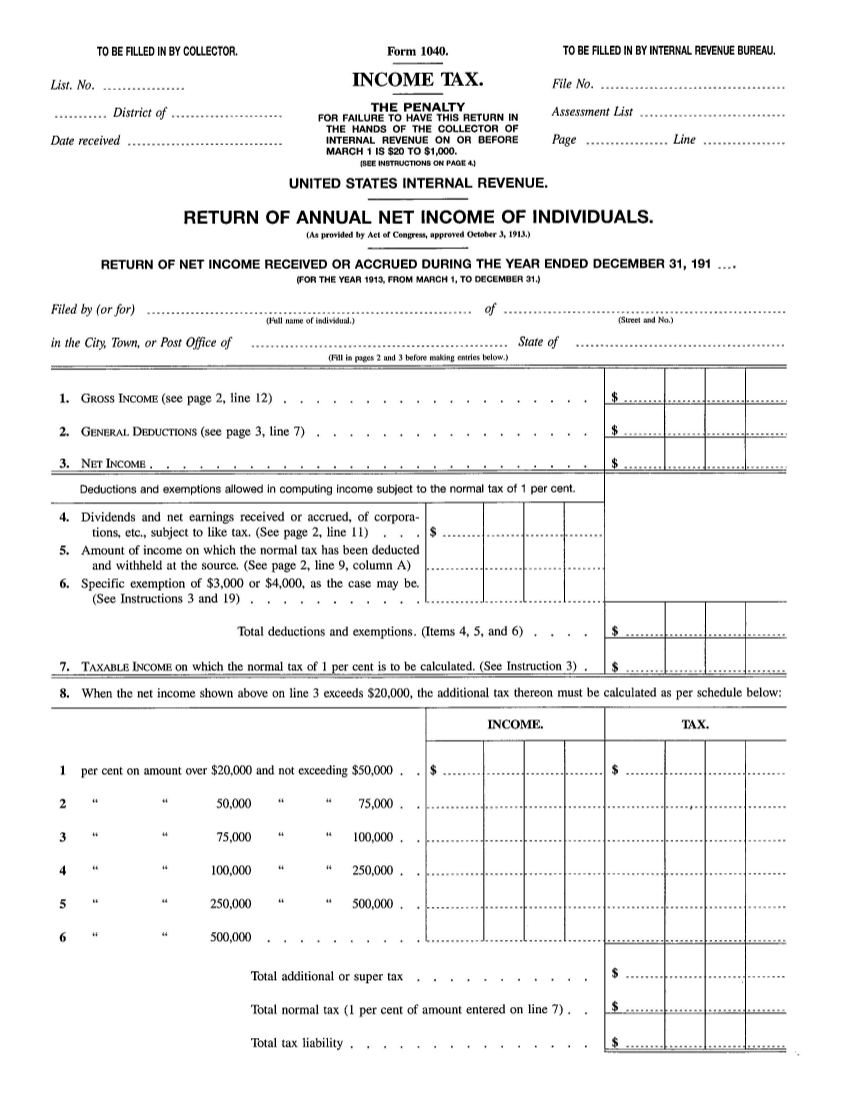
1913 tax form pg 1

click to enlarge

It was 100 years ago that the 1040 individual tax form many Americans dread filling out was introduced.

One thing is for sure, it was a lot simpler to file taxes in 1914 than today.

Pictured above is the 1913 1040 tax form which was due March 1, 1914.

With only three short pages to complete and one page of instructions, for most people who had to file, the average time to complete their taxes would take about an hour.

Had to file is an important term here, because the first $2,500 or $3,333.33 of income in 1913 for single and married couples respectively, was exempt. After 1914 the rate was $3,000 and $4,000 respectively. Considering very few Americans made more than $1,000 per year in income, the vast majority of Americans were exempt from paying any tax.

According to the Department of Labor in 1913, the average family household income was $827. Continue reading

Old Time Ads From The 1910 World Almanac – Part 2

More Interesting Ads From The 1910 World Almanac

1910 World Almanac Cover P1060720

We continue our look at the 1910 World Almanac And Encyclopedia’s advertising.

The New York World newspaper used their annual publication of the Almanac as a way to advertise their own newspaper.

1910 World Almanac Why the World P10607351910 World Almanac Subscribe to the World P1060734Why should you read The World?

There are seven good reasons according to the ad.

Considering almost every newspaper in the country had a political bias, The World claimed they were independent in politics. Another chief reason to read The World is that they were indefatigable in gathering news. As proof of their superiority, The World boasted they had more than twice the circulation of any other morning newspaper in New York.

A separate ad for Almanac readers to consider subscribing to The New York Sunday World stated that they were simply the best at everything, whether it be news, editorials, writers, humor etc. The annual cost for a subscription was $2.50.

1910 World Almanac Acme Fire Extinguisher P1060728A fire extinguisher was a necessity few could afford in 1910. Offered here straight out of a Roadrunner and Wile E. Coyote cartoon, comes the “Acme” Fire Extinguisher.

1910 World Almanac Baldness P1060751William Charles Keene, president of the Lorrimer Institute asks in his ad, “No More Bald Heads? Baltimore Specialist Says Baldness Is Unnecessary And Proves It.”

Of course it is not true. Continue reading

Old Time Ads From The 1910 World Almanac – Part 1

Huckesterism 101 – Useful? Crazy?  How Products Were Advertised In The 1910 World Almanac

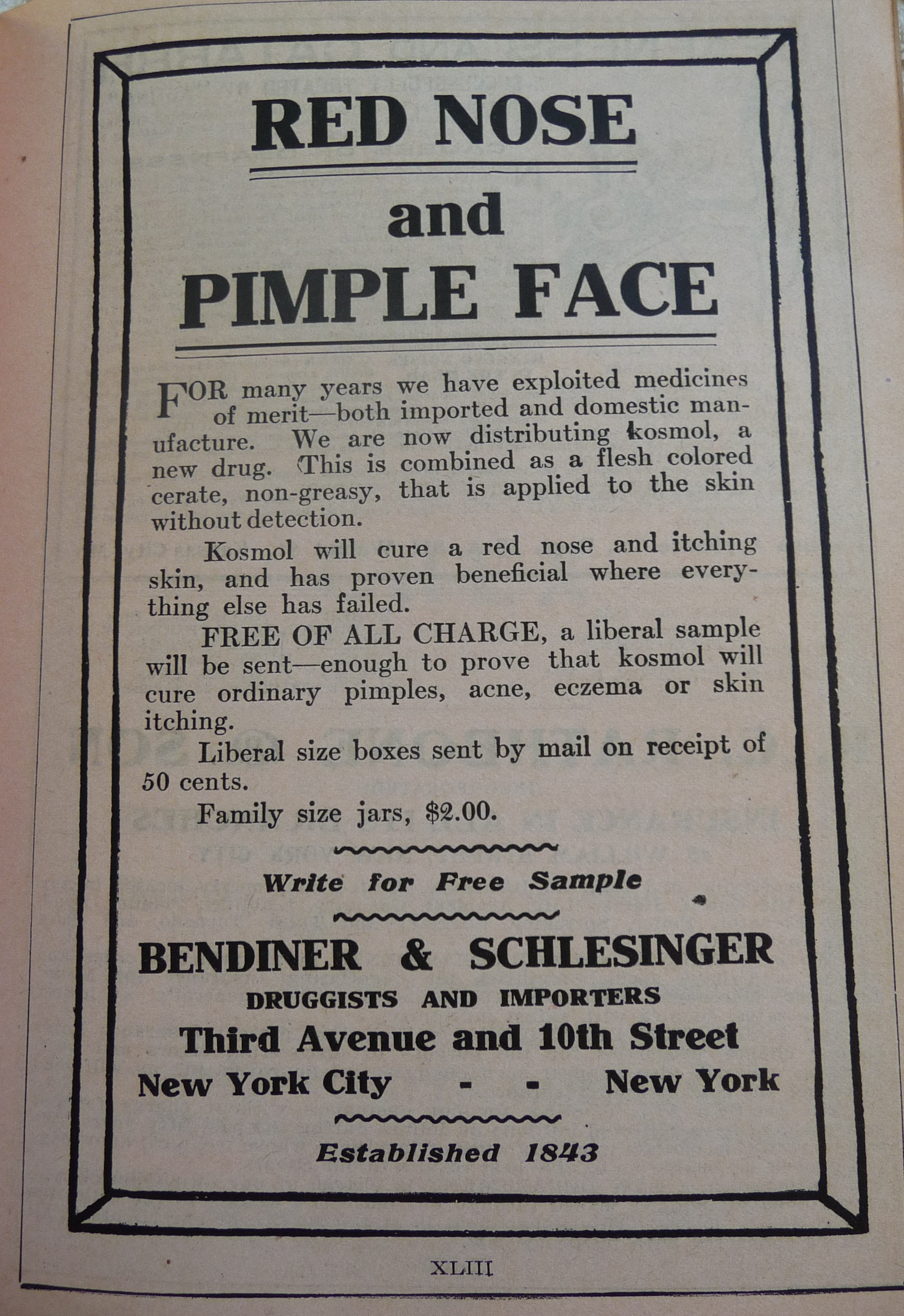
1910 World Almanac Red Nose Pimple Face P1060727

Red Nose and Pimple Face? Bendiner & Schlesinger Druggists on 3rd Avenue and 10th Street have something to help you.

One big difference between old advertising and today’s advertisements, is that today you sometimes have to scrutinize the ad to discover exactly what it is they are trying to sell to you.

Image plays a greater part in modern advertising.

Back in 1910 it was the words that counted.

When you look at old advertising you will notice that the copywriter gets right to the point about the product, though somewhat verbosely.

One thing has remained the same: advertisers used the same swaggering claims back then that they use today.

Even if they are completely false.

Here are some sample advertisements from among the hundreds contained in the 1910 World Almanac. Click on any image to enlarge.

1910 World Almanac Fat is Fatal P1060750


1910 World Almanac Fat is not Good Flesh P1060729


As long as their have been people unhappy with their weight, there have been people and companies who will exploit mankind’s battle with their waistlines. Loring & Co. marketed reducing tablets warning customers that “Fat Is Not Good Flesh.” Their reducing tablets tapped into something back then that is popular today: they contain no chemicals and are made wholly of roots and herbs.

Dr. J. Spillenger of New York City uses endorsements from customers and a dramatic illustration, while warning readers that “Fat Is Fatal.” New York City Mayor Michael Bloomberg would agree with the good doctor. What Dr. Spillenger does not say is exactly what his methods are to help you lose weight. Whatever his method, it involves not starving or exercising. “Rheumatism, Asthma, Kidney and Heart Troubles will leave as fat is reduced. Don’t take my word for this: I will prove it at my own expense,” the copy reads.

Sure, Doctor…sure.

1910 World Almanac Corpulent People P1060748Then there are those people who had no desire to lose weight but merely appear slimmer. Continue reading

All New York City Sidewalks Are Not Created Equal

What Is The Width Of The Sidewalks In Manhattan?

Following up on our November 19, story, All New York City Streets Are Not Created Equal, the 1904 World Almanac has a list of the width of Manhattan’s sidewalks. The chart can provide the answer to which avenue has wider sidewalks Fifth Avenue or Lenox Avenue? While this may not be a burning question on anyone’s mind, it is interesting to see how much the sidewalk width varies from street to street and avenue to avenue.  The obvious differences are plainly apparent to any New Yorker walking the streets so we thought it would be worth it to reproduce this list with the actual measurements.

Width of Sidewalks in Manhattan Borough

In streets 40 feet wide 10 ft.
In streets 50 feet wide 13 ft.
In streets 60 feet wide 15 ft.
In streets 70 feet wide 18 ft.
In streets 80 feet wide 19 ft.
In streets above 80 feet, not exceeding 100 feet. 20 ft.
All streets more than 100 feet 22 ft.
 
Lenox and 7th Avenues, north of W. 110th St 35 ft.
Grand Boulevard (Broadway above 59th Street) 24 ft.
Manhattan St. 15 ft.
Lexington Avenue 18 ft. 6 in.
Madison Avenue 19 ft.
5th Avenue 30 ft.
St. Nicholas Avenue 22 ft.
Park Avenue from E. 49th to E. 56th St. and from E. 96th St. to Harlem River 15 ft.
West End Avenue 30 ft.
Central Park West, from W, 59th St. to W. 110th, East side 27 ft.
Central Park West, from W. 59th St. to W. 110th, West side 35 ft. 6in.

How many of these sidewalk measurements remained the same throughout the 20th century is open to conjecture. I would imagine that many sidewalks have had their original dimensions changed due to the high value of Manhattan real estate.

click to enlarge

This photograph, taken November 10, 1914 at the corner of Fifth Avenue and 59th Street looking south, has a clear view of the sidewalk. The men near the carriage are standing in front of the Hotel Savoy (built 1892 – demolished 1927). On the right at 58th Street is the Cornelius Vanderbilt II mansion (built 1893 – demolished 1926).  It does not appear that the sidewalk is actually 30 feet wide.

All New York City Streets Are Not Created Equal

The Distances Between Streets & Avenues – Things You Probably Didn’t Know

If you are traveling at the same pace, regardless of the avenue, it is faster to walk between 6th and 7th Streets than walking from 13th to 14th Streets. Why? Because the block between 6th and 7th is only 181 feet, 9 inches while the block between 13th and 14th is 206 feet, 6 inches.

Anyone walking around Manhattan is sure to notice that street distances between blocks and avenues vary widely. But few know that the block lengths can vary by several feet.

When the grid plan for Manhattan’s streets were laid out, you’d think that the streets would be equidistant. They are not.

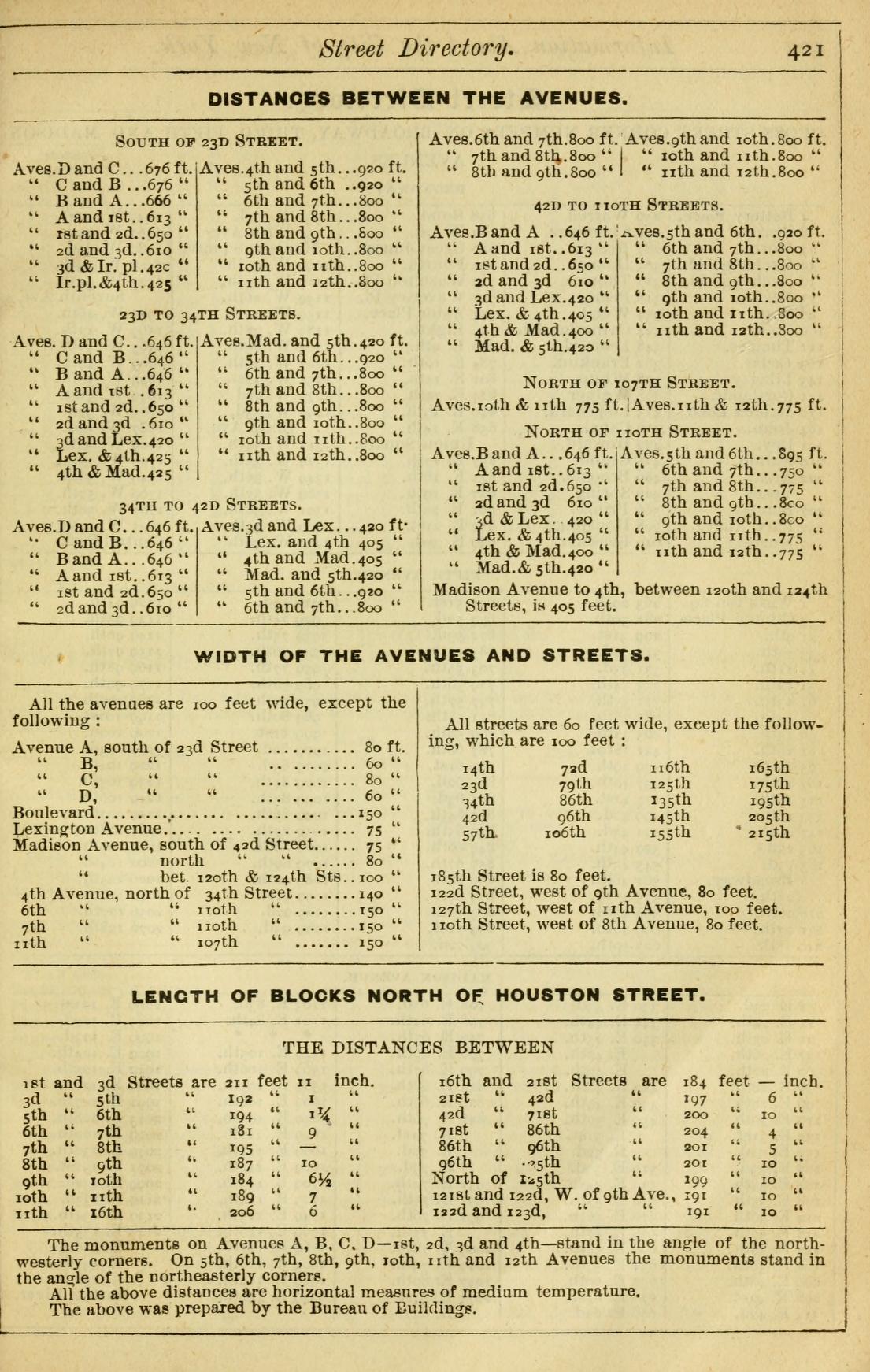
Maybe this is the sort of thing that almost no one would care about, but living up to this web site’s name, I found this chart very interesting. It is from the New York Bureau of Buildings in the 1892 edition of The World Almanac.

1892 World Almanac (click to enlarge)

As you see, the chart lists the distances between the avenues, the width of the avenues and streets and the length of blocks north of Houston Street.

There are a few interesting things to note. One is how far Avenues A, B, C and D extended northward in 1892. Avenue A was later renamed Sutton Place north from 53rd Street and York Avenue north from 59th Street. Avenue B was renamed East End Avenue from 79th to 90th Street. Many portions of Avenue A, B, C and D were never completed (the landfill required to extend them was never done), or wiped out with map changes and construction in the 20th century (e.g. The Franklin D. Roosevelt Drive). Regardless, the almanac still lists the proposed dimensions for the phantom avenues via the Bureau of Buildings.

The other thing to note is that the main cross streets of 14th, 23rd, 34th etc. are all the same: 100 feet wide as compared to the other streets which are all 60 feet wide.

I have used the modern names of avenues in parentheses. Below are some highlights of the chart.

Avenues in Manhattan are 100 feet wide with some notable exceptions:

Lexington Avenue – 75 feet

Boulevard (Broadway) above 59th Street – 150 feet

Madison Avenue South of 42nd Street – 75 feet

Madison Avenue North of 42nd Street – 80 feet

Madison Avenue From 120th to 124th Streets – 100 feet Continue reading

Crime, Murder, Prisons, Hangings and Lynchings in 1891

Some Interesting Facts The 1892 World Almanac

The 1892 World Almanac contains fascinating crime statistics.

Putting the crime numbers in perspective to the population, in 1890 the United States total population was 62,830,361.  The “colored” population  was 7,488,676. So, African-Americans made up about 12% of the population.

There were 45,233 people in penitentiaries, 14,687 were black. That means African-Americans comprised nearly one third of the inmates in the U.S. penitentiary system.

The number of murders and homicides reported by newspapers for 1891 was 5,906.

The murders and homicides are broken down as follows:

  1. Quarrels 2,820
  2. Liquor 877
  3. Unknown 859
  4. Jealousy 449
  5. By Highwaymen 241
  6. Infanticide 208
  7. Resisting Arrest 182
  8. Insanity 102
  9. Highway Men Killed 74
  10. Self Defense 74
  11. Strikes 10
  12. Outrages (?) 2

The number of legal executions reported in the U.S. was 123. The two leading states were Georgia and Texas with 19 and 12 executions respectively. The electric chair as a means of execution was first put into use in New York in 1890.  Almost all the executions in 1891, were by hanging.

The number of lynchings reported was 195. The leading three states were Louisiana 29, Alabama 26 and Mississippi with 23. Six of the people lynched were women.

Below is the full chart on all these statistics. (double-click to enlarge to full size)


How Many Books Were Published 100 Years Ago As Compared To Today?

A Glut of Publishing

In 1907 there were 9,260 books published in the United States according to the New York State Library Bookboard.

Compare that to 2010 when there were 316,480 books published by traditional publishing companies according to Bowker.

Add to that another 2,776,260 on-demand titles produced by reprint houses specializing in public domain works and by presses catering to self-publishers and ”micro-niche” publications.

That is over 3 million books published in one year.

No wonder it is so hard to separate the wheat from the chaff. Continue reading

The 1929 World Almanac

Some Vintage Advertisements of the Era and What Americans Paid in Taxes

The World Almanac was called The World Almanac because it was published by The New York World newspaper, not because it contained everything about the world. A version is still published every year even though the New York World has been gone for many years.

This edition was published in early 1929 when America was riding high. The stock market crash that caused the Great Depression in October was still months away.  The almanac covers the past events of 1928 and has data on thousands of items that are no longer covered in modern almanacs.

The first 70+ pages were advertisements. The rest, useful information.

Here are a few interesting things I found looking at my copy. (click on any photo to enlarge and click again for high resolution)

You need a coffin? The Springfield Metallic Casket Company of Springfield Ohio has many to choose from including “old reliable.” My favorite Continue reading