Tag Archives: Trolley

Old New York In Photos #63 – Herald Square 1895

Herald Square 1895

Herald Square Herald Building elevated 34th Street 1895 photo JS Johnston New York City commercial photographer John S. Johnston took this photo a few minutes before 1:00 pm on a lively day in 1895. We are looking north from 33rd Street where Sixth Avenue and Broadway converge to form Herald Square.

This vantage point from the Sixth Avenue Elevated station’s platform was a favorite for many photographers in the 19th century.

In the center stands the New York Herald newspaper building. The paper had just moved from Park Row to its new headquarters, designed by McKim Mead and White, in 1893.

A train is about to pull into the Sixth Avenue Elevated 33rd Street Station. Trolleys and horse drawn carriages share Broadway’s wide street and the sidewalks are crowded with pedestrians.

The large painted advertisement on the side of its building marks the eight story Hotel Normandie which was completed in 1884 and located at Broadway and 38th Street.

Years after our photograph of Herald Square was taken, the Hotel Normandie received a new advertising sign, but not for advertising the hotel.

On June 18, 1910 the Hotel Normandie unveiled one of the largest moving illuminated advertising signs in the world on its roof. The sign showed a Roman chariot race with three chariots appearing to race one another speeding around an arena. The sign had 20,000 white and colored lights and astounded crowds of people who gawked at its illusion of movement.

Hotel Normandie Chariot Race Sign photo: Byron Co. via MCNY collection Hotel Normandie Chariot Race Sign frame and truss photo: Byron Co. via MCNY collection Advertising sign Hotel Normandie

From the photograph above Continue reading

Old New York In Photos #59

Looking West Towards Sixth Avenue On 42nd Street – 1890s

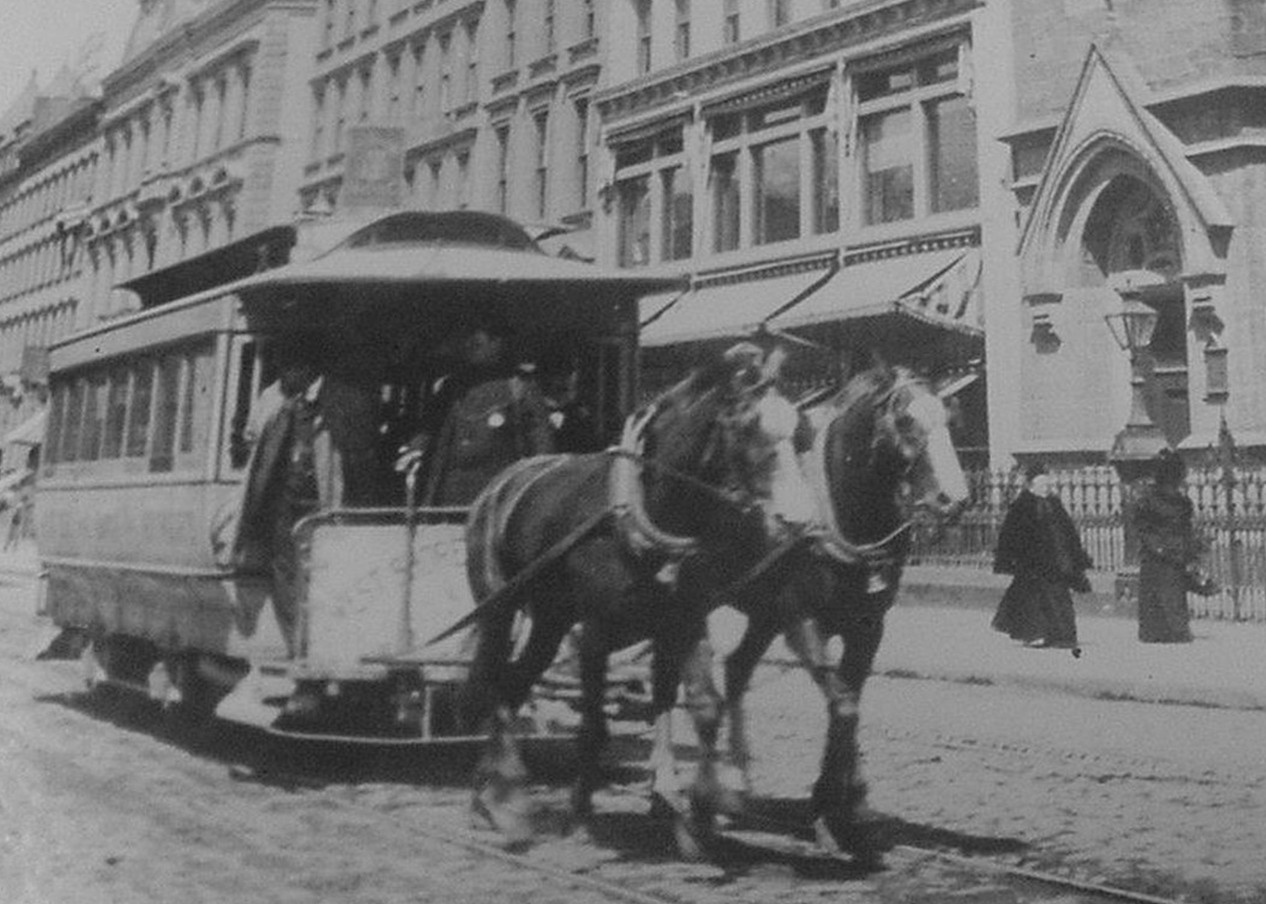
42nd St looking west from Fifth Ave Dr. Parkhursts Church Horse Trolley 1889 ph HN TiemannWe are looking west along 42nd Street towards Sixth Avenue in a photograph taken sometime during the last decade of the 19th century.

A cropped version of this photograph appeared in the must own book New York Then & Now 83 Matching Photographic Views from 1864-1938 and from the 1970s by Edward B. Watson and Edmund V. Gillon (Dover) 1976.

42nd St looking west from Fifth Ave close up photo HN Tiemann

close-up of trolley

When published in the book the date was given as 1900, but on the original photograph (seen above) taken by the firm of H.N. Tiemann, the caption says 1889 and lists the church as Dr. Parkhurst’s. This is definitely incorrect as Parkhurst was presiding at the Madison Square Presbyterian Church. The building next door, the Spalding Building was not constructed until around 1890, so there is doubt as to the true date of the scene.

Rapid transit is on display in the form of a couple of horse drawn trolleys and the Sixth Avenue Elevated’s 42nd Street station in the background.

West Presbyterian Church 1897 photo Byron & Co via MCNY

West Presbyterian Church 1897 photo Byron & Co via MCNY

On the north side of the street is the West Presbyterian Church (built 1862, demolished 1911) Continue reading

Old New York In Photos #58 – Panorama Columbus Circle 1904

Panoramic View of Columbus Circle – 1904

Columbus Circle Trolley 1904 photo: National ArchivesThis phenomenal panoramic street level view of Columbus Circle comes via the National Archives. On their website it is misidentified as Eighth Avenue Trolley, (true – Eighth Avenue changes names to Central Park West) Downtown (which it certainly is not.) Click the photo to greatly enlarge.

We are looking north from 59th Street (Central Park South). The Columbus monument is not visible, but would be to the extreme left near where two gentlemen are standing in the street. Directly behind them are two subway kiosks for the entrance and exit of the soon to be opened New York City subway system.

Besides the subway, the new metropolis is emerging in other ways. An automobile is heading east towards Central Park South. To the left of the automobile, a trolley makes its way up Central Park West. To the left of the trolley is one of many horse drawn vehicles traveling up and down Broadway. Continue reading

How A 1919 New York Law Enacted To Help Women, Ended Up Costing Them Their Jobs

An Uproar Ensues When Women Take Men’s Jobs In Wartime New York

Marie Bocinec First Woman Street Car Conductor New York City Dec 11 1917

1917 – Marie Bocinec Becomes The First Woman Streetcar Conductor In New York City. As New Doors To Working Women Were Opening, Everything Was About To Go All Wrong.

Recently while watching the movie Music For Millions (1944) on TCM I was reminded how great social shifts can subtly occur.  In the movie filmed and set during World War II, June Allyson portrays a bass player in a New York symphony orchestra which has been filled with many women replacements. In the movie as in real life, as men were drafted into the armed services, the symphony orchestra had little alternative but to have skilled women become members in a profession that had been male dominated with few women in the ranks.

After World War II entree for women into orchestras became more accepted as women had proved every bit as adept as their male musical counterparts.

So when I came across this old news photograph of Marie Bocinec, the first woman streetcar conductor in New York City, it became apparent that it was also a war that nudged progress forward for women’s rights over some objections. But as it turned out that progress would be short-lived.

The United States entry into World War I in 1917 meant women would soon be filling jobs once held exclusively by men. Remember that women were not even allowed to vote in the United States until the 19th amendment was ratified more than two years later August 18, 1920.

The caption to this news photograph reads:

Photo of Miss Marie Bocinec

Clad in black taffeta caps trimmed with two bright golden braids more than forty pretty young girls have introduced an innovation in the daily life of New York and will soon be collecting nickels for railway companies throughout the country. Women street car conductors came to stay. They stood the test, and in many instances proved even superior to men in the discharge of their duties. No girl conductor is employed unless she is at least twenty-one years old and in good health. Miss Marie Bocinec, one of the prettiest girls among the women conductors, was the first to graduate and begin work as a conductor.    Photo – NYH Service December 11, 1917

Marie Bocinec’s first practice run on December 7, 1917 took her from 146th Street and Lenox Avenue to the Battery without incident.  Three days later on December 10, Marie was assigned to the Broadway line. Her wages? A six day work week for a ten hour workday with a two hour unpaid luncheon paid twenty seven cents an hour. On the bright side, if it can be called that, it was the same pay rate that the male conductors were getting. Continue reading

Old New York in Photos #10 – Rapid Transit 1905

Crosstown Rapid Transit, 1905, New York City


It probably made the crosstown trip faster than we currently do.

I like the sign in the background – Milk, Cider, Cream Soda, Buttermilk, Lemonade 3¢.

And I  love old handwriting:

Tuesday A.M. Dear Mamma, What do you think of this for rapid N.Y.  Please send my letters to Aunt Emma’s. Came Monday, will write to-day Love, Evan(?)

According to Appleton’s Dictionary of New York in 1905, there were 7-8  mail deliveries per day and the postal service made a profit. Continue reading

Old New York in Photos #5 – 42nd Street c. 1909

42nd Street Looking West From Park Avenue c. 1909

42nd Street 1910 Photo Detroit Publishing Co.

Trolleys, horse drawn wagons and no cars, dominate this view of 42nd street.  The building on the right is Grand Central Terminal before being completely renovated by the architectural firm of Warren & Wetmore. The tall building on the right past the trolley is the Hotel Manhattan (demolished c. 1962 and replaced by Sperry Hutchinson Building in 1964). In the far background in the center is The New York Times Tower Building which was opened in 1906. Continue reading