Tag Archives: New York Times

How A 1919 New York Law Enacted To Help Women, Ended Up Costing Them Their Jobs

An Uproar Ensues When Women Take Men’s Jobs In Wartime New York

Marie Bocinec First Woman Street Car Conductor New York City Dec 11 1917

1917 – Marie Bocinec Becomes The First Woman Streetcar Conductor In New York City. As New Doors To Working Women Were Opening, Everything Was About To Go All Wrong.

Recently while watching the movie Music For Millions (1944) on TCM I was reminded how great social shifts can subtly occur.  In the movie filmed and set during World War II, June Allyson portrays a bass player in a New York symphony orchestra which has been filled with many women replacements. In the movie as in real life, as men were drafted into the armed services, the symphony orchestra had little alternative but to have skilled women become members in a profession that had been male dominated with few women in the ranks.

After World War II entree for women into orchestras became more accepted as women had proved every bit as adept as their male musical counterparts.

So when I came across this old news photograph of Marie Bocinec, the first woman streetcar conductor in New York City, it became apparent that it was also a war that nudged progress forward for women’s rights over some objections. But as it turned out that progress would be short-lived.

The United States entry into World War I in 1917 meant women would soon be filling jobs once held exclusively by men. Remember that women were not even allowed to vote in the United States until the 19th amendment was ratified more than two years later August 18, 1920.

The caption to this news photograph reads:

Photo of Miss Marie Bocinec

Clad in black taffeta caps trimmed with two bright golden braids more than forty pretty young girls have introduced an innovation in the daily life of New York and will soon be collecting nickels for railway companies throughout the country. Women street car conductors came to stay. They stood the test, and in many instances proved even superior to men in the discharge of their duties. No girl conductor is employed unless she is at least twenty-one years old and in good health. Miss Marie Bocinec, one of the prettiest girls among the women conductors, was the first to graduate and begin work as a conductor.    Photo – NYH Service December 11, 1917

Marie Bocinec’s first practice run on December 7, 1917 took her from 146th Street and Lenox Avenue to the Battery without incident.  Three days later on December 10, Marie was assigned to the Broadway line. Her wages? A six day work week for a ten hour workday with a two hour unpaid luncheon paid twenty seven cents an hour. On the bright side, if it can be called that, it was the same pay rate that the male conductors were getting. Continue reading

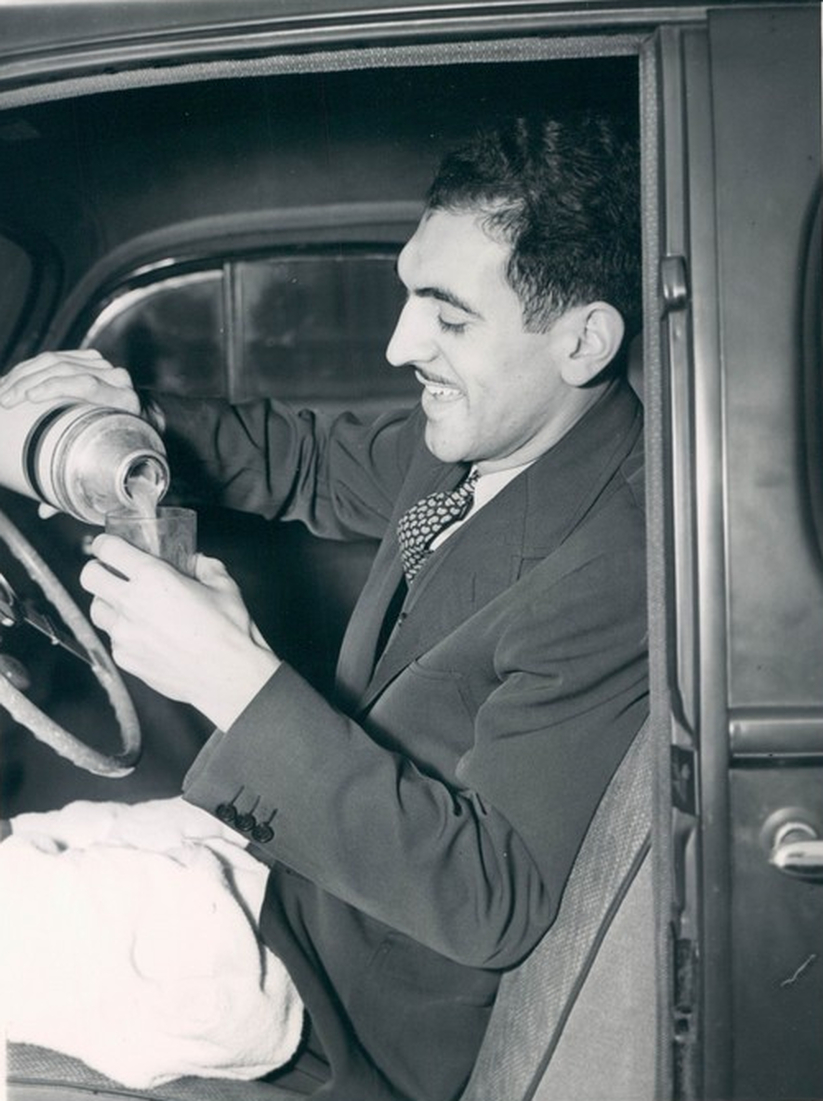
The Lincoln Tunnel Opens And “Mr. First” Is There – December 22, 1937

Omero C. Catan, Known As “Mr. First” Waits To Be First Through The New Lincoln Tunnel

Omero C Catan Lincoln Tunnel 1st through 12 21 1937

When he was 13-years-old in 1928, Omero C. Catan heard a story from a family friend who was one of the first people to cross the Brooklyn Bridge when it opened in 1883. It was then that Omero decided that being first would be something fun to do as a hobby.

Soon after Catan went down to Lakehurst, NJ from his home in Greenwich, CT to become the first American to tour the famous airship, Graf Zeppelin.

The Miami New Times 1995 profile of Omero and his brother Michael reported, “after that initial success, there was no stopping him.”

Catan paid the first toll on the George Washington Bridge linking New York and New Jersey (October 25, 1931). He was the first to buy a token on the Eighth Avenue subway (September 10, 1932). He was the first paying customer to skate on the Rockefeller Plaza ice rink (December 25, 1936).  After he proposed marriage to stenographer Jeanne Tobolka, he was to receive the first wedding license of 1939. He was the first to put a coin in a New York City parking meter (Sept. 19, 1951). He was the first to drive over the Tappan Zee Bridge (December 15, 1955).

In all Catan was “first” 537 times, acquiring the sobriquet “Mr. First”.

At 4 a.m. on December 22, 1937 the lights turned green and Omero Catan and George Horn started driving through the new Lincoln Tunnel from opposite sides.

According to the New York Times, Catan whose car had been parked Continue reading

Old New York In Photos #31 – Garbage Strike 1911

The Garbage Strike of 1911

boys chase garbage carts Nov 13 1911

This photograph shows First Avenue and 50th street looking north. A policeman is running after boys who were harassing and chasing a garbage truck (to the left of the trolley) driven by a strike-breaker (now what would be termed a scab) in November 1911.

On November 8, 1911 New York City’s garbage collector’s went on strike demanding better working conditions. The ashcart men did not like working at night when seeing dangerous items deposited in the trash and obstacles on the street was difficult, so they wanted to work only during the daylight hours when it was warmer and safer. Another complaint the union lodged was having only one man to lift trash cans that sometimes weighed over 200 pounds.

City officials were irate and refused to give in. Earlier in July during a smaller garbage strike, Mayor William Jay Gaynor warned that every worker who did not report to work would be fired. Continue reading

Art Donovan, A True Character and Football Great Dies At 89

Baltimore Colts Tackle, Football Hall of Famer, Art Donovan Passes Away

On Sunday, August 4, 2013 Art Donovan, one of the greatest tackles to ever play in the NFL died at the age of 89 of a respiratory ailment at Stella Maris Hospice in Timonium, MD.

The New York Times obituary summarizes Donovan’s interesting life appropriately. I’ll just say that professional athletes like Donovan are a rare breed today; talented, honest, humble and funny.

I remember the many classic Miller Lite beer commercials that Art Donovan appeared in. Unfortunately none are currently available for viewing.

This video clip below from 1988 is a classic. Art Donovan is promoting the paperback release of his autobiography “Fatso” on Late Night with David Letterman.

Letterman brings up the fact that when Donovan was on the show previously promoting the hardcover release of the book, Donovan admitted he had not read it.

Letterman asks, “now that it is out in paperback have you read it?”

Donovan shakes his head and says, “Uh, no David I can’t say I have. I know all the stories, so why should I waste my time reading the book!”

Exactly.

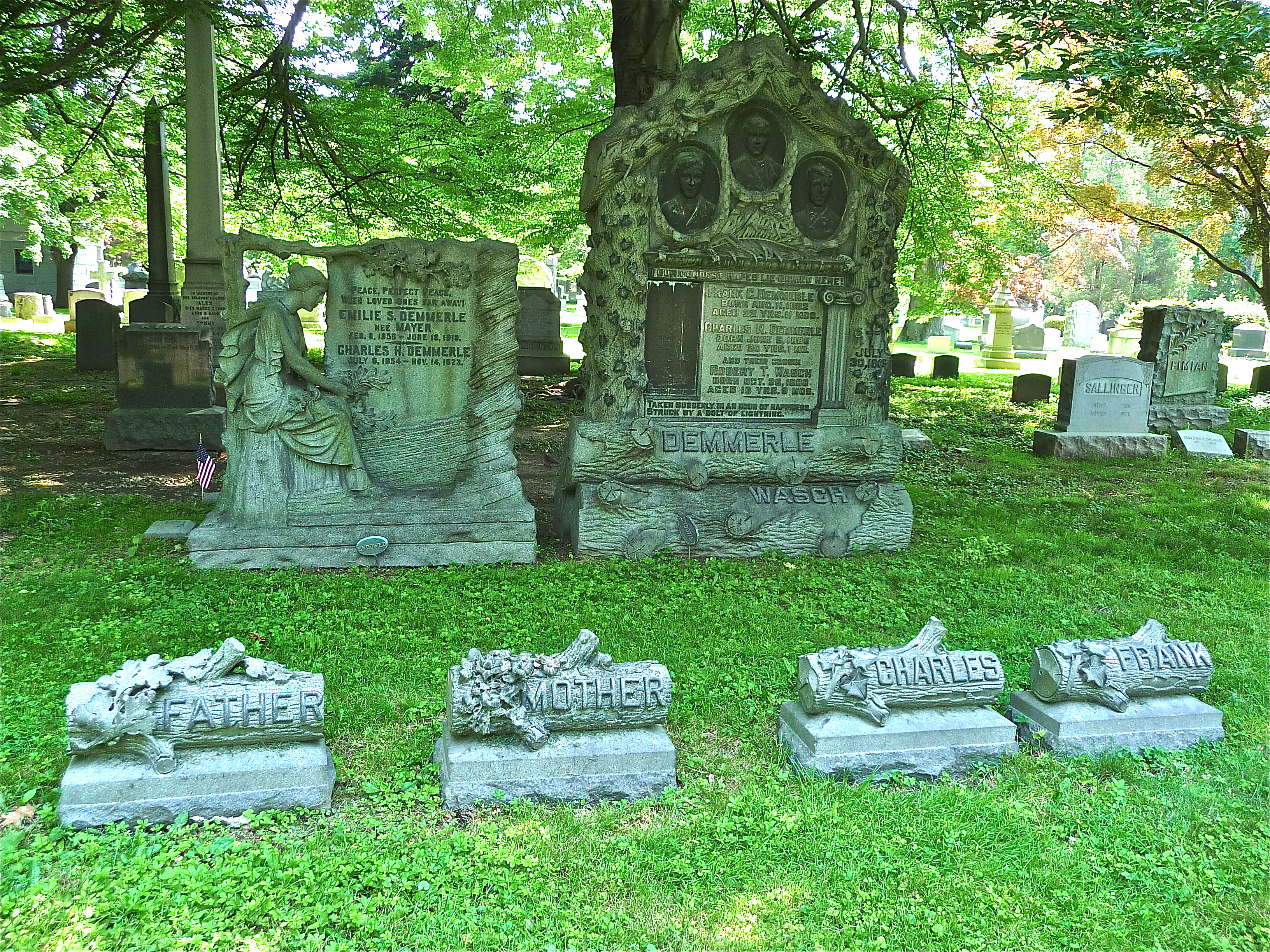
Woodlawn Cemetery Memorial Tells A Coney Island Story Of Unusual Death

Brighton Beach Lightning Strike Felt By Thousands, Kills Six – July 30, 1905

When walking through Woodlawn Cemetery in the Bronx, you can come across fancy mausoleums and simple grave markers of the famous and infamous. F.W. Woolworth, Fiorello LaGuardia, Duke Ellington, Bat Masterson and Herman Melville are among the half million souls interred in this historic place.Demmerle Memorial

Then out of the blue you may stumble across the lives of ordinary New Yorker’s memorialized in an extraordinary way. Such is the Demmerle monument.

Unlike many other tombstones which record a name and birth and death years with a short epitaph, the Demmerle memorial is an ornate series of carved monuments which tells and shows the story of one family’s tragedy.

Demmerle Charles and EmilieSunday July 30, 1905 started out as a beautiful, sun-filled, hot day Continue reading

Old New York In Photos #30 – Cooling Off During Heat Waves

Heat Waves In New York And Children Cooling Off

NYC Kids Playing at Hydrant

As New York City endures a heat wave this week, realize that for the majority of the 20th century there was virtually no air conditioning in most homes. The streets provided the easiest and most accessible way for children to cool off.

In New York, it is only recently that a heat wave has been defined as at least three straight days with temperatures reaching 90 degrees or more. Who decided this I do not know. Every region of the world has their own definition of what comprises a heat wave. Years ago, any sustained combination of high heat and humidity used to qualify as a heat wave.

This undated photograph above from the mid-1940’s shows city children on a Manhattan street playing and wallowing in the water. I like the fact that some of the people are looking directly at the photographer who is perched high above the street capturing the scene.

Cooling off Harlem 1933

This photo shows a Harlem street in 1933 with children gathering around a center stand sprinkler connected by a hose to the fire hydrant.

A four day heat wave in New York City that began June 7, ended on June 10, 1933 with a violent thunderstorm which dropped the temperature down to 86. The day before, the thermometer in the city reached the mid 90’s and reportedly hit 120 degrees in Hammonton, NJ, wilting strawberries right on the stem.

Joe Funranolla and Ray Bardini beat the heat by diving into the river July 22 1955

As unthinkable as it is now, for decades up until the 1970’s, to cool off many children would swim in the polluted East and Hudson Rivers. With the FDR Drive and the United Nations Secretariat Building in the background Joe Funranolla and Ray Bardini beat the heat by diving into the East River July 22, 1955. The temperature hit 96 that day.

It was the eighth day in July 1955 that the mercury went above 90 degrees. According to the New York Times, the record up to that time for 90 degree days in July was ten, which was accomplished in 1876 and 1952.

Boys Swimming East River 1937

This 1937 photograph shows teen boys making daring dives into the East River. The Williamsburg Bridge is in the background. I wonder how long it took to get back up to where they were diving from?

Hell Gate Bridge bathers Astoria Pool 1937

One thing has remained the same over the years: if they can get to one, kids still flock to the city pools. In this 1937 photograph the Astoria Pool entices a huge crowd, while the Hell Gate Bridge looms in the background.

The current heat wave will soon be over and when winter arrives, you can bet your bottom dollar many New Yorker’s will be saying they can’t wait for the warm weather.

Beauties Of The Past – Annabelle Whitford

Annabelle Whitford Moore Buchan And The Original “Gibson Girl”

Gibson Girl Annabelle Moore Whitford Buchan Follies 1908

The epitome of feminine beauty at the turn of the century was captured in artist Charles Dana Gibson’s skillful drawings of women, that came to be known as “Gibson Girls.”

Gibson Girl Social Ladder 0040

Annabelle Whitford was 15 years old when she achieved notoriety dancing at the Columbian World Exposition in Chicago in 1893. Annabelle appeared in movies performing her dances under the name Annabelle Moore from 1896 -1902. She went onto a successful stage career hitting the top as a star in the Ziegfeld Follies of 1908 playing one of the “Nell Brinkley Girls.” Brinkley (September 5, 1886 – October 21, 1944) was a female newspaper artist whose creations were very similar to the Gibson Girls. In 1910 Annabelle married Dr. Edward James Buchan and retired from performing.

Gibson Girl Annabelle Moore Whitford Buchan Nell Brinkley Girls Follies 1908

In her obituary in the New York Times it was said Annabelle “was the symbol of beauty in her day. She was billed as ‘the original Gibson Girl’ because of her striking resemblance to the Charles Dana Gibson portrait.” The illustrations below are from Gibson’s 1902 book The Social Ladder.

Gibson Girl Social Ladder 0074 Gibson Girl Social Ladder 0081 Gibson Girl Social Ladder 0012

Continue reading

Crime In New York In 1852

“Charged With The Most Heinous Crimes”

Fate of New York ThievesIn The New-York Daily Times of August 3, 1852 on page 3 there appears a summary of events occurring in New York City.

The most interesting parts comprising this article of brief news items is the crime news.

The flowery language used in the stories to describe the offenses have to be read to be fully appreciated.

Here are some interesting statistics in the first news item and a couple of crime stories which are excerpted below:

Crime in the City – The Court of General Sessions commenced its August term yesterday and a frightful array of crime awaits its action. No less than 67 individuals, charged with the most heinous crimes are to be tried. The following is the calendar:

Grand Larceny          24
Murder                         8
Burglary                       7
Attempt to Kill            4
Robbery                       4
False Pretences           3
Forgery                         3
Incest                            2
Carrying Slung-shot    2

Riot                              2
Bigamy                        1
Rape                             1
Bastardy                      1
Attempted Burglary  1
Abandonment             1
Manslaughter              1
Disorderly House        1
Arson                            1

Some of the crimes are unique to the time including: “Carrying Slung-shot,” (a striking weapon consisting of a small mass of metal or stone fixed on a flexible handle or strap), “Bastardy,” (the begetting of an illegitimate child) and “False Pretences” (an illegal, deliberate misrepresentation of facts, as to obtain title to money or property).

After some reports on license statistics, recent immigration, and admissions to the city hospital and the news report goes on with additional lists and details of crimes recently committed –

Crimes and Casualties

An unusual number of charges were made yesterday morning at the Jefferson Market Police Court, principally for assault and battery and for gross intoxication. Sunday night was evidently spent immorally. Over thirty cases of this kind were disposed of before the following were brought into Court: Michael Edwards residing at Manhattanville, was charged by James Kaiting for a violent assault with intent to kill. It appears the prisoner struck the complainant on the head with an ax, inflicting a severe, but not a dangerous wound. A struggle ensued, in which the complainant, with the help of some bystanders, arrested his cowardly assailant. He was locked up to answer…

Among the charges disposed of, was the following aggravated case of assault, in which Patrick Wheelan, John Trihan, Patrick Farrall, John Townsend and Bridget Crawley figured as assailants. It appears that the accused were having a nice little “muss” for their own private gratification, when they were accosted by police officers Atherton, Jones and Scott, who exhorted them , under the threat of various pains and penalties, to keep the peace. This aroused Bridget, who forthwith made a descent upon officer Atherton, and was followed by the male prisoners, when a general melée occurred. Some broken heads and other injuries were the result, but the assailants were captured an secured. They were committed to answer…

Old New York In Photos #28 – New York City Early Color Photos

New York City In Old Color Photographs At The Turn Of The Century

Mulberry Street Detroit Publishing Company

Mulberry Street in color New York City 1900

Life was colorful in turn of the century New York City. But because almost all the photographs we see from that era are in black and white, it is hard to imagine what the city looked like in its full color glory.

The Library of Congress holds the incredible collection of The Detroit Publishing Company who manufactured postcards and chronicled the world with their photographs from 1880-1920.

One of the processes used to achieve color was called the photochrom. Photochrom’s are color photo lithographs created from a black and white photographic negative. Color impressions are achieved through the application of multiple lithograph stones, one per color. In 1897, the Detroit Publishing Company brought the process over from Switzerland where it was first developed.

The images presented here were eventually used for postcards. Here is a look at New York circa 1900 in high resolution color photographs. Click on any image to vastly enlarge.

South Street Brooklyn Bridge 1900 Detroit Publishing

South Street and Brooklyn Bridge 1900

Looking north along South Street with the Brooklyn Bridge in the background. This was still the age when shipping and boats crowded the harbor.

City Hall 1900 Detroit Publishing

City Hall New York City 1900

City Hall looking northwest with a sliver of City Hall Park on the bottom extreme left. Continue reading

The Pride Of The Yankees – Was The Film Really Reversed?

Gary Cooper, Lou Gehrig and The Mystery of Reversing The Film

The New York Times published an article on February 9, 2013 based off of research conducted by Tom Shieber that he posted on his web site, that disputes a long held belief about the classic Lou Gehrig film, The Pride of The Yankees (1942).

Gary Cooper Pride Swinging Left Handed

Gary Cooper as Lou Gehrig (note the signature on the bat)

It had been reported for many years that the filming of the baseball action scenes were for the most part printed in reverse to accommodate righty Gary Cooper, who could not convincingly portray the left-handed Lou Gehrig.

We reported how the film was reversed in a previous post. But now Shieber has seemingly proven that Cooper did most of the scenes left-handed, without a reversal of the film when it was printed.

Interestingly Gary Cooper himself said in a 1956 Saturday Evening Post print interview that he could not do the action scenes left-handed, and the film had been reversed.

After you read Shieber’s full article, which makes a lot of sense, and watch the film, will you be convinced that Cooper did most of the film left-handed? I am.