Tag Archives: Fifth Avenue

What It Was Like Riding A Turn Of The Century New York Stagecoach

New York Transportation In The Early 1900’s

Hamilton Fish Armstrong was the longtime editor of the magazine Foreign Affairs. His charming memoir, Those Days published in 1963 by Harper and Row is a wonderfully evocative description of an upper middle class boyhood spent in New York City, the Hudson Valley and Quebec. The book’s dust jacket description states that it is: “A lively, spontaneous re-creation of the childhood of a famous editor and writer at the turn of the century – an unforgettable picture of a vanished New York.”

It’s one of those out of print, forgotten books that deserve to be read by a new generation. I highly recommend it.

Here is an excerpt from pages 68-69 where Armstrong describes getting uptown to school from his home on 10th street via the Fifth Avenue coach which was pulled by horses.

When I was nine the time came for me to go to a “real” school uptown, and unless it was pouring pouring rain or snowing I went of course, on skates. When the weather ruled this out I used the Fifth Avenue stage or the Sixth Avenue El.

On the stage I rode by choice  on the outside, either perched up behind the driver or, if I was lucky, along side him. Continue reading

Old New York in Photos #19 – First Traffic Light Signals

First Traffic Light Signals –  Fifth Avenue and 34th Street, 1922

The Beginning of New York City’s Traffic Lights

This ornate traffic light at 34th Street, was one of seven put up in New York City on the heavily traveled Fifth Avenue in 1922.

The city had experimented with traffic signals in 1917 when a device invented by an engineer, Foster Milliken, was installed at the intersection of Fifth Avenue and 57th Street. The device was a revolving flashlight that would flash signals as red to stop and green for go.  This may sound ridiculous now, but in the early days of traffic signals there was no standard for color relating to traffic. Continue reading

Old New York In Photos #17 – Where Was The Easter Parade Held In The 19th Century

The Easter Parade, circa 1900

This view looking north on Fifth Avenue taken at the turn-of-the-century shows New York City holding its famous Easter Parade. The parade, known for its display of beautiful bonnets and fancy hats, has been occurring since the 1870’s in New York.  You can see how packed the streets near St. Patrick’s Cathedral.

Anyone could walk Fifth Avenue on Easter, but it was generally the well to do who participated in the exhibition. Fifth Avenue being home to some of the most expensive homes made this a natural gathering spot for the wealthy. But is that where the tradition began?

One of the first places crowds gathered to display their Easter finery in New York City was not Fifth Avenue, but Central Park. Continue reading

Old New York In Photos #15 – Fifth Ave. & 42nd St. 1928

42nd Street and Fifth Avenue, 1928

A street level photograph looking east on 42nd Street towards 5th Avenue on a chilly day in 1928. On the left side of the photograph and just to the right of the twin street lamp globes is one of the early traffic towers which would control vehicular traffic flow with colored signals. Continue reading

New York in the 1920’s and 30’s as Seen by Luigi Kasimir

Six Views of New York by Luigi Kasimir

In 2000 and 2001 Swann Galleries (a New York auction house) held New York City auctions.  All the items: books, posters, maps, ephemera, photographs, prints and art were related to the city. It was a great concept that they discontinued after 2001. It was at these auctions where I first encountered the art work of Luigi Kasimir.

Kasimir was born in 1881 in the Austrian-Hungarian Empire and later came to New York where he repeatedly captured the architectural sights of the city. Today, Kasimir is best known for his detailed etchings, many of which were done in color, which apparently was not the norm for early 20th century etchings.  The New York Times distinguished Kasimir from other etchers of the time at a contemporary exhibition in 1926 by referring to him as a “colorist.” Continue reading

Old New York in Postcards #3 – A Tale of Three Buildings: Franconi’s Hippodrome, The Fifth Avenue Hotel & The Fifth Avenue Building

A Tale of Three Buildings: Franconi’s Hippodrome, The Fifth Avenue Hotel & The Fifth Avenue Building a.k.a. The Toy Center

The west side of Fifth Avenue between 23rd and 24th streets had been country land well into the middle of the 19th century. The land for many years had been occupied by a quaint tavern and horse changing station.

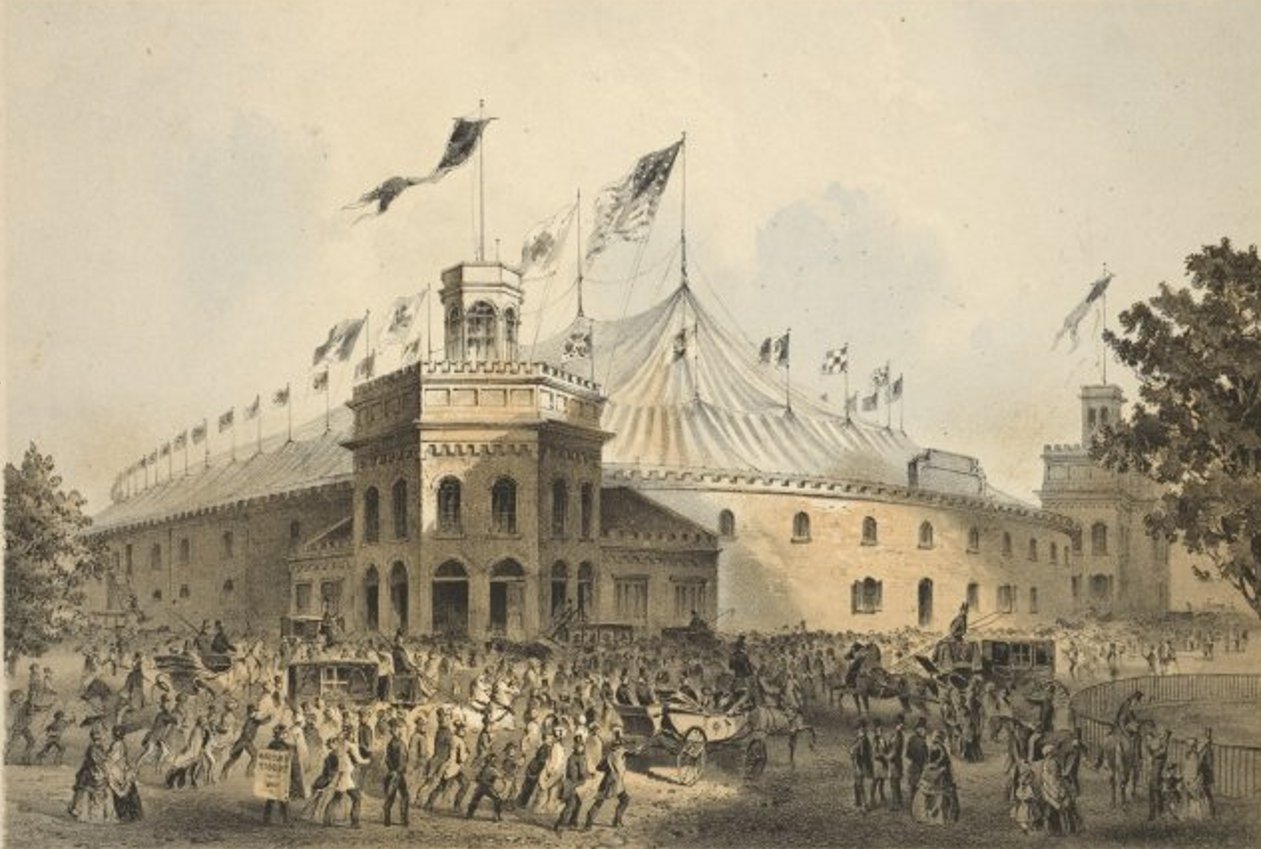
Franconi’s Hippodrome- Fifth Avenue 23rd -24th Streets (click to enlarge)

On this site in March 1853, Henri Franconi, a European from a long line of equestrian performers, arranged with investors to have an amphitheater built which was then called Franconi’s Hippodrome. This precursor of the modern day circus with performers, animals and chariot races was housed in a large structure shaped like an ellipse and was 338  feet by 196 1/2 feet that could seat 10,000 people and was covered by a red, white and blue canvas supported by a center pole 70 feet in height and a circle of smaller poles 40 feet in height.

It opened on Monday, May 2, 1853, and The New York Daily Times was not impressed with the class of people attending the Hippodrome shows. Attendees they said “…were blacklegs, gamblers, rowdies, and the miscellanea of polite roguery and blackguardism.”  The reporter added “The Hippodrome is badly conducted and Continue reading

Old New York in Photos #8 Fifth Avenue North From The Plaza 1930

Fifth Avenue Looking North from The Plaza (59th Street) 1930

Two way vehicular traffic is probably a shocking thing to see on Fifth Avenue, but in 1930 it was the norm.  We’re looking north from 59th Street. The Sherry-Netherland Hotel is on the right. Continue reading

Old New York in Photos #7 – Tiffany Mansion & Pulitzer Mansion

Two Homes With Different Fates

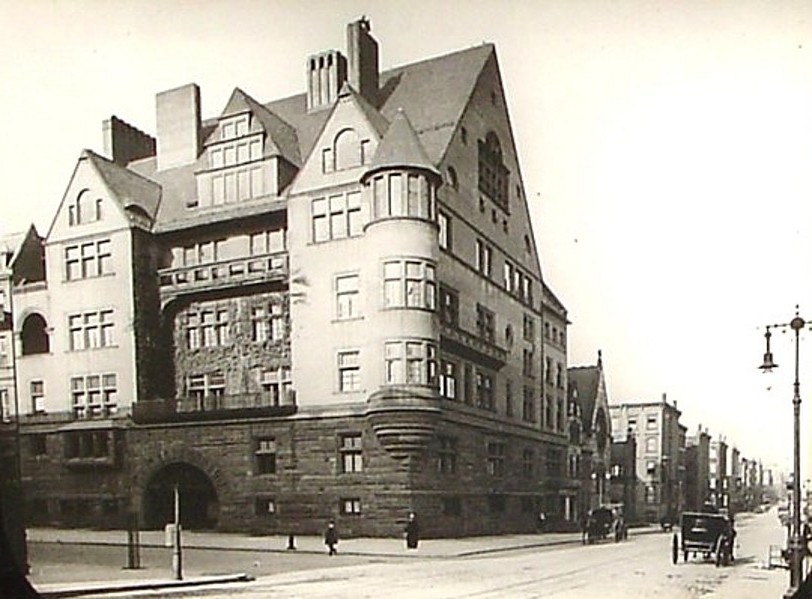
The Louis Comfort Tiffany Mansion (above) circa 1886 at the corner of 72nd Street and Madison Avenue designed by McKim, Mead & White.

The Joseph Pulitzer Mansion (below) 1903 at 7 East 73rd Street (just off of Fifth Avenue) designed by Stanford White of McKim, Mead & White.

Pulitzer Residence 7 East 73rd Street

Louis Tiffany’s home was built starting in 1882 by his father Charles Tiffany, but the elder Tiffany never lived there. The 57 room mansion took three years to complete.

Right around the corner, Joseph Pulitzer, owner of The New York World newspaper also hired the architectural firm of McKim, Mead and White in 1900 to build his home which was completed in 1903.

Pulitzer lived in the house Continue reading

The Cost of Living in Manhattan Apartments – 1926

The Prices of Fancy New York  Apartments and Where You Could Live on a Decent Salary

As I continue to look through the Sunday October 10, 1926 New York Times real estate section, I wanted to get a better understanding of what a dollar could buy when it came to apartments.

First I did some income research.

According to FRASER (the Federal Reserve Archival System for Economic Research) , a little over 4 million individual tax returns were filed in 1926.

The average net income on those returns was $5,306.43.

The average amount of tax liability was – get this – only $176.11!

So you might think that everyone was doing Continue reading