Tag Archives: Books About New York City

Book Review – Yorkville Twins

Twins Grow Up In An Exciting, Post-WWII New York City

Yorkville twins coverIf there were more books like Yorkville Twins we would have a clearer picture and better understanding of what it was like for the everyday existence of ordinary people living in Manhattan in post-war New York City. Twins Joseph G. Gindele and John F. Gindele, weave funny, touching and poignant stories of growing up in Yorkville on the upper east side of Manhattan from 1944-1962 with their three siblings and immigrant parents.

Unlike many New York memoirs written by famous or infamous personages who lay their memories of privileged upbringings or Dickensian struggles in print, the Gindele’s recount the daily experiences of middle class family life in a New York that has now largely vanished. This is the New York of cobblestone paved streets where the milkman and the iceman made deliveries with horse drawn wagons. Pushcarts sold vegetables and kids played with erector and chemistry sets and took the time to cut out the backs of cereal boxes and  redeem them in the mail for prizes. Continue reading

Historic List Of Every Hotel In Manhattan In 1964

All The Hotels In Manhattan With Addresses and Telephone Numbers From 50 Years Ago
New York Guidebook John KouwenhovenFrom one of the best (and for some reason uncommon) guidebooks to New York City ever published, The New York Guidebook edited by John A. Kouwenhoven (Dell) 1964, comes this useful list of every hotel in Manhattan. We should clarify “every” with the word “approved” hotel and motel. In other words, the flop houses on The Bowery or other squalid hotels did not make the final cut.

The New York Guidebook was published with the 1964 New York World’s Fair visitor in mind as there is a special section devoted to it.

All together there are 183 hotels listed in the book. If you are wondering about the prices, they are not listed. But by checking another pamphlet from the time I discovered The Plaza Hotel was charging from $20 – $34 per night for a double room, while The Madison Square Hotel was charging $7 – $8 per night for a double.

You will note that all the telephone numbers begin with the letter prefix’s such as GR for Gramercy, BU for Butterfield, CI for Circle and RH for Rhinelander. This was because the telephone exchange corresponded with the neighborhood a person or business was located in.  It is a much more picturesque way of assigning a phone number and made remembering the number much easier. PEnnsylvania 6-5000 anybody?

What is also interesting to notice is how many of these hotels are still in existence today and how many which had been in business for such a long time have now vanished.

This is presented as a research tool, but for many the list will bring up a wisp of nostalgia when you see the names Hotel Astor, The Drake, Biltmore and Savoy. I wish there was a list like this available online for every decade in New York City from the 1800’s and on.

So here is our online contribution to researchers or those who are just curious.

Hotels of Manhattan –  1964:

Abbey Hotel, 151 W. 51st St., N. Y. 19, N. Y., (CI 6-9400)

Aberdeen Hotel, 17 W. 32nd St., N. Y. 1, N. Y., (PE 6-1600)

Adams Hotel, 2 E. 86th St., N. Y. 28, N. Y., (RH 4-1800)

Alamac Hotel, 71st St. & Broadway, N. Y. 23, N. Y., (EN 2-5000)

Albert Hotel, 23 E. 10th St., N. Y. 3, N. Y., (OR 7-0100)

Alden Hotel, 225 Central Park W., N. Y. 24, N. Y., (TR 3-7300)

Algonquin Hotel, 59 W. 44th St., N. Y. 36, N. Y., (MU 7-4400) Continue reading

7 Old Ads Of New York Businesses From 1874

How Macy’s, Tiffany & Co. And Other New York Firms Advertised Their Businesses In 1874

Macy's Ad 1874 The 1874 book New York Past and Present by Charles Edwin Prescott (Mercantile Publishing) contains interesting advertising which provides a look at how various companies sold their wares.

Some companies or the buildings they occupied in 1874 are still here today, other companies vanished long ago without a trace and are completely forgotten.

Click on any advertisement to enlarge.

R. H. Macy was down on 14th Street at the corner of Sixth Avenue. They had a collection of buildings joined together on 14th Street as the company kept growing throughout the late 1800’s. They moved to their Herald Square location in 1902. I remember up until the 1980’s looking up at some of the buildings on 14th Street and still being able to see the Macy’s red star emblazoned on the facades of a few buildings.

In 1874 Macy’s top line for advertising was that they were “importers and dealers of embroideries and lace goods.” The rest of the ad goes on to describe carrying goods:”various ladies’, gents’ and childrens’ furnishing goods,” “white goods,” “fancy goods” and “kid gloves”

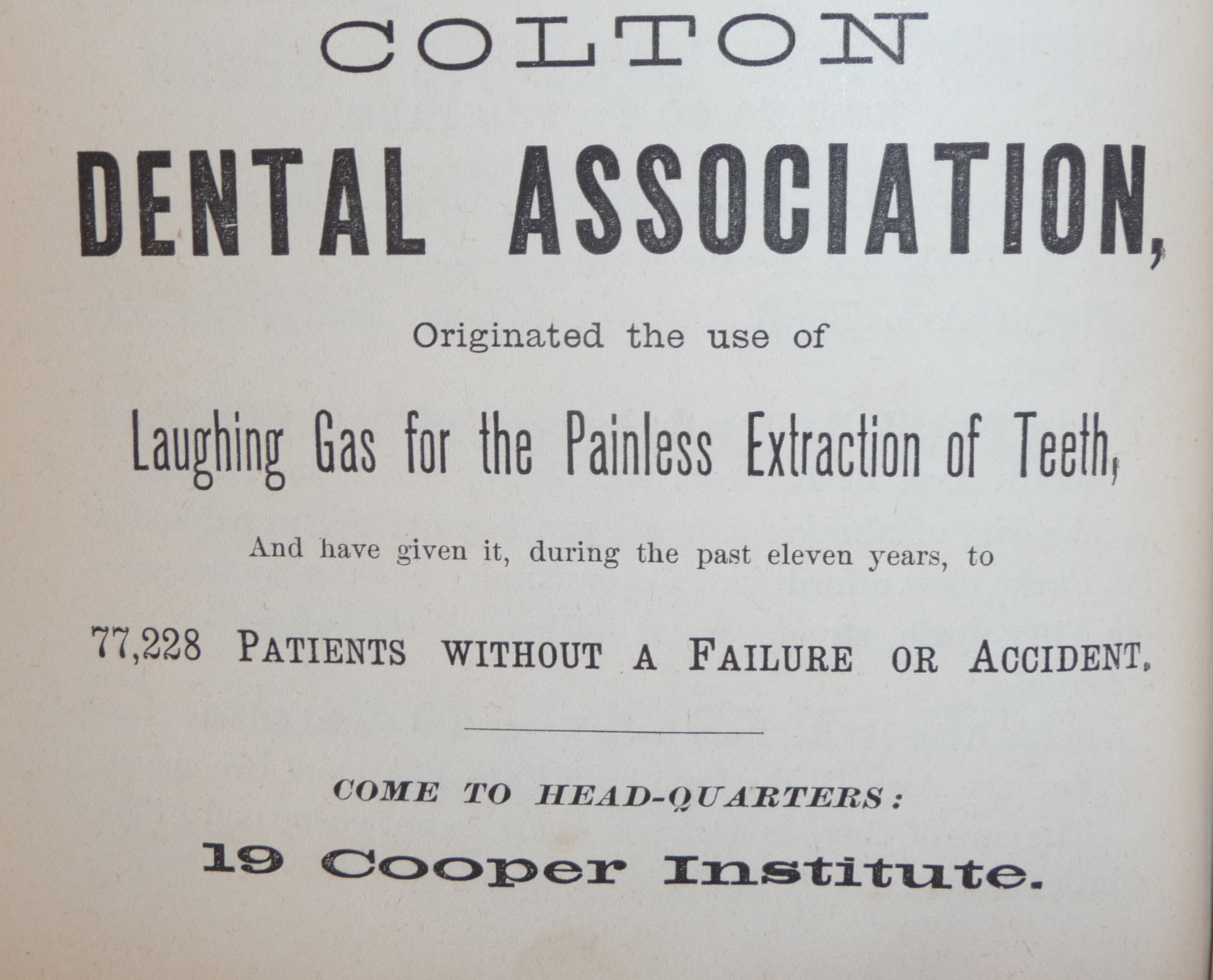
Colton Dental Ad 1874The advertisement for the Colton Dental Association located at 19 Cooper Institute says they originated the use of “laughing gas for the painless extraction of teeth.” Who knew?

In the 19th century, people were really scared of the dentist because it was generally a painful experience. The interesting part of the ad: “77,228 patients without a failure or an accident.”

Zero Refrigerator Ad 1874Seeing the word “refrigerator” in an 1874 ad may cause you to do a double take. But this is not a modern refrigeration system advertised by Alex M. Lesley, the manufacturer of the Zero Refrigerator with offices located at 224 -226 West 23rd Street. The Zero Refrigerator was merely an icebox with “water, wine and milk cooler.” Mr. Lesley simply says the Zero “is the best food and ice keeper in the world.” The world’s first refrigerator was built in 1834. Refrigerators for home use didn’t come into existence until 1913.    Continue reading

150th Anniversary Of The New York City Draft Riots

July 13, 1863 The Civil War Draft Riots Begin + Related Book Recommendations

"The Battle in Second Avenue" from John Shea's 1886 book, The Story of a Great Nation

“The Battle in Second Avenue” from John Shea’s 1886 book, The Story of a Great Nation

If you’ve watched Martin Scorcese’s 2002 film The Gangs of New York, you saw a vivid depiction of what the Civil War Draft Riots may have looked like. In reality the tumult was probably a lot worse than what was portrayed on the screen. It was the most violent civil disorder in 19th century American history.

Protesting the conscription act, mobs of citizens went on a multi-day rampage of killing and looting.  The riots were quelled after four or five days. The estimated number of people killed was 105. The number of injuries was in the hundreds.

In a November 26, 1938 New Yorker story, journalist Meyer Berger wrote about combing through the original blotters at the West Forty-Seventh Street Police Station. Berger came across the station’s last riot related arrest which occurred on July 30, 1863.  Fergus Brennan, 35 was charged with being a leader of the rioters. He was held on $2,000 bail by Justice Kelly.

There are several books which cover the draft riots in detail. Among the best are: July 1863 by Irving Werstein (Julian Messner, 1957); The New York City Draft Riots by Iver Bernstein (Oxford University Press, 1990); The Second Rebellion by James McCague (Dial Press, 1968); The Devil’s Own Work The Civil War Draft Riots of 1863 by Barnet Schecter (Walker & Co., 2006) and The Armies of the Streets: The New York City Draft Riots of 1863 by Adrian Cook (University of Kentucky, 1974).

Part 5 Vintage New York City Books With Great Art Deco Dust Jackets

The Art of The Book #5 – New York City Deco Dust Jackets From The 20′s & 30′s

As we complete our look at New York City books from 80+ years ago, some of these dust jackets incorporate photography into their covers which the other dust jackets we have featured do not. (click on any photo to enlarge)

Art Deco dj Portrait of New YorkPortrait Of New York by Felix Riesenberg & Alexander Alland, New York: Macmillan, 1939 dj illustrator, Alexander Alland

Felix Riesnberg (1879-1939) was a civil engineer and master mariner. He was a polar explorer and wrote numerous books with nautical themes. Portrait of New York ventures among the populace and is an accurate description of the city and its people.

Alexander Alland (1902-1989) was a master photographer and the book shows a small sample of his immense talents. Continue reading

Part 4 Vintage New York City Books With Great Art Deco Dust Jackets

The Art of The Book #4 – New York City Deco Dust Jackets From The 20′s & 30′s

Continuing our look at the those great New York City books from 80 years ago, here are more great dust jacket covers. (click on any photo to enlarge)

Art Deco dj Hacking New YorkHacking New York by Robert Hazard, New York: Charles Scribner’s Sons, 1930 dj illustrator, unknown

The first book of its kind – anecdotes of a New York taxi driver. Even back then the meter could be rigged and Hazard explains how it was done. The dust jacket is gorgeous and unfortunately the artist is unattributed. Continue reading

Part 3 Even More Vintage New York City Books With Great Art Deco Dust Jackets

The Art of The Book #3 – New York City Deco Dust Jackets From The 20′s & 30′s

We continue with our look at vintage books about New York City with great dust jackets. (click here to read part 1 and here to read part 2)

Starting with a look at an all-time classic of deco design, New York Nights. (click on any photo to enlarge)

Art Deco dj New York NightsNew York Nights by Stephen Graham, New York: George H. Doran, 1927, dj illustrator, Kurt Wiese

A native of Scotland, author Stephen Graham (1884-1975) goes on a tour of  jazz age nightclubs, speakeasies and cabarets. Graham provides the grittier side of life in an up to the minute description of prohibition New York neighborhoods, establishments and people.

Kurt Wiese (1887-1974) illustrated over 300 books and later became an award-winning children’s book author. Besides the knockout jacket cover, Wiese drew all the illustrations contained in the book. This was the first American book he worked on. Continue reading

Part 2 More Vintage New York City Books With Great Art Deco Dust Jackets

The Art of The Book #2 – New York City Deco Dust Jackets From The 20′s & 30’s

We continue our look at some great New York City books from the 1920’s and 1930’s with exceptional artwork on their dust jackets. (click here to read part 1)

We begin with graphics on a dust jacket worthy of a large size poster from the quintessential art deco New York book. (click on any photo to enlarge)

Art Deco dj New York Paul MorandNew York by Paul Morand and Joaquin Vaquero Palacios. New York: Henry Holt, 1930, dj illustrator, Joaquin Vaquero Palacios.

A witty description of New York, via French writer Paul Morand, (1888-1976) from four visits he made to New York, none longer than a month, from between 1925-1929. Morand later became a supporter of the French Vichy regime.

Joaquin Vaquero (1900-1998) as he is credited in the book without the Palacios surname, was a Spanish architect and painter. His paintings are held in museums across the globe. Continue reading

Part 1 Vintage New York City Books With Great Art Deco Dust Jackets

The Art of The Book #1 – New York City Deco Dust Jackets From The 20’s & 30’s

From the 1920’s until the 1940’s, book publishers put out some phenomenal books about New York. They also hired talented artists to design the book’s dust jackets.

The eye-catching art deco graphics were meant to attract potential buyers. Unfortunately, most people who purchased books 80 years ago would discard the dust jacket once they brought the book home with them.

Because of that, many of these books from that time are very scarce in their original dust jacket.

This is the first part of a five part series looking at the dust jackets of books about New York City, the artists that created the work and the authors.

Below are some fine examples of New York City books from the golden era of publishing.

(click on any photo to enlarge)

Art Deco dj New York By QuexNew York by Quex.  New York: David McKay, 1928, dj illustrator, Dixon (possibly Arthur A. Dixon)

Quex was the pseudonym of reporter George H.F. Nichols (1881-1933) of The Evening News of London. Nichols was at the time of his death one of the highest paid reporters in the world. Nichols was the originator of articles written in the form of “the diary of the man about town.” Quex’s observations about about New York are well worth reading.

The dust jacket is classic New York, but I am unsure about the attribution to Arthur Dixon, so we will leave biographical information out until someone can provide a conclusive identification on the artist.

Continue reading

How The Super Wealthy Woman Of 1903 Lived

“Free To Indulge Her Whims and Fads In Whatever Way The Gay World Of Society, And Her Own Inclination, May Lead Or Tempt Her”

Let’s say you are the wife of a turn of the century financier. How do you run your household and spend your time and money? Is there no one to teach you except your family or contemporary one percenters?

Fortunately there was a book written just for the rare woman who needed such advice.

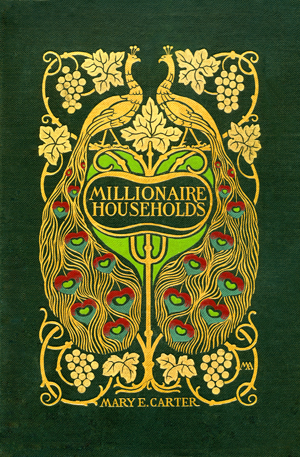
The book which could now be slightly updated and reprinted for today’s super wealthy billionaires is called, Millionaire Households and Their Domestic Economy With Hints Upon Fine Living by Mary Elizabeth Carter published by D. Appleton & Company 1903.

Miss Carter was not a society lady, but had managed a house for the wealthy Vanderbilt family.

With chapters such as Fine Living or Housekeeping; The Hostess’s Wardrobe; The Lady’s-Maid; The House-Maid; The Parlor-Maid; The Servant’s Dining Hall-Maid; The Butler and His Staff; The Valet; Monsieur Le Chef and His Aids; Side-Lights and Shifting Scenes When The “Smart Set” Dine; the book has everything you would need to know as the grande dame running an American version of Downton Abbey.

We learn from Miss Carter that a butler is more than just a servant. She writes, “When the ubiquitous newspaper reporter appears the butler knows how to get rid of him with as little information imparted as will spare the family from false statements or ridicule. During these interviews he requires his entire stock of aplomb. He must withhold all information possible, while appearing to give it out freely.”

This book was not for the 1% that we hear so much about today. In 1903, Millionaire Households and Their Domestic Economy would apply to only o.oo5% of Americans, since there were about 4,000 millionaires out of 80 million people living in the United States at the turn of the century. Approximately half of those millionaires resided in New York State. It is safe to say this book probably did not sell very many copies. It is also important to remember how much a million dollars was back in 1903. One would need to have about twenty million dollars today to have the purchasing power of a millionaire in 1900.

Comparatively today, globally there are about 10 million people (exclusive of their home) with a net worth  of one million dollars or more and approximately 3.1 million of them reside in North America.

The book gives a complete view into the way the millionairess should conduct her household. While the advice the book offers might seem frivolous and somewhat outrageous to read today, Continue reading