Tag Archives: 14th Street

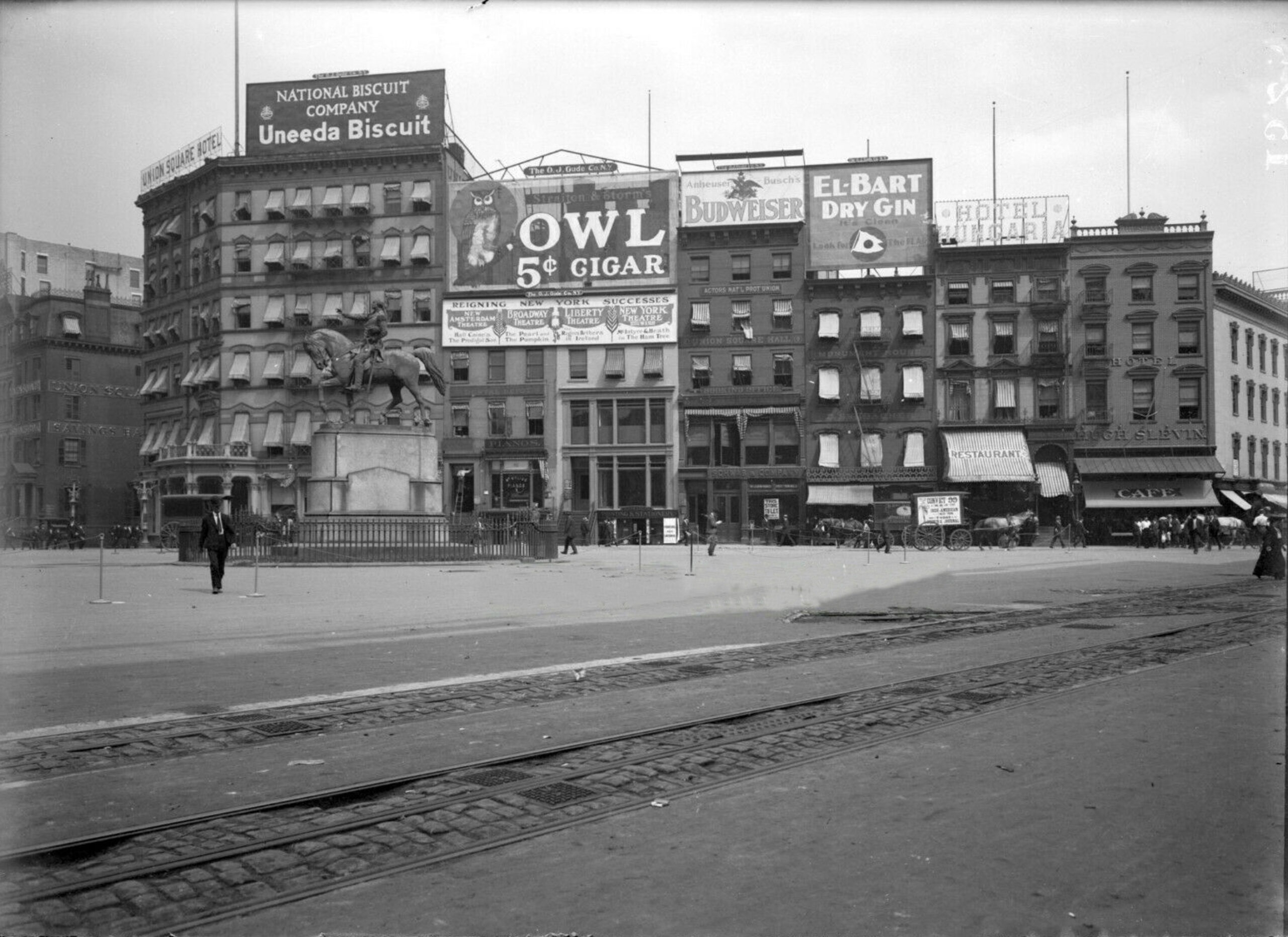
Old New York In Photos #196 – Union Square East 1905

Union Square 14th Street & 4th Avenue 1905

We are looking east along 14th Street towards Fourth Avenue. There are al least 50 people in the background, but the sparsity of pedestrians and traffic in this usually very busy area indicates that this was probably taken on a Sunday morning.

The seven small buildings between 14th and 15th Streets feature advertising of the day.

With street scenes as this, establishing a date is as simple as looking at the surroundings. Continue reading

Old New York In Postcards #26 – Broadway 1895-1915

Views Along Broadway From Bowling Green To Washington Heights

Broadway and 62nd Street – The Colonial Vaudeville Theater is on the left, 1913

Broadway means New York City. Sure there are other Broadway’s in the United States, but none have the same clout that New York’s Broadway does. It is the longest street in Manhattan and one of the oldest. What the Dutch called De Heere Straat and later De Heere Wegh, became Great George Street under English rule. The street was paved in 1707, but only from Bowling Green to Trinity Church at Wall Street. After the Revolution, New York’s citizens began renaming streets and Great George Street became Broadway.

Here are some postcard views of Broadway dating from 1895 – 1915 Continue reading

Old New York In Postcards #24 – Pre-Prohibition Manhattan Restaurants 1900 -1920

Manhattan Meals – Some Pre-Prohibition Turn-Of-The-Century Restaurants

Maxim’s Restaurant 108-110 West 38th Street. Maxim’s was the first restaurant raided a few hours before prohibition went into effect January 15, 1920

With few exceptions owning a restaurant is among the most precarious businesses to enter. Long hours, high upfront costs for rent, food and labor and changing public tastes almost insure that few restaurants can make a long and successful run.

100 years ago many of New York’s older restaurants shut down because of an unexpected decline in business- the victims of prohibition.

Once cafes and restaurants lost the right to sell beer, wine and liquor many closed soon after the Volstead Act went into effect in 1920. Some restaurants known for fine cuisine were able to ride out 13 years with no alcohol sales. Other restaurants would turn to selling spirits illegally. Others like cafeteria and luncheon type restaurants survived, having always been patronized for their food.

All of the following restaurants shown below closed long ago.

Restaurant and Cafe Leo

Cafe Leo 14th Street New York CIty Restaurant and Cafe Leo stood on the southwest corner of 14th Street and Fourth Avenue. Note the Star of David over the entrances, not always the sign of a Jewish establishment, but a decorative element. In this case however, proprietor Leo Greenbaum was letting potential diners know this was a Jewish owned business. By 1923 Cafe Leo vanished from the city directory. Continue reading

The Big Department Store In New York In 1898 – Siegel-Cooper

Some Facts About Siegel Cooper – The Big Store 1898

Siegel Cooper Dpartment store postcard 18th Street 6th Avenue New York CitySiegel-Cooper Department Store has been gone for over 100 years. But in 1898, Henry Siegel and Frank H. Cooper’s emporium was the Amazon of its day.

In the 1890s Siegel and Cooper successfully operated a department store in Chicago before setting their sights on an expansion in New York.

What Siegel, the driving force of the concern, conceived in New York was not just a department store, it was the “Big Store.” The Siegel-Cooper Department Store was built on Sixth Avenue between 18th and 19th streets. It was a great location, then being New York’s primary shopping district known as the “Ladies Mile.” Within a half mile stretch of Sixth Avenue between 14th and 23rd Streets could be found the giants of retailing including Macy’s; Altman’s; Hugh O’Neill’s; Adam’s Dry Goods;, Ehrich Brothers; and Simpson, Crawford & Simpson.

The Siegel-Cooper Big Store building opened on September 12, 1896 and was an instant smash with the public.

Siegel-Cooper provided the nineteenth century shopper with a incredible array of goods, from abdominal bands to zephyrs and everything in between. Perhaps the most unusual article available for sale was “Baby”, a live, baby female elephant. Baby was sold within two weeks of the store’s opening for $2,000.

Among the store’s innovations was a nursery with trained nurses Continue reading

Old New York In Photos #88 – 14th Street & 6th Ave. c. 1905

The 14th Street Store of Henry Siegel – 14th St. & 6th Ave c. 1905


These two photographs were taken by the Detroit Publishing Co. on the same day, likely minutes apart. They show Henry Siegel’s 14th Street Store (1904-1914) and the Sixth Avenue Elevated Railroad looking towards the southeast corner of Sixth Avenue and 14th Street.

There is much to see, especially when zooming in on the details by clicking to enlarge the photos.

Besides the orientation of landscape versus portrait there are slight but noticeable differences in the two photos.

In the first photo at the 14th Street elevated station the northbound passengers wait for the next train and all sorts of advertising can be seen along the station walls.

On top of the southbound station, a man is painting the roof with two cans of paint, one in front of him, the other behind him. In the other photo the painter is not in frame, but both cans of paint are near one another.


On the fourth floor of the store, two women appear to be watching the photographer as he set up to take his picture. The window openings are in the exact same position as the other photo, but the women are gone. Continue reading

Mendicants In New York City – 1910

Mendicants 1910

This photograph taken at Sixth Avenue and 14th Street by Lewis Hine in 1910 is simply labeled “Mendicants.”

It’s a word you don’t often hear today. Mendicant – a beggar; panhandler.

While you may think the main subject here is the blind man sitting by the pole of the el, that would not be the case The focus of the photograph is the little girl who is begging. She appears aged and streetwise beyond her years. But both of them are mendicants.

Hine’s photographs of children at work in major cities usually focuses on newspaper sellers, shoe shiners, telegraph boys, delivery boys and other street trades. In 1910 mendicant was considered a street trade.

Who are these two people? Father and daughter? Grandfather and granddaughter? Or just two people in need who have teamed up to ply their trade?

Where did they live?

Unfortunately Hine did not get the names, ages and addresses of this girl and blind man, as he did with many of his other subjects. Continue reading

Second Avenue Elevated, 100 Years Ago

A View Of The Second Avenue El From 14th Street

Second Avenue El from First Ave 14th Street Station Jan 13 1915The Second Avenue Elevated (El for short) was one of four elevated train lines that ran in Manhattan. This photo was taken 100 years ago today on Wednesday, January 13, 1915, and shows the view looking north from the 14th street station and First Avenue. That is correct, the Second Avenue El ran on First Avenue up until it turned west on 23rd Street to continue north on Second Avenue.

Enlarging the photo, at track level we can see the next station at 19th Street. At street level there is little activity, with a few people going about their errands. We see on the left side of the street a wall advertisement for Mecca Cigarettes and on the right side of the street on the second floor, a pawn shop window advertisement saying they’ve been “here since 1880” and a warning to any criminals that they have Holmes Electrical Protection (inventors of the modern burglar alarm).

The Els in Manhattan were discontinued over a 17 year period. The first to shut down was the Sixth Avenue El in 1938, followed by the Ninth Avenue El in 1940 and the Second Avenue El in 1942. The Third Avenue El ceased service in 1955 (the Bronx part of the Third Avenue line continued running until 1973), bringing a close to the era of Manhattan elevated trains.

Old New York In Photos #39 – 14th Street – Klein’s and Ohrbach’s

Union Square Looking East Along 14th Street From University Place – February 1954

The Story Of Department Store Titans Of Union Square, S. Klein and Ohrbach’s

14th st looking east Kleins February 1954

It is a brisk February morning in 1954 and on the left is Union Square Park. But dominating this view in the center of the photograph is what was a magnet for generations of bargain-hunting New Yorkers, the large department store of S. Klein On The Sqaure.

S. Klein’s emblem was a measuring square which can barely be seen under the “KLE” in the KLEIN sign in the photo. The “On The Square” tag line was a play on words in that S. Klein was not only located on Union Square,  but implied that they were fair and honest in their dealings – “on the square.” Continue reading