Tag Archives: Books About New York City

What It Was Like Riding A Turn Of The Century New York Stagecoach

New York Transportation In The Early 1900’s

Hamilton Fish Armstrong was the longtime editor of the magazine Foreign Affairs. His charming memoir, Those Days published in 1963 by Harper and Row is a wonderfully evocative description of an upper middle class boyhood spent in New York City, the Hudson Valley and Quebec. The book’s dust jacket description states that it is: “A lively, spontaneous re-creation of the childhood of a famous editor and writer at the turn of the century – an unforgettable picture of a vanished New York.”

It’s one of those out of print, forgotten books that deserve to be read by a new generation. I highly recommend it.

Here is an excerpt from pages 68-69 where Armstrong describes getting uptown to school from his home on 10th street via the Fifth Avenue coach which was pulled by horses.

When I was nine the time came for me to go to a “real” school uptown, and unless it was pouring pouring rain or snowing I went of course, on skates. When the weather ruled this out I used the Fifth Avenue stage or the Sixth Avenue El.

On the stage I rode by choice  on the outside, either perched up behind the driver or, if I was lucky, along side him. Continue reading

Old New York In Photos #23 – Subway Excavation Along Broadway & 49th St. 1901

Subway Excavation, Broadway and 49th Street – 1901

While the MTA is currently striving to build the new Second Avenue subway without disturbing businesses along the route, the Interborough Rapid Transit Company (IRT) had no such compunction about hampering businesses as demonstrated by this photograph taken on November 26, 1901.

We are looking north along Broadway towards 49th Street. The J.B. Brewster Carriage Continue reading

The Dangers And Lures Of New York City In 1957

Stay Out of the Parks At Night!

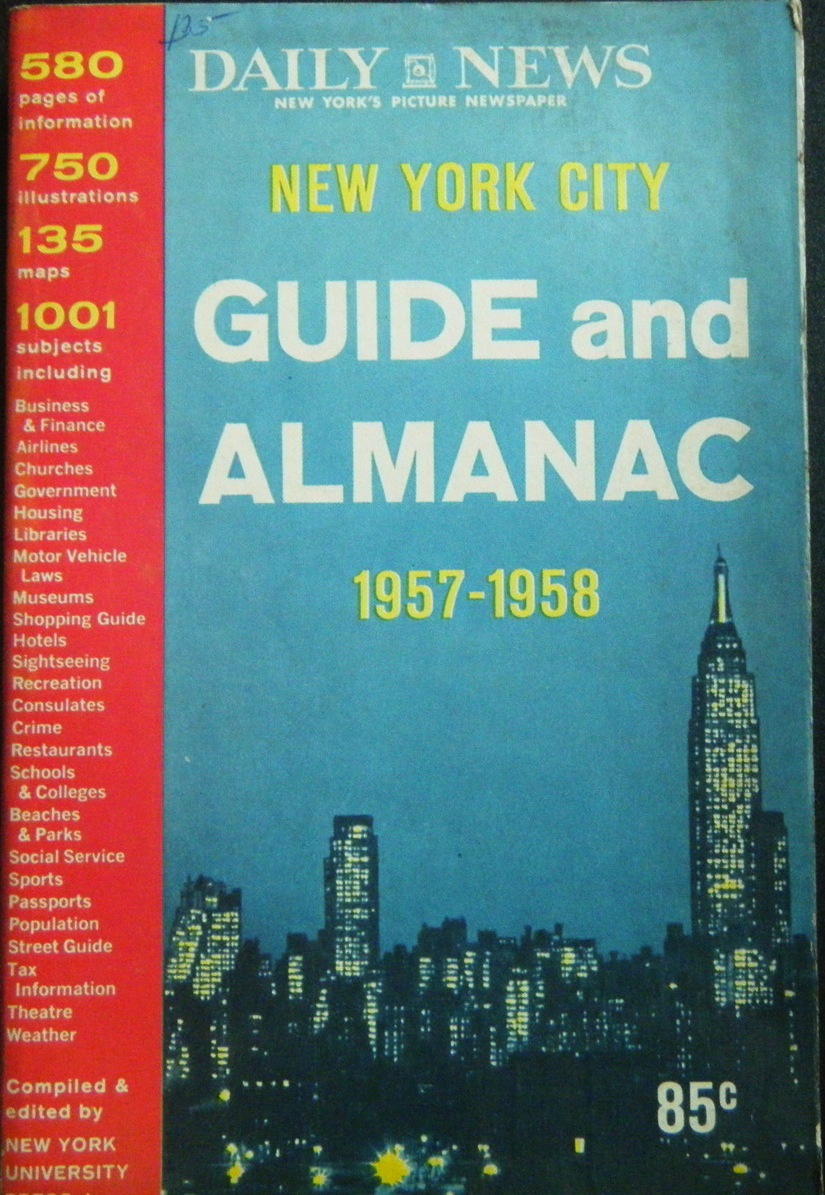
From the New York City Guide And Almanac 1957 – 1958

This vintage book is a great snapshot of New York City in the late 1950’s. I wish they would have printed this annually, but it was published for only one year by New York University Press in conjunction with The Daily News. It is 378 pages chock-full of fascinating facts and figures. The paperback version was originally 85 cents, while the hardcover version would set you back $2.75.  There are a few copies of this out of print gem for sale on abebooks.com ranging from$8.00 – $14.00. A veritable bargain.

Here is a snippet on crime from pages 197 – 198:

Traps for the Unwary

New York City is full of traps for the unwary visitor. It is doubtful if there are proportionately more crooks and criminals in New York than any other large city, but the metropolis is so large that the total is impressive. The bait generally used is greed, and the victims are most often people who regard themselves as sophisticated. Most effective traps for the unwary:

Auctioneers: Dishonest “auction stores” especially in the mid-town sections, where salesmen pretend to auction off “amazing” bargains, which often are samples of “flash goods” turned out for the carnival trade. Articles of genuine value are knocked down to stooges in the crowd, who later return them to be used again. The stranger who obtains a “bargain” is likely to find that a cheap duplicate was substituted during the process of wrapping up his purchase. He usually discovers that he has actually bought a garish gold-washed watch that will not run or an impressive pipe set made of celluloid. These shops should not be confused with operations of reputable auctioneers who preside over genuine sales which are usually advertised in honest fashion.

Confidence Men: Most of these offer money-making machines or counterfeit currency. They also offer to share rewards for well-filled pocketbooks lying on the pavement and “found” by the con man and the victim simultaneously. Continue reading

January 9, 1912 The Equitable Fire

The Equitable Assurance Building Is Destroyed By Fire 100 Years Ago Today

Equitable Building Jan. 10, 1912 – View From The Singer Building © Library of Congress

David Dunlap’s excellent story in The New York Times about the Equitable Assurance Building fire is merely a reminder about how great disasters are eventually forgotten over time. The Triangle Shirtwaist Fire in 1911 took 146 lives and was remembered in various ceremonies on its 100th anniversary.

No such commemorations will be held this year for the Equitable fire which killed six people, including Battalion Chief William Walsh.

The fire took place on a brutally cold day and the water froze quickly and left macabre ruins resembling an ice palace. Continue reading

Book Review: A Penny From Heaven

A Penny From Heaven by Max Winkler  (Appleton-Century-Crofts, Inc 1951)

Anyone suffering through the trepidation of an uncertain job market and being out of work with no savings, would find comfort and inspiration by reading Max Winkler’s, 1951 autobiography and ode to America,  A Penny From Heaven.

Even for those not being in the same circumstances, Winkler’s book is a page-turning, lively recreation of the United States at the dawn of the twentieth century.  Achieving the American Dream and leaving behind the “old country” forever, was the goal of millions of ignorant, poor and helpless European immigrants and Winkler conveys the struggle as well as any writer ever has. Continue reading

One of the Strangest Deaths in New York’s History

Girls Chase A Boy to Give Him Birthday Kisses… and He Dies

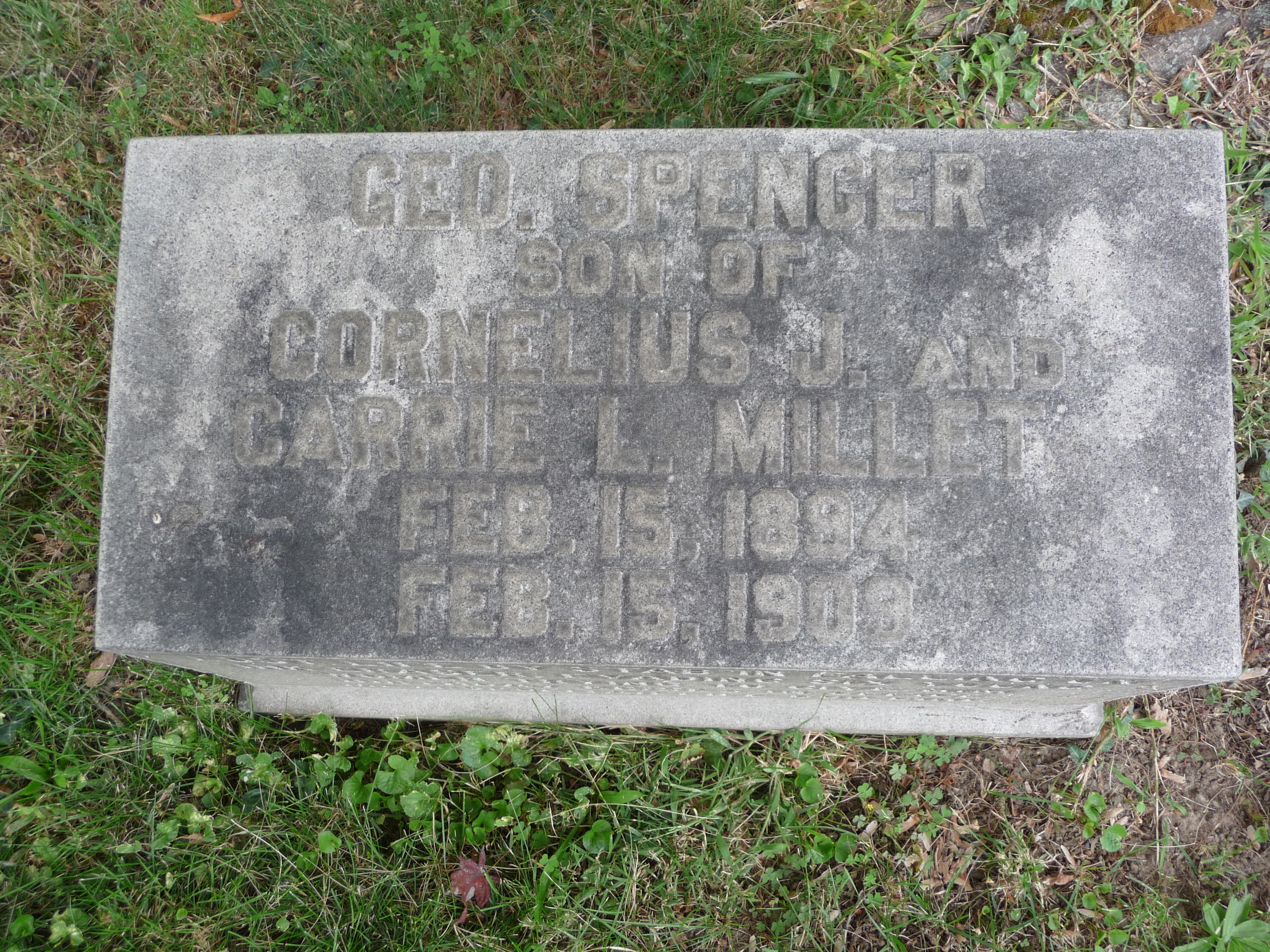
Woodlawn Cemetery Is The Final Resting Place of George Spencer Millet Who Had One Of The Strangest Deaths In New York’s History

Woodlawn cemetery 1909 Gravestone of George Spencer Millet died while evading girls kisses on his birthday at Metropolitan Life Building

There is a book called Woodlawn Remembers: Cemetery of American History by Edward F. Bergman (North County Books, 1988.)  The book is mostly comprised of beautiful full page color and black & white photographs of monuments, tombstones and mausoleums with one page of text describing each person profiled.  The cemetery is located in the northern part of the Bronx. Woodlawn is on my shortlist of recommendations of unusual places to go for New York visitors.

The book is fascinating to be sure. It covers many of the interesting and important historical figures at Woodlawn. But one story not mentioned, is the life and death of George Spencer Millet (misspelled as George Millitt by The New York Times in the story at the end of this article) who is interred at the cemetery.

Millet’s story is briefly recounted in Permanent New Yorkers A Biographical Guide To The Cemeteries of New York by Judi Culbertson and Tom Randall (Chelsea Green 1987.) This book contains photographs too, but has more detailed biographies than Woodlawn RemembersPermanent New Yorkers also covers the entire New York area, not just focusing on the two most famous New York City cemeteries. Woodlawn and Greenwood. I highly recommend both of these out-of-print books.

It was February 15, 1909 and Millet was a good-looking boy. Because when the girls he worked with at The Metropolitan Life Insurance Company found out that it was his 15th birthday, they all insisted on giving him a kiss. Continue reading

The Oldest Man In The World? A New Yorker Lives A Very,Very Long Time In The 19th Century

The Oldest Man In New York

I’ve always had a problem with people saying, “I read it on the internet and therefore it is true.”

I am more of a believer in the accuracy of books, but I’ll admit it- bibliophile that I am, even books are wrong sometimes. Actually, more than sometimes. How often, I’ve wondered, does a mistake appear in a book, that book becomes the “authority” or “reference” material for other books and the mistake becomes gospel?

When something strikes me as unusual, amazing or inconsistent with what I know, I try and check the facts by going to the original or earliest source material. This is just my natural curiosity. This includes lots of history that is inconsequential in the greater scheme of things. But when I get fascinated and have to know more, I’ll take the time to look into it.

In an earlier post we noted we would return to the book, “The Secrets of the Great City: A Work Descriptive of the Virtues and the Vices, the Mysteries, Miseries and Crimes of New York City” by Edward Winslow Martin (pseud. James D. McCabe) published by Jones, Brothers & Co. 1868.

One short chapter entitled The Oldest Man in New York aroused my investigative instincts, two samples from that chapter are reproduced below (the full three page text can be found here)

Strangers visiting the Church of the Ascension, in New York, cannot fail to notice the presence of an old gentleman, who occupies an arm-chair immediately in front of the chancel, in the middle aisle, and who gives the responses to the service in a very loud and distinct manner. This is, perhaps, the oldest man of the entire million of New York City inhabitants. It is Captain Lahrbush, formerly Continue reading

Old Time Crime In New York – Prostitutes And Panel Thieves

19th Century Prostitution and a Sly Trick of the Trade

Every so often we will look back at the history of New York City.

Secrets of a great cityToday’s entry is from “The Secrets of the Great City: A Work Descriptive of the Virtues and the Vices, the Mysteries, Miseries and Crimes of New York City” by Edward Winslow Martin published by Jones, Brothers & Co. 1868

Edward Winslow Martin was the pseudonym of James Dabney McCabe and he published this book or a slightly altered version of it many times beginning in 1868 under various titles and through different publishers until 1883 when he died.  The illustrated book is a 600 plus page turner of practically every sleazy Continue reading

The Triangle Shirtwaist Fire

The Triangle Fire – One Hundred Years Later

Anniversaries of older, tragic events are usually the only time those events play into the public consciousness. Other than that, they are rarely thought about, discussed or even remembered.

This week a vast amount of attention has been devoted by newspapers, PBS, HBO and news stations in New York that are marking the 100th anniversary of The Triangle Shirtwaist Fire in which 146 people, mostly young immigrant girls, perished.

The details of the March 25th, 1911 conflagration which are summed up best by Cornell University’s Industrial and Labor Relations School web site are heartbreaking. Many of these girls Continue reading

Happy Anniversary! Where’s The Snow? – The Great Blizzard of 1888

The Great Blizzard of ’88

For New Yorker’s who were able to obtain a newspaper on March 13, 1888, this is what they saw:

(click image to enlarge)

Starting very late in the evening of March 11 and continuing throughout March 12 and into March 13, 1888, modern New York City was paralyzed with its first stupendous blizzard.   The weather forecast for March 12 called for mild weather!

Over a little more than a 24 hour period mostly between March 12 and 13 New York City received 25 inches of snow, bringing virtually Continue reading