Classic Hollywood #38 – Boris Karloff In Make-Up Chair

The Making of the Monster

Boris Karloff makeup session Son of FrankensteinBoris Karloff gets his make-up applied by Universal’s chief make-up artist Jack Pierce and his assistant Bill Ely (left) for 1939’s Son of Frankenstein. It took four hours per day to apply Karloff’s make-up.

Karloff had been making movies since 1919 Continue reading

Second Avenue Elevated, 100 Years Ago

A View Of The Second Avenue El From 14th Street

Second Avenue El from First Ave 14th Street Station Jan 13 1915The Second Avenue Elevated (El for short) was one of four elevated train lines that ran in Manhattan. This photo was taken 100 years ago today on Wednesday, January 13, 1915, and shows the view looking north from the 14th street station and First Avenue. That is correct, the Second Avenue El ran on First Avenue up until it turned west on 23rd Street to continue north on Second Avenue.

Enlarging the photo, at track level we can see the next station at 19th Street. At street level there is little activity, with a few people going about their errands. We see on the left side of the street a wall advertisement for Mecca Cigarettes and on the right side of the street on the second floor, a pawn shop window advertisement saying they’ve been “here since 1880” and a warning to any criminals that they have Holmes Electrical Protection (inventors of the modern burglar alarm).

The Els in Manhattan were discontinued over a 17 year period. The first to shut down was the Sixth Avenue El in 1938, followed by the Ninth Avenue El in 1940 and the Second Avenue El in 1942. The Third Avenue El ceased service in 1955 (the Bronx part of the Third Avenue line continued running until 1973), bringing a close to the era of Manhattan elevated trains.

Old New York In Postcards #10 – Restaurants

A Look At Churchill’s and Four Other Restaurants From Old New York

Exterior Churchills Restaurant Broadway 49th St c 1915Churchill’s Restaurant southwest corner 49th Street and Broadway, circa 1915.

Police Sergeant Jim Churchill did not have the background of a typical restauranteur. He put in 20 years on the job policing the streets of New York and was named acting Captain of a precinct in the Bowery for a few months starting in November of 1901. He wound up being dismissed from the force in 1902 for neglect of duty.

It seems that Churchill was not aggressive enough in closing saloons operating illegally on Sunday and shutting down houses of ill-repute under his jurisdiction. From reading the newspaper accounts of his trial, Churchill may have been set up by others in the police department who wanted his ouster.

Churchill, with the help of friends and backers went into business for himself. In May 1903 Churchill ironically opened a saloon at 1420 Broadway between 39th and 40th Streets. The small bar and restaurant prospered and in 1906 he moved north to new digs on Broadway at 46th street to a space which could accommodate up to 350 patrons.

But even that was not enough room for the captain’s friends and clientele. In 1909 Churchill built for himself a spacious, luxurious entertainment and feasting palace at 49th Street that could seat 1,400 diners. Designed by architect Harold M. Baer, the three story terra cotta brick building with stucco ornamentation attracted huge crowds. Even with so much more space, guests frequently would have to wait in line for a table as capacity crowds filled the restaurant.

Employing over 300 people and with an annual advertising budget of $50,000 for a $250,000 business, Churchill’s became world famous and remained a favorite restaurant and cabaret spot for the Broadway crowd throughout the teens.

Churchill’s stayed in business until prohibition cut into profits and forced Jim Churchill to close his doors and lease the space to a Chinese restaurant. The building was demolished in 1937 and the location eventually housed heavyweight champ Jack Dempsey’s Broadway Bar and Grill from 1938 until its closing in 1974.

Churchill went abroad for a number of years after closing his restaurant and upon returning to the states, he commented about the changes that many New York City restaurants had undergone during the 1920’s. To the New York Times he remarked, “Hostesses? There were no such things in my days. No one ever thought of such a thing. It was not permitted that any woman come into a restaurant-cabaret unaccompanied. Instead of hostesses I employed 30 boys, one of them the late Rudolph Valentino, to dance with women who came unescorted for luncheon.”

When Churchill died in 1930 at the age of 67, he left most of his sizable estate, a half million dollars, to his wife.

Exterior Cafe Boulevard Restarant 156 2nd ave at 10th st 1911The Cafe Boulevard 156 Second Ave southeast corner of 10th Street, circa 1909. Continue reading

The Transforming New York City Skyline 1880-2009

Lower Manhattan’s Skyline Evolution

On March 21, 1909 The New York Sun newspaper published an illustration (reproduced below) that showed the rapid growth of the New York City skyline as seen from New Jersey in four line drawings from 1880 -1909.

Click to greatly enlarge this illustration.

We have added a photograph from approximately 100 years later showing the same view.

Transforming New York City skyline 1880-1909 The Sun March 21 1909new york skyline 2009  photo HiltonThe two constants are Trinity Church and St. Paul’s Chapel Continue reading

Lois DeFee Bouncer At The Dizzy Club, New York City 1936

Don’t Mess With The Lady

woman bouncer Lois DeFee 1936 photo AcmeLois DeFee started her working life at the age of 18 in an unusual occupation – as a bouncer. A couple of years later she would achieve fame of another sort.

“Little Miss Bouncer”

Gentlemen guests at the Dizzy Club, New York night spot; are polite, especially to Miss Lois DeFee, (shown above), with a waiter of average size. Miss DeFee who stands six feet two inches, without high heels, is the official bouncer at the night club, and has acted in that capacity for seven weeks to the satisfaction of the management. Women drunks give her the most trouble, says Miss DeFee. She has been married twice; one of her husbands was a jockey who was only five feet tall. Yes– she enjoys her work, and Broadway night life in general. Credit Line: (ACME 5/15/36)

Lois DeFee was soon hired away from The Dizzy Club on 52nd street to go work across the street at the more famous Leon & Eddie’s performing the same duties at their nightclub.

Lois was later discovered by Harold Minsky of Minsky’s burlesque and she became a top burlesque star for many years, billed as a “glamazon.” Because of her great height, columnist Walter Winchell billed her as”The Eiffel Eyeful.” Lois died in Florida in 2012 at the age of 93.

New Year’s Eve Celebrations Of The Past, New York City 1906

Festivities In New York City On New Year’s Eve 1906

A couple of years ago we featured photos of Times Square and New Year’s celebrations from the 1950’s – 1960’s. This time we went back in time a bit further to New Year’s Eve 1906.

Probably something you never thought about: where else did New Yorkers celebrate New Year’s besides Times Square, which started drawing crowds in 1904 with the completion of the New York Times Tower Building?

The answer is all over the city at various churches, hotels, restaurants and clubs, with Trinity Church being a focal point for large crowds.

Seen below is the crowd outside of Trinity Church at Broadway and Wall Street on New Year’s Eve 1906 awaiting the arrival of 1907.

New Year's Eve 1907 outside Trinity Church

It proves again that celebrating the New Year has not changed that much over the years. People have always liked to congregate on New Year’s Eve in New York City even in freezing weather. It’s just that back then the majority of celebrants were New Yorkers, unlike today where many revelers are visiting from all over the globe.

Here is how the New York Tribune described Continue reading

W.C. Fields Will Gave The Bulk Of His Estate To Establish A College For White Orphans

W.C. Fields Died On A Day He Pretended To Despise, Christmas Day 1946

When His Will Was Read, It Had A Peculiar Racial Provision In It

WC Fields full face and portraitsMovie star comedian W.C. Fields is not well remembered by today’s generation, his cerebral brilliance generally going unappreciated or unrecognized. But those who know comedy such as Monty Python’s John Cleese said of Fields, “At a time when political correctness often stifles honesty and impulse to laugh and genuine wit is in such short supply, I think nothing could be healthier than the re-discovery of this most original, perceptive and unrepentant of comedians.”

When Fields died 68 years ago today on December 25, 1946, his will provided small amounts for family members and friends with the $800,000 remainder of his estate being left to establish “The W. C. Fields College for White Orphan Boys and Girls Where No Religion of Any Kind is Ever to be Taught.”

This strange racial provision seemed completely out of character for a man who treated blacks as equals and stood up for racial equality long before it was popular.  It was at W.C. Fields insistence that his Zigfield Follies friend, the great black vaudeville star Bert Williams, be allowed to join Actor’s Equity. Williams was finally admitted to the association. Fields said Williams was, “The funniest man I ever saw and the saddest man I ever knew.”

So why would Fields put this exclusionary provision in his will? Continue reading

Old New York In Photos #45 – Broadway After Snowstorm 1905

New York City 1905 After A Big Snowstorm – The Sights Along Broadway Between 29th and 30th Streets Described

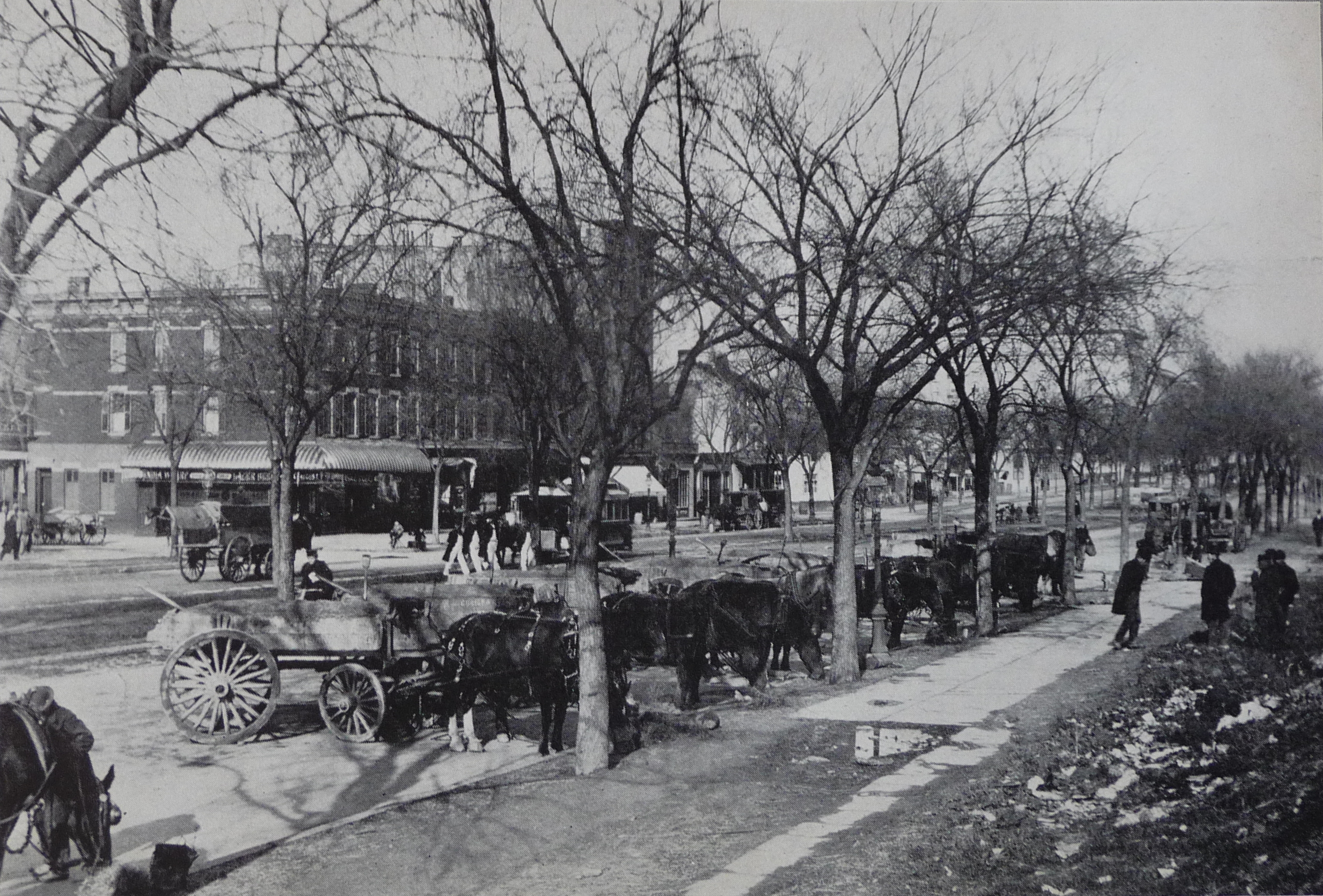
New York After a Big Snowstorm 1905 ph Detroit Photo Library of CongressSo far New York City has not had a major snowstorm this season like upstate New York received earlier this month. But I dream of New York City days gone by like this one shown above.

In this high resolution photograph (click to greatly enlarge) taken in 1905, the effects of a recent snowstorm can be seen as the snow has been shoveled high onto the edge of the street and sidewalk.

We are looking up Broadway from the northwest corner of 29th Street towards 30th Street. On the extreme left at 1209 Broadway is one of the many United Cigar Stores outlets, a chain store which dominated New York’s tobacco retail industry at the turn of the century. Next door at 1211 Broadway is Marcus & Marcus supplying men’s furnishings.

Across the street at 1204 Broadway an advertisement in the window at ground level announces that the entire stock in their window was purchased by The Maurice Company, a clothing company run by Maurice Rogaliner. The “Broadway Dentists” also had offices in the same building along with Sol Young, Photographer.

Next door to the Maurice Company is Shanley’s Restaurant, owned by brothers Tom and Michael Shanley.

Shanley’s was one of the most famous eateries of the late 19th and early 20th century in Manhattan. With three restaurants, this one at 1210-1212 Broadway was their second location which opened in 1896. As the restaurant guide Where And How To Dine In New York (Lewis, Scribner & Co; 1903) describes it:

Everybody in New York knows Shanley’s and almost everybody has dined at one or another of the three establishments conducted under this name. The management acknowledges but one purpose in the conduct of its restaurants — to make its guests absolutely comfortable and to persuade them that Shanley^s holds the recipe for good cheer. It has taken twelve years to develop the atmosphere which one finds in Shanley’s and during this time the extent of its business operations has been greatly enlarged.   The service at Shanley’s is entirely a la carte. The cuisine is proverbial for its excellence. Chops, steaks, lobsters, game, shell fish and kidneys are among the special attractions of the house.

Next to Shanley’s the building with the initials HB and the crown on its sign is the Hof Brau Haus Restaurant. Continue reading

Classic Hollywood #37 – Lilian Harvey

Lilian Harvey – “I Am Suzanne” 1934

Lilan Harvey 1934 I Am SuzanneLilian Harvey was born Helene Lilian Muriel Pape on January 19, 1906 in England. Her mother was British and her father German and Lilian was schooled in Switzerland. Lilian became a leading star in Germany in the 1920’s and 1930’s.

A Hungarian nobleman once offered to give Lilian a castle and a whole village to go along with it. Speaking 13 different languages, Lilian was able to make films in four. She left Germany permanently after the outbreak of World War II. Continue reading