Peter Bogdanovich early in his career was a film writer for magazines. Over the years he interviewed many people in the film industry and continued to do so even after becoming a successful director himself. The interviews with directors are compiled in a great book: Who The Devil Made ItConversations With Legendary Film Directorsby Peter Bogdanovich (Knopf; 1997).
He interviewed director Joseph H. Lewis (1907-2000) an adept filmmaker best known for his 1950 movie Gun Crazy, a precursor to Arthur Penn’s landmark film, Bonnie and Clyde (1967).
Bogdanovich asked Lewis in 1994, to “define the change that had happened in Hollywood.”
Lewis was able to clearly answer him:
“Yes, I define it one way. When I was a little boy I worked at MGM: I loaded film; from there I became an assistant camera boy; from there, an assistant cutter; from there, the head of a cutting department; from there I became a director. These things don’t happen today. A guy comes up and, yes, he has a script- he wrote it; he’ll let them do it, providing he can direct it. And they go for it.” Continue reading →
I sometimes wonder if every photo of Nellie Fox shows him with a chaw of chewing tobacco bulging out of his cheek. Was he born with the chewing tobacco permanently attached inside one cheek? This photograph of Nellie Fox shows that ballplayers were much more accommodating for publicity photographers back in the 1950’s, as Nellie lies on his stomach on a tarpaulin in an empty ballpark. Continue reading →
Lord who had been battling pancreatic cancer, died unexpectedly at the London Clinic of a pulmonary embolism. He leaves behind his second wife Vickie, their daughter, Amy, and Sara, his daughter with his first wife Judith Feldman whom he married in 1969 and divorced in 1981.
I grew up admiring Deep Purple and they have always been one of my favorite bands. I had seen them perform live which was a very festive and loud experience. After seeing them live I came away with the first hand knowledge that Jon Lord was without a doubt one of the most exciting and greatest rock keyboard players ever.
Being an extremely amateur musician myself, there are two things I wish I had the ability to do. One is to play stride style piano like James Johnson or Fats Waller and the other is to flawlessly play the guitar solo or keyboard solo to Deep Purple’s driving locomotive of a song, Highway Star.
Jon Lord was a classically trained musician and that training always came through in Deep Purple’s music. The structure of many of the bands songs are clearly classically influenced and this is due to the fact that both Lord and guitarist Ritchie Blackmore drew a lot of their inspiration from the classical realm.
(l-r) Ian Paice, Ian Gillan, Ritchie Blackmore, Roger Glover, Jon Lord
In rock n’ roll there are many talented composers that are not great performers. There are great live bands, without good original songs. Then, there are phenomenal studio bands who can’t cut it live. During the height of their fame in the 1970’s, I don’t think there was a more talented group of individuals playing together as a band than Deep Purple. What I mean is each individual was a virtuoso in his own right, a master at their instrument. Together they were able to write great songs, record them in the studio and play them effortlessly with an edge in front of a live audience as few rock bands could. To do any one of these three things well is an accomplishment. Deep Purple was in a rare class as they did all three. Continue reading →
Looking at Rush’s upcoming concert tour of North America I noticed something interesting. Take a look at this schedule:
Sep -7
Sep -9
Sep-11
Sep-13
Sep-15
Sep-18
Sep-20
Sep-22
Sep-24
Sep-26
Sep-28
Sep-30
Oct-10
Oct-12
Oct-14
Oct-16
Oct-18
Oct-20
Oct-22
Oct-24
Oct-26
Oct-28
Oct-30
*Nov-1
Nov-3
Nov-13
Nov-15
Nov-17
Nov-19
Nov-23
Nov-25
Nov-28
Nov-30
Dec-2
Manchester,NH
Washington, DC
Pittsburgh, PA
Indianapolis, IN
Chicago, IL
Detroit, MI
Columbus, OH
St. Louis, MO
Minneapolis,MN
Winnipeg, MB
Saskatoon, SK
Edmonton, AB
Bridgeport, CT
Philadelphia, PA
Toronto, ON
Toronto, ON
Montreal, QC
Newark, NJ
Brooklyn, NY
Boston, MA
Buffalo, NY
Cleveland, OH
Charlotte, NC
Atlanta, GA
Tampa, FL
Seattle, WA
San Jose, CA
Anaheim, CA
Los Angeles, CA
Las Vegas, NV
Phoenix, AZ
Dallas, TX
San Antonio, TX
Houston, TX
Verizon Wireless Arena
Jiffy Lube Live Amphitheater
CONSOL Energy Center
Bankers Life Fieldhouse
United Center
Palace of Auburn Hills
Nationwide Arena
Scottrade Center
Target Center
MTS Centre
Credit Union Centre
Rexall Place
Webster Bank Arena
Wells Fargo Center
Air Canada Centre
Air Canada Centre
Bell Centre
Prudential Center
Barclays Center
TD Garden
First Niagara Center
Quicken Loans Arena
Time Warner Cable Arena
Verizon Wireless Amphitheatre
1-800-ASK-GARY Amphitheatre
KeyArena
HP Pavilion
Honda Center
Gibson Amphitheatre
MGM Grand Garden Arena
US Airways Center
American Airlines Center
AT&T Center
Toyota Center
Out of 34 venuesonly one arenais not named after some corporation (The Palace in Michigan).
No arena except The Palace has the name of the city it is located in or attaches the local sports team to its name. Virtually every arena has sold its “naming rights.” Yes, arenas today still have unique names if you consider auto companies, airlines, tech companies, mega-banks and their ilk to be representative of the city.
If someone asked me where The Quicken Loans Arena, The Jiffy-Lube Live Amphitheater or The Honda Center was I’d be hard pressed to tell you. What do these corporate names say about the cities and the arenas they stuck their names on?
Up until the 1970’s most arenas and stadiums were clearly defined: The Boston Garden; Detroit Olympia;The Montreal Forum; Memorial Stadium in Baltimore; The Spectrum in Philadelphia; Maple Leaf Gardens in Toronto; Buffalo Memorial Auditorium; Pittsburgh Civic Arena – and on and on it went for traditional names. The Buffalo Bills were one of the first to do a naming rights deal with Rich Stadium in 1972 and the practice picked up steam in the 1990’s to the point of obliterating almost all historic stadium and arena names. Corporate naming rights are now expected if a new facility opens up. Continue reading →
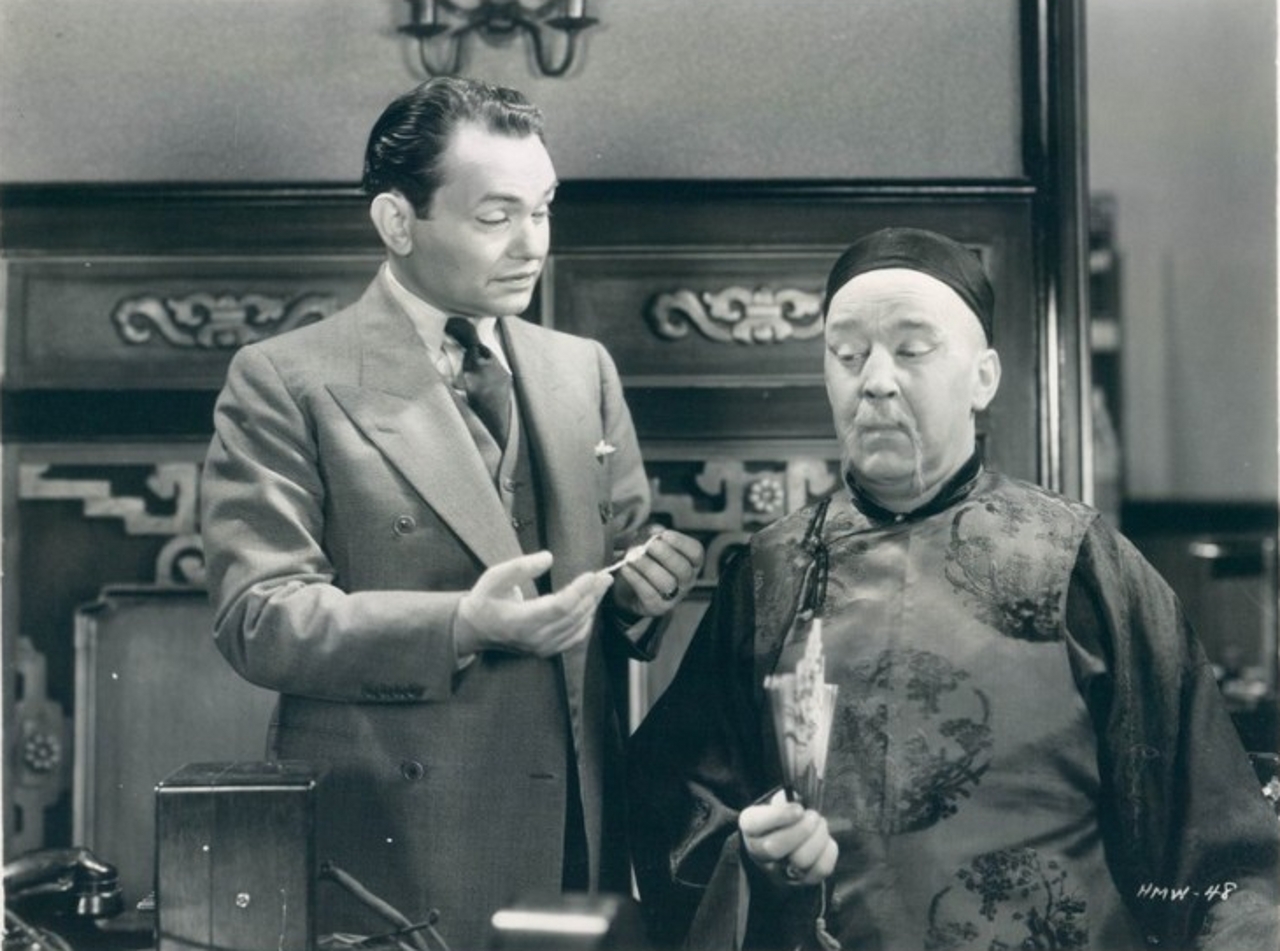
If it seems preposterous that Edward G. Robinson (left) would be cast as a Chinese hitman, then consider that all the leads of this 1932 film The Hatchet Man, directed by William Wellman, are Caucasian.
Robinson, seen here standing next to character actor Dudley Digges, plays Wong Low Get, an anti-hero assassin, in this story about Tong Wars in Chinatown.
The movie is occasionally shown on Turner Classic Movies (TCM) and is worth watching because Robinson turns in a fine performance, even if he doesn’t even slightly resemble someone of Asian descent.
Unfairly labeled second rate Crosby, Stills, Nash & Young imitators by many music critics, America was able to crack the music charts in the early to mid 1970’s with a string of pop rock hits. Their influences ran from The Beatles to The Beach Boys to Jackson Browne.
Guitarists, singers and songwriters all, the trio of Dewey Bunnell, Gerry Beckley and Dan Peek crafted songs that have stood the test of time. Originally staples of AM radio and now relegated to light FM and background supermarket music play-lists, the band deserves a better fate. Their tight harmonies and musical abilities are quite honestly underrated. Especially live. Continue reading →
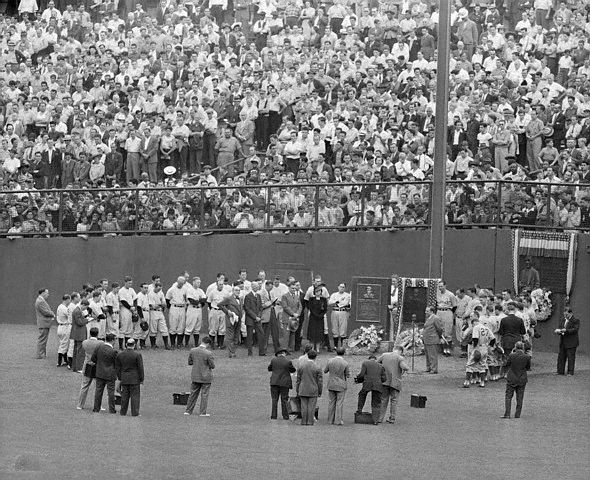
The Day The Yankees Paid Their Final Tribute To The “Iron Horse”
This monument ceremony seen below was supposed to take place July 4 1941, on the two year anniversary of Lou Gehrig Day in 1939.
Many baseball fans know that the New York Yankees began the tradition of Old-Timers Day with a ceremony on July 4, 1939 to honor Lou Gehrig, the “Iron Horse.” On that day, the Yankees brought together Lou’s old teammates to show their deep admiration for a man who exemplified everything the Yankees were about. At the last minute Gehrig was asked to say something to the packed house at Yankee Stadium.
The words he said, now known as, “The Luckiest Man on the Face of the Earth” speech, live on in immortality because it was completely spontaneous and from the heart.
What you may not know, is that you really have never heard or seen that speech.
You have only seen or heard small portions of Gehrig’s speech, because believe it or not, there is not one extant movie or audio recording of Gehrig’s complete speech. Only snippets.
As incredible as it sounds with all those newsreel cameras present to record the activities at Yankee Stadium, no complete version of the speech has surfaced in all these years. Continue reading →
This movie is so bad that they misspelled the title on the promotional still as Sinderalla. If your idea of a seductive temptress is Lily Tomlin then you are in luck. The no-name cast Continue reading →
Everyone is in an unnecessary uproar over the Dewayne Wise phantom catch of a baseball that disappeared into the crowd at Yankee Stadium on June 26, 2012 during a 6-4 Yankee victory over the Cleveland Indians.
The umpire, Mike DiMuro is human. He made a mistake and admitted it after the game. That was the right thing to do.
Do you want the game to stop every time there is a controversial play? Aren’t the games slow enough?
Mistakes similar to this have been happening since baseball began and have been forgotten unless they affect the pennant race or a World Series game.
One forgotten incident that occurred on August 1, 1920 was whether Joe Jackson of the Chicago White Sox actually caught a baseball Babe Ruth hit into an overflow crowd at Comiskey Park. The aftermath of that play is shown below.
Going into the game against the White Sox, Ruth was on a tear, having hit 37 home runs already, shattering his own record of 29 home runs set the previous year. Continue reading →


 He interviewed director Joseph H. Lewis (1907-2000) an adept filmmaker best known for his 1950 movie Gun Crazy, a precursor to Arthur Penn’s landmark film, Bonnie and Clyde (1967).