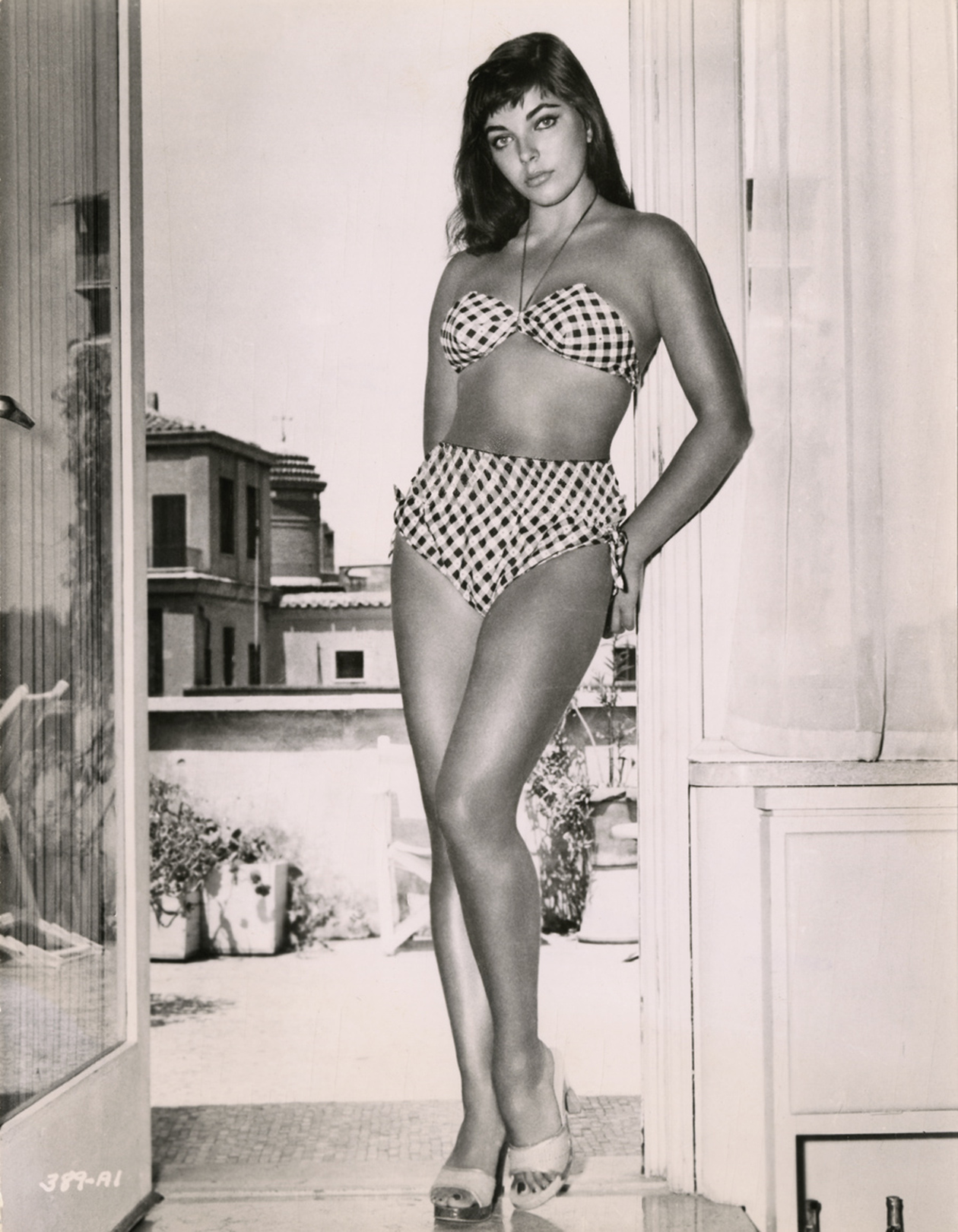
Classic Hollywood #34 – Jayne Mansfield & Marilyn Monroe Photographed Together

Jayne Mansfield In A Revealing Pose – 1955

Later That Year, Jayne Is Photographed With Her Role Model, Marilyn Monroe

Jayne Mansfield in a negligee 1955 photo Milton Greene

This photograph of Jayne Mansfield in a sheer negligee top is not your standard cheesecake photo. And it’s not because Jayne is a little overexposed, which tended to be her modus operandi in front of the camera.

It is because the photograph was taken by Milton Greene, known for his business partnership with Marilyn Monroe. In 1955, Greene did a whole session of photographs with Mansfield and made some stunning images of her.

Considering Greene’s business dealings and personal closeness to Marilyn Monroe,(Marilyn was living for a time with Greene and his wife Amy) it is a bit of a surprise that Marilyn Continue reading

Old New York In Photos #40 – View From The Woolworth Building Observatory

A 1920’s View Of Lower Manhattan Looking Northeast From The Now Closed Woolworth Building Observation Deck

Lower Manhattan from Wooloworth building Observatory 1920s

A tourist in the early 1920’s took this panoramic view of lower Manhattan from a place that is currently off-limits to the general public, the observation deck of the Woolworth Building. The visitors observation deck was shut down in 1941 right before the United States entry into World War II, when the Navy ordered it closed because it offered too good a view of ships in the harbor. Recently even the Woolworth Building lobby was declared off-limits to anyone wanting a view inside of the ornamental entrance.

Woolworth Building 1913

Woolworth Building 1913

From this vantage point we can see from right to left the Brooklyn Bridge, the East River, the Manhattan Bridge. In the hazy distance is the Williamsburg Bridge. Spread across the lower east side are an array of many small buildings. There are a couple of exceptions, most notably the tower of the New York City Municipal Building, partially seen on the extreme left in the foreground.

When completed in 1913, the 792 foot tall Woolworth Building at 233 Broadway was the tallest building in the world. The Woolworth Building retained that title until the Chrysler Building usurped it in 1930. Depending upon your source and how you are counting stories, the Woolworth Building contains anywhere between 55 – 60 floors.

For the admission fee of 50¢, visitors could get an incredible view of the surrounding metropolitan area from its observation deck. The tour book the building Continue reading

Gilligan’s Island Cast Related Albums

The Skipper’s Orgy Album and Other LP’s

album cover Alan Hale's Roman OrgyThis year September 26, marks the 50th anniversary of the premiere of one of television’s all-time classic shows.

Gilligan’s Island originally ran on CBS from September 26 1964 until April 17, 1967 and will be seen forever in re-runs. It spawned an unforgettable theme song and a cast of actors that for better or worse became synonymous with their characters.

Nowadays merchandising and licensing for nearly every quasi-celebrity is the norm. But Gilligan’s Island never took advantage of the popularity of the show and issued albums on behalf of the cast members.

But looking around the web you will find a few albums related to the cast of the show.

Alan Hale’s incredibly titled album, Skipper Alan Hale’s Roman Orgy, would not inspire many of the eleven-year-old fans of the program to purchase it.

Unfortunately it is not a real album, but just one of a series of fake album covers by animator Chris Shapan.album cover Bob Denver Maynard Krebs fake album
Continue reading

One Of The Greatest Pitching Performances Ever

49 Years Ago, Satchel Paige Shut Out The Red Sox For Three Innings. 

No Big Deal, Except That He Was 59

Satchel Paige, age 59 warming up on September 13, 1965 two weeks before facing the Red Sox photo: AP

Satchel Paige, age 59 warming up on September 13, 1965 two weeks before facing the Red Sox photo: AP

To hold “a day” for a ballplayer years after he last played in the major leagues is a special treat for the player. What makes it even more special is when the player participates in the game.

Forty nine years ago on September 25, 1965, Satchel Paige stepped on to the field at Kansas City’s Municipal Stadium on Satchel Paige Night as the starting pitcher for the Kansas City Athletics. It was supposed to be a publicity stunt conceived by Athletics owner Charlie Finley to boost attendance, but Paige took his pitching seriously and would not be embarrassed.

Paige considered by many to be the Negro League’s best pitcher for over two decades, came to the Major Leagues when he was 42-years-old in 1948 when he was signed by Indians owner Bill Veeck.

Paige went 6-1 with a 2.48 ERA that year and helped Cleveland win the pennant. Paige stayed in the majors until he was 46 and continued playing in the minors and barnstorming into the early 1960’s.

At Satchel Paige Night, Charlie Finley had provided a rocking chair for Paige to sit in before the ball game began and a nurse was stationed next to Paige to massage him and keep his arm loose.

The visiting Boston Red Sox did not lay down for Paige. They tried, but the crafty 59-year-old was not going to let a bunch of kids show him up on his own night.

In the first three innings the Red Sox managed to get a runner on with an error and a double by Sox star Carl Yastrzemski.

At the beginning of the fourth inning with the A’s winning one to nothing, Paige went to the mound Continue reading

The Ninth Avenue Elevated Train Crash Of 1905

 In 1905, The Worst Elevated Train Accident In New York’s History Occurred

9th ave elevated railway accident 9 11 1905 postcard photo R Weigel

For as long as you live September 11 will be remembered as the date of  the terrorist attacks on America that brought down the World Trade Center towers. But before 2001,  9/11 marked the anniversary of the worst elevated train disaster in New York’s history. It is a disaster no one wanted to remember and was quickly forgotten except by train and New York history buffs.

The four elevated lines in Manhattan which had a glorious history are long gone, demolished between 1938 and 1955. The elevated lines began service in 1878 and until the subway was built, they provided the quickest and safest routes around New York.

9th Ave 53rd Street junction photo via - http://warofyesterday.blogspot.com

9th Ave 53rd Street elevated junction
photo via – http://warofyesterday.blogspot.com

But there were always fears among riders that one day an elevated train would jump the tracks.

Those fears came true on September 11, 1905.

Not surprisingly it happened at one of the more dangerous stretches of track along the elevated system.

The Sixth and Ninth Avenue Elevated lines shared their tracks above 53rd Street along Ninth Avenue. At 53rd Street the lines diverged, with the Sixth Avenue el traveling three avenues east along 53rd Street to continue its journey along Sixth Avenue.

At that Ninth Avenue junction, the towerman (also called switchman) was responsible for controlling whether trains traveling downtown would continue straight on the Ninth Avenue line or go along 53rd Street to the Sixth Avenue line.

The passengers aboard a five car “el” train that September 11 morning believed their train was going to continue straight down Ninth Avenue, as that was what the station guards at the previous station at 59th Street had told them.

If the train was proceeding down Sixth Avenue it was supposed to come to a full stop at 54th street and await a signal. The recommended maximum speed if a train was to continue down Ninth Avenue was nine miles per hour.

Diagram of Ninth Avenue El crash

Diagram of Ninth Avenue El crash (click to enlarge)

It was 7:05 in the morning as Paul Kelly, the motorman of the el train approached the intersection at 53rd street without stopping.

Witnesses said Kelly slowed down a bit but the train’s estimated speed was 25 miles per hour. Continue reading

While Touring With A Friend, A New Yorker Finds Her Missing Brother – 1905

Places A Tourist Should Go in 1905?

Bellevue And The Morgue.

1st Ave. 26th Bellevue Hospital postcard circa 1912

Visiting New York City today there are things that most tourists go and see. Typical touristy places include The Empire State Building, Times Square, The Statue of Liberty . A hundred years ago you might be surprised at what sights people would go and visit. In 1905 for one New Yorker, accompanying a visiting friend to Bellevue and visiting the morgue seemed like an interesting, if not macabre way to spend the day.

They say truth is stranger than fiction, so we’ll let The New York Evening World of September 11, 1905 pick up the rest of this strange story:

SAW PICTURE AT MORGUE OF DEAD BROTHER

Miss Magner, Showing a Friend the Sights, Identifies Photograph.

This isn’t a very big world since the railroad, the telegraph and the telephone annihilated distances, but here is the strange story of what happened at the points of a triangle with sides only a mile long.

On Feb. 26, 1904, the body of a young man was found on the doors of No. 269 Ninth Avenue, dead. No one knew him. At the morgue the body was photographed and a complete description taken. The breast and arms were tattooed with the form of a woman, the emblems of Faith, Hope and Charity and the initials “J.M.”

After a few days the unidentified body was burled In Potter’s Field, where it has lain for nineteen months. Last Saturday Miss Laura Magner, of No. 354 West Forty-sixth Street, who was entertaining a visiting friend from out-of-town, took him to see Bellevue Hospital and the Morgue.

Continue reading

Old New York in Postcards #9 – Postcard Views Of The Interior Of Old Penn Station

Postcard Views Of The Interior Of Old Penn Station

Because it was dismantled over 50 years ago, many people are familiar with the grandeur of the original Penn Station only through photographs.

The station was opened to the public on September 8, 1910 and the cost of the exterior alone was over $100 million.

Seen from the exterior, the beautiful McKim Mead and White masterpiece represented a merging of modernity and classic architecture. Penn Station exterior

The interior was spacious and wondrous to behold. But according to the Pennsylvania Railroad, the owners of Penn Station, by the mid 1950’s, it was also grimy, outdated, in need of costly repairs and difficult to keep clean. These conditions existed mostly because the Pennsylvania Railroad let the station fall into that state.

The Pennsylvania Railroad knew the land the building was sitting on was worth more than the station itself. This grand monument to railroads and public space was sacrificed to “progress,” the development of the Penn Plaza office buildings and a new Madison Square Garden.

Without regard that a great civic wrong was being done, Penn Station was demolished between 1963 and 1966. It was replaced by a banal, claustrophobic, ugly underground maze also called Penn Station which bears no resemblance to the original, to cattle chute passengers to their trains.

More than two generations of New Yorkers have lamented the loss and contemplated replacements to bring about a new edifice and station worthy of the name. The Farley Post Office (also by McKim Mead and White) between 8th and 9th Avenues directly across the street from the current Penn Station is often discussed as hosting a remodeled station, but nothing has been done to bring those plans to fruition.

Here are some postcard interior views of the original Penn Station. (click on any image to enlarge.)

Salaries Of Hollywood In 1937 – A List of The Film Stars Pay

Katharine Hepburn Was Paid $206,928, While Peter Lorre Made Just $15,265

1937 Was A Good Year For Film Salaries

Gary Cooper - Filmdom's top paid personality in 1937

Gary Cooper – Filmdom’s top paid personality in 1937

I find this sort of stuff fascinating.

In 1938 the U.S. Treasury released a report to Congress that listed how much compensation was paid to luminaries in the film industry for 1937.

The highlight of the report was that Gary Cooper ($370,214) overtook Mae West ($323.333) as the highest salaried film personality.

This was during the height of the Great Depression, so many of the salaries seem astronomical when compared to the average annual salary of a working person which was only $890 in 1937 according to Time magazine.

The list is interesting to look over and there are quite a few surprises. For instance Zeppo Marx ($56,766) is listed in the report and his more famous brothers Groucho, Chico and Harpo are not. Laurel and Hardy are there, and Stan Laurel ($135,167 ) earned nearly $50,000 more than his rotund comedy partner Oliver Hardy ( $88,600).

Ginger Rogers and those famous legs. Ginger received a $124,770 salary in 1937.

Ginger Rogers and those famous legs. Ginger received $124,770 in pay in 1937.

Studio chief and creative genius Walt Disney made only $39,000, yet William A. Seiter, director in 1937 of This is My Affair and Life Begins In College made $135,750!

Box office draws, Barbara Stanwyck, Ginger Rogers and Claudette Colbert were all pulling in over $100,000.

I recognized most of the names on the list, but there are also a handful of people I never heard of like The Yacht Club Boys, ($32,166) who were a popular singing group. And I should have known Alan Dinehart, ($39,666) a busy character actor who appeared in 89 movies during his abbreviated acting career (he died at the age of 54 in 1944).

Bette Davis, Joan Crawford, Spencer Tracy, Olivia de Havilland, Clark Gable, Humphrey Bogart and many others who were big stars are unfortunately not listed.

There are writers, directors, producers, and songwriters mixed in among the stars and supporting players of the movies.

Sadly, so many of these names are now completely forgotten except by a much older generation of contemporaries or rabid TCM movie fans.

Here are the 1937 salaries of over 160 of some of Hollywood’s top talent in alphabetical order:

  1. Don Ameche, $34,499;
  2. Heather Angel, $15,375;
  3. Jean Arthur, $119,041;
  4. Fred Astaire, $211,666; Continue reading

Thurman Munson And Billy Martin Argue A Call

Thurman Munson Is Out And Billy Martin Does Not Agree

Thurman Munson Billy Martin argue call July 21 1978

There was no instant replay back when this scene occurred on July 21, 1978 as Billy Martin pleads his case in vain to umpire Durwood Merrill. Believe it or not, they are arguing that Munson should have been called safe when he attempted to steal home.

The Yankees were playing the Minnesota Twins at Metropolitan Stadium, a place very familiar to Yankees manager Billy Martin and the theft of home. When Martin managed the Twins in 1969 he taught Rod Carew how to swipe home and Carew ended up with a record seven steals of home.

It was not a big deal that Munson was called out in this instance, as the Yankees won the game 4-0.