Hockey Without Helmets

Chicago Black Hawks Playing Hard Against The Boston Bruins – 1958

Chicago Black Hawks play Boston Bruins 1958 photo: Chicago Sun-TimesThe date is February 23, 1958 and the Boston Bruins are on the road against the Chicago Black Hawks. (After the 1985 – 86 season the Black Hawks shortened their name to one word.)

The Black Hawks Glen Skov (14) is sprawled out on the ice and continues to play the puck as Bruins winger Larry Regan sees an opportunity ahead if he does not lose his balance. Lorne Ferguson of the Black Hawks is in pursuit of Regan.

The Bruins would win this game 2-0.

A couple of things to note to the modern hockey fan besides the fact that the players did not wear helmets: Continue reading →

Remembering AC/DC’s Bon Scott

It Was 35 Years Today That The Greatest Front-man in Rock History Died

Bon Scott 1979 I clearly remember when Bon Scott of AC/DC died. I heard it on the radio on a dreary February day in 1980. To me he was just a good singer in a band where all the members were very short.

It was sad, but honestly I didn’t think too much about it at the time having heard only some of AC/DC’s songs such as Let There be Rock, Highway To Hell and Touch Too Much. I was more into The Beatles, Led Zeppelin, E.L.O., Judas Priest, Van Halen, The Cars, Elvis Costello and The Clash and many other mainstream bands. But his death sparked an interest in discovering what Bon Scott and AC/DC was about.

Over the next year I would come to love AC/DC especially with the American release of Dirty Deeds in 1981, five years after it was released everywhere else in the world. After hearing Dirty Deeds, I went out and bought all of the old AC/DC albums. To say I liked the Bon Scott version of AC/DC would be an understatement.

As the years have passed and I get older, I get more and more depressed that Bon Scott left us at age 33. It is hard to fathom he has been gone 35 years.

While not diminishing the passing of Buddy Holly, Jimi Hendrix or Jim Morrison and countless other rock icons, Bon’s death along with John Lennon’s and John Bonham’s (all coincidentally in 1980) are among the greatest losses to rock music ever.

What Bon Scott would have gone on to do can only be left to conjecture, but I would venture to say he would have built upon the previous successes the band had finally achieved. My friends who had seen AC/DC live said Bon’s charismatic stage presence was palpable in person and it came through on film and video as well. With his unique voice and take no prisoners attitude when performing, the audience felt an authentic connection to Bon Scott.

In the six years Bon Scott was the lead singer for AC/DC he recorded six studio albums. It says a lot that from those six albums are where AC/DC have continually pulled half of their live set from.

Brian Johnson who replaced Bon as AC/DC’s lead singer Continue reading →

New Hampshire, A Frozen Lake, A Young Babe Ruth and His First Wife

Babe Ruth At Lake Winnipesaukee, NH – 1916

Babe Ruth and wife Helen Lake Winnipesaukee NH 1916 Hunt auctionsIn this rare photograph the dapper and relatively slender Babe Ruth stands on frozen Lake Winnipesaukee in his Red Sox warm-up jacket. With Babe is his first wife Helen Woodford who was just 16 when they married in 1914. While the Babe may not look very happy at least he does not look too cold.

Babe’s marriage never interfered in his womanizing. His appetite for women was Continue reading →

How To Behave And Act Like A Lady – 1847

35 Rules To Be Followed, Etiquette For Ladies – 1847

Book Etiquette For LadiesHow were women supposed to conduct themselves in the middle of the 19th century?

Well for starters; No kissing other women in the presence of men you don’t know; never sing two songs consecutively; if newly married do not display conspicuous public affection; avoid the “horse laugh”; and if you break something at someone else’s house, ignore that you have done it.

Those are some of the suggestions for proper ladies that were laid out 168 years ago by an anonymous woman author.

They are all from the book “True Politeness, A Hand-Book of Etiquette For Ladies” by an American Lady published in 1847 by Leavitt & Allen.

This fascinating book covers everything a proper lady should know when it comes to etiquette, behavior and fashion. Some of the chapters include; Introductions; Recognitions and Salutations; Conversation-Tattling; The Dinner Table; Courtship and Marriage and a dozen other subjects.

How much has life changed in just a century and a half? Read on and discover 35 of these somewhat practical, but many archaic, rules and suggestions to make the present day reader scratch your head and wonder, did women really act like this?

1. It is, in general, bad taste for ladies to kiss each other in the presence of gentlemen, with whom they are but slightly acquainted.

2. If on paying a morning visit you meet strangers at the house of your friend and are introduced, it is a mere matter of form, and does not entitle you to future recognition by such persons.

3. The plainest dress is always the most genteel, and a lady that dresses plainly will never be dressed unfashionably. Next to plainness, in every well-dressed lady, is neatness of dress and taste in the selection of colors.

4. Never wear mosaic gold or paste diamonds; they are representatives of a mean ambition to appear what you are not, and most likely what you ought not to wish to be.

5. Perfumes are a necessary appendage to the toilet; let them be delicate, not powerful ; the Atta of roses is the most elegant ; the Heduesmia is at once fragrant and delicate. Many others may be named; but none must be patronized which are so obtrusive as to give the idea that they are not indulged in as a luxury but used from necessity.

6. Keep your finger-nails scrupulously clean, and avoid the disagreeable habit of allowing them to grow to an unnatural length.

7. It is better to say too little than too much in company: let your conversation be consistent with your sex and age.

8. Avoid pedantry and dogmatism. Be not obtrusively positive in the assertion of your opinions — modesty of speech, as well as manner, is highly ornamental in a woman.

9. Double entendre is detestable in a woman, especially when perpetrated in the presence of men; no man of taste can respect a woman who is guilty of it: though it may create a laugh, it will inevitably excite also disgust in the minds of all whose good opinions are worth acquiring. Therefore not only avoid all indelicate expressions, but appear not to understand any that may be uttered in your presence.

10. Rather be silent than talk nonsense, unless you have that agreeable art, possessed by some women, of investing little nothings with an air of grace and interest; this most enviable art is indeed very desirable in a hostess, as it often fills up disagreeable pauses, and serves as a prelude for the introduction of more intellectual matter. Continue reading →

Classic Hollywood #39 – Basil Rathbone and Angela Lansbury

Basil Rathbone and Angela Lansbury – 1954

Basil Rathbone Angela Lansbury Paramount Commisary 1954 Court Jester photo EisenstadtThis very appealing photograph was taken in 1954 and shows Basil Rathbone and Angela Lansbury eating lunch at the Paramount studio commissary.

Rathbone and Lansbury are  in costume for the filming of The Court Jester (1955) which they starred in along with Danny Kaye.

Rathbone looks less than enthused with his meal and Lansbury has taken a couple of bites of her hamburger and has decided to fix her hair, possibly sensing that Life magazine photographer Alfred Eisenstadt is about to snap this candid photo of the pair.

Lansbury appears Continue reading →

New York City Subway Advertising 1912

Broadway & 207th Street IRT Subway Station – 1912

Subway Station Broadway 207th St 1912Some things in New York have not changed in 100 years and advertising in the subway is one of them. Paper ads are still put up at stations all along the subway system.

The IRT’s Broadway and 207th Street station is captured here on June 12, 1912 and shows a deserted station. Currently the “1” train runs on this line and the station is elevated and outdoors.

Looking at the photo we notice the thin strip wood plank flooring and tasteful globe lighting to illuminate the station at night.

As for the ads we see from right to left: Continue reading →

Old New York In Photos #46 – The History of New York’s Shot Towers

Birds-eye View  Of The City From The Shot Tower At Centre Street

And A Brief History Of New York’s Shot Towers

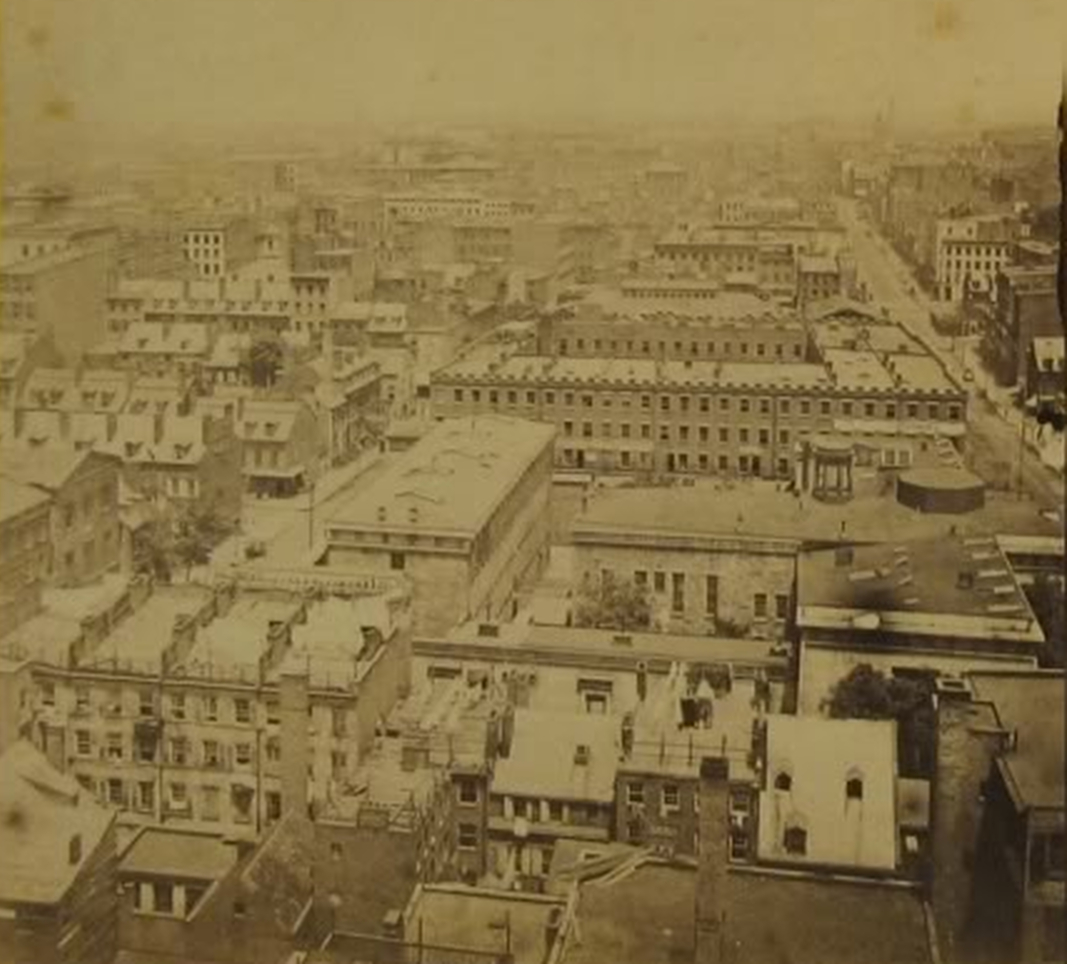
Birdseye View From shot tower Centre StreetThis view of lower Manhattan looking north is from the top of the Centre Street shot tower and was taken in approximately 1870 by E & H.T. Anthony, providers of some of the best 19th century stereoviews of New York.

The view confirms that New York was a low profile city in the 1870’s. The tallest structures in the metropolis were generally churches and their steeples. This view is dominated primarily by three and four story dwellings (some with laundry on clotheslines drying on the roof) as far as the eye can see.

print shot tower Centre Street 1905 Samuel HollyerThe shot tower was 175 feet tall and was built in 1855 by James Bogardus, a pioneer of cast iron building for James McCullough.

Located at 63 Centre Street and bounded by Pearl Street, Worth Street, New Elm Street and Centre Street, the shot tower was operated for many years by the Colwell Lead Company who acquired it from McCullough after the Civil War.

The Centre Street shot tower was octagonal in shape and constructed of brick with 10 iron pillars reaching from the foundation to the top. The base of the tower was 25 feet in diameter, tapering off to 11 feet in diameter at the summit.

Shot towers were among the tallest structures in 19th century New York. They served a necessity in the manufacture of shot ammunition. Molten pig lead would be mixed with arsenic and dropped from the top of the tower through a sieve. The semi-liquid cooled as it fell through the air into a globular shape, and it was caught in a basin of water below. The process would form perfect spherical shot. It was estimated that the tower could produce 15 tons of shot in a day.

As you approached the shot tower the cacophony of sound was described by a contemporary reporter “as if 1,000 sewing machines were at full play.”  If you stood just outside the room where the shot was produced the noise level jumped incrementally to the sound of “100,000 sewing machines now put in full motion.” And if you entered the production room, it was as if  “1,000,000 sewing machines were at work for all they were worth.”

In a strong gale of wind workers described how the tower would sway, not backward or forward but “like a man full of liquor desirous of taking in all the points of the compass at one and the same time.”

According to the superintendent of the lead company, considering the view which could be obtained from the top of the tower there were few requests from visitors to ascend it.

The Centre Street shot tower was razed in 1908. On its site is Thomas Paine Park.

Shot Towers In Manhattan

All the other shot towers that existed in New York are now gone as well.

They included:

A shot tower was located at 261 & 263 Water Street operated by Continue reading →

Worst Snowstorms In New York History – January 1925

January 2015, Not As Bad January 1925

Trolley stuck in snow during storm

Trolley stuck in snow during storm

It was bad for Suffolk County, NY and Boston, MA, but New York City’s 2015 “worst blizzard of all time” did not live up to its billing.

Official records for the city have been kept since 1869, and so far this January, New York City has received a relatively small amount of snow with 14.3 inches accumulating.

January 1925 arrived and departed like a polar bear and New York City was the unwelcome recipient of 27.4 inches of snow, the most ever recorded for any January up to that time. (This record was finally eclipsed in January 2011 when the city recorded 36 inches of snow.)

But it was not only New York City that got hit multiple times in January 1925 with lots of snowstorms, but upstate New York got slammed as well.

The tally for the city read like this: A relentless snowstorm that lasted two days occurred from January 2-3. On January 12 the city required 12,000 shovelmen to tackle another snowstorm that clogged the streets. January 20 New York City got hit with two blizzards in one day. January 27 more snow fell and then the coup de grace; the giant storm on January 30 that affected the metropolitan area.

Ninety years ago today on January 30, New York City was hit hard, but so was the entire region. How bad was it? Cattle in the streets? Ferry service ground to a halt? Here are a few excerpts of what Continue reading →

Part 2 – An Interview With Avery Corman “My Old Neighborhood Remembered A Memoir”

Avery Corman Talks About: Dating, Restaurants, High School in The Bronx, The Advertising World, Getting Published and Having His Books Adapted To Film

We continue our interview with Avery Corman, author of the new book My Old Neighborhood Remembered A Memoir (Barricade Books) 2014, and his story of growing up in the Bronx during the 1940’s and 50’s.

Divided into 5 parts the first two parts of the interview can be seen here.

In part 3 Avery Corman discusses dating, blind dates, sex, going to the movies, the differences between eating out and restaurants, dessert havens like Krum’s, Addie Vallins and Jahn’s and the coming of television.

Part 4 Avery Corman recalls his high school years at DeWitt Clinton High School and his decision to go to New York University. Upon graduating Continue reading →

Old New York in Postcards #11 – Unbuilt New York

The New York That Was Never Built

West Jersey BridgeNew York City: plans are made, plans are scrapped. We’ve dug up postcards of unbuilt projects, variations of existing structures or other anomalies such as a lawn in front of the main branch of the New York Public Library.

Bridges

The postcard seen here is the West Jersey Bridge which predates the George Washington Bridge by a few years. In the 1880’s Gustav Lindenthal came up with a design for a large train bridge for the Pennsylvania Railroad that would have connected Manhattan at 23rd Street with New Jersey. The railroad opted for tunnels instead of a bridge. Lindenthal had a long career in bridge engineering supervising the building of the Queensboro and Hell Gate Bridges.

Over thirty years later, in 1920 Lindenthal drew up plans for the West Jersey Bridge. The West Jersey Bridge would have 20 lanes of traffic on its upper deck and a dozen on the lower level. Pedestrian walkways were to be part of the gargantuan bridge stretching from Weehawken, NJ to 57th Street in Manhattan. The master plan included cutting a highway completely across Manhattan connecting to the Queensboro Bridge. The West Jersey Bridge was never built. Instead, Lindenthal’s protege Othmar Ammann designed the George Washington Bridge which was constructed further north at 177th Street.

Hudson River BridgeWhich brings us to something we covered previously: that the George Washington Bridge was originally supposed to have its towers sheathed in stone. Architect Cass Gilbert’s stone arches were depicted in various early drawings and plans for the Hudson River Bridge. The stone plan was ditched. The arches retain the graceful steel skeleton and the bridge was formally renamed the George Washington Bridge.

Williamsburg BridgeWith this illustration of the Williamsburg Bridge completed in 1903, the artist took some liberties in showing the completed towers.  On the top of each of the towers we see what appear to be windowed rooms, possibly for observation or just decoration. They were never built.

Manhattan Bridge Approach

The Manhattan Bridge completed in 1909 is accurately seen here. But the entrance is certainly not something that came to fruition. The bridge approach imagined is a veritable garden in a park-like atmosphere with neatly pruned trees, shaped into squares surrounding the entrance way.

Hudson Fulton Bridge 1Hendrick Hudson River Bridge 2

1955 photograph of current Henry Hudson Bridge

1955 photograph of current Henry Hudson Bridge

For the Hudson-Fulton celebration of 1909 there were various proposals to build a bridge connecting upper Manhattan with the Bronx. Known as The Hendrick Hudson Memorial Bridge or Hudson-Fulton Memorial Bridge, both designs featured elegant approaches for an arch bridge over Spuyten Duyvil. Continue reading →