Jimmy Stewart & Ginger Rogers Win Oscars – 1941

February 27, 1941 – the Oscars are awarded at the Biltmore Hotel in Los Angeles, CA. This was the first time sealed envelopes were used to keep the winners names secret. Continue reading

February 27, 1941 – the Oscars are awarded at the Biltmore Hotel in Los Angeles, CA. This was the first time sealed envelopes were used to keep the winners names secret. Continue reading
Alvin Dark Slides In Safely As Yogi Berra Drops The Ball And The Yankees Fall Apart

Giants shortstop Alvin Dark is safe at home plate as Yankees catcher Yogi Berra can’t handle the ball
NEW YORK: ERROR FOR BERRA – Giant Alvin Dark is safe at the plate as Yogi Berra drops the ball trying to tag him. Bobby Brown threw to Berra from third on Monte Irvin’s grounder in the Giants big five-run sixth inning. The National League champs made it their second victory over the Yankees in the third game of the 1951 World Series at the Polo Grounds, Oct 6, with a 6-2 score. Credit (ACME) 10-6-51
The New York Giants had every reason to believe that this was the year they would win the World Series. They had defeated the Brooklyn Dodgers just days before in a best of three tie-breaker playoff series. On October 3, Giants fans witnessed the “Miracle of Coogan’s Bluff” – Bobby Thomson’s dramatic 9th inning home run off of Ralph Branca that propelled them into the Series against the Yankees.
The World Series would be a match-up between cross-river rivals and their respective rookie stars Willie Mays and Mickey Mantle and it would end up being the finale for Joe DiMaggio’s career.
On October 6, 1951 with 52,305 fans packed into the Polo Grounds, the largest crowd ever to see a World Series game in a National League ballpark, the Giants fans were cautiously optimistic.
The series was tied at one game apiece and the Giants were holding a slim 1-0 lead in the fifth inning, when depending on how you look at it, the Giants erupted or the Yankees fell apart. Continue reading
The Dodgers All-Star Shortstop Maury Wills Gets His 104th Stolen Base

LOS ANGELES, Oct. 3 – WILLS STEALS AGAIN – Maury Wills of the Dodgers slides safely into third for his 104th stolen base of the season, as the throw from catcher Ed Bailey of the Giants bounces past third baseman Jim Davenport and into left field. Wills kept going and scored on the action to put the Dodgers ahead 4-2. (AP Wirephoto)
Maury Wills lead the National League six straight times in stolen bases from 1960 -1965. When he shattered Ty Cobb’s 47-year-old single season record of 96 stolen bases in 1962, with 104 steals, Wills revolutionized the game. Teams looked at Wills style of play and realized they could change the outcome of the game by having their own speedsters.
Eventually Lou Brock and Rickey Henderson would each succeed in establishing new stolen base records of 118 and 130 bases respectively. But it was Maury Wills who brought back the art of the steal from the deadball era of baseball. In addition to an all-star selection and gold glove award Wills was named the National League’s Most Valuable Player in 1962.
One interesting side note: Wills got caught stealing only 13 times in 1962. In his 96 steals, Ty Cobb was caught 38 times in 1915.
October 1, 1961, A Home Run Record Is Set & Baseball Blows Its Big Moment
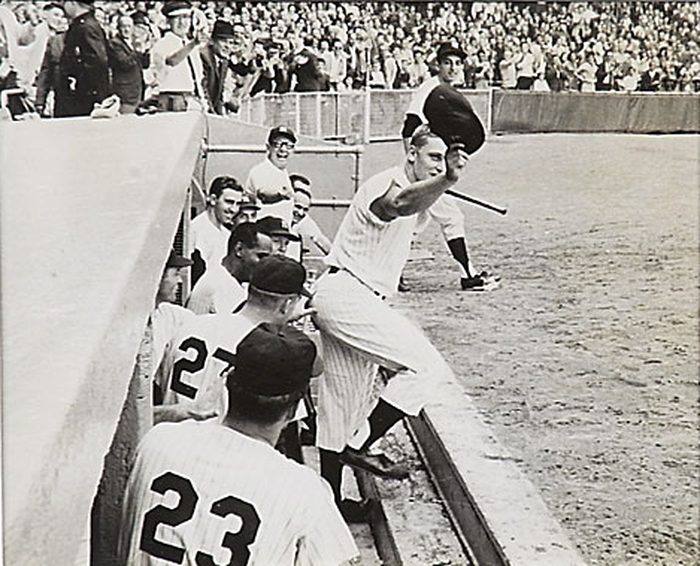
Roger Maris emerges from the dugout to tip his cap after hitting his 61st home run of the season. October 1, 1961
52 years ago today, on the last day of the regular season October 1, 1961, Roger Maris hit his 61st home run of the season off of the Red Sox hurler Tracy Stallard in the fourth inning. For those who were fortunate enough to be there, it was a great moment in baseball history.
Unlike many of today’s players who will take a curtain call without any prodding for driving in the go-ahead run, Maris had to literally be pushed out of the dugout to acknowledge the 23,154 cheering fans at Yankee Stadium.
So why were there only 23,154 fans to see Babe Ruth’s record eclipsed?
That has to do with former sportswriter and then baseball Commissioner, Ford Frick who was a great friend of Babe Ruth and his ghost-writer.
Frick had declared that an asterisk be placed next to any home run record set, if it was not accomplished in 154 games, which was the number of games Ruth played in 1927 when he set his home run mark at 60.
Legendary baseball owner Bill Veeck tells this scathing and hilarious story in his wonderful memoir, Veeck as in Wreck written with Ed Linn (G.P. Putnam’s Sons) 1962.
Let us be fair. Ford Frick does not try to do the wrong thing. Given the choice between doing something right or something wrong, Frick will usually begin by doing as little as possible. It is only when he is pushed to the wall for a decision that he will always, with sure instinct, and unerring aim, make an unholy mess of things.
Suppose that, purely as an exercise, I had put the following baseball question to you at any time during the past twenty-five years.
Suppose, starts the question, that someone comes along to challenge Babe Ruth’s record- which is THE record the same way Mt. Everest is THE mountain. Continue reading
Yankees Win Game 1, But Brooklyn Wins Their Only World Series

The World Series began on September 28, 1955. Yes, they actually used to begin the “fall classic” right after fall began. Yankee first baseman Joe Collins slugged his second home run of the game, a two run shot in the bottom of the sixth, to put the Yankees up 6-3 in a game they would go on to win 6-5. The outfielder in the photograph leaping in vain for the baseball is Dodger centerfielder Duke Snider.
This was also the game where Jackie Robinson stole home, which to this day is still disputed by Yankees catcher Yogi Berra who insists Robinson was out.
As covered previously by stuffnobodycaresabout, this World Series would be the Brooklyn Dodgers moment of glory as they ended up beating the Yankees in seven games.

Mickey Mantle looks on as his longtime teammate Whitey Ford announces his retirement May 30, 1967.
With all the celebrations surrounding Mariano Rivera’s retirement and last game at Yankee Stadium, it got me thinking about Mickey Mantle’s last game at Yankee Stadium.
It was a sunny day on Wednesday, September 25, 1968 and not being able to attend school yet because I was too young, my father who worked a night shift took me to Yankee Stadium to see a meaningless 2:00 pm game between the Cleveland Indians and the New York Yankees. It was the last home game of the season for the 5th place Yankees. I vividly remember the game, but it originally wouldn’t be because it was Mickey Mantle’s last game at Yankee Stadium. Continue reading
A Marriage Not Made To Last
On July 17, 1954 Groucho Marx married Eden Hartford at Sun Valley, Idaho. It was his third marriage, it was her second. He was 63, she was 24.
This was the beginning.

This was the end.

The look on both of their faces in this photo from around 1962 says it all about the state of their marriage after eight years.
Groucho and Eden are dining at the famous Brown Derby restaurant and apparently not enjoying each other’s company. Groucho and Eden displayed similar expressions during the 1960’s anytime they were photographed together.
Even though the love affair was apparently over, the official end wouldn’t come until 1969 after 15 years of marriage when Groucho and Eden were divorced.
Six years after Groucho died, Eden passed away from cancer at the age of 53 on December 15, 1983.
Dolores Costello
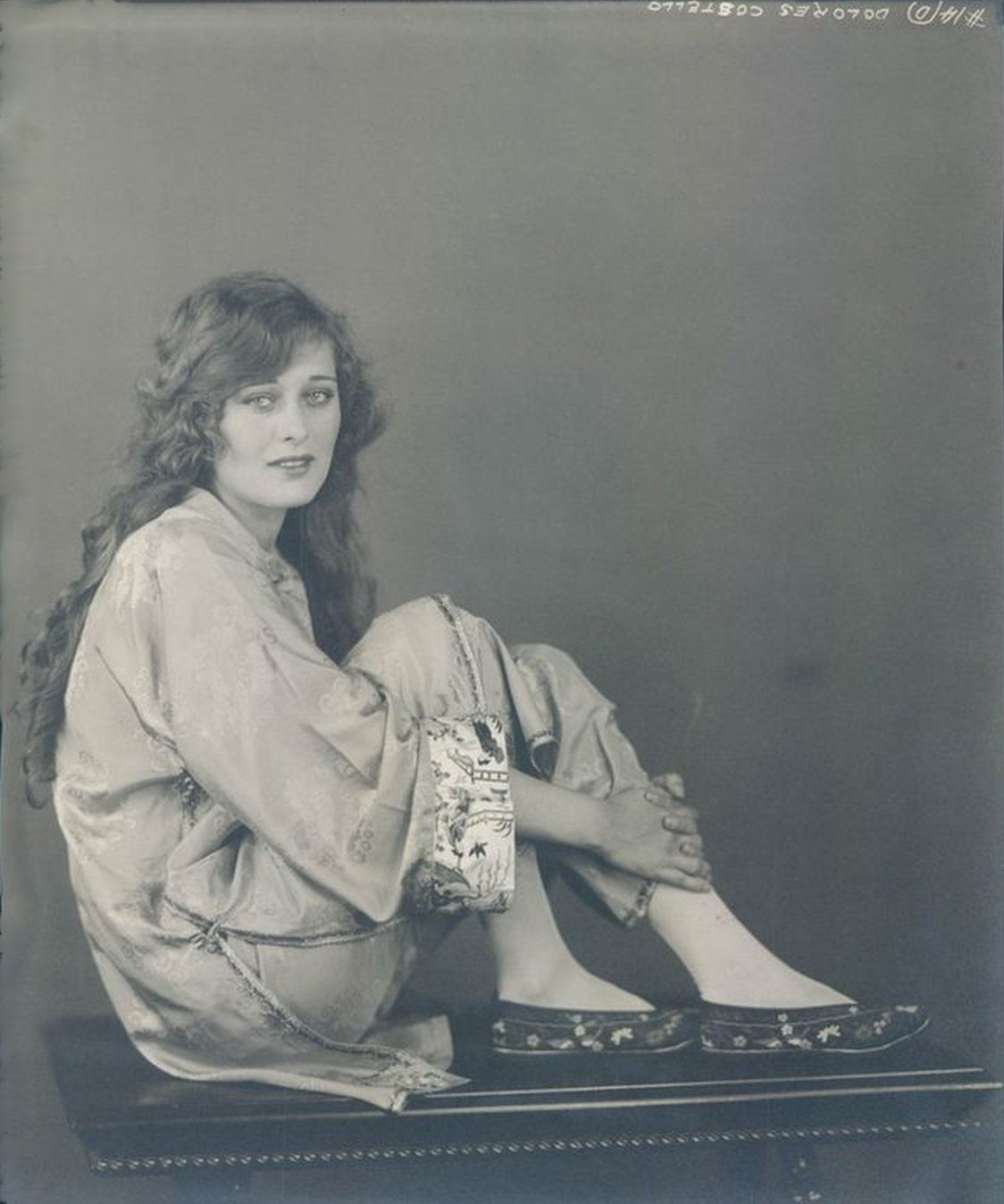
The beautiful Dolores Costello (1903-1979) was nicknamed “The Goddess of The Silent Screen.”
Dolores’s father, Maurice Costello was a Broadway stage and early silent screen star, and her mother was stage actress Mae Costello. With that parentage, and her natural beauty, Dolores had access to enter motion pictures in New York at the age of six in 1909. After 1915 she took a break from films for the next eight years. She did some modeling and appeared on the stage. Famous illustrator James Montgomery Flagg who had used Dolores as a model described her beauty as the most perfect for his illustrations. Dolores returned to the screen briefly for some bit parts in 1923.
Dolores had a fairy tale rise to stardom after being “discovered” in Chicago in April 1925 by Jack Warner of Warner Bros., who was sitting in the audience watching Dolores in the chorus of George White’s Scandals. A screen test followed, and she was signed to a motion picture contract.
In just under eight months after her arrival in Hollywood, Dolores appeared in a few supporting roles and then landed a big starring role opposite the legendary John Barrymore in The Sea Beast in 1926.
John Barrymore reportedly said of Dolores, “I have just seen the most beautiful woman in the world. I shall not rest or eat until I have seen her again.”
Barrymore and Costello appeared in a couple of films together and were married in 1928. The couple had two children, John Jr. and Dolores. Their marriage was tumultuous and they divorced in 1935.
Even though she had a lisp, Costello made a successful transition to sound films. Her most notable starring role was as Isabel, the widowed mother in Orson Welles 1942 drama, The Magnificent Ambersons. Her final film appearance was in 1943. Dolores spent the remainder of her life running an avocado ranch in Fallbrook, CA near San Diego.
Stand Up Straight Please, This Is A Publicity Stunt
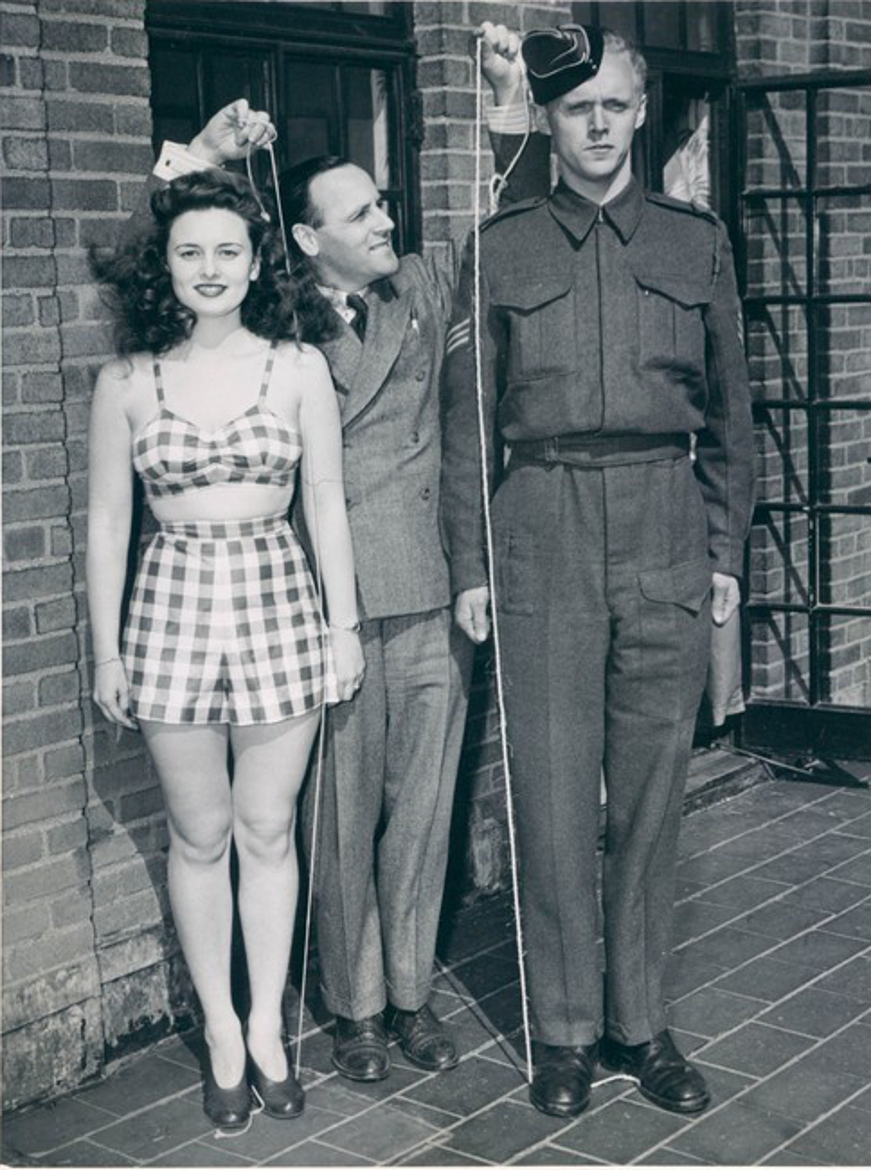
New York, NY – Miss Lillian McKevitt, of Jackson Heights, New York is chosen as “Posture Queen” from among forty beautiful Walter Thornton models who demonstrated exercises to provide good posture in celebration of Good Posture Week (May 4-11), has her posture matched by Mr. Thornton with that of Sgt. Lester Hare of the military police of the Canadian army, who attended the matinee performance on the penthouse terrace of the Mayflower Hotel. – April 27, 1942: Acme News Photograph
By whom Lillian McKevitt was chosen Posture Queen is not noted in the news photo caption.
The interesting story here is about the modeling agency Lillian came from, The Walter Thornton Modeling Agency which began its business in 1931.
A June 27, 1948 Associated Press article describes how Walter Thornton created the World War II “Pin-Up Girl.” Strangely this is based only on Walter Thornton’s assertion.
The story goes, “while in the service, Thornton pinned his girlfriend’s picture to the canvas wall of his tent. The pin put a hole in the tent and the Sergeant put Thornton on K.P. (Kitchen Punishment duty). The new soldiers however lived in lush barracks and could pin up pictures of pretty girls without punching a hole in the wall. So one day in 1940, Thornton dug out about 5,000 photos of girls from his modeling agency and sent them to Fort Dix, NJ. The idea was a winner and the World War II pin-up girl was born.”
Allegedly.
Thornton also put on a hair-pulling match in 1940 at Palisades Amusement Park which we previously profiled here.
Time Magazine noted in 1954, “He (Thornton) also has shown a talent for getting publicity for Walter Thornton.” Continue reading
New York says goodbye to Babe Ruth at Yankee Stadium August 17-18, 1948.

Sixty five years ago today, when Babe Ruth died of cancer at the age of 53 on Monday, August 16, 1948, New Yorker’s and the baseball world mourned as it never had before.
As lines stretched into the night on August 17, 1948 for a last look at the Babe lying in state in the rotunda at Yankee Stadium, the stream of fans never let up. It was estimated that 50,000 fans on August 17th and 55,000 on the 18th filed past the open coffin. Among the mourners at the stadium were baseball executives Dan Topping, owner of the Yankees, Will Harridge, president of the American League, Commissioner, Happy Chandler and former players Hank Greenberg and Leo Durocher.

They filed by at the rate of 100 people per minute. People waited all night. To see this…

Some were given more than a moment to mourn.
In this photograph above, Frankie Haggerty, 10, of Danvers, MA wipes away a tear as he looks upon Babe Ruth lying in his casket at Yankee Stadium. When Ruth was too ill to attend the funeral of one of his mentors, Brother Gilbert, he gave Frankie permission to attend as his personal representative.
One father said, “I wanted my boy to come see this so he could always say he had seen the Babe in person.”
Another elderly white haired visitor lifted his grandson for a look into Ruth’s casket. “Take a good look sonny,” he said. “You’ll never see another man like him.”
Eleven-year-old Peter Carter said, “I feel very sad. Every night I pray the Babe’s soul will go to heaven.”
A requiem mass and funeral for the Babe was held at St. Patrick’s Cathedral on August 19, 1948.
6,000 mourners bowed their heads as Cardinal Spellman made a special prayer at the end of the solemn 1 hour service. 75,000 people waited outside the Cathedral in the pouring rain.
What was unexpected was that after the funeral over 100,000 people lined the route in silence from Manhattan to Westchester as the Babe was driven to his final resting place at Gate of Heaven Cemetery in Mt. Pleasant, NY.
At the cemetery another 6,000 people were there to see the Babe off. Ruth was put into a receiving vault until the family selected a site for burial.
Millions of people from around the country all said the same thing that you always hear after someone famous passes away, “he will never be forgotten.”
This time they were right.