Category Archives: Photography

Classic Hollywood #25 – Dolores Costello

Dolores Costello

Dolores Costello

The beautiful Dolores Costello (1903-1979) was nicknamed “The Goddess of The Silent Screen.”

Dolores’s father, Maurice Costello was a Broadway stage and early silent screen star, and her mother was stage actress Mae Costello. With that parentage, and her natural beauty, Dolores had access to enter motion pictures in New York at the age of six in 1909. After 1915 she took a break from films for the next eight years. She did some modeling and appeared on the stage. Famous illustrator James Montgomery Flagg who had used Dolores as a model described her beauty as the most perfect for his illustrations. Dolores returned to the screen briefly for some bit parts in 1923.

Dolores had a fairy tale rise to stardom after being “discovered” in Chicago in April 1925 by Jack Warner of Warner Bros., who was sitting in the audience watching Dolores in the chorus of George White’s Scandals.  A screen test followed, and she was signed to a motion picture contract.

In just under eight months after her arrival in Hollywood, Dolores appeared in a few supporting roles and then landed a big starring role opposite the legendary John Barrymore in The Sea Beast in 1926.

John Barrymore reportedly said of Dolores, “I have just seen the most beautiful woman in the world. I shall not rest or eat until I have seen her again.”

Barrymore and Costello appeared in a couple of films together and were married in 1928. The couple had two children, John Jr. and Dolores. Their marriage was tumultuous and they divorced in 1935.

Even though she had a lisp, Costello made a successful transition to sound films. Her most notable starring role was as Isabel, the widowed mother in Orson Welles 1942 drama, The Magnificent Ambersons. Her final film appearance was in 1943. Dolores spent the remainder of her life running an avocado ranch in Fallbrook, CA near San Diego.

Posture Queen And The Creation Of The World War II Pin-Up Girl

Stand Up Straight Please, This Is A Publicity Stunt

Lillian McKevitt

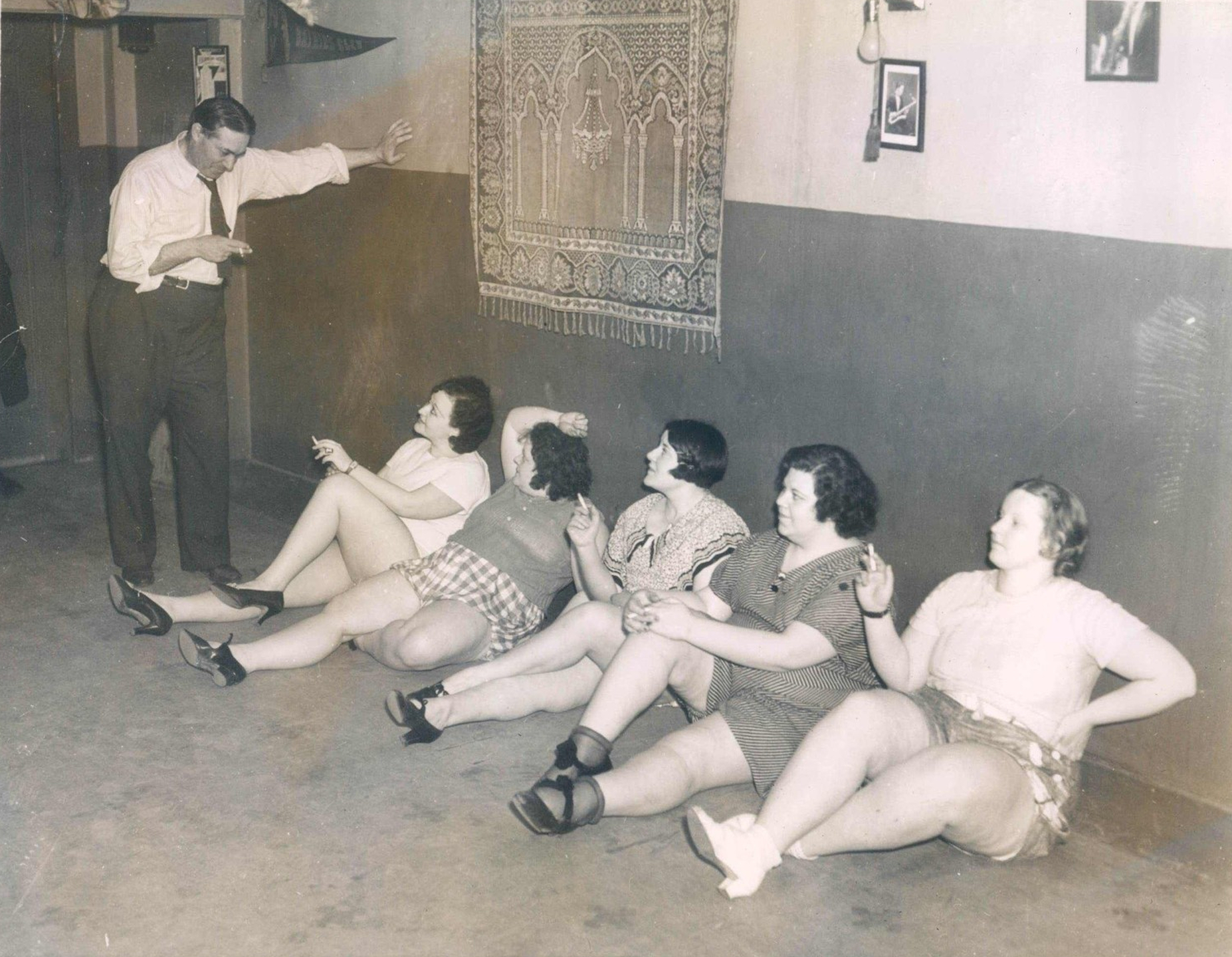
New York, NY – Miss Lillian McKevitt, of Jackson Heights, New York is chosen as “Posture Queen” from among forty beautiful Walter Thornton models who demonstrated exercises to provide good posture in celebration of Good Posture Week (May 4-11), has her posture matched by Mr. Thornton with that of Sgt. Lester Hare of the military police of the Canadian army, who attended the matinee performance on the penthouse terrace of the Mayflower Hotel.  –  April 27, 1942: Acme News Photograph

By whom Lillian McKevitt was chosen Posture Queen is not noted in the news photo caption.

The interesting story here is about the modeling agency Lillian came from, The Walter Thornton Modeling Agency which began its business in 1931.

A June 27, 1948 Associated Press article describes how Walter Thornton created the World War II “Pin-Up Girl.”  Strangely this is based only on Walter Thornton’s assertion.

The story goes, “while in the service, Thornton pinned his girlfriend’s picture to the canvas wall of his tent. The pin put a hole in the tent and the Sergeant put Thornton on K.P. (Kitchen Punishment duty).  The new soldiers however lived in lush barracks and could pin up pictures of pretty girls without punching a hole in the wall. So one day in 1940, Thornton dug out about 5,000 photos of girls from his modeling agency and sent them to Fort Dix, NJ. The idea was a winner and the World War II pin-up girl was born.”

Allegedly.

Thornton also put on a hair-pulling match in 1940 at Palisades Amusement Park which we previously profiled here.

Time Magazine noted in 1954, “He (Thornton) also has shown a talent for getting publicity for Walter Thornton.” Continue reading

Babe Ruth’s Funeral

Paying Respects To Babe Ruth

New York says goodbye to Babe Ruth at Yankee Stadium August 17-18, 1948.

Babe Ruth funeral Yankee Stadium 8 18 48

Sixty five years ago today, when Babe Ruth died of cancer at the age of 53 on Monday, August 16, 1948, New Yorker’s and the baseball world mourned as it never had before.

As lines stretched into the night on August 17, 1948 for a last look at the Babe lying in state in the rotunda at Yankee Stadium, the stream of fans never let up. It was estimated that 50,000 fans on August 17th and 55,000 on the 18th filed past the open coffin. Among the mourners at the stadium were baseball executives Dan Topping, owner of the Yankees, Will Harridge, president of the American League, Commissioner, Happy Chandler and former players Hank Greenberg and Leo Durocher.

Babe Ruth funeral fans line up 8 17 1948


They filed by at the rate of 100 people per minute. People waited all night. To see this…

Babe Ruth Lies in state 8 18.1948

Some were given more than a moment to mourn.

In this photograph above, Frankie Haggerty, 10, of Danvers, MA wipes away a tear as he looks upon Babe Ruth lying in his casket at Yankee Stadium. When Ruth was too ill to attend the funeral of one of his mentors, Brother Gilbert, he gave Frankie permission to attend as his personal representative.

One father said, “I wanted my boy to come see this so he could always say he had seen the Babe in person.”

Another elderly white haired visitor lifted his grandson for a look into Ruth’s casket. “Take a good look sonny,” he said. “You’ll never see another man like him.”

Eleven-year-old Peter Carter said, “I feel very sad. Every night I pray the Babe’s soul will go to heaven.”

A requiem mass and funeral for the Babe was held at St. Patrick’s Cathedral on August 19, 1948.

6,000 mourners bowed their heads as Cardinal Spellman made a special prayer at the end of the solemn 1 hour service. 75,000 people waited outside the Cathedral in the pouring rain.

What was unexpected was that after the funeral over 100,000 people lined the route in silence from Manhattan to Westchester as the Babe was driven to his final resting place at Gate of Heaven Cemetery in Mt. Pleasant, NY.

At the cemetery another 6,000 people were there to see the Babe off.  Ruth was put into a receiving vault until the family selected a site for burial.

Millions of people from around the country all said the same thing that you always hear after someone famous passes away, “he will never be forgotten.”

This time they were right.

Gil Coan Washington Senators Outfielder

Gil Coan May 29, 1948

Gil Coan 5 29 1948

Gil Coan turned 91 on May 18, 2013. The North Carolina native started his major league career in Washington in 1946 at the age of 24.

The speedy left fielder had a few good seasons on some unspectacular Washington Senators teams. Though he hit only .254 for his career, Coan finished in the top ten in stolen bases in the American League six times and hit .303 in consecutive seasons, 1950 and 1951.

The Trade

No one could possibly foresee that the trade Gil Coan was involved in would turn out to be one of the most one-sided in baseball history. Continue reading

An Incredible Babe Ruth Accomplishment

The Babe Hit Homers, But Didn’t Give Them Up

Babe Ruth 1916 at Comiskey Park LOC 2When I’m asked who was the greatest baseball player of all-time, I never hesitate in my answer that it was Babe Ruth. For the few people still living who saw Ruth play, they will attest to his skills as not just a great hitter, but an excellent fielder, surprisingly fast base runner (excepting his 1926 World Series blunder) and of course a dominant pitcher.

In 1916 with the Boston Red Sox, Ruth did something that only five other pitchers in the modern era have accomplished. Ruth pitched over 300 innings (324) without allowing a home run. Can you imagine that? Even in the deadball era when home runs were tough to come by, this is still an amazing achievement and one that will likely never be done again.

Starting pitchers today do not come close to pitching 300 innings, let alone not give up homers. The last pitcher Continue reading

Old New York In Photos #30 – Cooling Off During Heat Waves

Heat Waves In New York And Children Cooling Off

NYC Kids Playing at Hydrant

As New York City endures a heat wave this week, realize that for the majority of the 20th century there was virtually no air conditioning in most homes. The streets provided the easiest and most accessible way for children to cool off.

In New York, it is only recently that a heat wave has been defined as at least three straight days with temperatures reaching 90 degrees or more. Who decided this I do not know. Every region of the world has their own definition of what comprises a heat wave. Years ago, any sustained combination of high heat and humidity used to qualify as a heat wave.

This undated photograph above from the mid-1940’s shows city children on a Manhattan street playing and wallowing in the water. I like the fact that some of the people are looking directly at the photographer who is perched high above the street capturing the scene.

Cooling off Harlem 1933

This photo shows a Harlem street in 1933 with children gathering around a center stand sprinkler connected by a hose to the fire hydrant.

A four day heat wave in New York City that began June 7, ended on June 10, 1933 with a violent thunderstorm which dropped the temperature down to 86. The day before, the thermometer in the city reached the mid 90’s and reportedly hit 120 degrees in Hammonton, NJ, wilting strawberries right on the stem.

Joe Funranolla and Ray Bardini beat the heat by diving into the river July 22 1955

As unthinkable as it is now, for decades up until the 1970’s, to cool off many children would swim in the polluted East and Hudson Rivers. With the FDR Drive and the United Nations Secretariat Building in the background Joe Funranolla and Ray Bardini beat the heat by diving into the East River July 22, 1955. The temperature hit 96 that day.

It was the eighth day in July 1955 that the mercury went above 90 degrees. According to the New York Times, the record up to that time for 90 degree days in July was ten, which was accomplished in 1876 and 1952.

Boys Swimming East River 1937

This 1937 photograph shows teen boys making daring dives into the East River. The Williamsburg Bridge is in the background. I wonder how long it took to get back up to where they were diving from?

Hell Gate Bridge bathers Astoria Pool 1937

One thing has remained the same over the years: if they can get to one, kids still flock to the city pools. In this 1937 photograph the Astoria Pool entices a huge crowd, while the Hell Gate Bridge looms in the background.

The current heat wave will soon be over and when winter arrives, you can bet your bottom dollar many New Yorker’s will be saying they can’t wait for the warm weather.

Things You Didn’t Know About The George Washington Bridge

The George Washington Bridge Was Going To Have Its Steel Towers Covered In Stone

George Washington Bridge Under Construction circa 1930

The George Washington Bridge seen here during construction in 1930, was built from 1927 until 1931. Architect Cass Gilbert intended its towers to be sheathed in stone. Still visible on the towers are the hooks for which the stone was to be attached.

George Washington Bridge Original Design

Proposed Original Design With Stone Arches

It was decided for practical reasons that the bridge towers did not need to be encased in stone. The Depression hit soon after construction started and the cost of procuring and installing the stone would have been prohibitive. The designers and builders reevaluated the whole look of the bridge and felt that there was a natural beauty in showing the function through the form of the exposed naked steel.

The bridge’s chief designer and engineer Othmar Ammann had incredible foresight. Though the bridge had only one level when originally constructed, the design he came up with allowed for the eventual addition of a lower level which was added in 1962. This increased the number of traffic lanes from eight to fourteen. Morning and evening rush hours can create delays of one hour or longer. Can you imagine what the delays would be like without the second deck?

12 other interesting facts about the George Washington Bridge:

1. When completed in 1931 the George Washington was the longest suspension bridge in the world. It was eventually displaced as the longest bridge by San Francisco’s Golden Gate Bridge in 1937.

2. The bridge was completed eight months ahead of schedule and under budget.

3. To finance the bridge, the states of New York and New Jersey each advanced $5 million and $50 million in bonds were issued.

4. Tolls were set to pay off the bonds, which would mature serially starting in 1953. It was assumed after paying off the bond holders, the tolls would eventually be reduced or even eliminated. (Hah!) Continue reading

Classic Hollywood #24 – W.C. Fields In Color

W.C. Fields In A Rare Color Photograph Circa 1940

WC Fields color

W.C. Fields or Bill Fields to his friends, was one of the most talented comedians of the first half of the 20th century. He began his show business career in vaudeville as a juggler and worked his way up to top billing in the Ziegfeld Follies for a ten year stretch. From there he went on to become a major film star during the 1930’s and early 1940’s. Today, upon viewing his films, many people do not understand why he was considered funny. But I assure you there is a subtle brilliance in Fields’ portrayals of the henpecked husband, disreputable man and misunderstood misanthrope.

One of the more popular, yet apocryphal stories about Fields, was that he had hundreds of bank accounts spread across the country, many under ridiculous pseudonyms such as Otis Criblecoblis; Mahatma Kane Jeeves; Aristotle Hoop; Ludovic Fishpond; Figley E. Whitesides and so on. After Fields died in 1946, his mistress Carlotta Monti claimed that there was over $1.3 million in unclaimed funds in banks under the fake names. An assistant hired to solve the dilemma of Fields estate found only 24 accounts all under Fields real name. Continue reading

Frank Chance, Chicago Cubs Player-Manager circa 1912

Frank Chance, Subject of Baseball’s Most Famous Poem

Frank Chance 1912These are the saddest of possible words:

“Tinker to Evers to Chance.”

Trio of bear cubs, and fleeter than birds,

Tinker and Evers and Chance.

Ruthlessly pricking our gonfalon bubble

Making a Giant hit into a double –

Words that are heavy with nothing but trouble:

“Tinker to Evers to Chance.”

Just what is a “gonfalon” anyway? It is a pennant or a flag.

When columnist Franklin P. Adams wrote the poem “That Double Play Again” (later retitled “Baseball’s Sad Lexicon”) in 1910, Frank Chance was the manager and first baseman of the Chicago Cubs. With double play partners Johnny Evers and Joe Tinker, the three would be immortalized first in the popular poem and later in the Baseball Hall of Fame.

Chance played for the Cubs from 1898 -1912 and was claimed off waivers by the Reds after the 1912 season. A month later he was claimed off waivers again from the Reds by the Yankees. In 1913, Chance became the manager of the New York Yankees and played a few games at first base.

He managed the Yankees for two seasons, leading the team to 7th place in 1913 and 6th place in 1914.

Frank Chance died at the age of 48 on  September 15, 1924. He was elected to the Hall of Fame in 1946, 22 years after his death by the Old Timers Committee.

Nellie Fox, Eddie Robinson and Phil Rizzuto

Before The Game -1951

Nellie Fox Eddie Robinson Phil Rizzuto 1951

Chicago, June 10, 1951 – Scooter Makes Them Laugh — Phil “Scooter” Rizzuto (right), diminutive New York Yankees shortstop, draws a laugh from Chicago White Sox infielders Nelson Fox (left) and Ed Robinson before game in Comiskey Park yesterday. Fox is batting at a healthy .360 clip while Robinson leads the American League in the runs batted in department with 48 and is tied with Ted Williams in homers with 11. Rizzuto drew the laugh when he told Fox not to stand on his toes in an attempt to look taller than he. (AP Wirephoto)