59th Street Entrance To The Queensboro Bridge December 21, 2011 9:15 am

At first glance this is an ordinary street scene. Until you see what is written on the electronic sign. Continue reading

At first glance this is an ordinary street scene. Until you see what is written on the electronic sign. Continue reading

September 29, 2011 8:35pm
They say the neon lights are bright on Broadway. Not much neon, Continue reading

This photograph is from a stereoview which captioned the Presbyterian Hospital as “the old men and women’s hospital.” This photo was taken by E. & H.T. Anthony Co. about 1872, shortly before the hospital’s first complex of buildings was completed. The hospital was built by the leading architect of the day, Richard Morris Hunt. Though you cannot tell from the black and white photograph, the contrasting color scheme had bricks that were very red and others that were pale. Continue reading
December 19, 1948 – Times Square 8:53 pm

On this day 63 years ago, 19.6 inches of snow blanketed the city. Here is Times Square in the midst of this snowstorm with only a few pedestrians and cars visible. Because it was a Sunday, traffic was light and the city was able to prepare and battle the storm efficiently. Mayor William O’Dwyer had a force of 18,340 men to remove the snow and keep the city running.
To the disappointment of children on Monday, New York City schools were open.
Looking north from the Times Building we see on the left The Paramount Building with the Paramount Theatre’s marquee lights casting an extreme white glow and on the next block The Hotel Astor. On the right are two iconic neon advertising signs; one for Camel cigarettes between 43rd and 44th Streets and the other for Bond Clothiers between 44th and 45th Streets.
The Bond sign contained nearly two miles of neon and had two fifty foot nude figures at each end, one male and one female. A huge recirculating waterfall between the two figures topped off this amazing advertising sign which was in place from 1948-1954.

 Marbles is a game that I have never seen anyone play in person in my entire life. When I was a young boy, I had a collection of marbles that my grandparents gave me. I would roll them around and marvel at the beautiful orbs of color, but no one ever taught me how to play marbles. Somewhere among my many apartment moves I did lose my marbles. American children seem to have lost their marbles too, for the game is clearly not popular anymore.

click to enlarge
Marbles as a competitive game is still played, but there are probably more collectors of marbles than there are players worldwide. Continue reading
Open For Business ** Shop 2nd Ave ** It’s Worth It!

A cryptic poster on a city bus that says absolutely nothing. Typical of the MTA.
The punishment for the person who wrote this slogan should be to live in an apartment adjacent to the constant construction.
Below is the text of this MTA sign pictured above that “encourages” shoppers.
The many interesting shops, restaurants and services on Second Avenue are open while MTA Capital Construction builds the Second Avenue Subway. Shop Second Avenue. It’s Worth It!
Visit mta.info and click on the Capital Construction link for more about your local shops, restaurants and services.
The Manhattan Chamber of Commerce is a partner with MTA Capital Construction in support of local establishments as construction continues on the Second Avenue Subway.
This is going to convince anyone to shop in the construction zone?
Lame signs do not get people to shop in an area that is having many of its businesses being decimated by the constant construction for the Second Avenue Subway project. The poor business owners and residents along the construction route have suffered since 2007 and many stores have gone under in the intervening four-plus years.
Solutions, Not Signs
More people might patronize the establishments on Second Avenue if the MTA didn’t in a prima facie way, block access to the stores along the construction path. One side of certain streets appear to be inaccessible. Maybe the MTA could cut down on the hours that allowed filth and noise to be generated. Or just make a conscious effort to make the streets more inviting by not chopping the sidewalks to half their normal width and blocking re-routing crosswalks, making it difficult for pedestrians to stroll.
Plus the area is just plain ugly. It seems little or no thought was given into making the avenue look more appealing. The fences, walls and temporary banners give Second Avenue a very shabby appearance. In many places Second Avenue looks more like a post-war zone, not a construction zone.
Originally the MTA projected the first phase from 105th Street to 72nd Street of the Second Avenue subway would be completed in 2014. It is of course delayed and over budget. If they don’t run out of funds it might be completed by June 2018.
One side note: the entire first phase of the original New York City subway from City Hall to 145th Street, (almost nine miles) was built in just over four years from March 27, 1900 – October 26, 1904.

34th Street where Sixth Avenue and Broadway intersect is known as Herald Square because the New York Herald newspaper had their building located there. It was designed and completed in 1894 by the famous architectural firm of McKim, Mead & White. The building was torn down in two phases, 1928 and 1940. Continue reading

There is nothing extraordinary about 1113 First Avenue, the building at the northwest corner of 61st Street and First Avenue. A late 19th century five story walk-up building with a restaurant at ground level. But if you look up to the corner between the second and third floors you will see the street name etched in stone and attached to the building, circled in red in the photo above.


The rectilinear street grid layout imposed upon Manhattan at the beginning of the nineteenth century assured the builder of this building that it would be located at 61st street and First Avenue seemingly forever.
Before the twentieth century street signs were not at every corner. There were in fact few street signs in New York and they were usually at major intersections or the nicer parts of town. Continue reading

A logging community possibly? Actually it is Fifth Avenue and 101st Street. Continue reading
The New York City Junior High Schools or Middle Schools as they are called now, were once the breeding ground for a well-rounded education. My parents and grandparents were the products of the old New York City public school system and they never went to college. Yet they could read and understand Latin, had beautiful handwriting, could type, played and studied music and developed “the lifelong habit of turning to books for the information they needed.”
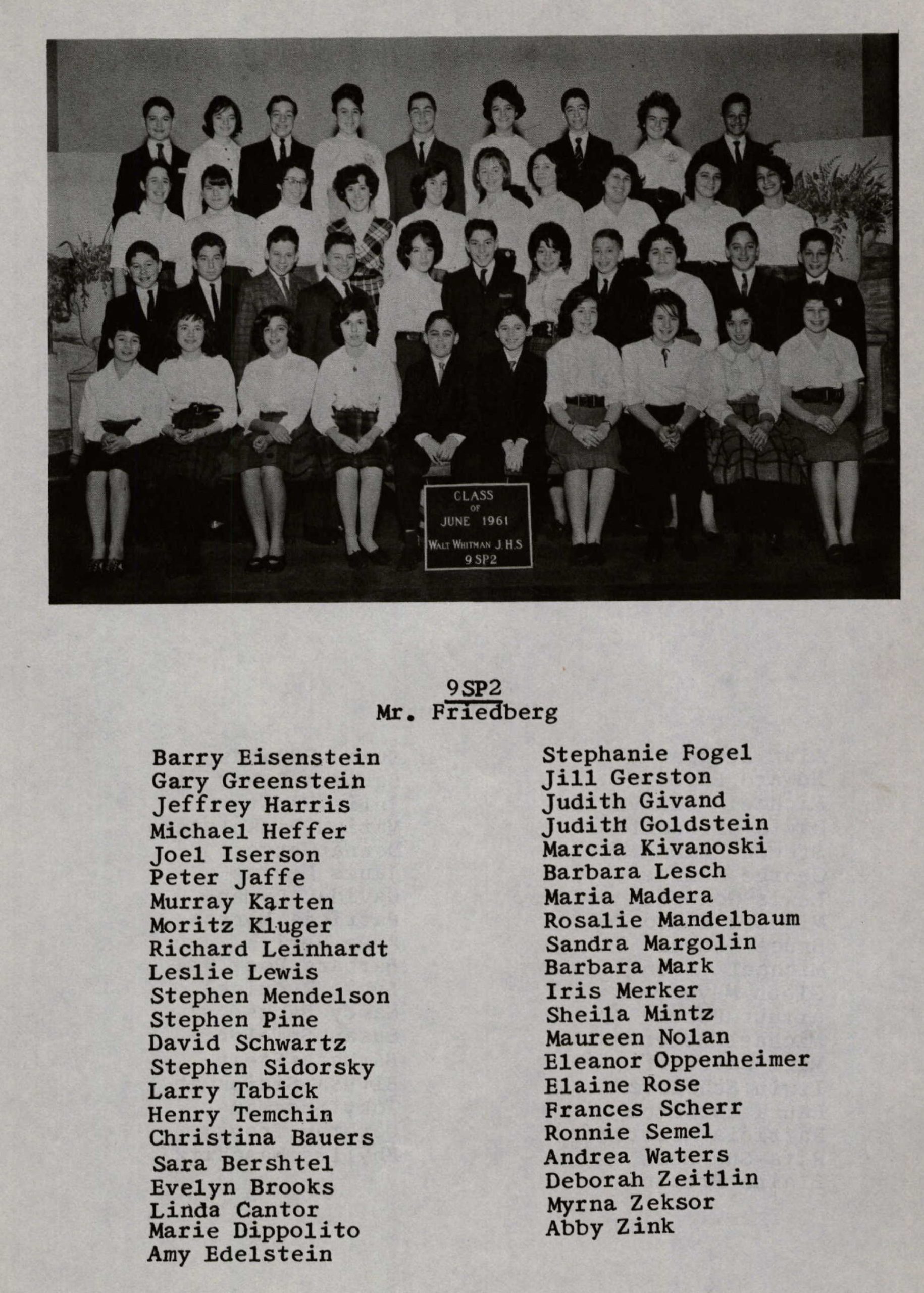
Brooklyn, NY Walt Whitman JHS 1961 Yearbook page
In 1961 students learned how to make things because the U.S.A. was still an industrial society and could actually design and manufacture useful products.
As shown in this 20 minute film, everyone learned about electricity, the elements of printing and participated in the novelty shop; where they could “build things for use and for pleasure.” There was what would now be termed sexism – girls learned millinery work, domestic arts, dressmaking, respect for manual labor and “neatness,” while boys learned the manly arts of metal, wood, print, plastics and electrical wire. But up until the 1970’s gender work roles were applied in most of the fields of employment.
The children were taught “ideas and facts in citizenship, current affairs, history, geography, and government, to appreciate democratic ideals.”
Okay, maybe they were brainwashed.
But compared to today’s middle schools, they got a fine education. Continue reading