Category Archives: New York

Old New York In Photos #44 – Western Union Building & The Day It Caught Fire

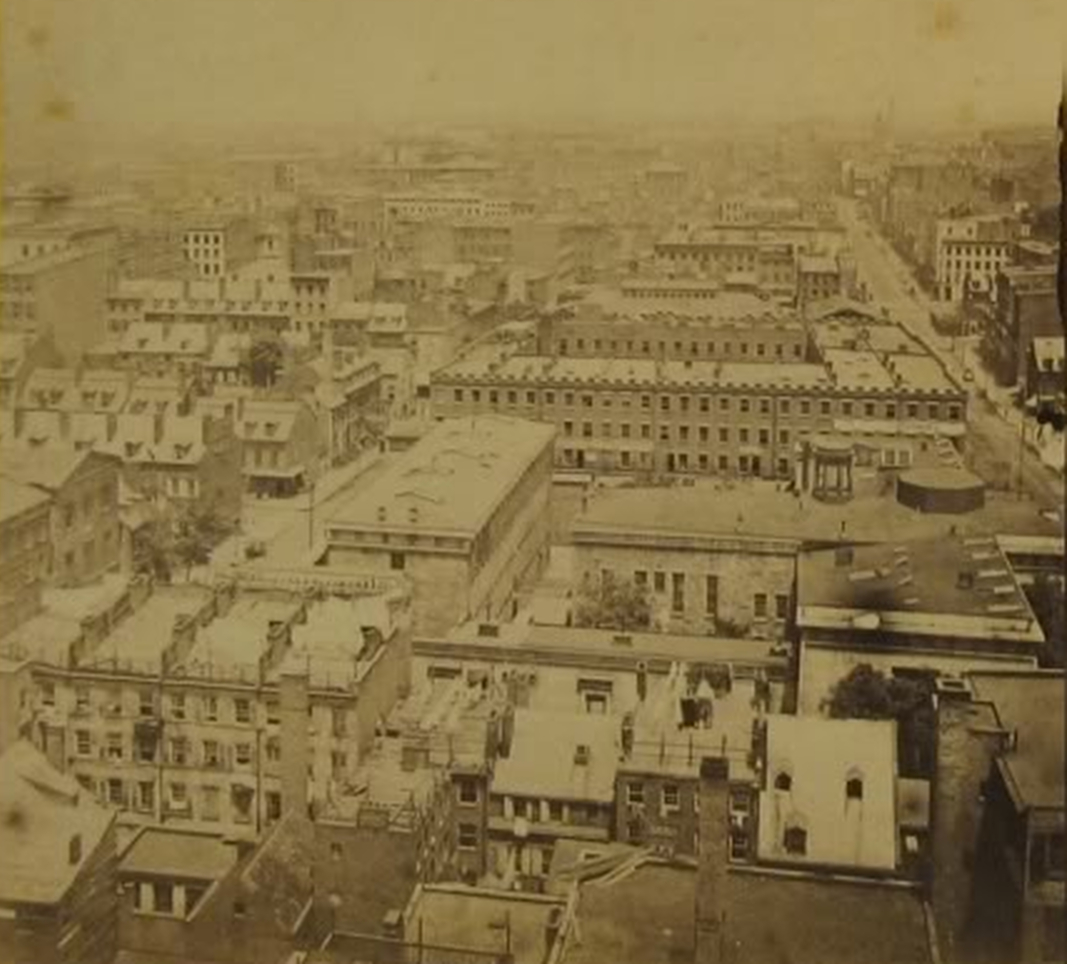
Western Union Telegraph Building – 1880

Broadway looking south Western Union Building 1880This view looking south on Broadway was taken from the Old Post Office in 1880 and shows a deserted stretch of the usually traffic clogged thoroughfare.

On the left in the foreground is the New York Herald Building. The building partially seen on the right side is the Astor House Hotel. Adjacent to the Astor with the columns is St. Paul’s Chapel. The tall structure further down Broadway is Trinity Church with its spire rising 281 feet. This was the highest point in New York until the World Building was built in 1890.

The main building dominating the photo at the corner of Broadway and Dey Street is the Western Union Telegraph Building designed by architect George B. Post. At 230 feet, it was one of the tallest commercial buildings in the city when it was built from 1872-1875. To put this tremendous height in perspective, this was four times the height of the average New York building. On top of the building’s flagstaff a time ball was perched which would drop precisely at noon, so everyone in the surrounding financial area could set their watch to the correct time.

The telegraph was still the predominant way to get a message to someone quickly. To send a telegram with the body message being ten words or less from New York to Baltimore or Boston cost 25¢; to Chicago 40¢ and to San Francisco $1.00.

Western Union Building Fire - New York Evening World

Western Union Building Fire – New York Evening World

A Fire Destroys The Building

As the night shift of telegraph operators and workers was letting out at 6:55 a.m. on Friday, July 18, 1890 the Western Union Building caught fire.

The fire broke out on the 6th floor and quickly spread to the upper floors. Firefighters arrived within six minutes of the first alarm being turned in.

The fire was far above the roof lines of the adjacent buildings and the water pressure from street level could not possibly come close to the fire. The firemen strung several hoses together and carried them up  into nearby buildings on to the roofs to fight the flames.

20,000 people watched from the surrounding streets as the firemen placed ladders from the adjacent building at 8 Dey Street to rescue people trapped in the Western Union Building and pour water on to the upper floors. Continue reading

Things You Should Know If Visiting New York City In 1873

“Thousands of children are imported from Italy each year to turn them into organ-grinders and street beggars.”

12 Helpful Hints And Notes From 1873

Standing on Broadway by New York City Hall circa 1870

A tourist standing on Broadway by New York City Hall circa 1870

From the wordily titled – Wood’s Illustrated Handbook To New York and Environs: A Guide For The Traveller or Resident With Minute Instructions For Seeing The Metropolis In One or More Days Together With Numerous Valuable Hints To Visitors On Nearly Every Topic That Arises Upon The Subject of Sight-Seeing, G.W. Carleton Publishers, 1873, we learn surprising things about New York City.

If you lost something of value in public there was an excellent chance that it would be returned to you.

Saturday was the fashionable day for ladies to attend public entertainments – alone!

Wood’s Handbook’s aim was to point out interesting things about New York City without preaching to the reader.

As the guidebook says;

We think the sight-seer may now be safely left with the “Handbook ” to the guidance of the Index and Map and to his own inclinations and judgment.

He will speedily discover that our object in the preparation of this volume has been not to confuse and weary him by stale remarks and hackneyed observations about this or that, but to put him in a position to see, and admire, and criticize from his own stand-point of taste and opinion. We think the sight-seer requires ready hints, not stupid essays; and if we conduct him to a remarkable locality or a well-known structure, he will not care to have us stand perpetually at his elbow telling him what to admire, and what he ought not to be pleased with.

Since the book contains no “hackneyed observations,” the section called “helpful hints” are what we thought were worth highlighting rather than the sights to be seen.

From among the many listed, we have culled, a dozen of the helpful hints for visiting New York:

1- A GLASS OF BRANDY, in an emergency, can be obtained at any apothecary. No wines, ales, or liquors are permitted to be sold in New York at any bar on Sunday. The guests of a hotel can be served with them, however, at table or in their rooms.

2- ORGAN-GRINDERS and STREET-BEGGARS — Thousands of children are annually exported from Italy to the United States for the purpose of making them organ-grinders and street-beggars, of whom a multiplicity are to be seen in New York. A bill has been brought before the Italian Parliament, designed to put a stop to this disgraceful traffic in children. It punishes with five years’ imprisonment all persons exporting children under twelve years of age to foreign countries, under any pretext. Continue reading

Old New York In Photos #43 – Times Square Advertising Billboards

Giant Times Square Advertising Billboards Of The Past

New York's Times Square at night 60 Years ago, 1954 photo: Charles Shaw

New York’s Times Square at night 60 Years ago, 1954 photo: Charles Shaw

The New York Times article about the new eight story high, block long, LED illuminated billboard that will be put into use on Tuesday night, November 18, 2014, made me think about some of the classic advertising signs that were in place during the 1940’s and 1950’s at the crossroads of the world.

Bond Clothiers sign, 1948, Times Square looking north

Bond Clothiers sign, 1948, Times Square looking north

Chief among these ads was the dramatic Bond Clothiers sign taking up the entire Broadway block between 44th and 45th Streets. The 200 foot wide, 50 foot high billboard was brightly lit up at night and had a waterfall cascading between the two large scantily clad statues flanking it. The figures appeared nude during by day and had electric lights draped around them which produced a quasi-covering effect on the statues when the lights went on.

With two miles of neon, it was a colorful spectacle to behold in person, especially at nigTimes Square 1948 Bond Clothiers at night billboardht. The sign was only up from 1948-1954.

We previously showed what the area looked like at night in our story about the giant New York snowstorm of 1948.

The Bond sign replaced an earlier sign for Wrigley’s Spearmint Gum that also was breathtaking with its neon aquatic design. Designed by Dorothy Shepard, it occupied the site from about 1936 to 1948.

Times Square Wrigleys Billboard sign Ad postcardThe other billboard Continue reading

Brooklyn’s Green-Wood Cemetery Epitaphs

To Be Remembered – Some Thoughts About Inscriptions On Tombstones

Green wood Henry Croatman epitaph 1120840
 
Henry Croatman                                                  Eddie Brewster Croatman 
Born January 17 1845                                                Died Dec. 2, 1878
Died June 4, 1876                                                        Aged 19 Mo’s 26 Days
 
Come view the grave and drop a tear                           Budded on earth
O’er your kind brother once so dear                              To bloom in heaven
Who once delighted in your charms
But now he’s bound in deaths cold arms
 

When wandering around Green-Wood cemetery in Brooklyn I especially take note of  monuments with epitaphs. Rather than gravitate towards the costly and grand monuments that abound in great numbers, I am drawn to those anonymous graves with no known fame attached to them. It is interesting to see how these people, buried long ago, are eulogized in stone.

Green wood John F Abbott epitaph 1100936John F. Abbott
Died Sept. 23rd, 1857
Aged 23 Years and 10 Months
A Good Life Hath But Few Days
But A Good Name Endureth Forever


Many of these monuments mark the last resting spots of common people with unextraordinary lives. But we all have a story to tell. Tombstones try to do that. How can you sum up a person’s life with a few sentences?

Green wood Ann Lee epitaph 1160006A Tribute of Love to
My Dear Wife
ANN LEE
Died Feb. 25, 1887
Aged 58 Years
A fond and faithful wife,
A dear devoted mother,  And a kind friend to all

Without their simple marker and words engraved upon them, these people’s lives would go completely unrecognized. Today, it is hard to fathom that thought, considering all the information that is now collected and shared about us.

Green wood C Ella Ellison epitaph 1120836C. Ella Ellison
Wife of John T. Ellison
Born March 22, 1846
Died December 20, 1900
 
A Loving Daughter,
A Devoted Mother,
A Faithful Wife


Continue reading

This Man Was The Last Immigrant To Pass Through Ellis Island

60 Years Ago – Ellis Island Closes

Arne Petterson last Ellis Island immigrant, 1954 photo: A.P.

Arne Petterson last Ellis Island immigrant, 1954 photo: A.P.

On November 12, 1954 Arne Petterson became the last alien immigrant to pass through Ellis Island, when the busiest immigration station in the United States permanently closed its doors.

Petterson is seen here waving goodbye on a ferry in New York Harbor as he was on his way to be picked up by a friend who would sponsor him for citizenship.

Petterson, 48, was a Norwegian merchant seaman from Narvik who had overstayed his shore leave while in New York. In 1942, during World War II, Petterson survived a German u-boat attack on his ship, the Leiv Eiriksson.

Ellis Island was in operation for 62 years and processed over 12 million immigrants.

World Series Photos Delivered Instantly

Before The Internet, The Quickest Way To Get Photos Back To The Newspaper- Via Pigeon

Walker Cooper Phil Rizzuto pigeon delivers negatives 1942 world series

Walker Cooper, Phil Rizzuto and Private Harry Myers and carrier pigeons, October 4, 1942 photo: New York Journal-American

You would have thought by 1942 there was a quicker way for a newspaper to get photos from one place to another than using a carrier pigeon. Apparently not.

Before game four of the World Series at Yankee Stadium, Private Harry Myers, the Journal-American’s pigeon specialist, shows the Cardinal’s Walker Cooper and the Yankee’s Phil Rizzuto how photographic negatives of the World Series game are sent by pigeon from the ballpark to the newspaper’s offices for same-day publication of the photos.

Amazing.

Maybe it was just the New York Journal-American’s method, as I cannot imagine all the newspapers releasing pigeons during a baseball game.

One Big Reason Baseball Is Dropping In Popularity

Catering To The Next Generation Of Baseball Fans

You may have read that one of the 2014 World Series games was competing for viewers with a Thursday night football game. The television audience for the World Series ended up being less than half of that of the football game.

No surprise there as football has become the dominant televised sport in America. So besides letting World Series games be played at night when the next generation of fans is going to bed, what else is MLB doing to discourage young people from getting to like baseball?

This photograph below will clue you in:

Group Seating Citifield September 2013

Group Seating Citifield September 2013

This photo taken in mid-September 2013 shows a class trip of 12-year-olds at Citifield, the New York Mets ballpark.

It was a beautiful sunny weekday and the Mets and San Francisco Giants were playing for nothing, nada, zilch. Both teams had been eliminated from any playoff possibilities weeks earlier.

Obviously with group seating the Mets gave the kids the best possible seats in the house to get them engaged and interested in the game, right?

Well of course not. Group seats are usually in the farthest reaches of the ballpark and these were no exception, in the corner of the upper deck in right field in section 503.

Now I understand why the Mets and most other teams put group seats in generally undesirable places. These are seats that will usually never be sold, because who wants to pay $15 or more and sit in the stratosphere. The Mets are not going to give $75 seats away for $15 to a group.

But this photograph below shows the kids view of the game and the reality of how many fans were at the ballpark just 10 minutes before starting time.

Citifield 10 minutes before game time

Citifield 10 minutes before game time

It never got much more crowded than this when the game got underway. The announced attendance was 22,897. Everyone there knew that there was no possible way that there were even 12,000 people at this game. The ballpark remained as you see it: thousands of empty seats in huge clusters.

There were schoolgirls sitting on either side of me and both were attending their first baseball game. Being a chaperone on this trip, they asked me questions and tried to watch from our birds-eye vantage point. As the game progressed, with the exception of the few boys who follow baseball, most of the children lost interest rapidly.

For many of the kids who were in attendance this would be the only game they would ever go to because they had no interest in baseball before the game, and were not going to have any interest after the game.

What could the Mets have done?

They should have taken the thousand or so children that were in the four to five large groups seated in the far reaches of the upper deck and moved them to seats anywhere closer to the field. When I actually mentioned this to the Mets personnel man in charge of groups in our section he looked at me like I was crazy and said that was not possible.

It was indeed possible if someone from the Mets ticketing, marketing or publicity department could have had a bright idea and made an executive decision and said something like, “Hey, the season’s virtually over and our ballpark is pretty empty today. You know what might get us more fans in the future? Let’s move these kids down to decent seats so that they will be close enough to be involved in the game. Maybe some of them will come to appreciate and love baseball if they can actually see what is going on up close, rather than watching the jumbotron screen or straining to see the ant-size ballplayers from their mile away seats. This would be a good way to develop a new generation of Mets fans.”

Well that never happened and it probably never will happen. Unless MLB and their teams realize that they are rapidly losing a huge part of their future baseball audience, baseball  will be as popular here as cricket.

Classic Hollywood #35 – Claudia Cardinale & The NYPD

A New York City Cop Takes Exception To Claudia Cardinale’s Dress – 1971

Claudia Cardinale 1971 Streets of NYC 2Disturbing the Peace

New York, NY – A New York policeman is not deterred in his duty as Italian actress Claudia Cardinale turns on her charm in front of Grand Central Station. After telling Cardinale to “move along,” the policeman rubs shoulders with her as he goes his way and she goes hers. Front view of the departing actress shows why he asked her to move. The dress she wore to plug a new movie caused a mid-town traffic jam. (UPI) 8-3-71

Here is how Claudia was causing the traffic jam —

Claudia Cardinale 1971 Streets of NYCI love the men’s faces in the background, while the cop scowls and bumps into Cardinale. For 1971 this mode of dress on the city streets was considered very risque. Today it would barely attract attention, let alone have the police intervening.

A member of the Turner Classic Movie Fan Forum, FrankT65, posted a behind the scenes account of what occurred here.

Frank was responsible for running a publicity junket for Paramount’s The Red Tent starring Claudia Cardinale, Sean Connery and Peter Finch. Here is how Frank describes the event:

We had lots out of town press coming in for a junket and if anything we would have plenty of publicity coverage for the film.

Our VP in charge of marketing was Charles Glenn….a man who believed in the publicity stunt, which had been considered by many to be outdated. I myself loved publicity stunts…it got you out of the office and in with the public where a public relations person belonged. Problem was there were too few stunts you could connect with THE RED TENT. Finally someone came up Continue reading

Old New York In Photos #42 – Central Park Transverses

Central Park Transverses 1863

Central Park Transverse at 79th St looking east 1863

Central Park Transverse 79th St looking east 1863

Central Park Transverse (which one?) 1863

Central Park Transverse (which one?) 1863


Frederick Law Olmstead and Calvert Vaux, the designers of Central Park, had amazing foresight to build transverses through the park so that omnibus, carriage and horse traffic, could get crosstown without disrupting the flow of the landscape. Users of the park today are the beneficiaries of the uninterrupted paths and vistas as automobile traffic crosses the park out of sight and mind.

These two photographs are from stereoviews taken in 1863 by E. & H.T. Anthony & Co. who took some of the best images of mid-nineteenth century New York. They show the recently opened Central Park with little activity and just a few buildings in the background. Continue reading

Old New York In Photos #41 – Park Avenue & 51st Street 1889

Park Avenue And 51st Street 1889

Park Avenue 51st St looking north 1889

In 1886 what had been unglamorous Fourth Avenue above 42nd Street was renamed Park Avenue. This mix of 19th century modernity and bleak landscape is Park Avenue looking north from 51st Street in 1889. You would be hard pressed to find a time today when this busy intersection of New York would be so deserted. There is little activity besides a lone horse and cart on the right side of the incline by the tunnel and a ghostly man in a derby by a boulder in the lower portion of the photograph.

Commodore Vanderbilt reluctantly covered the tracks used by his New York Central & Hudson and New York & Harlem Railroads along Park Avenue from 58th through 99th Streets between 1872-1875. This improvement opened up building possibilities in what had been an undesirable stretch of land with noisy and polluted streets. But from 56th Street to Grand Central Depot at 42nd Street, the tracks had an open cut as seen here. The railroad tracks remained that way until they were finally covered in 1914.

The main building on the right in this photograph is Steinway & Sons Piano Forte  finishing factory, which occupied the entire block on Park Avenue from 52nd to 53rd Streets. According to King’s Handbook of New York City (1892) “There, 500 workmen plain, saw, join, drill, turn, string, fit, varnish and tune the piano works and cases received from the 600 workmen of Steinway, Astoria.”

The Steinway Factory Continue reading