Category Archives: Old New York In Photos

Series: Old New York In Photos

Old New York In Photos #45 – Broadway After Snowstorm 1905

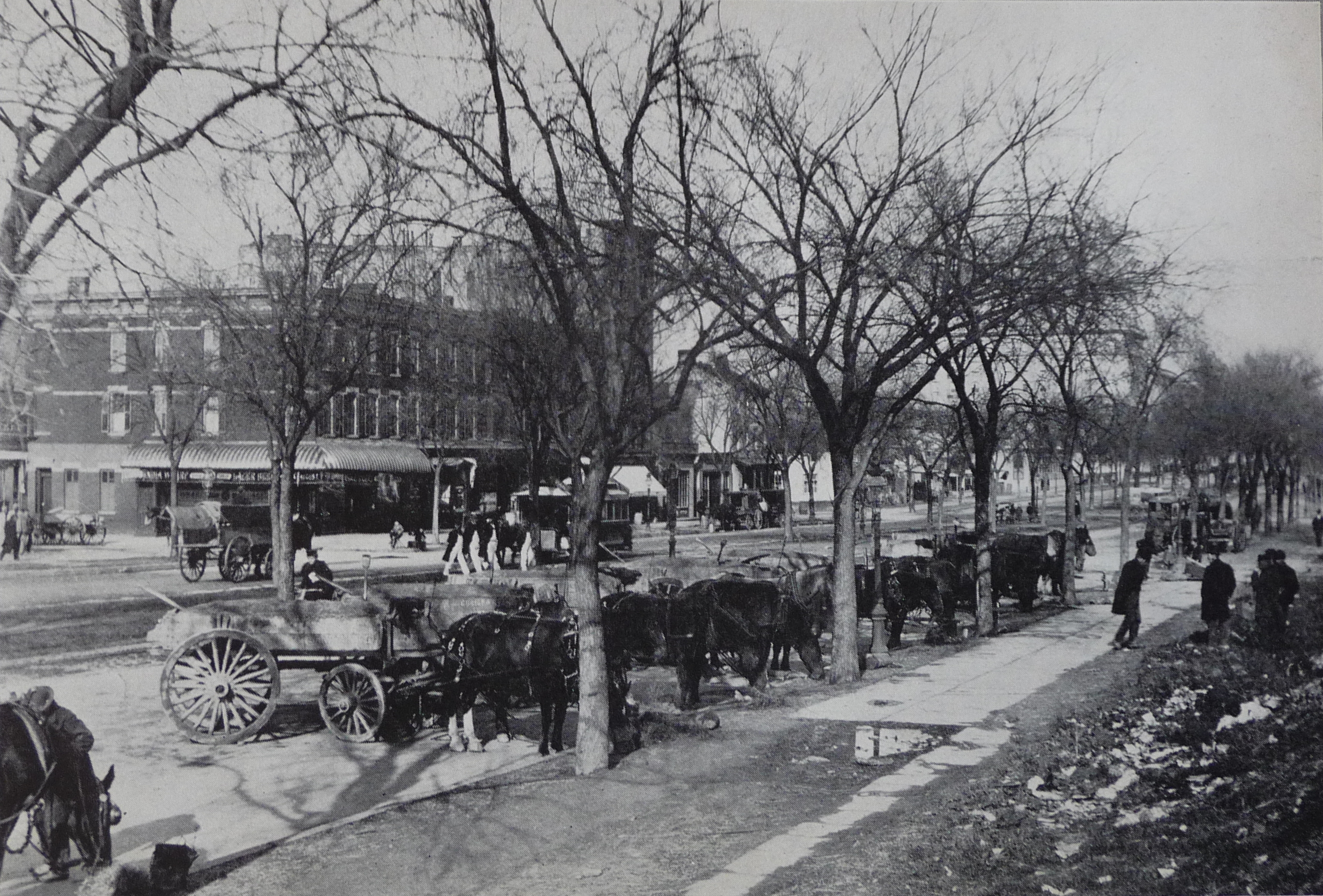
New York City 1905 After A Big Snowstorm – The Sights Along Broadway Between 29th and 30th Streets Described

New York After a Big Snowstorm 1905 ph Detroit Photo Library of CongressSo far New York City has not had a major snowstorm this season like upstate New York received earlier this month. But I dream of New York City days gone by like this one shown above.

In this high resolution photograph (click to greatly enlarge) taken in 1905, the effects of a recent snowstorm can be seen as the snow has been shoveled high onto the edge of the street and sidewalk.

We are looking up Broadway from the northwest corner of 29th Street towards 30th Street. On the extreme left at 1209 Broadway is one of the many United Cigar Stores outlets, a chain store which dominated New York’s tobacco retail industry at the turn of the century. Next door at 1211 Broadway is Marcus & Marcus supplying men’s furnishings.

Across the street at 1204 Broadway an advertisement in the window at ground level announces that the entire stock in their window was purchased by The Maurice Company, a clothing company run by Maurice Rogaliner. The “Broadway Dentists” also had offices in the same building along with Sol Young, Photographer.

Next door to the Maurice Company is Shanley’s Restaurant, owned by brothers Tom and Michael Shanley.

Shanley’s was one of the most famous eateries of the late 19th and early 20th century in Manhattan. With three restaurants, this one at 1210-1212 Broadway was their second location which opened in 1896. As the restaurant guide Where And How To Dine In New York (Lewis, Scribner & Co; 1903) describes it:

Everybody in New York knows Shanley’s and almost everybody has dined at one or another of the three establishments conducted under this name. The management acknowledges but one purpose in the conduct of its restaurants — to make its guests absolutely comfortable and to persuade them that Shanley^s holds the recipe for good cheer. It has taken twelve years to develop the atmosphere which one finds in Shanley’s and during this time the extent of its business operations has been greatly enlarged.   The service at Shanley’s is entirely a la carte. The cuisine is proverbial for its excellence. Chops, steaks, lobsters, game, shell fish and kidneys are among the special attractions of the house.

Next to Shanley’s the building with the initials HB and the crown on its sign is the Hof Brau Haus Restaurant. Continue reading

Old New York In Photos #44 – Western Union Building & The Day It Caught Fire

Western Union Telegraph Building – 1880

Broadway looking south Western Union Building 1880This view looking south on Broadway was taken from the Old Post Office in 1880 and shows a deserted stretch of the usually traffic clogged thoroughfare.

On the left in the foreground is the New York Herald Building. The building partially seen on the right side is the Astor House Hotel. Adjacent to the Astor with the columns is St. Paul’s Chapel. The tall structure further down Broadway is Trinity Church with its spire rising 281 feet. This was the highest point in New York until the World Building was built in 1890.

The main building dominating the photo at the corner of Broadway and Dey Street is the Western Union Telegraph Building designed by architect George B. Post. At 230 feet, it was one of the tallest commercial buildings in the city when it was built from 1872-1875. To put this tremendous height in perspective, this was four times the height of the average New York building. On top of the building’s flagstaff a time ball was perched which would drop precisely at noon, so everyone in the surrounding financial area could set their watch to the correct time.

The telegraph was still the predominant way to get a message to someone quickly. To send a telegram with the body message being ten words or less from New York to Baltimore or Boston cost 25¢; to Chicago 40¢ and to San Francisco $1.00.

Western Union Building Fire - New York Evening World

Western Union Building Fire – New York Evening World

A Fire Destroys The Building

As the night shift of telegraph operators and workers was letting out at 6:55 a.m. on Friday, July 18, 1890 the Western Union Building caught fire.

The fire broke out on the 6th floor and quickly spread to the upper floors. Firefighters arrived within six minutes of the first alarm being turned in.

The fire was far above the roof lines of the adjacent buildings and the water pressure from street level could not possibly come close to the fire. The firemen strung several hoses together and carried them up  into nearby buildings on to the roofs to fight the flames.

20,000 people watched from the surrounding streets as the firemen placed ladders from the adjacent building at 8 Dey Street to rescue people trapped in the Western Union Building and pour water on to the upper floors. Continue reading

Old New York In Photos #43 – Times Square Advertising Billboards

Giant Times Square Advertising Billboards Of The Past

New York's Times Square at night 60 Years ago, 1954 photo: Charles Shaw

New York’s Times Square at night 60 Years ago, 1954 photo: Charles Shaw

The New York Times article about the new eight story high, block long, LED illuminated billboard that will be put into use on Tuesday night, November 18, 2014, made me think about some of the classic advertising signs that were in place during the 1940’s and 1950’s at the crossroads of the world.

Bond Clothiers sign, 1948, Times Square looking north

Bond Clothiers sign, 1948, Times Square looking north

Chief among these ads was the dramatic Bond Clothiers sign taking up the entire Broadway block between 44th and 45th Streets. The 200 foot wide, 50 foot high billboard was brightly lit up at night and had a waterfall cascading between the two large scantily clad statues flanking it. The figures appeared nude during by day and had electric lights draped around them which produced a quasi-covering effect on the statues when the lights went on.

With two miles of neon, it was a colorful spectacle to behold in person, especially at nigTimes Square 1948 Bond Clothiers at night billboardht. The sign was only up from 1948-1954.

We previously showed what the area looked like at night in our story about the giant New York snowstorm of 1948.

The Bond sign replaced an earlier sign for Wrigley’s Spearmint Gum that also was breathtaking with its neon aquatic design. Designed by Dorothy Shepard, it occupied the site from about 1936 to 1948.

Times Square Wrigleys Billboard sign Ad postcardThe other billboard Continue reading

Old New York In Photos #42 – Central Park Transverses

Central Park Transverses 1863

Central Park Transverse at 79th St looking east 1863

Central Park Transverse 79th St looking east 1863

Central Park Transverse (which one?) 1863

Central Park Transverse (which one?) 1863


Frederick Law Olmstead and Calvert Vaux, the designers of Central Park, had amazing foresight to build transverses through the park so that omnibus, carriage and horse traffic, could get crosstown without disrupting the flow of the landscape. Users of the park today are the beneficiaries of the uninterrupted paths and vistas as automobile traffic crosses the park out of sight and mind.

These two photographs are from stereoviews taken in 1863 by E. & H.T. Anthony & Co. who took some of the best images of mid-nineteenth century New York. They show the recently opened Central Park with little activity and just a few buildings in the background. Continue reading

Old New York In Photos #41 – Park Avenue & 51st Street 1889

Park Avenue And 51st Street 1889

Park Avenue 51st St looking north 1889

In 1886 what had been unglamorous Fourth Avenue above 42nd Street was renamed Park Avenue. This mix of 19th century modernity and bleak landscape is Park Avenue looking north from 51st Street in 1889. You would be hard pressed to find a time today when this busy intersection of New York would be so deserted. There is little activity besides a lone horse and cart on the right side of the incline by the tunnel and a ghostly man in a derby by a boulder in the lower portion of the photograph.

Commodore Vanderbilt reluctantly covered the tracks used by his New York Central & Hudson and New York & Harlem Railroads along Park Avenue from 58th through 99th Streets between 1872-1875. This improvement opened up building possibilities in what had been an undesirable stretch of land with noisy and polluted streets. But from 56th Street to Grand Central Depot at 42nd Street, the tracks had an open cut as seen here. The railroad tracks remained that way until they were finally covered in 1914.

The main building on the right in this photograph is Steinway & Sons Piano Forte  finishing factory, which occupied the entire block on Park Avenue from 52nd to 53rd Streets. According to King’s Handbook of New York City (1892) “There, 500 workmen plain, saw, join, drill, turn, string, fit, varnish and tune the piano works and cases received from the 600 workmen of Steinway, Astoria.”

The Steinway Factory Continue reading

Old New York In Photos #40 – View From The Woolworth Building Observatory

A 1920’s View Of Lower Manhattan Looking Northeast From The Now Closed Woolworth Building Observation Deck

Lower Manhattan from Wooloworth building Observatory 1920s

A tourist in the early 1920’s took this panoramic view of lower Manhattan from a place that is currently off-limits to the general public, the observation deck of the Woolworth Building. The visitors observation deck was shut down in 1941 right before the United States entry into World War II, when the Navy ordered it closed because it offered too good a view of ships in the harbor. Recently even the Woolworth Building lobby was declared off-limits to anyone wanting a view inside of the ornamental entrance.

Woolworth Building 1913

Woolworth Building 1913

From this vantage point we can see from right to left the Brooklyn Bridge, the East River, the Manhattan Bridge. In the hazy distance is the Williamsburg Bridge. Spread across the lower east side are an array of many small buildings. There are a couple of exceptions, most notably the tower of the New York City Municipal Building, partially seen on the extreme left in the foreground.

When completed in 1913, the 792 foot tall Woolworth Building at 233 Broadway was the tallest building in the world. The Woolworth Building retained that title until the Chrysler Building usurped it in 1930. Depending upon your source and how you are counting stories, the Woolworth Building contains anywhere between 55 – 60 floors.

For the admission fee of 50¢, visitors could get an incredible view of the surrounding metropolitan area from its observation deck. The tour book the building Continue reading

Old New York In Photos #39 – 14th Street – Klein’s and Ohrbach’s

Union Square Looking East Along 14th Street From University Place – February 1954

The Story Of Department Store Titans Of Union Square, S. Klein and Ohrbach’s

14th st looking east Kleins February 1954

It is a brisk February morning in 1954 and on the left is Union Square Park. But dominating this view in the center of the photograph is what was a magnet for generations of bargain-hunting New Yorkers, the large department store of S. Klein On The Sqaure.

S. Klein’s emblem was a measuring square which can barely be seen under the “KLE” in the KLEIN sign in the photo. The “On The Square” tag line was a play on words in that S. Klein was not only located on Union Square,  but implied that they were fair and honest in their dealings – “on the square.” Continue reading

Old New York In Photos #38 – Fifth Ave. & 44th St. 1923

Fifth Avenue Looking North From 44th Street 1923

Fifth Ave north from 44th st 1923

There is a lot of activity in this photograph taken in 1923 showing Fifth Avenue looking north from 44th Street.

No traffic signals impede the two way traffic which runs on the avenue. A Fifth Avenue double-deck bus is heading northbound packed with passengers. Pedestrians walk along on the avenue while deliveries are being made from trucks, like the one in the lower center of the photograph.

Among the buildings seen are H. Jaeckel and Sons Furriers which occupied the west side corner of Fifth Avenue at 45th street and further in the distance at 48th street is the spire of the Collegiate Reformed Protestant Dutch Church of Saint Nicholas. The church was designed by architect Wheeler Smith and was built from 1869-1872. Theodore Roosevelt and his family occupied pew number number 39. The church was demolished in 1949 and the land was leased to Rockefeller Center.

Old New York In Photos #37 – Riverside Drive 108th Street

Riverside Drive 108th Street – 1894

Riverside Drive 108th St Residence Samuel Gamble Bayne

Left – 360 Riverside Drive, Right -355 Riverside Drive corner of 108th Street, circa 1894- both designed by architect Frank Freeman, both, one time homes of financier Samuel G. Bayne

Viewing Riverside Drive today with its large apartment buildings lining the street, it’s hard to fathom the avenue with any open land and large private homes, but it was only a little more than 100 years ago when dwellings like this dominated the landscape. What is more amazing is that both of these ritzy houses were built for the same man.

Looking east on the south corner of Riverside Drive and 108th Street, the imposing house on the right in the foreground is the formidable residence of Samuel Gamble Bayne, an oil industry pioneer, financier, world traveler, author and President of The Seaboard National Bank.

Samuel G Bayne residence 108th St Riverside Drive rendering Frank Freeman architect

Architect’s rendering 355 Riverside Drive- Samuel Bayne Villa

The large Romanesque Revival villa residence located at 355 Riverside Drive was built from 1890-1891 by architect Frank Freeman who happily called the style “architecture at rest,” because of its massiveness and immobility.

Also built by Frank Freeman is the building to the left of Bayne’s large villa, which was Bayne’s original home at 360 Riverside Drive on the north corner of 108th Street. It was built in 1887 and Bayne lived here for a little over two years. When Bayne desired more space for his growing family, he moved with his wife Emily and their five children to the south side of 108th street to his new villa, selling his original home March 11, 1891 to the Pullman family for $105,000. Continue reading

Old New York In Photos #36 – Grand Central 1909

Grand Central Station – 1909

Grand Central Terminal 1909 Acme

We are looking north on Park Avenue from 41st Street towards Grand Central Station. Grand Central became a “terminal” (end of the line) in 1913 with the completion of the current facility. When passengers disembarked they could hop on the elevated line shuttle which connected Grand Central at 42nd Street with the Third Avenue elevated or go on any one of the many trolley lines as seen in the photograph.

The caption for this 1960 AP News Features photograph showing Grand Central in 1909 says:

Once She Was A Lady

Grand Central Station in 1909 plainly was a bustling rail center – but nothing like what it is today. A $100 million skyscraper is going up on the venerable Park Avenue matron’s back, and the problem of building it reach deep under the terminal’s 48 acres. The new building will be finished in 1962.  Credit-  AP Newsfeatures 11-17-1960

The building the caption is referring to is the Pan Am Building (now known as the MetLife Building) at 200 Park Avenue designed by architects Emery Roth & Sons, Walter Gropius and Pietro Belluschi. Completed in 1962 and opened in 1963, the 59 story building remains an ugly boxy behemoth marring the New York City skyline.