Category Archives: Old New York In Photos

Series: Old New York In Photos

Old New York In Photos #54 – Fifth Ave & 96th Street 1894

Fifth Avenue and 96th Street

96th 5th ave shanties 1894This may seem incredible, but this color photograph is from 1894 and shows Fifth Avenue and 96th Street.

The buildings shown are shanties put up by squatters. Until the early 20th century much of upper Manhattan was undeveloped, enabling the “have-nots” to build on what would soon become the priciest and most desirable real estate in the world .

In 1898 Andrew Carnegie purchased land nearby on 91st Street and Fifth Avenue that he would build his mansion on. 1903 saw Carnegie’s home completed and the tide had turned for the squatters as the land along Fifth Avenue had been bought up by the wealthy. By 1910 almost all of upper Fifth Avenue was developed with a long row of large pretentious mansions.

Old New York In Photos #53 – Looking Down Broadway 1875

Broadway 1875

Broadway looking South Astor House 1875 publisher ThorneThis great view of Broadway looking south from Park Place was taken in 1875 by Thorne & Co. publishers of New York City views. With evidence from the shadows and with virtually no street traffic and few pedestrians, this photo apparently was taken early on a Sunday morning.

On the right hand side of the photo we see a couple of five story commercial buildings populated with local businesses offering sales including a clothing store, a jeweler and a toy distributor. One sign on the side of the stairs offers soda for a nickel.

The next building taking up the entire west side of Broadway from Barclay to Vesey Streets is the Astor House Hotel. Beyond the Astor House is St. Paul’s Chapel, followed by the recently completed Western Union Building. Further in the distance you can see the spire of Trinity Church. Continue reading

Old New York In Photos #52-A – Penn Station At Night 1941

Penn Station And The City At Night – January 1941

Pennsylvania Station seen at night from The New Yorker Hotel January 1941 - photo Underwood & Underwood

Pennsylvania Station seen at night seen from The New Yorker Hotel January 1941 – photo Underwood & Underwood

Every time you see photographs of New York’s old Pennsylvania Railroad Station you have to ask yourself how could this architectural masterpiece be knocked down and carted off piece by majestic piece to the landfill? The answer resided with the owners of the Pennsylvania Railroad and real estate developers who saw the station as a white elephant: filthy; declining train ridership; losing tons of money and impractical as a revenue generator. The land Penn Station sat upon was too valuable to let this monument to interstate travel remain in place. It would be redeveloped as office buildings and the fourth Madison Square Garden put in its place with the railroad station relegated to an unsightly subterranean labyrinth.

Soon after its destruction lasting from 1963 -1966, the city and New Yorkers began yearning for the old Penn Station. All New Yorkers today await a suitable replacement for the modern underground lair we now possess ignominiously called Penn Station.

Look at this panoramic view of Manhattan looking lit up to capacity in January 1941. Here is the original photo caption:

Pennsylvania Station

The electric glamor of New York by night shines out in this shot looking southeast from the roof of the Hotel New Yorker at 34th Street and 8th Avenue.  Directly below is Pennsylvania Terminal, its glass roof aglow. Surrounding it are gleaming office buildings and hotels. No more thrilling metropolitan scene could be recommended to the thousands who arrive at this station daily. The beacon-like light in the background surmounts the Metropolitan Life Building (23rd Street Madison Avenue). credit: Underwood & Underwood,  January 26, 1941

11 months later this photographic view would not be possible because America had entered World War II. The mandatory brownouts (dimming of all lights at night) in American cities blotted out the spectacle of light and cast a protective veil over New York City that would not be lifted until the conclusion of the war in 1945.

editor’s note; We have changed the title of this story to Old New York in Photos 52-A because someone forgot how to count – there were two number 52’s!

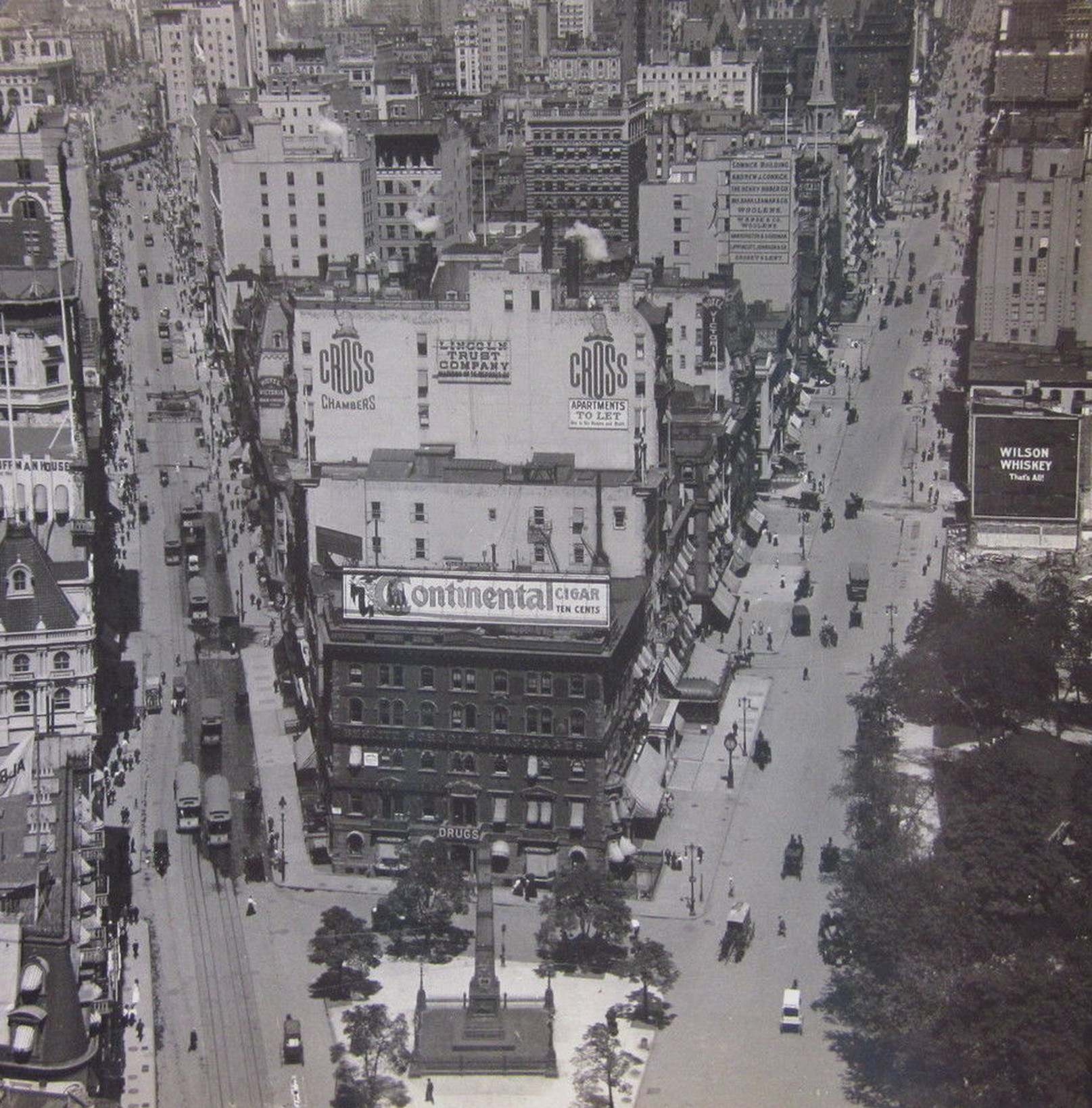
Old New York In Photos #52 – Aerial View Of Broadway & Fifth Ave 1904

Fifth Ave and Broadway Looking North From The Top of the Flatiron Building 1904

Fifth Ave Broadway looking North from Flatiron Building

The Fuller Building known more commonly as the Flatiron Building sits at the convergence of Fifth Avenue and Broadway at 23rd Street. It is a great place to get a nice view of Manhattan, so the Keystone View Company sent a photographer to take this picture on a clear late summer day in 1904. This photo shows the two principal avenues of Manhattan splitting north after 24th street with Broadway branching off to the left and Fifth Avenue on the right.

The streets are busy with horsecars, trolleys and a few automobiles making their way up and downtown as all streets had traffic running both ways. Continue reading

Old New York In Photos #51 – Broadway & The Astor Hotel 1868

Broadway And The Astor House Hotel circa 1868

Broadway with the Astor House Hotel on the left circa 1868

Broadway with the Astor House Hotel on the left circa 1868

We are looking north on Broadway from Barclay Street on what has to be a weekend, as there is hardly any traffic on this normally bustling part of Broadway.

Enlarging the photograph you can see some interesting details. Horse drawn vehicles line up on both sides of the street as a few pedestrians mill about. A glimpse of City Hall Park and its trees can be seen on the right. Architect Alfred Mullett’s main Post Office has not been built yet (1869-1880) and has not encroached upon the southern end of the park, which was sacrificed for that building.

A few gas lamps provide the nighttime illumination for the area. There are also no overhead telegraph wires or poles visible. Surrounding most trees in the foreground are wrap-around wooden advertising placards. In the left hand corner of the photograph is a large ad for the Pennsylvania Railroad, in what may have been the Astor House’s ticketing office.

Besides the interesting view up Broadway, the famous five-story granite Astor House Hotel on the left is the focal point of this photograph. Astor House was built on Broadway between Barclay and Vesey Streets in 1836 by John Jacob Astor. After it opened it was called “the world’s finest hotel.” Presidents and statesmen like Abraham Lincoln, Andrew Jackson, Martin Van Buren, Franklin Pierce, Henry Clay, Daniel Webster and John Calhoun made Astor House their chosen hostelry when visiting New York. Continue reading

Old New York In Photos #50 – Fifth Ave. & 42nd St. c. 1897

Fifth Avenue & 42nd Street circa 1897

5th Ave 42nd Street c 1897By the shadows we can see it is morning on a somewhat chilly day in the heart of Manhattan in about 1897. We are looking north up Fifth Avenue from the corner of 42nd Street. Pedestrians stroll on the flagstone sidewalks while horse drawn vehicles make their way up and down the avenue.

Croton Distributing Reservoir photo: NYPL

Croton Distributing Reservoir photo: NYPL

On the extreme left the small wall with the iron fence marks the perimeter of the Croton Distributing Reservoir also known as the Murray Hill Reservoir, on the west side of Fifth Avenue between 40th and 42nd Streets. Beyond the fence, stood massive walls 25 feet thick and over 50 feet high which when filled to capacity held 21 million gallons of water. The old reservoir served New York’s thirsty population from 1842 until it was taken out of service in 1897. The structure was demolished in 1900 and the main branch of the New York Public Library now stands on the site.

On the same corner we see an old fashioned fire hydrant and new electric lamppost standing next to what appears to be a gas lamp.

Just to the right of the wall a policeman chats another man perhaps a plain clothes detective as they look east across 42nd Street.  The building just behind them is the eight story Hotel Bristol. In 1903 the hotel would be converted to the Bristol Building.

500 Fifth Avenue Building

500 Fifth Avenue Building

After the Bristol was demolished the art deco 59 story skyscraper, 500 Fifth Avenue Building, would go up on the site between 1929-1931. 500 Fifth Avenue was built  by Shreve, Lamb & Harmon the same architects of the Empire State Building, also completed in 1931.

Next to the Hotel Bristol we see a glimpse of the seven story Hotel Renaissance built in the obligatory French Renaissance style and completed in 1891. Though the hotel was designed with the intention of attracting a “high class family and bachelor clientele” there were a certain class of people that were not welcome.

In 1907 Continue reading

Old New York In Photos #49 – Broadway & 80th Street

Broadway & 80th Street 1898 and 1928

What A Difference 30 Years Makes

Broadway 80th 81st Street 1898 photo H. N. Tiemann

Broadway looking north and west between 80th & 81st Streets. 1898 photo: H.N. Tiemann

Up until the late 1800’s Broadway above 59th Street still retained much of its sleepy Dutch ways and was still called the Boulevard which followed the course of the Old Bloomingdale Road. The upper west side neighborhoods had their own unique character which were based upon the villages of Harsenville, Striker’s Bay, Bloomingdale and Manhattanville.

In the photo above from 1898 we see the Boulevard looking north and west from 80th Street with horses lined up along the curb. Building is sparse with low profile two and three story buildings. Commercial structures might contain blacksmith’s, grocery shops and tailors. Open land and farms were still nearby. In thirty years the change would be striking.

Land speculation and the coming of the subway would end the ruralness of the area.

Broadway 80th 81st Street 1928 photo H. N. Tiemann

Broadway looking north and west between 80th & 81st Streets. 1928 photo: H.N. Tiemann

This photograph taken in 1928 from the median of Broadway and 80th Street and looking in the same direction as the previous photo shows that almost everything from 1898 has vanished.

We see automobiles, but no horses. The trees that lined the street are gone and there is quite a bit of pedestrian activity along the street. Commercial stores line Broadway and 80th Street to the west and the north. The white building in the foreground is still standing today and now contains Zabar’s.

Continue reading

Old New York In Photos #48 – Brooklyn’s Fulton Ferry House

Brooklyn’s Fulton Ferry House and Brooklyn Bridge circa 1885

Brooklyn Fulton Ferry House and Brooklyn BridgeThis view captures the newly built Brooklyn Bridge and Brooklyn’s Fulton Ferry House, a beautiful Queen Ann style Victorian building with its ornate mansard roof.

This picturesque scene showing street railways, horse carts, telegraph poles and light fixtures are all vestiges of the 19th century that vanished long ago. The photo was taken around 1885 from the corner of Everett Street (that is the original spelling) and Fulton Street (now called Old Fulton Street) looking north toward Water Street and the Brooklyn Bridge. Besides the Brooklyn Bridge, the small hotel on the corner of Water and Fulton Street on the extreme right with the striped awning, is the only structure in this photo that is still standing.

The service that became the Fulton Ferry began in 1642. The ferry service moved location several times and Robert Fulton inventor of the steamboat, in the 1810’s secured the lease on the land at the foot of Fulton Street for East River ferry service. William Cutting established a ferry line there starting in 1819.

The Brooklyn Fulton Ferry House building was constructed in 1871 by the Union Ferry Company. Called “The Great Gateway to Brooklyn,” the Ferry House was designed by architect William Belden Olmsted a distant relative of Central Park and Prospect Park landscape designer Frederick Law Olmsted.

At a time when fire laws generally prevented construction of any wooden structures, the Ferry House was built of wood rather than iron because the company believed that vapors from the sewage deposited directly into the river and the salt water would cause iron to rust! It was probably more of an economic ploy to save on building costs as iron or brick was much more expensive than wood. The three story building measured 173 feet wide and 35 feet high, with the tower reaching a height of 86 feet and the main floor containing large waiting rooms featuring every modern convenience. Even opting for the cheaper wood construction, the final cost was a lofty $138,000.

As the new Fulton Ferry House building was opening its demise was literally right behind it. The construction of the Brooklyn Bridge which began in 1869 led to an inevitable and slow decline of the viability of Fulton Ferry service.

With the 1883 completion of the Brooklyn Bridge Continue reading

Old New York In Photos #47 – Before The Flatiron Building 1900

Before The Flatiron Building

The Intersection of 23rd Street Where 5th Avenue and Broadway Meet – 1900

23rd Street site of Flatiron Building c 1900 Photo Robert L BracklowThis view of 23rd Street at the intersection of Fifth Ave and Broadway was taken around 1900 by Robert Bracklow. The ornate street lamp and multitude of signs and advertising make this a great street level photograph. There is also something very interesting that I have rarely seen in any late 19th century photo of New York and that is another photographer taking a picture at the same time that this one was taken. He is directly to the left of the street lamp and the tripod is clearly visible while his head is under the covers to line up his shot.

From the approximate direction his camera is pointing, it looks like he is shooting straight up Broadway toward the Worth monument. I’d like to imagine that behind the camera is Joseph or Percy Byron of the famous New York Byron Company.

The famous Fuller Building, better known as the Flatiron went up in 1902 Continue reading

Old New York In Photos #46 – The History of New York’s Shot Towers

Birds-eye View  Of The City From The Shot Tower At Centre Street

And A Brief History Of New York’s Shot Towers

Birdseye View From shot tower Centre StreetThis view of lower Manhattan looking north is from the top of the Centre Street shot tower and was taken in approximately 1870 by E & H.T. Anthony, providers of some of the best 19th century stereoviews of New York.

The view confirms that New York was a low profile city in the 1870’s. The tallest structures in the metropolis were generally churches and their steeples. This view is dominated primarily by three and four story dwellings (some with laundry on clotheslines drying on the roof) as far as the eye can see.

print shot tower Centre Street 1905 Samuel HollyerThe shot tower was 175 feet tall and was built in 1855 by James Bogardus, a pioneer of cast iron building for James McCullough.

Located at 63 Centre Street and bounded by Pearl Street, Worth Street, New Elm Street and Centre Street, the shot tower was operated for many years by the Colwell Lead Company who acquired it from McCullough after the Civil War.

The Centre Street shot tower was octagonal in shape and constructed of brick with 10 iron pillars reaching from the foundation to the top. The base of the tower was 25 feet in diameter, tapering off to 11 feet in diameter at the summit.

Shot towers were among the tallest structures in 19th century New York. They served a necessity in the manufacture of shot ammunition. Molten pig lead would be mixed with arsenic and dropped from the top of the tower through a sieve. The semi-liquid cooled as it fell through the air into a globular shape, and it was caught in a basin of water below. The process would form perfect spherical shot. It was estimated that the tower could produce 15 tons of shot in a day.

As you approached the shot tower the cacophony of sound was described by a contemporary reporter “as if 1,000 sewing machines were at full play.”  If you stood just outside the room where the shot was produced the noise level jumped incrementally to the sound of “100,000 sewing machines now put in full motion.” And if you entered the production room, it was as if  “1,000,000 sewing machines were at work for all they were worth.”

In a strong gale of wind workers described how the tower would sway, not backward or forward but “like a man full of liquor desirous of taking in all the points of the compass at one and the same time.”

According to the superintendent of the lead company, considering the view which could be obtained from the top of the tower there were few requests from visitors to ascend it.

The Centre Street shot tower was razed in 1908. On its site is Thomas Paine Park.

Shot Towers In Manhattan

All the other shot towers that existed in New York are now gone as well.

They included:

A shot tower was located at 261 & 263 Water Street operated by Continue reading