Category Archives: Music

Jim McCrary, Rock Photographer Dies at 72, Famous For Carole King Tapestry Photos

Jim McCrary Photographed Over 300 Album Covers For A&M Records

Cover Photograph to Carole King’s Tapestry Album

Jim McCrary who will be remembered for taking in 1971 one of the most iconic album cover photos in music history, Carole King’s Tapestry, died  at the age of 72 on April 29, 2012 of complications from a chronic nervous system disorder at the Veterans Affairs hospital in Palo Alto, CA.

Jim McCrary self-portrait 1978

McCrary was a self-taught photographer beginning his career in 1952. He worked for many years as staff photographer for several portrait studios and in the photography department of Rockwell International during the 1950’s and 1960’s. McCrary joined Herb Alpert’s and Jerry Moss’ A&M Records in 1967 as chief photographer. For the next seven years he photographed most of A&M’s albums, publicity and advertising work.  Among his better known images are of Joe Cocker, Cat Stevens, Gram Parsons & The Carpenters.


McCrary left rock photography in the late 70’s after he felt he had lost touch with the music of the bands he was working with.  His work won many awards from the Los Angeles & New York Art Directors Clubs, and appeared in several “Best” Album Cover books.

McCrary shared his talent and taught at the Art Center College of Design in Pasadena. Tom Upton, who was once a student of McCrary’s in the 70’s said “…he was magnanimous and kind. He expected hard work and absolute transparency when reviewing work. He was the antithesis of the celebrity photographer as guru, popular at the time. He required no fealty or brown-nosing, just honesty and plain backgrounds so you had to engage your subject. He taught us about hard light and soft light in a portrait, and what the consequences were.  You, the subject, the light, and no bull.  His assignments were affectionately termed ‘McCrary Portraits’ by his students.”

Survivors include his son Jason McCrary and two brothers Wylee Dale McCrary and Doug McCrary.

To read the story about how Carol King’s Tapestry photo shoot unfolded, click here.

When Lyrics Meant Something – Crosby, Stills, Nash & Young and “Ohio”

May 4th Marks the Anniversary of Four Kent State University Students Murdered For Protesting The U.S. Invasion of Cambodia and the Vietnam War

Do today’s songs have meaning?

One of the things I am confronted with in the 21st century is the degraded state of music today, especially lyrically. Do people really listen to the lyrics of songs and give them any serious thought?  Or are the majority of songs being written not worthy of deep examination?

In the 1960’s and 70’s music listeners certainly did pay attention to the words being sung. They pored over lyric sheets which were inserted into LP albums with artwork that was meant to be contemplated, pondered, discussed, interpreted and argued over. Beginning with the shift to CD’s in the late eighties with their micro-printing of lyrics Continue reading

Subway Song

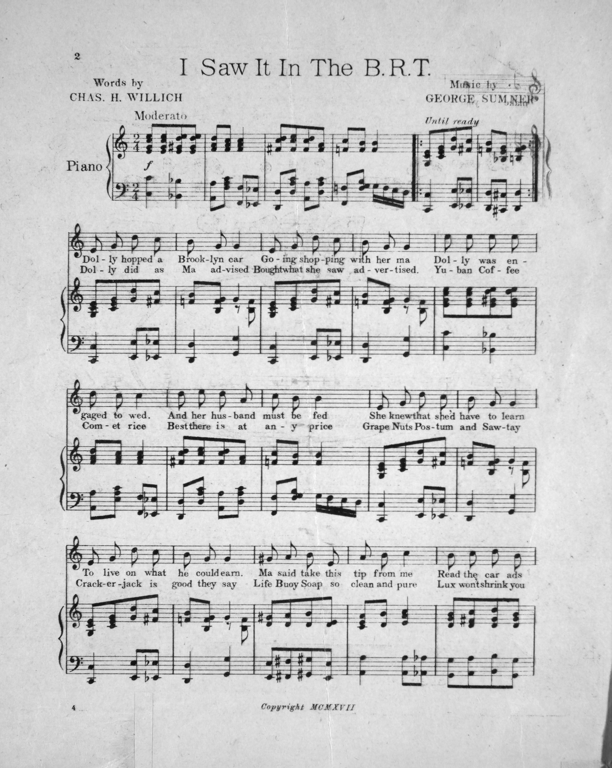
“I Saw It in The BRT”

An ode to the subway.

This 1917 ditty was written about the BRT (Brooklyn Rapid Transit System), which was the former name to the BMT (Brooklyn Manhattan Transit System).  The words which extoll the virtues of the advertising you would see on the train were written by Charles H. Willich and the music by George A. Sumner.

It is amazing how many products mentioned in the song are still around from almost 100 years ago: Grape Nuts, Wrigley’s Gum, Cracker Jacks, Aunt Jemima Pancake Mix and many others.

New Yorker’s have no more BRT, BMT, IND (Independent) or IRT (Interboro Rapid Transit). Now we just call it the subway, run by the oligarchal fiefdom called the MTA (Metropolitan Transit Authority).  And most of the ads you see are for acne treatments, learning English, and filing lawsuits.

Lyrics can be read here (click to enlarge):


Outtake Photos From The Sexiest Album Cover of The 1960’s

Dolores Erickson on Whipped Cream and Other Delights

The cover is the stuff of teenage dreams and yearning of older men to return to their youth.  Innocence and come-hither looks wrapped into one alluring package.

If an album cover ever helped to sell mega amounts of copies, this was it. Herb Alpert and the Tijuana Brass, certainly benefited from the album design of  A&M art director Peter Whorf, and model, Dolores Erickson, gracing the cover of Whipped Cream and Other Delights.

The iconic album cover, which is best appreciated in its full 12″ x 12″ vinyl incarnation, can still be found for sale at many thrift shops, flea markets and garage sales for a couple of dollars.

The album released in 1965, went to #1 on the Billboard pop music charts and ended up selling over six million copies over the years.

Was it based on the music? While it is a good album of instrumentals, I am positive that the provocative cover Continue reading

Book Review: A Penny From Heaven

A Penny From Heaven by Max Winkler  (Appleton-Century-Crofts, Inc 1951)

Anyone suffering through the trepidation of an uncertain job market and being out of work with no savings, would find comfort and inspiration by reading Max Winkler’s, 1951 autobiography and ode to America,  A Penny From Heaven.

Even for those not being in the same circumstances, Winkler’s book is a page-turning, lively recreation of the United States at the dawn of the twentieth century.  Achieving the American Dream and leaving behind the “old country” forever, was the goal of millions of ignorant, poor and helpless European immigrants and Winkler conveys the struggle as well as any writer ever has. Continue reading

Ritchie Blackmore Explains The Origin of Some Of Deep Purple’s Greatest Songs

Is Anything Original?

In this fascinating interview with guitarist Ritchie Blackmore, he briefly explains and demonstrates how he came up with the riffs to some of Deep Purple’s greatest songs, including Mandrake Root, Black Night, Speed King, Smoke On The Water, Lazy and Highway Star.

Musicians and public alike look at Blackmore and see a complicated and private man who has an immense talent for songwriting.

What Blackmore acknowledges in this interview (which I wish was complete) is that previous works by others can play a big part in your own creativity.

Inspiration can come from anywhere. From Mozart to Jimi Hendrix.

UPDATE 2025

Unfortunately the original video was taken down> Here is a truncated version where Blackmore discussion of Mandrake Root and Lazy have been edited out.

But  below that we have added Blackmore discussing Child In Time. A song that was clearly “borrowed” from the band, It’s A Beautiful Day.


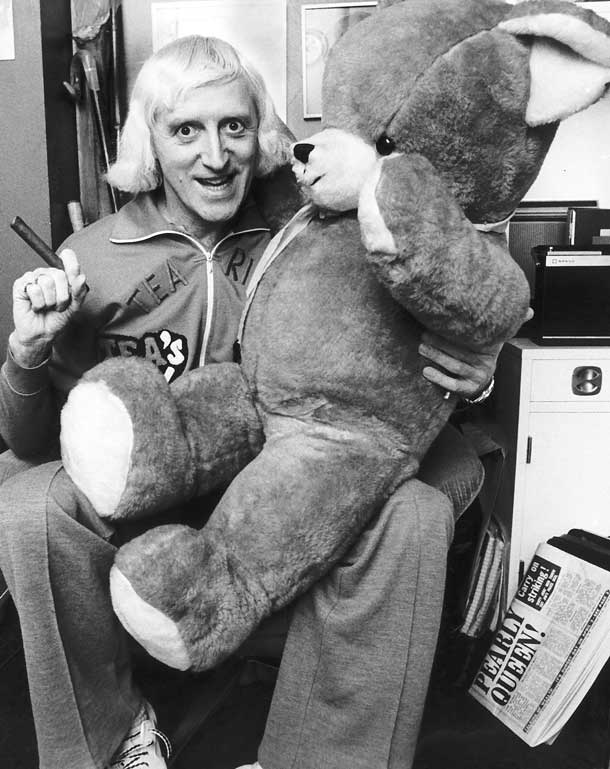
Jimmy Savile, Long Time “Top of the Pops” Host (& Pervert) Is Dead at 84

Jimmy Savile, Zany British TV Host & PERVERT
(see update at end of article.)

Jimmy Savile was found dead at his home in Leeds October 29. He was just two days shy of turning 85.

In the United States Jimmy Savile is a relatively unknown name except to die-hard music fans or those who might have spent time in the United Kingdom.

In the UK you could not help but know Jimmy Savile. For twenty years, from its inception in 1964, Savile hosted Top of the Pops, a television music countdown show featuring hit singles.   Think of a British version of a cross between Casey Kasem’s radio program American Top 40 and Dick Clark’s television show American Bandstand and that was, Top of The Pops. Savile ended his reign as a regular host in 1984. Continue reading

Who is Strider? The Bron-Y-Aur Stomp Dog

Led Zeppelin’s Robert Plant With His Dog Strider

For those of you who are big Led Zeppelin fans you already know that the song Bron-Y-Aur Stomp off of Led Zeppelin III is about Robert Plant’s dog Strider. Here’s a photo of the pooch in question with his somber companion. Interestingly the song was misspelled on the original album: it was supposed to read Bron-Yr-Aur Stomp.

Listen to: Bron-Y-Aur Stomp live from the Led Zeppelin live album How The West Was Won

Lyrics: Continue reading

Did That Song Just Make Fun of Stuttering?

Speech Impediments Were Fair Game For Early Songwriters

Forget The Who with “My Generation” or David Bowie with “Changes.” Stuttering lyrics were once blatant and over the top. Unlike today where some songs contain stuttering verses,  100 years ago, the stuttering was in the title or subtitle.

In 1907 an imaginative songwriter said to himself, “Hey. I’ve got an idea, I’ll write a song about stuttering, it will be a smash!” But he thought it over, “Hmmm,  that’s been done already. What if I added something about having a lisp?”Maybe that is the way the smash hit, The Boy Who Stuttered and The Girl Who Lisped by Louis Weslyn came to fruition.  Two speech impediments are better than one.

Today it seems politically incorrect (and in bad taste.) If songs like this were being produced today, protesters would be lining up to have the songs banned.

Back then, nothing was thought of it; a stutter or lisp would make perfectly acceptable lyrical content. The more outrageous the lyric, the better. Click here to listen to the song performed in 1908 by Billy Murray and Ada Jones.

The unusual thing is that Billy Murray seemed to be very good at fake stuttering and recorded one of the most popular stuttering songs of all-time, K-K-K-Katy “the sensational stammering song success” written by Geoffrey O’Hara in 1917. When you hear Murray’s rendition of K-K-K-Katy in the vocal break towards the end, you will be reminded of Mel Blanc, the famous Warner Brother’s cartoon voice of Porky Pig and Bugs Bunny, Daffy Duck etc. etc.) . You can be sure Blanc took a page from Murray to create Porky’s stammer as Blanc later recorded his own version of K-K-K-Katy.  Click here to listen to Murray’s K-K-K-Katy.

And while Murray was an accomplished early recording star and performer, and could sing in other styles, he recorded another stuttering song in 1922, You Tell Her I S-T-U-T-T-T-E-R which was written by Billy Rose and Cliff Friend. Continue reading