Category Archives: Commentary

Graffiti As Vandalism, Not Art

Museum of The City Of New York Graffiti Exhibition Doesn’t Show What The Majority Of Graffiti Is – Unintelligible Scrawls By Vandals

I caught the newest exhibit at The Museum of the City of New York entitled “City as Canvas,” which glorifies the practitioners of graffiti and their “work” during the 1970’s and 1980’s in New York City.

For anyone who thinks that graffiti is something to be celebrated in a retrospective by an exhibition at an important cultural institution, here is some evidence to contradict that viewpoint.

Iouri Podladtchikov, Olympic half-pipe king visits the lower east side with typical graffiti defacing a grand old building. photo - Casey Kelbaugh for the New York Times

Iouri Podladtchikov, Olympic half-pipe king visits the lower east side with typical graffiti defacing a grand old building. photo – Casey Kelbaugh for the New York Times

A typical display of current graffiti “art” as seen in this building covered by spray paint on the lower east side really is a better representation of the so called graffiti artist. It pains me to see old handcrafted stone buildings covered with paint. The beautiful Queensboro Bridge girders and stonework are always being cleaned and re-painted due to these miscreants who attack our public property with their spray cans, markers and etching knives.

Subway graffiti photo taken Feb 8, 1982

Subway graffiti photo taken Feb 8, 1982

The onslaught of graffiti began in earnest in the subway system in the 1970’s where riding a train was a demoralizing prospect. Almost every single car was covered in dripping unintelligible paint and marker scrawls, which obliterated any blank spaces. Continue reading

Book Review – Yorkville Twins

Twins Grow Up In An Exciting, Post-WWII New York City

Yorkville twins coverIf there were more books like Yorkville Twins we would have a clearer picture and better understanding of what it was like for the everyday existence of ordinary people living in Manhattan in post-war New York City. Twins Joseph G. Gindele and John F. Gindele, weave funny, touching and poignant stories of growing up in Yorkville on the upper east side of Manhattan from 1944-1962 with their three siblings and immigrant parents.

Unlike many New York memoirs written by famous or infamous personages who lay their memories of privileged upbringings or Dickensian struggles in print, the Gindele’s recount the daily experiences of middle class family life in a New York that has now largely vanished. This is the New York of cobblestone paved streets where the milkman and the iceman made deliveries with horse drawn wagons. Pushcarts sold vegetables and kids played with erector and chemistry sets and took the time to cut out the backs of cereal boxes and  redeem them in the mail for prizes. Continue reading

Vanishing America: An Old Fashioned Style Candy Store – Ojai, CA

Kingston’s Candy Company: A Candy Trip Down Memory Lane

Kingston's Candy Co. Interior

If you are ever near Ojai, about 85 miles north of Los Angeles, Kingston’s Candy Co. is worth a visit, even if you don’t crave sweets.

When I first visited Ojai, California around five years ago I kept wanting to pronounce Ojai, “O.J.” as in O.J. Simpson. It is pronounced Oh Hi.

Kingston's Candy Co. ExteriorThe reason for my initial visit to Ojai was Bart’s Books, a unique used book store that is mostly outdoors. Walking along East Ojai Avenue, the main street of Ojai’s small downtown area with its quaint shops and restaurants, you will eventually stumble upon Kingston’s Candy Co..

Walking into Kingston’s you will discover an unpretentious, real candy store, the kind that used to flourish in every neighborhood in every metropolitan city until the 1960’s.

Kingston's Candy Co. Standard CandyThe prices are about on par with supermarkets for the regular candy such as M&M’s, Kit Kat’s, Milky Way’s, and other standard fare. What makes Kingston’s unique is that it has a lot of older candy brands that were popular years ago and you thought might have vanished forever. Confections like Sugar Daddy, Whatchamacallit’s, Coconut Alice’s, Good n’ Plenty, Teaberry, Glee, Hubba Bubba and Gold Mine Chewing Gum, and dozens of other candy’s, gums and sugar based sweets line the small shop. Continue reading

25 Incredible Real Names

Crook Klutz (1913-1979) and 24 Other “Unique” American Names
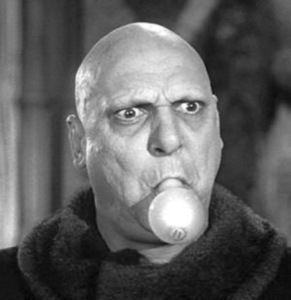
Uncle Fester (Jackie Coogan)

A useful tool for genealogists, the Social Security Death Index (SSDI) contains over 92 million death records for individuals with United States Social Security numbers. There are many portals to give you access to the list. On some web portals for the SSDI you can enter just the first name, which can yield interesting results.

Either their parents thought they were being funny or in some cases they were just cruel. Maybe the person had their name legally changed. Who knows.

Besides Crook Klutz, the ones that stood out in no particular order:

24. Dummy Boy 1896-1969 (Not a name you’d want to call out in public.)

23. Hitler Johnson 1933-1986  (Nice. Definitely a way to distinguish yourself from the other Johnson’s in your town.)

22. Uncle Caves 1911-1977

21. Strange Amos 1884-1966 (How did the parents know?)

20. Fatty Claw 1884-1973

19. Lurch Williams 1906-1979 (The only person ever named Lurch.)

18. Danger Dangervil 1943-2005

17. Weird Adkins 1917-1964

16. Shitley J. Metcalf  1949-2012 (No way.)

15. Poison Repp 1913-1964

14. Phony Brooks 1903-1966 (Did Phony have a hard time making friends?)

13. Murder Williams 1926-1983

12. Fester King 1896-1971 [also another Fester King 1915-1974, Senior and Junior perhaps?]  (Everyone should have an Uncle Fester.)

11. Flipper Butts 1919-1975 (Perfect name for the adult entertainment industry.)

10. Moron Bobo 1896-1974 (The last name alone would probably lead to a difficult life, adding the first insures it.)

9. Jack Ass 1958-2003 (Could have had a franchise on that name.)

8. Hernia Dalton 1906-1976 (Ow.)

7. Very Bland 1979-1999

6. Big Wife 1888-1982

5. Funny Smith 1919-1986 (Was he? Or is “Funny” a she?)

4. Zoo Parks 1897-1981

3. Will Moron Read 1927-1989 (I don’t know. How did he do in school?)

2. Pimp Freeman 1893-1983 (That is kind of cool in a weird way.)

1. Jesus Christ 1941-2007.  (Guess you missed him. He was here. I’ve always wondered if Jesus were to return would anyone recognize him? Apparently not.)

The Greatest TV Game Show Ever

What’s My Line 1950 – 1967

Whats-My-Line-Cast-Dorothy-Kilgallen-death-November-8-1965 cr

A few years ago my Tivo was tuned into the Game Show Network weeknights at 3:00 a.m., taping every episode of the greatest TV game show ever made, What’s My Line.

Let me state it was not just a great game show, but one of the best television shows ever.

Unfortunately the series is not being broadcast now, but many segments of the show are available on Youtube.

To describe the brilliance of the show better than I ever could, we will refer to The Complete Directory to Prime Time Network TV Shows 1948 – Present by Tim Brooks and Earle Marsh (Ballantine 1988), an indispensable television reference book.

What’s My Line was the longest-running game show in the history of prime-time network television. It ran for 18 seasons, on alternate weeks from February to September 1950, then every Sunday at 10:30 p.m. for the next 17 years. The format was exceedingly simple. Contestants were asked simple yes-or-no questions by the panel members, who tried to determine what interesting or unusual occupation the contestant had. Each time the contestant could answer no to a question, he got $5, and a total of 10 no’s ended the game. The panel was forced to don blindfolds for the “mystery guest,” a celebrity who tried to avoid identification by disguising his voice.

That little game, by itself, hardly warranted an 18-year run, when other panel shows of the early 1950’s came and went every month. But What’s My Line was something special, both for the witty and engaging panel, and for a certain élan which few other shows ever captured. There were no flashy celebrities-of-the-moment or empty-headed pretty faces on this panel; they were obviously very intelligent people all, out to have some genteel fun with an amusing parlor game. Like (moderator) John Daly with his bow tie and perfect manners, it reeked of urbanity [“that’s three down and seven to go, Mr. Cerf?”]

The panelists who created this special atmosphere were an elite group. Continue reading

The Difficulties Of The Used Book Store Business

Thinking Of Opening A Used Bookstore? “Don’t Do It!” Advises Bookseller Greg Gibson

Interior of Iliad Bookshop North Hollywood California

Interior of Iliad Bookshop North Hollywood California

Greg Gibson, the owner of the Ten Pound Island Book Company wrote about his nearly 40 year odyssey in the world of second hand books and used book stores in an excellent article called “Don’t Do It!” published here. You don’t have to be interested in collecting or  the book business to enjoy this very well written story.

Many people who love books, daydream about setting up a second hand book shop. Not the paperback emporiums or remainder stores that dot many towns throughout the country, but a real general used book store where when you walk in there is an aroma of old books and the possibility that a customer will find a long sought after treasure.

Running a used book store is a profession that will not make you rich and runs counter-intuitive to the notion that publishing is in a perpetual state of decline and printed books are dying.

Used bookstores that keep regular hours that are open to the public are called open shops. Where there were literally thousands of open shops in the United States twenty years ago,  there are about 1,000 in existence today, victims of a combination of an aging populace; both proprietors and collectors/readers, changing technology and rising rents.

Fewer people have the opportunity to apprentice in a used book store and get the experience necessary to open their own book business. Barely making enough money to survive also discourages many young people from considering books as a career. This is why it is mostly retirees who will entertain the book store notion as a career. The internet has changed the pricing structure for used books and many people who deal in used books do so via mail order through the internet or by eBay without a thorough knowledge of books.

While not completely a warning against going into the book business, the article does describe the lessons Gibson took many years to learn. If you still have dreams of running a used book store, you can get some valuable advice from Gibson before you start on your venture.

Prophetic Words About Lying Politicians From T. De Witt Talmage

Our 21st Century Dysfunctional Politicians Accurately Described

DeWitt TalmageHe described our lying politicians better than anyone today could have. And he did it 140 years ago.

T. De Witt Talmage (1832-1902) was a sanctimonious Brooklyn preacher who attained a huge following in the 19th century as an orator and prolific author. Overflow crowds attended his Sunday sermons at The Brooklyn Tabernacle.

Talamge's Brooklyn Tabernacle courtesy New York Public Library

Brooklyn Tabernacle


While many people were quite enthralled by Talmage, there were just as many critics who called him a “pulpit clown” and a “mountebank.”

As would be expected from any of the crusading Victorian holy rollers, Talmage railed against vice and crime in his writings and firebrand speeches. His verse contains the typical road to ruin warnings that make reading his books unbearable today. However, Talmage did manage to string together some words that still ring true. Especially about lying.

If you didn’t know any better, you would swear that Talmage is describing our modern day politicians. This short passage is from 1872.

LIES: WHITE AND BLACK.

Abominations of modern Society Talmage

There are ten thousand ways of telling a lie. A man’s entire life may be a falsehood, while with his lips he may not once directly falsify. There are those who state what is positively untrue, but afterwards say, “may be,” softly. These departures from the truth are called “white lies;” but there is really no such thing as a white lie. Continue reading

Mutilating The Main Branch Of The New York Public Library

Who Cares That New York’s Landmark Library Is About To Be Marred As Part Of A Sweetheart Land Grab Deal?

Library Protest1 May 8

Who cares? Apparently less than 100 people.

That is about the number of protesters who showed up on Wednesday, May 8 to try and bring about public awareness of the decision by the trustees of the New York Public Library to catastrophically alter one of New York’s greatest buildings, the main branch of  The New York Public Library at Fifth Avenue between 40th and 42nd street.

Library Protest4 May 8As the stoic group held up signs to the passing throng on Fifth Avenue, some pedestrians slowed or took photos, many just walked by without notice.

The group was protesting the closed door deal that will sell off the land and buildings of two libraries, the Mid-Manhattan branch at 40th Street and Fifth Avenue and the Science, Industry and Business Library at 34th Street and Madison Avenue. Their operations would be condensed and the main library would be remodeled into a circulating library in addition to being a research library. The main library would then store 3.5 million books off-site in New Jersey. This defeats the entire purpose of the building: to be a first-class, on-site repository of research materials critical to tens of thousands of patrons.

Library Protest2 May 8The small group of protesters was comprised of mostly older people. It is true that this was a weekday afternoon, but there were maybe ten people under the age of 40 in attendance and one or two in their teens. Continue reading

Mia Kovacs And Her Bible

It Went Unsold

Portraits Mia Kovacs and Bible Heritage Auctions

Heritage Auctions had Mia Kovacs bible on the auction block on February 21, 2009. There were no bidders.

The bible and portrait pictured above were consigned as part of the estate of Mia’s mother, Edie Adams, the wife of comic genius, Ernie Kovacs. There were many awards, photos, props and autographs that were available to be bid upon belonging to Ernie and Edie. This item was the only one connected with Mia.

While not passing judgment, I understand de-cluttering and getting rid of “things” that have no sentimental or other value to family members. After all you can’t keep everything that was passed down by a family member. Since it went unsold in the auction, hopefully the book was given to one of Mia’s friends rather than discarded.

Today, May 8 marks the 31st anniversary of Mia’s death in a car accident at the age of 22.

Five 1970’s Rock Songs About Losing Your Virginity

Those Naughty 70’s Songs

Raspberries Go All The Way coverRock lyrics tell stories. Many times those stories are about love. Often they are about sex. Rarely are they about virginity. If they are, the lyrics are cloaked in the language of teenage angst. In the 1970’s bands that would sing about losing your virginity were pushing the boundaries.

For a band to get radio airplay which was a key to sales, they had to carefully construct a song so that they did not arouse the suspicions of the parents of “impressionable” kids. This means the lyrics were not too lascivious or explicit.

These five songs exemplify the “losing it” genre of the 70’s.

1. Foreigner – Feels Like The First Time

Foreigner likes songs with the theme of first time sex. Feels Like The First Time was just part of a trio of songs that play on the whole virgin thing; Urgent (which some people misheard as Virgin) and I Want To Know What Love Is also cover the virginity field.

I liked Feels Like The First Time when it was originally released. It is a very catchy song with a good hook, as are most of the early Foreigner songs. But Feels Like The First Time comes off today a little schmaltzy with lines like “And it feels like the first time, like it never did before (ooh-ooh ooh-ooh oooh), Feels like the first time, like we’ve opened up the door, feels like the first time, like it never will again, never again.”

2. Meat Loaf – Paradise By The Dashboard Light

Probably the most overt and famous rock song about losing it. Graphically described and all rolled up in a mini rock opera. When I hear this song today all I can think of is that every teenager in New York in the 1970’s had a copy of this album in one form or another LP or cassette. If you are ever at a flea market and see a bunch of 8 track tapes I can practically guarantee that this album will be among the stash.  A brilliant stroke of this song was to have Yankees announcer Phil Rizzuto do the “play by play” of getting “from base to base” in the middle break. Continue reading