Category Archives: Books

Prophetic Words About Lying Politicians From T. De Witt Talmage

Our 21st Century Dysfunctional Politicians Accurately Described

DeWitt TalmageHe described our lying politicians better than anyone today could have. And he did it 140 years ago.

T. De Witt Talmage (1832-1902) was a sanctimonious Brooklyn preacher who attained a huge following in the 19th century as an orator and prolific author. Overflow crowds attended his Sunday sermons at The Brooklyn Tabernacle.

Talamge's Brooklyn Tabernacle courtesy New York Public Library

Brooklyn Tabernacle


While many people were quite enthralled by Talmage, there were just as many critics who called him a “pulpit clown” and a “mountebank.”

As would be expected from any of the crusading Victorian holy rollers, Talmage railed against vice and crime in his writings and firebrand speeches. His verse contains the typical road to ruin warnings that make reading his books unbearable today. However, Talmage did manage to string together some words that still ring true. Especially about lying.

If you didn’t know any better, you would swear that Talmage is describing our modern day politicians. This short passage is from 1872.

LIES: WHITE AND BLACK.

Abominations of modern Society Talmage

There are ten thousand ways of telling a lie. A man’s entire life may be a falsehood, while with his lips he may not once directly falsify. There are those who state what is positively untrue, but afterwards say, “may be,” softly. These departures from the truth are called “white lies;” but there is really no such thing as a white lie. Continue reading

150th Anniversary Of The New York City Draft Riots

July 13, 1863 The Civil War Draft Riots Begin + Related Book Recommendations

"The Battle in Second Avenue" from John Shea's 1886 book, The Story of a Great Nation

“The Battle in Second Avenue” from John Shea’s 1886 book, The Story of a Great Nation

If you’ve watched Martin Scorcese’s 2002 film The Gangs of New York, you saw a vivid depiction of what the Civil War Draft Riots may have looked like. In reality the tumult was probably a lot worse than what was portrayed on the screen. It was the most violent civil disorder in 19th century American history.

Protesting the conscription act, mobs of citizens went on a multi-day rampage of killing and looting.  The riots were quelled after four or five days. The estimated number of people killed was 105. The number of injuries was in the hundreds.

In a November 26, 1938 New Yorker story, journalist Meyer Berger wrote about combing through the original blotters at the West Forty-Seventh Street Police Station. Berger came across the station’s last riot related arrest which occurred on July 30, 1863.  Fergus Brennan, 35 was charged with being a leader of the rioters. He was held on $2,000 bail by Justice Kelly.

There are several books which cover the draft riots in detail. Among the best are: July 1863 by Irving Werstein (Julian Messner, 1957); The New York City Draft Riots by Iver Bernstein (Oxford University Press, 1990); The Second Rebellion by James McCague (Dial Press, 1968); The Devil’s Own Work The Civil War Draft Riots of 1863 by Barnet Schecter (Walker & Co., 2006) and The Armies of the Streets: The New York City Draft Riots of 1863 by Adrian Cook (University of Kentucky, 1974).

Old Time Ads From The 1910 World Almanac – Part 2

More Interesting Ads From The 1910 World Almanac

1910 World Almanac Cover P1060720

We continue our look at the 1910 World Almanac And Encyclopedia’s advertising.

The New York World newspaper used their annual publication of the Almanac as a way to advertise their own newspaper.

1910 World Almanac Why the World P10607351910 World Almanac Subscribe to the World P1060734Why should you read The World?

There are seven good reasons according to the ad.

Considering almost every newspaper in the country had a political bias, The World claimed they were independent in politics. Another chief reason to read The World is that they were indefatigable in gathering news. As proof of their superiority, The World boasted they had more than twice the circulation of any other morning newspaper in New York.

A separate ad for Almanac readers to consider subscribing to The New York Sunday World stated that they were simply the best at everything, whether it be news, editorials, writers, humor etc. The annual cost for a subscription was $2.50.

1910 World Almanac Acme Fire Extinguisher P1060728A fire extinguisher was a necessity few could afford in 1910. Offered here straight out of a Roadrunner and Wile E. Coyote cartoon, comes the “Acme” Fire Extinguisher.

1910 World Almanac Baldness P1060751William Charles Keene, president of the Lorrimer Institute asks in his ad, “No More Bald Heads? Baltimore Specialist Says Baldness Is Unnecessary And Proves It.”

Of course it is not true. Continue reading

Old Time Ads From The 1910 World Almanac – Part 1

Huckesterism 101 – Useful? Crazy?  How Products Were Advertised In The 1910 World Almanac

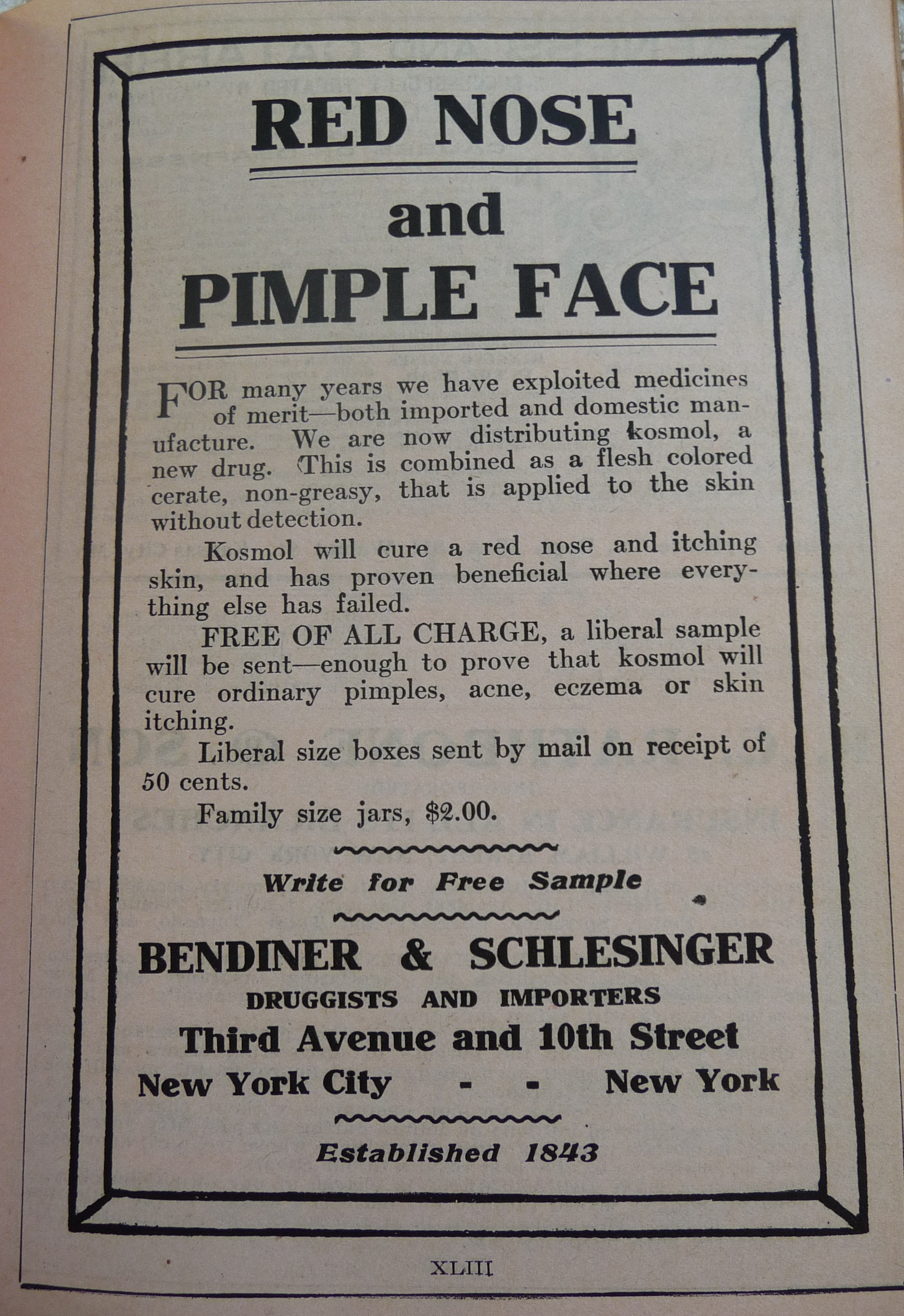
1910 World Almanac Red Nose Pimple Face P1060727

Red Nose and Pimple Face? Bendiner & Schlesinger Druggists on 3rd Avenue and 10th Street have something to help you.

One big difference between old advertising and today’s advertisements, is that today you sometimes have to scrutinize the ad to discover exactly what it is they are trying to sell to you.

Image plays a greater part in modern advertising.

Back in 1910 it was the words that counted.

When you look at old advertising you will notice that the copywriter gets right to the point about the product, though somewhat verbosely.

One thing has remained the same: advertisers used the same swaggering claims back then that they use today.

Even if they are completely false.

Here are some sample advertisements from among the hundreds contained in the 1910 World Almanac. Click on any image to enlarge.

1910 World Almanac Fat is Fatal P1060750


1910 World Almanac Fat is not Good Flesh P1060729


As long as their have been people unhappy with their weight, there have been people and companies who will exploit mankind’s battle with their waistlines. Loring & Co. marketed reducing tablets warning customers that “Fat Is Not Good Flesh.” Their reducing tablets tapped into something back then that is popular today: they contain no chemicals and are made wholly of roots and herbs.

Dr. J. Spillenger of New York City uses endorsements from customers and a dramatic illustration, while warning readers that “Fat Is Fatal.” New York City Mayor Michael Bloomberg would agree with the good doctor. What Dr. Spillenger does not say is exactly what his methods are to help you lose weight. Whatever his method, it involves not starving or exercising. “Rheumatism, Asthma, Kidney and Heart Troubles will leave as fat is reduced. Don’t take my word for this: I will prove it at my own expense,” the copy reads.

Sure, Doctor…sure.

1910 World Almanac Corpulent People P1060748Then there are those people who had no desire to lose weight but merely appear slimmer. Continue reading

Part 5 Vintage New York City Books With Great Art Deco Dust Jackets

The Art of The Book #5 – New York City Deco Dust Jackets From The 20′s & 30′s

As we complete our look at New York City books from 80+ years ago, some of these dust jackets incorporate photography into their covers which the other dust jackets we have featured do not. (click on any photo to enlarge)

Art Deco dj Portrait of New YorkPortrait Of New York by Felix Riesenberg & Alexander Alland, New York: Macmillan, 1939 dj illustrator, Alexander Alland

Felix Riesnberg (1879-1939) was a civil engineer and master mariner. He was a polar explorer and wrote numerous books with nautical themes. Portrait of New York ventures among the populace and is an accurate description of the city and its people.

Alexander Alland (1902-1989) was a master photographer and the book shows a small sample of his immense talents. Continue reading

Part 4 Vintage New York City Books With Great Art Deco Dust Jackets

The Art of The Book #4 – New York City Deco Dust Jackets From The 20′s & 30′s

Continuing our look at the those great New York City books from 80 years ago, here are more great dust jacket covers. (click on any photo to enlarge)

Art Deco dj Hacking New YorkHacking New York by Robert Hazard, New York: Charles Scribner’s Sons, 1930 dj illustrator, unknown

The first book of its kind – anecdotes of a New York taxi driver. Even back then the meter could be rigged and Hazard explains how it was done. The dust jacket is gorgeous and unfortunately the artist is unattributed. Continue reading

Part 3 Even More Vintage New York City Books With Great Art Deco Dust Jackets

The Art of The Book #3 – New York City Deco Dust Jackets From The 20′s & 30′s

We continue with our look at vintage books about New York City with great dust jackets. (click here to read part 1 and here to read part 2)

Starting with a look at an all-time classic of deco design, New York Nights. (click on any photo to enlarge)

Art Deco dj New York NightsNew York Nights by Stephen Graham, New York: George H. Doran, 1927, dj illustrator, Kurt Wiese

A native of Scotland, author Stephen Graham (1884-1975) goes on a tour of  jazz age nightclubs, speakeasies and cabarets. Graham provides the grittier side of life in an up to the minute description of prohibition New York neighborhoods, establishments and people.

Kurt Wiese (1887-1974) illustrated over 300 books and later became an award-winning children’s book author. Besides the knockout jacket cover, Wiese drew all the illustrations contained in the book. This was the first American book he worked on. Continue reading

Part 2 More Vintage New York City Books With Great Art Deco Dust Jackets

The Art of The Book #2 – New York City Deco Dust Jackets From The 20′s & 30’s

We continue our look at some great New York City books from the 1920’s and 1930’s with exceptional artwork on their dust jackets. (click here to read part 1)

We begin with graphics on a dust jacket worthy of a large size poster from the quintessential art deco New York book. (click on any photo to enlarge)

Art Deco dj New York Paul MorandNew York by Paul Morand and Joaquin Vaquero Palacios. New York: Henry Holt, 1930, dj illustrator, Joaquin Vaquero Palacios.

A witty description of New York, via French writer Paul Morand, (1888-1976) from four visits he made to New York, none longer than a month, from between 1925-1929. Morand later became a supporter of the French Vichy regime.

Joaquin Vaquero (1900-1998) as he is credited in the book without the Palacios surname, was a Spanish architect and painter. His paintings are held in museums across the globe. Continue reading

Part 1 Vintage New York City Books With Great Art Deco Dust Jackets

The Art of The Book #1 – New York City Deco Dust Jackets From The 20’s & 30’s

From the 1920’s until the 1940’s, book publishers put out some phenomenal books about New York. They also hired talented artists to design the book’s dust jackets.

The eye-catching art deco graphics were meant to attract potential buyers. Unfortunately, most people who purchased books 80 years ago would discard the dust jacket once they brought the book home with them.

Because of that, many of these books from that time are very scarce in their original dust jacket.

This is the first part of a five part series looking at the dust jackets of books about New York City, the artists that created the work and the authors.

Below are some fine examples of New York City books from the golden era of publishing.

(click on any photo to enlarge)

Art Deco dj New York By QuexNew York by Quex.  New York: David McKay, 1928, dj illustrator, Dixon (possibly Arthur A. Dixon)

Quex was the pseudonym of reporter George H.F. Nichols (1881-1933) of The Evening News of London. Nichols was at the time of his death one of the highest paid reporters in the world. Nichols was the originator of articles written in the form of “the diary of the man about town.” Quex’s observations about about New York are well worth reading.

The dust jacket is classic New York, but I am unsure about the attribution to Arthur Dixon, so we will leave biographical information out until someone can provide a conclusive identification on the artist.

Continue reading

Jack Klugman, Odd Couple’s Oscar Madison, Dies At 90

Last Of “12 Angry Men” Cast Passes Away At Home

Jack Klugman with son Adam Klugman promoting Tony and Me 2005 © stuffnobodycaresabout.com

Jack Klugman with son Adam Klugman promoting Tony and Me 2005 © stuffnobodycaresabout.com

When Jack Klugman decided to write a book he insisted it would not be an autobiography. He was too modest for that. Instead he wrote a book about his close relationship with his Odd Couple co-star Tony Randall. The book, Tony and Me A Story of Friendship, published in 2005 by Good Hill Press, was short on details about Klugman’s life, but very illuminating about Randall and Klugman’s close relationship.

After Klugman was treated for throat cancer he thought his acting career might be over. It wasn’t. With the encouragement of Tony Randall, Klugman returned to the stage and began his career anew, re-learning how to use his new voice, a scratchy rasp that pained some people to listen to. Klugman insisted it didn’t hurt him at all to talk, it just sounded that way to others.

The star of one of the best written and best acted television programs of all-time, The Odd Couple, Jack Klugman died on December 24, 2012 at his home in Woodland Hills, CA at the age of 90. He had been in declining health for the past year. He leaves behind his sons Adam and David and his second wife Peggy. His first wife actress Brett Somers died in 2007, they had been separated since 1974, but had never divorced.

I spent quite a bit of time in 2005 with Jack Klugman helping to promote his book. One of the things I asked him was why he didn’t write an autobiography. He said, “This is all there ever will be. I’m the sort of of person who likes to keep things private. I’ll write about Tony because our relationship was special and that story should be told, but that’s it.”

Our conversations about life and acting made me believe that this was a mistake, and I told Jack Klugman he could have told the world so much more about his career and recollections and many people would be fascinated.

He politely replied that it wasn’t that interesting.

I disagree. His full life story would have been very interesting.

Some things people may not have known about Jack Klugman:

Klugman had an incredibly sharp mind and he attended the prestigious Carnegie Tech (now Carnegie Mellon University).

On The Odd Couple, Klugman portrayed Oscar Madison, a sloppy sportswriter who was a New York Mets fan. In reality Klugman knew little about modern baseball and his knowledge after the DiMaggio era of baseball was lacking. I arranged an appearance on the New York Mets pre-game radio show with Gary Cohen to promote his book. After some initial nervousness and hesitancy on Klugman’s part, he did the interview and both Klugman and Cohen were very satisfied with the results and Cohen said it was one of his favorite interviews that he had ever conducted. Klugman’s real love was the track. He loved the horses. But for that interview you would not have known that Jack Klugman was not a real life New York Mets fan.

He worked with some of the most famous actors of their day, such as Humphrey Bogart, on live television. Most of those appearances are now lost forever.

Klugman’s role as Juror #5 in of one of the all-time greatest movies, 12 Angry Men was a breakthrough part for him, leading to many more acting offers. He discounted his importance to that film as being “small.” It wasn’t small. Klugman’s portrayal may have had the most authenticity of all the actors based on his rough and tumble upbringing.

On a bright day in late June 2005 in the midst of the book publicity tour in a chilly New York office building, we had some spare time alone between interviews. Klugman was wearing his trademark V-neck sweater and cap.  I asked Klugman what he remembered about working with Henry Fonda and Lee J. Cobb and rest of the stellar cast of 12 Angry Men. Klugman grew wistful, saying, “I never really liked acting in the movies, the pace was too slow. I always preferred the stage and television. But that cast…that was amazing. It was a privilege to be a small part of that movie.”

We talked about John Fiedler (the voice of Piglet from Winnie The Pooh) who had co-starred with Klugman on a couple of episodes of The Odd Couple and appeared in 12 Angry Men as Juror #2.  I told Klugman he just passed away.

Klugman was surprised and said, “I just spoke to John a few months ago.” Apparently no one had told him about Fiedler’s very recent death. He was silent for a moment or two, looked out toward the window and said slowly, “They’re all gone. Fonda, Balsam, Cobb, Warden. I’m the last of the 12 Angry Men.”