Category Archives: Books

Five Of The Best Latin Quotations

Latin To Impress Your Friends & Improve Your Mind

Certain maxims, proverbs or quotations simply sound better in Latin.  Here are five simple and profound Latin quotations from great books.

“Malum quidem nullum esse sine aliquo bono.”
There is no evil without something good.
(Plinius the Elder, Naturalis historia)

“Mea mihi conscientia pluris est quam omnium sermo.”
My conscience means more to me than all speech.
(Cicero, Epistulae ad Atticum)

“Odi profanum vulgus et arceo.”
I loathe the uneducated mass and keep them away from me.
(Horatius, Carmina.)

“Oderint, dum metuant.”
May they hate me, if only they fear me.
(Suetonius, Vitae Caesarum, Caligula)

“Dulce bellum inexpertis.”
War is sweet to those not acquainted with it.
(Pindar, Greek poet)

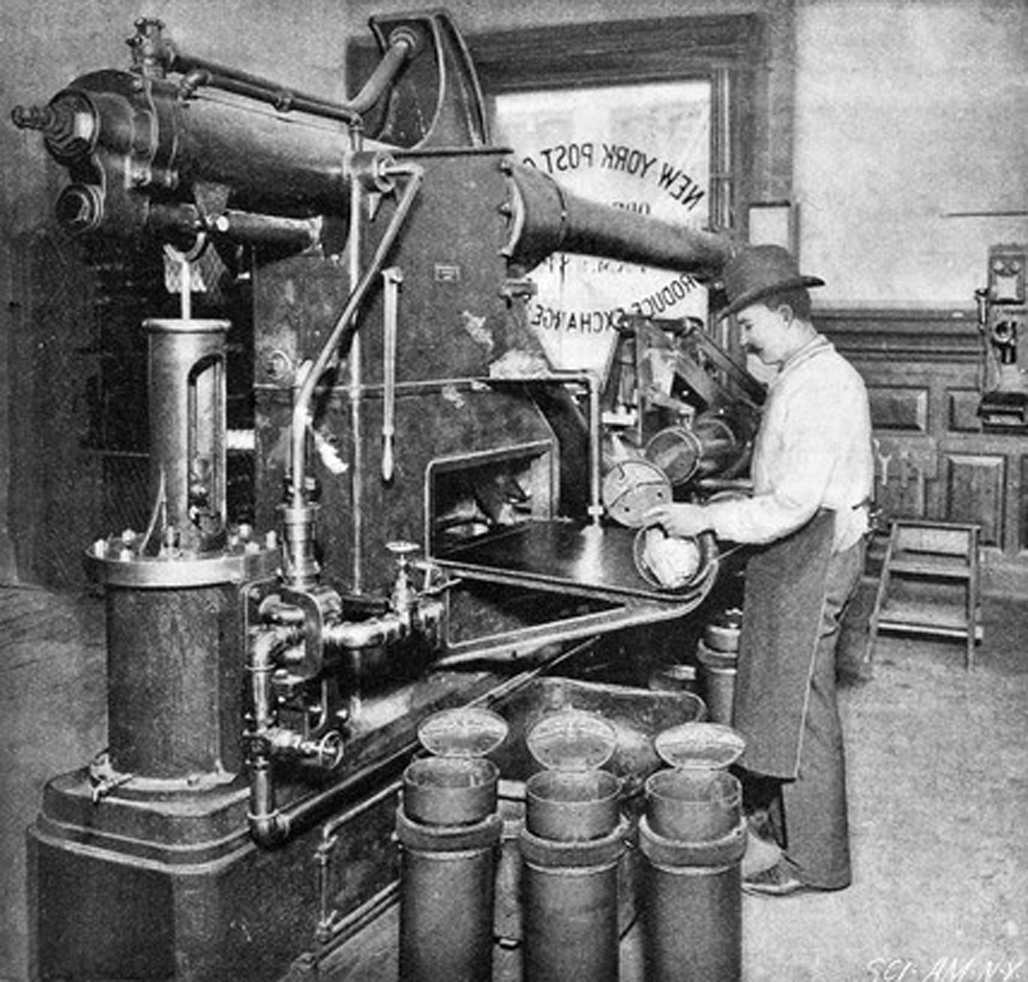
First Pneumatic Mail Delivery In New York 1897

The Pneumatic Mail Tubes And The “Age of Speed”

Pneumatic Tubes Produce Exchange Post Office 1897

Reading Howard Wallace Connelly’s highly entertaining 1931 autobiography Fifty-Six Years In The New York Post Office–  A Human Interest Story of Real Happenings in the Postal Service (self-published) the following anecdote begins Chapter VI:

When the pneumatic tubes were installed at the General Post Office, October 7, 1897, we Supervisors were given a fine treat after the ceremonies were over. A rough hastily constructed row of steps (circus show style) had been erected facing the tubes. Senator Chauncey M. Depew was Master of Ceremonies. Probably over a hundred friends and Post Office officials were spectators. The first tube contained only a large artificial peach. The roar of laughter that greeted it was heartily joined by the Senator. A Bowery audience that had attended a political meeting at which he was the principal speaker, instead of trying to break up the show, took quite a liking to the speaker and a loud voiced man yelled, “Chauncey, you’re a peach.” Hence the laugh when the first tube arrived. From the second tube, a cat was taken. How it could live after being shot at terrific speed from Station P in the Produce Exchange Building, making several turns before reaching Broadway and Park Row, I cannot conceive, but it did. It seemed to be dazed for a minute or two but started to run and was quickly secured and placed in a basket that had been provided for that purpose.  A suit of clothes was the third arrival and then came letters, papers, and other ordinary mail matter.

Hah-ha very funny. The postal officials must have had a ball putting a cat into the tubes. Can you imagine the public outcry if something like that was done now?

Connelly omits that the first parcel actually sent through the tubes was sent by Depew to the Produce Exchange Post Office which included Continue reading

All New York City Sidewalks Are Not Created Equal

What Is The Width Of The Sidewalks In Manhattan?

Following up on our November 19, story, All New York City Streets Are Not Created Equal, the 1904 World Almanac has a list of the width of Manhattan’s sidewalks. The chart can provide the answer to which avenue has wider sidewalks Fifth Avenue or Lenox Avenue? While this may not be a burning question on anyone’s mind, it is interesting to see how much the sidewalk width varies from street to street and avenue to avenue.  The obvious differences are plainly apparent to any New Yorker walking the streets so we thought it would be worth it to reproduce this list with the actual measurements.

Width of Sidewalks in Manhattan Borough

In streets 40 feet wide 10 ft.
In streets 50 feet wide 13 ft.
In streets 60 feet wide 15 ft.
In streets 70 feet wide 18 ft.
In streets 80 feet wide 19 ft.
In streets above 80 feet, not exceeding 100 feet. 20 ft.
All streets more than 100 feet 22 ft.
 
Lenox and 7th Avenues, north of W. 110th St 35 ft.
Grand Boulevard (Broadway above 59th Street) 24 ft.
Manhattan St. 15 ft.
Lexington Avenue 18 ft. 6 in.
Madison Avenue 19 ft.
5th Avenue 30 ft.
St. Nicholas Avenue 22 ft.
Park Avenue from E. 49th to E. 56th St. and from E. 96th St. to Harlem River 15 ft.
West End Avenue 30 ft.
Central Park West, from W, 59th St. to W. 110th, East side 27 ft.
Central Park West, from W. 59th St. to W. 110th, West side 35 ft. 6in.

How many of these sidewalk measurements remained the same throughout the 20th century is open to conjecture. I would imagine that many sidewalks have had their original dimensions changed due to the high value of Manhattan real estate.

click to enlarge

This photograph, taken November 10, 1914 at the corner of Fifth Avenue and 59th Street looking south, has a clear view of the sidewalk. The men near the carriage are standing in front of the Hotel Savoy (built 1892 – demolished 1927). On the right at 58th Street is the Cornelius Vanderbilt II mansion (built 1893 – demolished 1926).  It does not appear that the sidewalk is actually 30 feet wide.

How The Super Wealthy Woman Of 1903 Lived

“Free To Indulge Her Whims and Fads In Whatever Way The Gay World Of Society, And Her Own Inclination, May Lead Or Tempt Her”

Let’s say you are the wife of a turn of the century financier. How do you run your household and spend your time and money? Is there no one to teach you except your family or contemporary one percenters?

Fortunately there was a book written just for the rare woman who needed such advice.

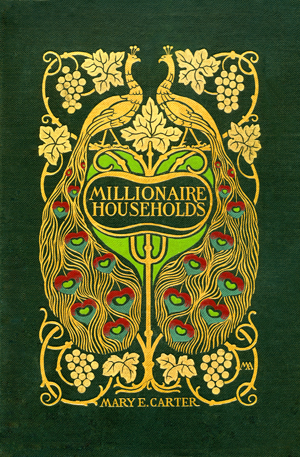
The book which could now be slightly updated and reprinted for today’s super wealthy billionaires is called, Millionaire Households and Their Domestic Economy With Hints Upon Fine Living by Mary Elizabeth Carter published by D. Appleton & Company 1903.

Miss Carter was not a society lady, but had managed a house for the wealthy Vanderbilt family.

With chapters such as Fine Living or Housekeeping; The Hostess’s Wardrobe; The Lady’s-Maid; The House-Maid; The Parlor-Maid; The Servant’s Dining Hall-Maid; The Butler and His Staff; The Valet; Monsieur Le Chef and His Aids; Side-Lights and Shifting Scenes When The “Smart Set” Dine; the book has everything you would need to know as the grande dame running an American version of Downton Abbey.

We learn from Miss Carter that a butler is more than just a servant. She writes, “When the ubiquitous newspaper reporter appears the butler knows how to get rid of him with as little information imparted as will spare the family from false statements or ridicule. During these interviews he requires his entire stock of aplomb. He must withhold all information possible, while appearing to give it out freely.”

This book was not for the 1% that we hear so much about today. In 1903, Millionaire Households and Their Domestic Economy would apply to only o.oo5% of Americans, since there were about 4,000 millionaires out of 80 million people living in the United States at the turn of the century. Approximately half of those millionaires resided in New York State. It is safe to say this book probably did not sell very many copies. It is also important to remember how much a million dollars was back in 1903. One would need to have about twenty million dollars today to have the purchasing power of a millionaire in 1900.

Comparatively today, globally there are about 10 million people (exclusive of their home) with a net worth  of one million dollars or more and approximately 3.1 million of them reside in North America.

The book gives a complete view into the way the millionairess should conduct her household. While the advice the book offers might seem frivolous and somewhat outrageous to read today, Continue reading

All New York City Streets Are Not Created Equal

The Distances Between Streets & Avenues – Things You Probably Didn’t Know

If you are traveling at the same pace, regardless of the avenue, it is faster to walk between 6th and 7th Streets than walking from 13th to 14th Streets. Why? Because the block between 6th and 7th is only 181 feet, 9 inches while the block between 13th and 14th is 206 feet, 6 inches.

Anyone walking around Manhattan is sure to notice that street distances between blocks and avenues vary widely. But few know that the block lengths can vary by several feet.

When the grid plan for Manhattan’s streets were laid out, you’d think that the streets would be equidistant. They are not.

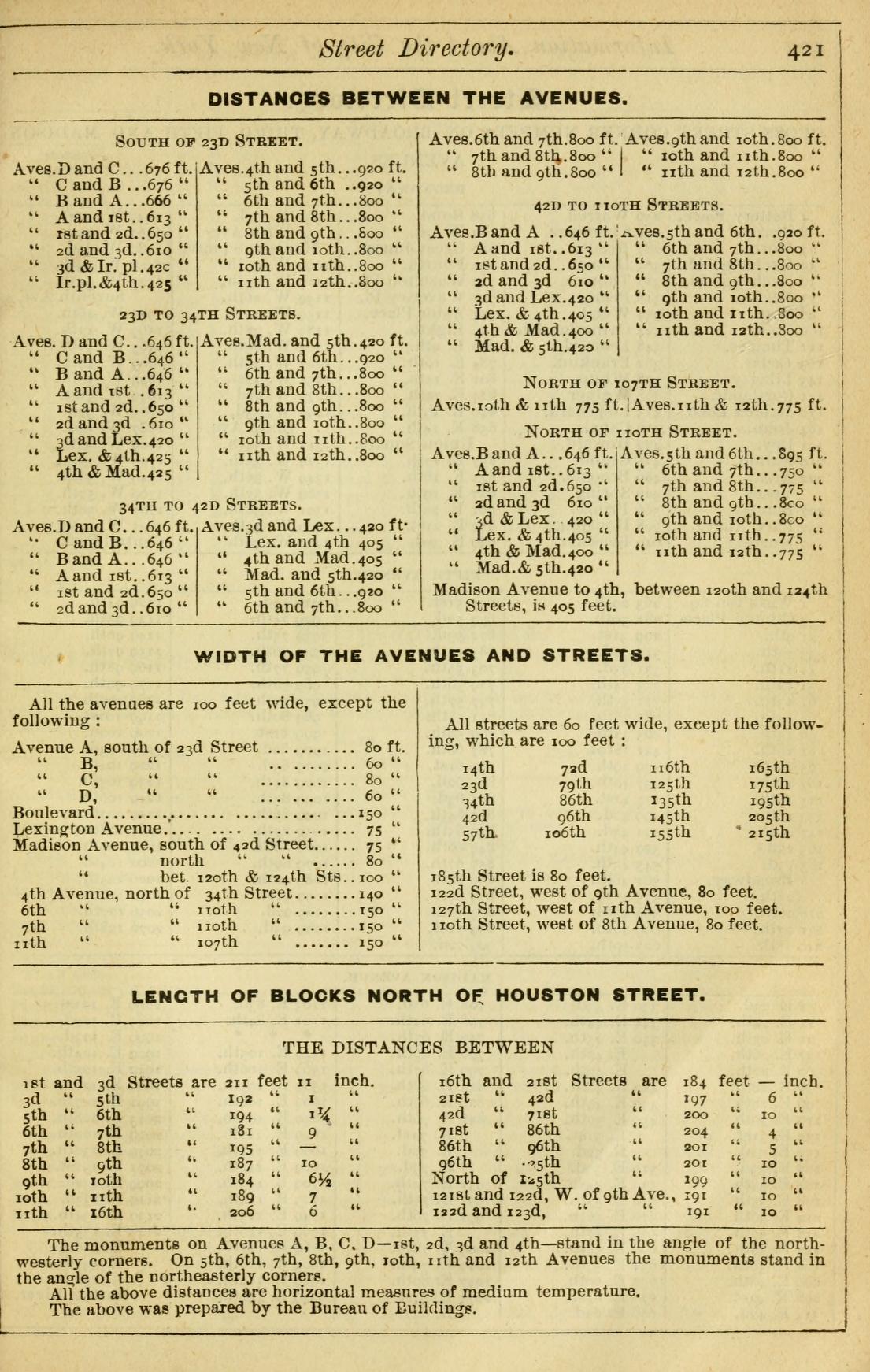
Maybe this is the sort of thing that almost no one would care about, but living up to this web site’s name, I found this chart very interesting. It is from the New York Bureau of Buildings in the 1892 edition of The World Almanac.

1892 World Almanac (click to enlarge)

As you see, the chart lists the distances between the avenues, the width of the avenues and streets and the length of blocks north of Houston Street.

There are a few interesting things to note. One is how far Avenues A, B, C and D extended northward in 1892. Avenue A was later renamed Sutton Place north from 53rd Street and York Avenue north from 59th Street. Avenue B was renamed East End Avenue from 79th to 90th Street. Many portions of Avenue A, B, C and D were never completed (the landfill required to extend them was never done), or wiped out with map changes and construction in the 20th century (e.g. The Franklin D. Roosevelt Drive). Regardless, the almanac still lists the proposed dimensions for the phantom avenues via the Bureau of Buildings.

The other thing to note is that the main cross streets of 14th, 23rd, 34th etc. are all the same: 100 feet wide as compared to the other streets which are all 60 feet wide.

I have used the modern names of avenues in parentheses. Below are some highlights of the chart.

Avenues in Manhattan are 100 feet wide with some notable exceptions:

Lexington Avenue – 75 feet

Boulevard (Broadway) above 59th Street – 150 feet

Madison Avenue South of 42nd Street – 75 feet

Madison Avenue North of 42nd Street – 80 feet

Madison Avenue From 120th to 124th Streets – 100 feet Continue reading

Philip Roth On The Death Of Readership, Not The Novel

Novel Readership, Not The Novel, Being Killed By The Screen According To Philip Roth

On the front page of the November 18, New York Times, Philip Roth discusses his retirement from writing fiction.  2010’s Nemesis, Roth’s last published work of fiction will remain his final novel.

In the article he clears up a long held misquote, that “the novel is dying.” He says, “I do not believe the novel is dying. I said the readership is dying out. That’s a fact, and I’ve been saying it for 15 years. I said the screen will kill the reader, and it has. The movie screen in the beginning, the television screen and now the coup de grace, the computer screen.”

What It Was Like Riding A Turn Of The Century New York Stagecoach

New York Transportation In The Early 1900’s

Hamilton Fish Armstrong was the longtime editor of the magazine Foreign Affairs. His charming memoir, Those Days published in 1963 by Harper and Row is a wonderfully evocative description of an upper middle class boyhood spent in New York City, the Hudson Valley and Quebec. The book’s dust jacket description states that it is: “A lively, spontaneous re-creation of the childhood of a famous editor and writer at the turn of the century – an unforgettable picture of a vanished New York.”

It’s one of those out of print, forgotten books that deserve to be read by a new generation. I highly recommend it.

Here is an excerpt from pages 68-69 where Armstrong describes getting uptown to school from his home on 10th street via the Fifth Avenue coach which was pulled by horses.

When I was nine the time came for me to go to a “real” school uptown, and unless it was pouring pouring rain or snowing I went of course, on skates. When the weather ruled this out I used the Fifth Avenue stage or the Sixth Avenue El.

On the stage I rode by choice  on the outside, either perched up behind the driver or, if I was lucky, along side him. Continue reading

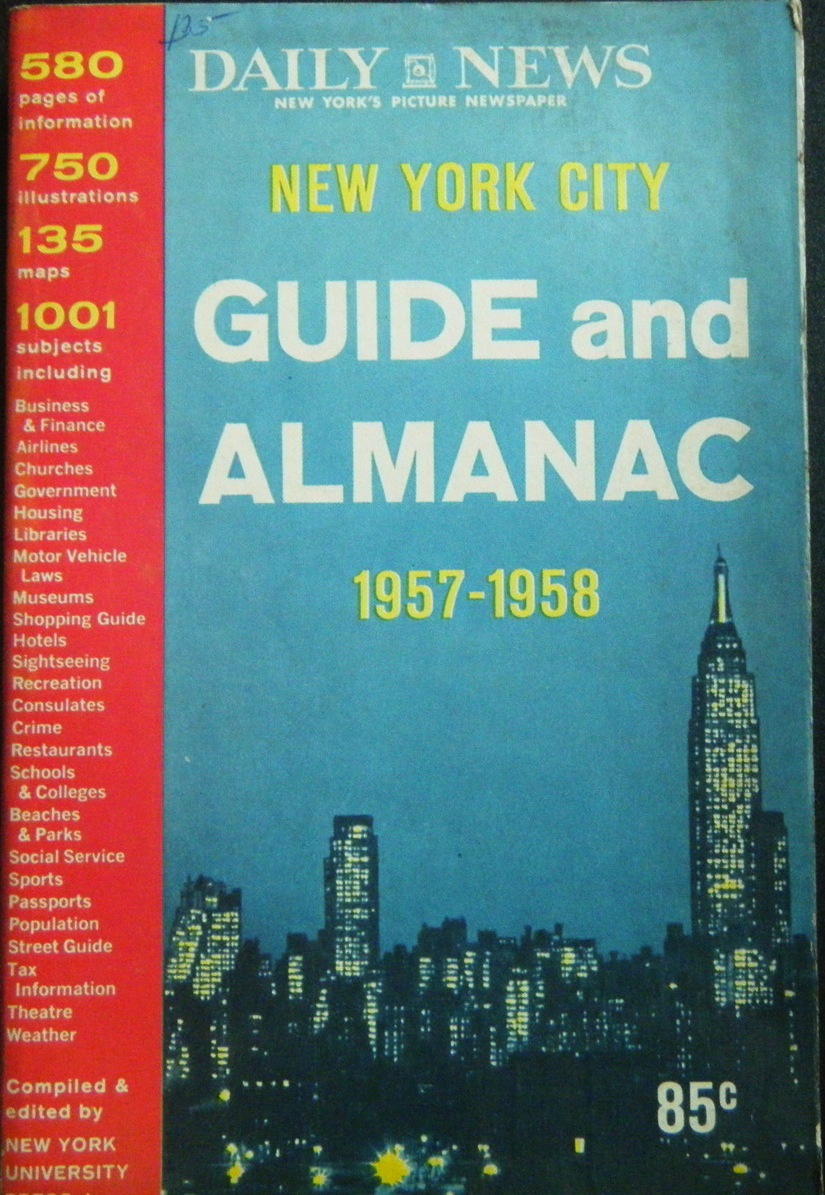
The Dangers And Lures Of New York City In 1957

Stay Out of the Parks At Night!

From the New York City Guide And Almanac 1957 – 1958

This vintage book is a great snapshot of New York City in the late 1950’s. I wish they would have printed this annually, but it was published for only one year by New York University Press in conjunction with The Daily News. It is 378 pages chock-full of fascinating facts and figures. The paperback version was originally 85 cents, while the hardcover version would set you back $2.75.  There are a few copies of this out of print gem for sale on abebooks.com ranging from$8.00 – $14.00. A veritable bargain.

Here is a snippet on crime from pages 197 – 198:

Traps for the Unwary

New York City is full of traps for the unwary visitor. It is doubtful if there are proportionately more crooks and criminals in New York than any other large city, but the metropolis is so large that the total is impressive. The bait generally used is greed, and the victims are most often people who regard themselves as sophisticated. Most effective traps for the unwary:

Auctioneers: Dishonest “auction stores” especially in the mid-town sections, where salesmen pretend to auction off “amazing” bargains, which often are samples of “flash goods” turned out for the carnival trade. Articles of genuine value are knocked down to stooges in the crowd, who later return them to be used again. The stranger who obtains a “bargain” is likely to find that a cheap duplicate was substituted during the process of wrapping up his purchase. He usually discovers that he has actually bought a garish gold-washed watch that will not run or an impressive pipe set made of celluloid. These shops should not be confused with operations of reputable auctioneers who preside over genuine sales which are usually advertised in honest fashion.

Confidence Men: Most of these offer money-making machines or counterfeit currency. They also offer to share rewards for well-filled pocketbooks lying on the pavement and “found” by the con man and the victim simultaneously. Continue reading

50 Years After Marilyn Monroe’s Death – Examining The Books That Were Written About Her While She Was Living

The Fascination With Marilyn Monroe: A Look At The First Six Books About Her

Sometime during the evening or early morning hours of August 4 or 5, 1962 Marilyn Monroe died under mysterious circumstances at the age of 36. Even after fifty years to the day that she died, Marilyn Monroe may be more popular now than when she was living. Her movies are what propelled her to fame and are the way people today primarily become familiar with Marilyn. Her image is part of our popular culture. But books about Marilyn have helped her achieve a level of immortality that is not shared by any other star.

By a wide margin no other entertainment personality has been covered in books more than Marilyn Monroe. Elvis would run a distant second. Since 1953 there have been slightly more than 200 books in English that are directly about Marilyn Monroe. There are dozens more that have been printed in other languages and hundreds of others that contain chapters about her.

Her movie career spanned from 1947-1962, yet only six books were written about Marilyn while she was living, with various levels of cooperation from the star herself.

The first book written about Marilyn was published with little fanfare on October 29, 1953. The Marilyn Monroe Story by Joe Franklin and Laurie Palmer, (1953 Rudolph Field Co.) distributed by Greenberg.  The book retailed in paperback for $1.00 and hardcover for $2.00. It is considered the rarest and most collectible book about Marilyn and very good condition paperback copies sell for upwards of $150 and hardcovers without the dustjacket fetch over $250 and with a nice dustjacket can sell for $500 or more.

So besides being the first book about Marilyn what makes it rare? In the early 1990’s I mentioned I owned a copy of his Marilyn book to author Joe Franklin and the longtime radio and television host told me quite a story about the book.

“I now don’t even have a copy of my own book,” Franklin said. Continue reading

Film Director Joseph H. Lewis On Why Films, Hollywood & L.A. Changed For The Worse

Observations On Hollywood Trash

Director Joseph H. Lewis

Peter Bogdanovich early in his career was a film writer for magazines. Over the years he interviewed many people in the film industry and continued to do so even after becoming a successful director himself.  The interviews with directors are compiled in a great book: Who The Devil Made It Conversations With Legendary Film Directors by Peter Bogdanovich (Knopf; 1997).

He interviewed director Joseph H. Lewis (1907-2000) an adept filmmaker best known for his 1950 movie Gun Crazy, a precursor to Arthur Penn’s landmark film, Bonnie and Clyde (1967).

Bogdanovich asked Lewis in 1994, to “define the change that had happened in Hollywood.”

Lewis was able to clearly answer him:

“Yes, I define it one way. When I was a little boy I worked at MGM: I loaded film; from there I became an assistant camera boy; from there, an assistant cutter; from there, the head of a cutting department; from there I became a director. These things don’t happen today. A guy comes up and, yes, he has a script- he wrote it; he’ll let them do it, providing he can direct it. And they go for it.” Continue reading