Author Archives: B.P.

Old New York In Photos #45 – Broadway After Snowstorm 1905

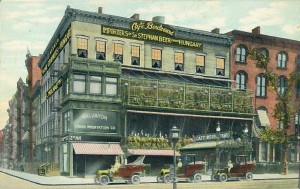
New York City 1905 After A Big Snowstorm – The Sights Along Broadway Between 29th and 30th Streets Described

New York After a Big Snowstorm 1905 ph Detroit Photo Library of CongressSo far New York City has not had a major snowstorm this season like upstate New York received earlier this month. But I dream of New York City days gone by like this one shown above.

In this high resolution photograph (click to greatly enlarge) taken in 1905, the effects of a recent snowstorm can be seen as the snow has been shoveled high onto the edge of the street and sidewalk.

We are looking up Broadway from the northwest corner of 29th Street towards 30th Street. On the extreme left at 1209 Broadway is one of the many United Cigar Stores outlets, a chain store which dominated New York’s tobacco retail industry at the turn of the century. Next door at 1211 Broadway is Marcus & Marcus supplying men’s furnishings.

Across the street at 1204 Broadway an advertisement in the window at ground level announces that the entire stock in their window was purchased by The Maurice Company, a clothing company run by Maurice Rogaliner. The “Broadway Dentists” also had offices in the same building along with Sol Young, Photographer.

Next door to the Maurice Company is Shanley’s Restaurant, owned by brothers Tom and Michael Shanley.

Shanley’s was one of the most famous eateries of the late 19th and early 20th century in Manhattan. With three restaurants, this one at 1210-1212 Broadway was their second location which opened in 1896. As the restaurant guide Where And How To Dine In New York (Lewis, Scribner & Co; 1903) describes it:

Everybody in New York knows Shanley’s and almost everybody has dined at one or another of the three establishments conducted under this name. The management acknowledges but one purpose in the conduct of its restaurants — to make its guests absolutely comfortable and to persuade them that Shanley^s holds the recipe for good cheer. It has taken twelve years to develop the atmosphere which one finds in Shanley’s and during this time the extent of its business operations has been greatly enlarged.   The service at Shanley’s is entirely a la carte. The cuisine is proverbial for its excellence. Chops, steaks, lobsters, game, shell fish and kidneys are among the special attractions of the house.

Next to Shanley’s the building with the initials HB and the crown on its sign is the Hof Brau Haus Restaurant. Continue reading

In 1961 Dr. Richard W. Hamming Predicted The Harmful Effects of Computer Technology

Loss Of Privacy, Pooling Of Data And The Slow Blurring Of The Distinction Between Human And Machine “Thinking.”

Richard W. Hamming photo: Naval Postgraduate School

Richard W. Hamming photo: Naval Postgraduate School

In 1961, scientist and mathematician Dr. Richard W. Hamming of Bell Telephone Laboratories, had enormous foresight in predicting that computers would soon change our lives in ways that few people could have imagined half a century ago.

Dr. Hamming saw the future improvements that the computer revolution would bring, but he also warned of the coming dangers in that revolution.  Looking back at his insights today you will find them eerily accurate. In many ways Dr. Hamming merely scraped the surface on many of his suppositions.

Today we are all aware that marketers are tracking your movements on the internet. Unless you’ve set up blockers, all your clicks, all your searches, every site you visit is captured and analyzed. Big Data firms want that information, supposedly just to market to you. The government, banks, schools, brokerage firms, doctor’s offices, pharmacies, and merchants all collect information that you are obliged to provide in order to receive services. You just hope your information is secure and not compromised.

But then you voluntarily share information on Facebook, Twitter and Linked-In. We know that the information we provide is used to compile an aggregate online portrait of our lives that is available for the world to peer into and that includes stalkers, thieves and hackers and yet we still provide it!

Which leads us back to a symposium held in December 27-29, 1961 on “Man and the Computer” at the annual meeting of the American Association for the Advancement of Science held in Denver, CO. At the symposium Dr. Hamming’s observations were listened to attentively and the New York Times interviewed him afterwards. Summarizing  Hamming’s observations:

While computers will surely benefit mankind in ways not yet dreamed of he said, certain harmful effects of the computer revolution can be foreseen. One example he gave was a reduction in individual privacy that would be possible with the increasing storage of personal records even travel information in computers.

A major concern is that a growing amount of personal information was being committed to the memory of machines: various data collected by Selective Service; Social Security, Internal Revenue, insurance companies, places of employment, medical services and even airline companies.

“How do we know that this is always being used for the benefit of the individual?” he asked, “How can we be sure that this information will not be used against a person?”

Continue reading

Old New York In Photos #44 – Western Union Building & The Day It Caught Fire

Western Union Telegraph Building – 1880

Broadway looking south Western Union Building 1880This view looking south on Broadway was taken from the Old Post Office in 1880 and shows a deserted stretch of the usually traffic clogged thoroughfare.

On the left in the foreground is the New York Herald Building. The building partially seen on the right side is the Astor House Hotel. Adjacent to the Astor with the columns is St. Paul’s Chapel. The tall structure further down Broadway is Trinity Church with its spire rising 281 feet. This was the highest point in New York until the World Building was built in 1890.

The main building dominating the photo at the corner of Broadway and Dey Street is the Western Union Telegraph Building designed by architect George B. Post. At 230 feet, it was one of the tallest commercial buildings in the city when it was built from 1872-1875. To put this tremendous height in perspective, this was four times the height of the average New York building. On top of the building’s flagstaff a time ball was perched which would drop precisely at noon, so everyone in the surrounding financial area could set their watch to the correct time.

The telegraph was still the predominant way to get a message to someone quickly. To send a telegram with the body message being ten words or less from New York to Baltimore or Boston cost 25¢; to Chicago 40¢ and to San Francisco $1.00.

Western Union Building Fire - New York Evening World

Western Union Building Fire – New York Evening World

A Fire Destroys The Building

As the night shift of telegraph operators and workers was letting out at 6:55 a.m. on Friday, July 18, 1890 the Western Union Building caught fire.

The fire broke out on the 6th floor and quickly spread to the upper floors. Firefighters arrived within six minutes of the first alarm being turned in.

The fire was far above the roof lines of the adjacent buildings and the water pressure from street level could not possibly come close to the fire. The firemen strung several hoses together and carried them up  into nearby buildings on to the roofs to fight the flames.

20,000 people watched from the surrounding streets as the firemen placed ladders from the adjacent building at 8 Dey Street to rescue people trapped in the Western Union Building and pour water on to the upper floors. Continue reading

Hockey Legend Jean Beliveau Dies At 83

Jean Beliveau – The Epitome Of Grace And Power

Jean Beliveau puts his arms around teammates Ken Dryden and Frank Mahovlich following their victory over the Chicago Blackhawks in Game 6 of the 1971 Stanley Cup Finals on May 16, 1971, at the Montreal Forum. photo: B Bennett / Toronto Star

Jean Beliveau, who won 10 Stanley Cup championships playing for the Montreal Canadiens from 1951-1971 died Tuesday, December 2, 2014 in Longueuil, Quebec at the age of 83.

Beliveau was among the smoothest and fastest skaters I have ever seen. His hockey skills were extraordinary in every way. He dominated the game like only a handful of players have ever done. He had a wrist shot that was keenly accurate and was among the best play-makers to ever lace up a pair of skates in the NHL.

Jean Beliveau (No. 4) scores a goal against the Toronto Maple Leafs October 15 , 1959. Goalie is Johnny Bower. Canadiens won the game 4-2 - photo: UPI

Jean Beliveau (No. 4) scores a goal against the Toronto Maple Leafs October 15 , 1959. Goalie is Johnny Bower. Canadiens won the game 4-2 – photo: UPI

Beliveau amassed 507 goals and 712 assists in 1125 games. In 162 career playoff games he tallied 176 points. A two-time Hart Trophy (league MVP) winner, he was the captain of the Montreal  Canadiens for the final ten seasons of his career.

Besides his greatness as a player, what people will remember about Jean Beliveau was that he was a modest gentleman, both on and off the ice.

Teammates, opposing players, coaches and fans respected and admired Jean Beliveau. He carried himself with class, the way few athletes do nowadays.

Adieu, Jean Believeau.

Classic Hollywood #36 – Joan Collins

 Joan Collins In A Bikini 1950’s

Joan Collins in bikini 1950sI’m not sure which production this is from, but when I first came across this photograph of Joan Collins from the 1950’s my first reaction was just “wow.” I don’t think I’ve seen her looking any better than this.

The two early films from this period I remember Joan starring in were The Girl in The Red Velvet Swing, which told the story of Evelyn Nesbit, Stanford White and Harry Thaw and Land of the Pharaohs, both from 1955. They are mediocre films and Joan does an admirable job in both. Continue reading

Old New York In Photos #43 – Times Square Advertising Billboards

Giant Times Square Advertising Billboards Of The Past

New York's Times Square at night 60 Years ago, 1954 photo: Charles Shaw

New York’s Times Square at night 60 Years ago, 1954 photo: Charles Shaw

The New York Times article about the new eight story high, block long, LED illuminated billboard that will be put into use on Tuesday night, November 18, 2014, made me think about some of the classic advertising signs that were in place during the 1940’s and 1950’s at the crossroads of the world.

Bond Clothiers sign, 1948, Times Square looking north

Bond Clothiers sign, 1948, Times Square looking north

Chief among these ads was the dramatic Bond Clothiers sign taking up the entire Broadway block between 44th and 45th Streets. The 200 foot wide, 50 foot high billboard was brightly lit up at night and had a waterfall cascading between the two large scantily clad statues flanking it. The figures appeared nude during by day and had electric lights draped around them which produced a quasi-covering effect on the statues when the lights went on.

With two miles of neon, it was a colorful spectacle to behold in person, especially at nigTimes Square 1948 Bond Clothiers at night billboardht. The sign was only up from 1948-1954.

We previously showed what the area looked like at night in our story about the giant New York snowstorm of 1948.

The Bond sign replaced an earlier sign for Wrigley’s Spearmint Gum that also was breathtaking with its neon aquatic design. Designed by Dorothy Shepard, it occupied the site from about 1936 to 1948.

Times Square Wrigleys Billboard sign Ad postcardThe other billboard Continue reading

Brooklyn’s Green-Wood Cemetery Epitaphs

To Be Remembered – Some Thoughts About Inscriptions On Tombstones

Green wood Henry Croatman epitaph 1120840
 
Henry Croatman                                                  Eddie Brewster Croatman 
Born January 17 1845                                                Died Dec. 2, 1878
Died June 4, 1876                                                        Aged 19 Mo’s 26 Days
 
Come view the grave and drop a tear                           Budded on earth
O’er your kind brother once so dear                              To bloom in heaven
Who once delighted in your charms
But now he’s bound in deaths cold arms
 

When wandering around Green-Wood cemetery in Brooklyn I especially take note of  monuments with epitaphs. Rather than gravitate towards the costly and grand monuments that abound in great numbers, I am drawn to those anonymous graves with no known fame attached to them. It is interesting to see how these people, buried long ago, are eulogized in stone.

Green wood John F Abbott epitaph 1100936John F. Abbott
Died Sept. 23rd, 1857
Aged 23 Years and 10 Months
A Good Life Hath But Few Days
But A Good Name Endureth Forever


Many of these monuments mark the last resting spots of common people with unextraordinary lives. But we all have a story to tell. Tombstones try to do that. How can you sum up a person’s life with a few sentences?

Green wood Ann Lee epitaph 1160006A Tribute of Love to
My Dear Wife
ANN LEE
Died Feb. 25, 1887
Aged 58 Years
A fond and faithful wife,
A dear devoted mother,  And a kind friend to all

Without their simple marker and words engraved upon them, these people’s lives would go completely unrecognized. Today, it is hard to fathom that thought, considering all the information that is now collected and shared about us.

Green wood C Ella Ellison epitaph 1120836C. Ella Ellison
Wife of John T. Ellison
Born March 22, 1846
Died December 20, 1900
 
A Loving Daughter,
A Devoted Mother,
A Faithful Wife


Continue reading

This Man Was The Last Immigrant To Pass Through Ellis Island

60 Years Ago – Ellis Island Closes

Arne Petterson last Ellis Island immigrant, 1954 photo: A.P.

Arne Petterson last Ellis Island immigrant, 1954 photo: A.P.

On November 12, 1954 Arne Petterson became the last alien immigrant to pass through Ellis Island, when the busiest immigration station in the United States permanently closed its doors.

Petterson is seen here waving goodbye on a ferry in New York Harbor as he was on his way to be picked up by a friend who would sponsor him for citizenship.

Petterson, 48, was a Norwegian merchant seaman from Narvik who had overstayed his shore leave while in New York. In 1942, during World War II, Petterson survived a German u-boat attack on his ship, the Leiv Eiriksson.

Ellis Island was in operation for 62 years and processed over 12 million immigrants.

Smoking Cigarettes For A Living

Here Is A Real Chain Smoker

Man tests cigarettes for a living photo Acme 1945This is not part of some government secret test program to see how many cigarettes you need to smoke before you develop cancer. Testing cigarettes was part of Sol C. Korn’s job as the director of various cigarette and cigar company’s from the 1920’s until the 1960’s. In 1945 when this picture was taken he was president of the Fleming-Hall Tobacco Company.

The caption reads: Continue reading

World Series Photos Delivered Instantly

Before The Internet, The Quickest Way To Get Photos Back To The Newspaper- Via Pigeon

Walker Cooper Phil Rizzuto pigeon delivers negatives 1942 world series

Walker Cooper, Phil Rizzuto and Private Harry Myers and carrier pigeons, October 4, 1942 photo: New York Journal-American

You would have thought by 1942 there was a quicker way for a newspaper to get photos from one place to another than using a carrier pigeon. Apparently not.

Before game four of the World Series at Yankee Stadium, Private Harry Myers, the Journal-American’s pigeon specialist, shows the Cardinal’s Walker Cooper and the Yankee’s Phil Rizzuto how photographic negatives of the World Series game are sent by pigeon from the ballpark to the newspaper’s offices for same-day publication of the photos.

Amazing.

Maybe it was just the New York Journal-American’s method, as I cannot imagine all the newspapers releasing pigeons during a baseball game.