Tag Archives: New York History

A Photographic Trip To Green-Wood Cemetery Part 3

Monuments And Odds & Ends

The focus for the final installment on Green-Wood Cemetery are monuments and some interesting things that I took note of.

Dogs

Dogs are not permitted to be buried in human cemeteries. Somehow though fourteen years after inventor Elias Howe’s death, a dog “Fannie,” was buried at the family plot in 1881. That is the exception.

For many people, their dogs were like members of the family. Continue reading

January 9, 1912 The Equitable Fire

The Equitable Assurance Building Is Destroyed By Fire 100 Years Ago Today

Equitable Building Jan. 10, 1912 – View From The Singer Building © Library of Congress

David Dunlap’s excellent story in The New York Times about the Equitable Assurance Building fire is merely a reminder about how great disasters are eventually forgotten over time. The Triangle Shirtwaist Fire in 1911 took 146 lives and was remembered in various ceremonies on its 100th anniversary.

No such commemorations will be held this year for the Equitable fire which killed six people, including Battalion Chief William Walsh.

The fire took place on a brutally cold day and the water froze quickly and left macabre ruins resembling an ice palace. Continue reading

MTA Propaganda

Open For Business  ** Shop 2nd Ave ** It’s Worth It!

A cryptic poster on a city bus that says absolutely nothing. Typical of the MTA.

The punishment for the person who wrote this slogan should be to live in an apartment adjacent to the constant construction.

Below is the text of this MTA sign pictured above that “encourages” shoppers.

The many interesting shops, restaurants and services on Second Avenue are open while MTA Capital Construction builds the Second Avenue Subway. Shop Second Avenue. It’s Worth It!

Visit mta.info and click on the Capital Construction link for more about your local shops, restaurants and services.

The Manhattan Chamber of Commerce is a partner with MTA Capital Construction in support of local establishments as construction continues on the Second Avenue Subway.

This is going to convince anyone to shop in the construction zone?

Lame signs do not get people to shop in an area that is having many of its businesses being decimated by the constant construction for the Second Avenue Subway project. The poor business owners and residents along the construction route have suffered since 2007 and many stores have gone under in the intervening four-plus years.

Solutions, Not Signs

More people might patronize the establishments on Second Avenue if the MTA didn’t in a prima facie way, block access to the stores along the construction path. One side of certain streets appear to be inaccessible. Maybe the MTA could cut down on the hours that allowed filth and noise to be generated. Or just make a conscious effort to make the streets more inviting by not chopping the sidewalks to half their normal width and blocking re-routing crosswalks, making it difficult for pedestrians to stroll.

Plus the area is just plain ugly. It seems little or no thought was given into making the avenue look more appealing.  The fences, walls and temporary banners give Second Avenue a very shabby appearance. In many places Second Avenue looks more like a post-war zone, not a construction zone.

Originally the MTA projected the first phase from 105th Street to 72nd Street of the Second Avenue subway would be completed in 2014.  It is of course delayed and over budget. If they don’t run out of funds it might be completed by June 2018.

One side note: the entire first phase of the original New York City subway from City Hall to 145th Street, (almost nine miles) was built in just over four years from March 27, 1900 – October 26, 1904.

Permanent Street Signs in New York

Looking Above Street Level

There is nothing extraordinary about 1113 First Avenue, the building at the northwest corner of 61st Street and First Avenue. A late 19th century five story walk-up building with a restaurant at ground level. But if you look up to the corner between the second and third floors you will see the street name etched in stone and attached to the building, circled in red in the photo above.

The rectilinear street grid layout imposed upon Manhattan at the beginning of the nineteenth century assured the builder of this building that it would be located at 61st street and First Avenue seemingly forever.

Before the twentieth century street signs were not at every corner. There were in fact few street signs in New York and they were usually at major intersections or the nicer parts of town.  Continue reading

New York City Middle Schools – As They Were Fifty Years Ago

1961 Documentary – New York City Junior High Schools

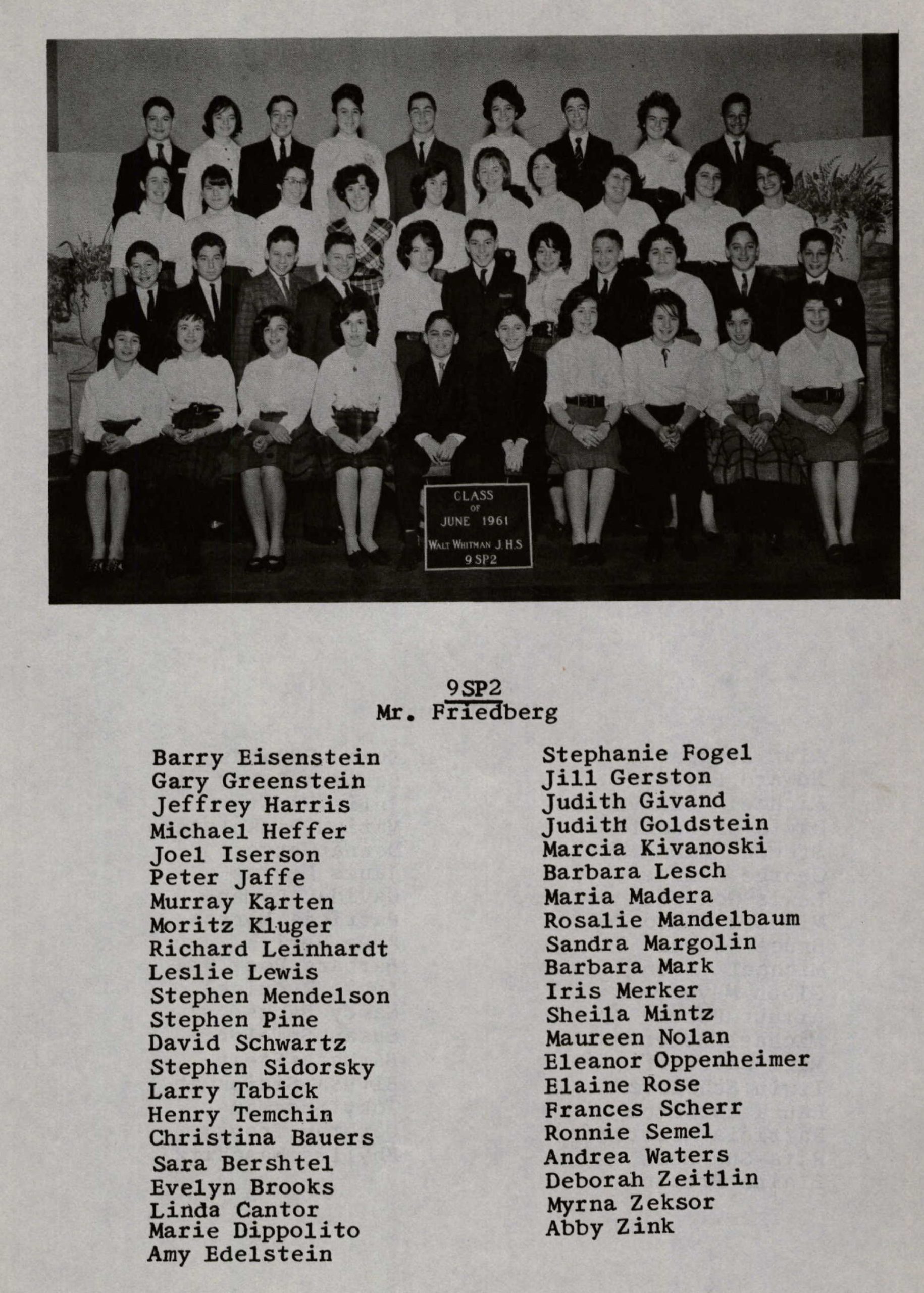
The New York City Junior High Schools or Middle Schools as they are called now,  were once the breeding ground for a well-rounded education. My parents and grandparents were the products of the old New York City public school system and they never went to college. Yet they could read and understand Latin, had beautiful handwriting, could type, played and studied music and developed “the lifelong habit of turning to books for the information they needed.”

Brooklyn, NY Walt Whitman JHS 1961 Yearbook page

In 1961 students learned how to make things because the U.S.A. was still an industrial society and could actually design and manufacture useful products.

As shown in this 20 minute film, everyone learned about electricity, the elements of printing and participated in the novelty shop; where they could “build things for use and for pleasure.” There was what would now be termed sexism – girls learned millinery work, domestic arts, dressmaking, respect for manual labor and “neatness,” while boys learned the manly arts of metal, wood,  print, plastics and electrical wire. But up until the 1970’s gender work roles were applied in most of the fields of employment.

The children were taught “ideas and facts in citizenship, current affairs, history, geography, and government, to appreciate democratic ideals.”

Okay, maybe they were brainwashed.

But compared to today’s middle schools, they got a fine education. Continue reading

Old New York in Postcards #3 – A Tale of Three Buildings: Franconi’s Hippodrome, The Fifth Avenue Hotel & The Fifth Avenue Building

A Tale of Three Buildings: Franconi’s Hippodrome, The Fifth Avenue Hotel & The Fifth Avenue Building a.k.a. The Toy Center

The west side of Fifth Avenue between 23rd and 24th streets had been country land well into the middle of the 19th century. The land for many years had been occupied by a quaint tavern and horse changing station.

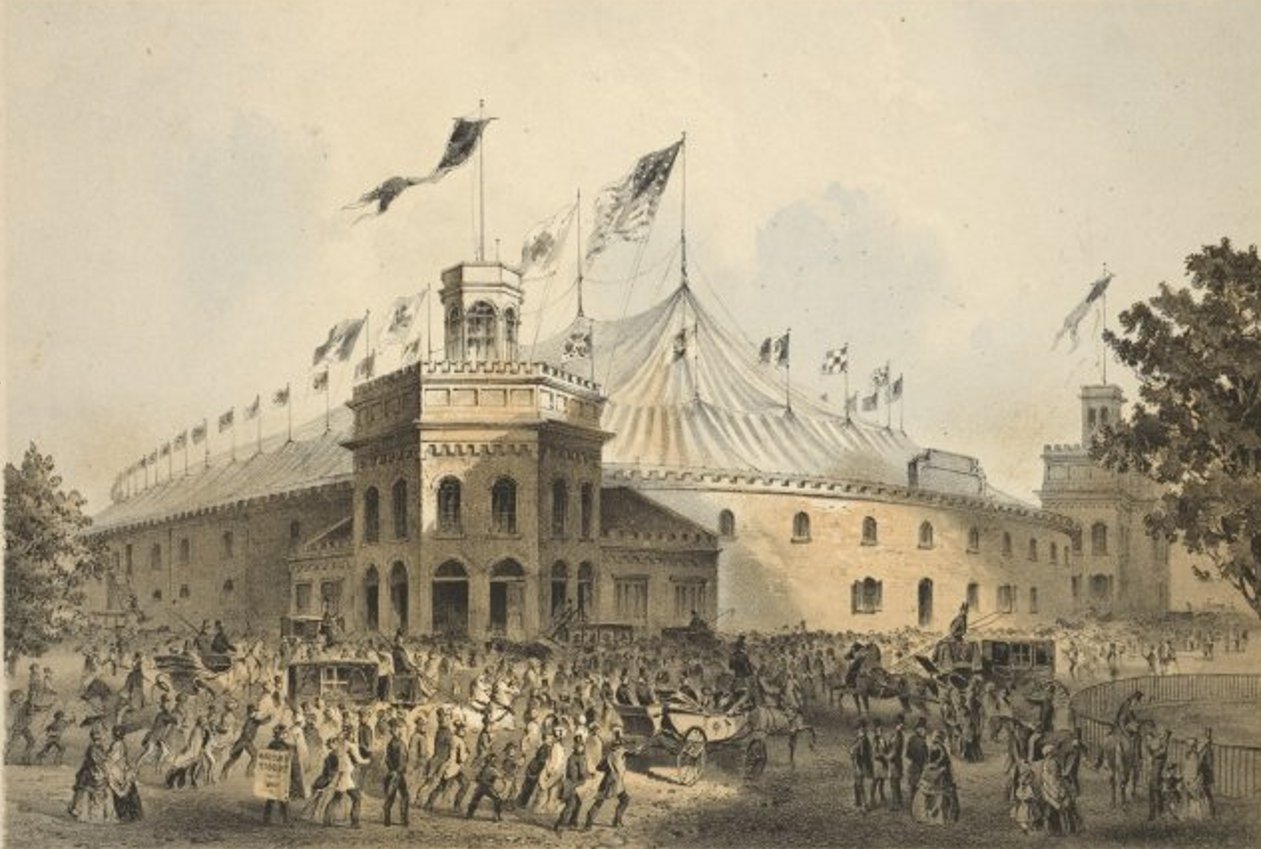
Franconi’s Hippodrome- Fifth Avenue 23rd -24th Streets (click to enlarge)

On this site in March 1853, Henri Franconi, a European from a long line of equestrian performers, arranged with investors to have an amphitheater built which was then called Franconi’s Hippodrome. This precursor of the modern day circus with performers, animals and chariot races was housed in a large structure shaped like an ellipse and was 338  feet by 196 1/2 feet that could seat 10,000 people and was covered by a red, white and blue canvas supported by a center pole 70 feet in height and a circle of smaller poles 40 feet in height.

It opened on Monday, May 2, 1853, and The New York Daily Times was not impressed with the class of people attending the Hippodrome shows. Attendees they said “…were blacklegs, gamblers, rowdies, and the miscellanea of polite roguery and blackguardism.”  The reporter added “The Hippodrome is badly conducted and Continue reading

The Coney Island of Yesteryear – The Original Coney Island, Luna Park and Steeplechase Park In A Vintage Film

Coney Island in the Late 1930’s Early 40’s

Coney Island Luna Park entrance 1942On so many levels this is extraordinary. The time is somewhere between 1937 & 1941 based upon the rides shown at Luna Park at Coney Island. The original Luna Park closed in 1944.

When I first saw this film I re-watched it three times. What would it be like to experience the original Luna Park? This film gives you an idea.

Where is the time machine?

Old New York in Photos #10 – Rapid Transit 1905

Crosstown Rapid Transit, 1905, New York City


It probably made the crosstown trip faster than we currently do.

I like the sign in the background – Milk, Cider, Cream Soda, Buttermilk, Lemonade 3¢.

And I  love old handwriting:

Tuesday A.M. Dear Mamma, What do you think of this for rapid N.Y.  Please send my letters to Aunt Emma’s. Came Monday, will write to-day Love, Evan(?)

According to Appleton’s Dictionary of New York in 1905, there were 7-8  mail deliveries per day and the postal service made a profit. Continue reading

Old New York in Photos #7 – Tiffany Mansion & Pulitzer Mansion

Two Homes With Different Fates

The Louis Comfort Tiffany Mansion (above) circa 1886 at the corner of 72nd Street and Madison Avenue designed by McKim, Mead & White.

The Joseph Pulitzer Mansion (below) 1903 at 7 East 73rd Street (just off of Fifth Avenue) designed by Stanford White of McKim, Mead & White.

Pulitzer Residence 7 East 73rd Street

Louis Tiffany’s home was built starting in 1882 by his father Charles Tiffany, but the elder Tiffany never lived there. The 57 room mansion took three years to complete.

Right around the corner, Joseph Pulitzer, owner of The New York World newspaper also hired the architectural firm of McKim, Mead and White in 1900 to build his home which was completed in 1903.

Pulitzer lived in the house Continue reading

The Cost of Living in Manhattan Apartments – 1926

The Prices of Fancy New York  Apartments and Where You Could Live on a Decent Salary

As I continue to look through the Sunday October 10, 1926 New York Times real estate section, I wanted to get a better understanding of what a dollar could buy when it came to apartments.

First I did some income research.

According to FRASER (the Federal Reserve Archival System for Economic Research) , a little over 4 million individual tax returns were filed in 1926.

The average net income on those returns was $5,306.43.

The average amount of tax liability was – get this – only $176.11!

So you might think that everyone was doing Continue reading